The morning of August 9, 1945, began with a malfunction. In the predawn darkness over Tinian Island, the bomb bay of the B-29 Superfortress Bockscar was already loaded with a plutonium core, but a faulty fuel pump threatened to scrub the mission entirely. The crew stood on the tarmac, engines idling, as the clock ticked toward a decision that would alter history. “We’re going anyway,” the order came down. No one knew then that this would be the last atomic strike of the war—or that the target had already shifted from the ancient capital of Kyoto to a shipyard city called Nagasaki.
Twelve hours earlier, another plane had lifted off from Tinian. The Enola Gay had left Hiroshima in ruins, and the shockwaves were still rippling through Tokyo’s imperial circles. But the Japanese military refused to surrender. “The Empire must continue to resist,” General Torashirō Kawabe wrote in his diary, even as reports of total destruction flooded in. The war was far from over—and the second bomb was already on its way.
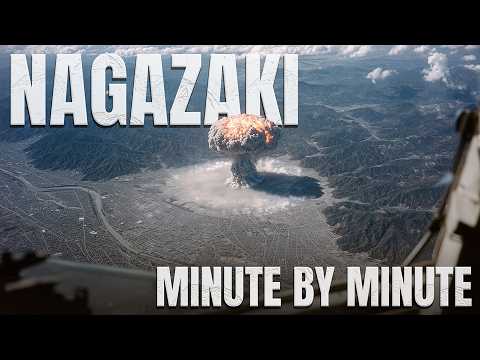
At 3:47 a.m., Major Charles Sweeney eased Bockscar off the runway, its bomb bay cradling the 10,000-pound “Fat Man.” His orders were explicit: rendezvous over Yakushima, then strike the Kokura Arsenal. But the rendezvous went wrong from the start. The escort plane Big Stink never appeared. For forty minutes, Sweeney circled the assembly point, burning precious fuel, while the weather over Kokura worsened by the minute.
By the time Bockscar reached Kokura at 10:44 a.m., the city was shrouded in haze and smoke from an earlier firebombing. Three bomb runs were attempted; each time, the aim point vanished behind clouds. Japanese anti-aircraft fire erupted, and fighter planes clawed into the sky. “We can’t stay here,” Sweeney’s co-pilot warned. The crew argued fiercely. Some wanted to abort and ditch the bomb in the ocean. Others insisted on the secondary target: Nagasaki, ninety-six miles to the south.
At 11:32 a.m., Sweeney turned the plane. The fuel gauges were already dipping into the red. Bockscar had enough for exactly one pass over Nagasaki—and even then, an emergency landing in Okinawa would be a gamble. No one spoke of the alternative: ditching in the Pacific with a live atomic bomb on board.
In Nagasaki, the morning had been quiet. Air-raid sirens had wailed hours earlier, but the all-clear sounded at 8:30 a.m. Children returned to school; factory workers resumed their shifts in the Mitsubishi shipyards. The city’s ancient wooden buildings and narrow streets held no hint of the firestorm that had consumed Hiroshima. “We thought we were safe,” a survivor would later recall. “We were wrong.”
At 11:58 a.m., Bockscar arrived over Nagasaki. The sky was mostly clouded, but a last-minute break in the overcast revealed the city below. Bombardier Kermit Beahan peered through the Norden bombsight. The aim point—the Mitsubishi steelworks—was barely visible. He had seconds to decide. “I’ve got it,” he said, and released the bomb.
The “Fat Man” fell for forty-three seconds. At 12:02 p.m., it detonated 1,650 feet above the Urakami Valley. The blast was equivalent to 21 kilotons of TNT—nearly twice the power of the Hiroshima bomb. A searing flash turned the morning to white, followed by a roar that seemed to split the earth. Three shockwaves rippled outward, tossing Bockscar like a toy. Sweeney fought the controls as the plane heeled violently to the right.
Below, the city vanished. The Urakami Valley was erased—factories, homes, schools, a cathedral. “It’s like the end of the world,” a crewman whispered. No one answered. They had seen Hiroshima’s photographs, but this was different. This was happening now, in real time, and they were the ones who had made it happen.
By the time Bockscar turned away, half of Nagasaki was gone. An estimated 40,000 to 75,000 people were already dead or dying. The crew flew in silence, their ears still ringing, their minds numbed. They had completed their mission—but the war was not over yet. In Tokyo, the Supreme War Council was still arguing. The second bomb had not yet forced a surrender. And on Tinian, a third plutonium core was already being prepared for shipment.
The story of Nagasaki did not end with the explosion. It was only the beginning of a desperate, chaotic race toward surrender—and a final, failed coup that would nearly plunge Japan into civil war.
At precisely the same moment the bomb detonated over Nagasaki, the Supreme War Council was convening in Tokyo. Eleven o’clock, Tokyo time. The generals and ministers seated around the table were unaware that a second atomic weapon had just fallen. They had gathered to debate a single, impossible question: could Japan accept the Potsdam Declaration while preserving the imperial institution?
Minister of War Korechika Anami argued for resistance to the bitter end. “The Army will not lay down its arms while a single enemy soldier stands on Japanese soil,” he declared. Foreign Minister Shigenori Tōgō countered that the war was already lost. The Soviet invasion of Manchuria had shattered any hope of a negotiated peace through Moscow’s mediation. The council was deadlocked.
Then, at 12:30 p.m., the first dispatches from Kyushu arrived. Nagasaki had been struck. The report was fragmentary—communications were down, the city was cut off—but one phrase appeared repeatedly: “The city has ceased to function.” Anami’s argument collapsed before it could be fully spoken. Two atomic bombs in three days. The Soviet Army advancing through Manchuria. The council adjourned without a decision.
That evening, Emperor Hirohito summoned his closest advisers. He had spent the day reviewing the reports from Hiroshima and Nagasaki, and the testimony of the seven-man army investigation team that had flown over the ruins. The destruction was not merely physical, they told him. It was absolute—a city reduced to ash by a single aircraft.
In the early hours of August 10, Hirohito made his decision. He would accept the Potsdam Declaration, but with one condition: the emperor must retain his sovereignty. The message was encoded and sent to the Allies through Swiss and Swedish diplomatic channels. It was the first time Japan had formally offered to surrender.
But the war was not over. On the afternoon of August 10, the Japanese government sent a second message, this time through the Domei news agency, using Morse code. The Allies intercepted it. Washington, London, and Moscow now knew that Japan was prepared to capitulate—provided the emperor remained on his throne.
In the Pentagon, General Leslie Groves received the news with grim satisfaction. The bomb had worked. Two cities had been destroyed, and the enemy was finally talking. But Groves had another problem: the third plutonium core was already on its way to Tinian. If Japan did not surrender within days, a third city would be obliterated. “The schedule remains unchanged,” he wrote in a memo to Oppenheimer. “The core will be shipped on the twelfth.”
On August 11, Secretary of State James Byrnes drafted the American reply. It was a carefully worded document, designed to give Japan a way out without explicitly guaranteeing the emperor’s safety. “From the moment of surrender, the authority of the Emperor and the Japanese Government to rule the state shall be subject to the Supreme Commander of the Allied Powers,” it read. The final form of government, it added, would be determined by the freely expressed will of the Japanese people.
When Hirohito read the Byrnes note, he understood what it meant. The emperor would not be removed—but he would be subordinate to an American general. It was a humiliation, but it was also survival. On August 12, he informed the imperial family that he would accept the note and surrender unconditionally. “We must bear the unbearable,” he told them. “We must endure the unendurable.”
But the military was not ready to obey. That same night, a group of junior officers gathered in a barracks near the Imperial Palace. They were young, idealistic, and convinced that surrender was a betrayal of everything Japan had fought for. Their leader, Major Kenji Hatanaka, spoke in a low, urgent voice. “The Emperor has been misled by traitors in the court,” he said. “We will restore him to his rightful place—and we will do it before the surrender is announced.”
The plan was audacious: seize the Imperial Palace, cut off the emperor from his advisers, and force him to reconsider. If they could control the palace grounds, they could control the narrative. The war would continue. Japan would fight on.
On the morning of August 14, the conspirators moved. They had gathered a small force of loyal officers, and they believed that once they occupied the palace, the rest of the army would follow. But they had miscalculated. The senior generals—including Anami himself—refused to support the coup. Anami, torn between loyalty to the emperor and loyalty to the army, chose the emperor. He committed seppuku that evening, but not before ordering his officers to stand down.
The coup collapsed. Hatanaka and his co-conspirator, Lieutenant Colonel Jirō Shiizaki, fled to the palace grounds and shot themselves. The surrender was safe. But the war had one final, terrible act to play out.
On the night of August 14, Hirohito recorded the Imperial Rescript—his voice, high and formal, announcing Japan’s acceptance of the Potsdam Declaration. The recording was rushed to the palace for safekeeping, hidden from the very officers who had tried to seize it. “The war has ended,” he told his aides. “We must now endure what cannot be endured.”
At noon on August 15, the radio crackled across a stunned nation. For most Japanese, it was the first time they had ever heard their emperor speak. Some wept. Some knelt. Some refused to believe. Outside the palace, a handful of soldiers bowed their heads; others tore off their insignia and vanished into the ruins.
On the island of Tinian, the third plutonium core sat in its shipping crate, untouched. General Groves had ordered it held. The war was over—the bomb would never be needed. “We got lucky,” one Manhattan Project physicist wrote home. “Twice was enough.”
On September 2, aboard the USS Missouri in Tokyo Bay, Japanese officials signed the instrument of surrender. The deck was crowded with Allied officers, the sky a brilliant blue. General Douglas MacArthur spoke of a “better world” born from the ashes. No one mentioned Nagasaki. No one mentioned the 80,000 dead.
Years later, Charles Sweeney would say he never lost sleep over the mission—but he never celebrated it either. “We did what we were ordered to do,” he said. “And then we flew home.” The Bockscar itself now sits in a museum in Ohio, its bomb bay empty, its story frozen in time.
But the question remains: was the second bomb necessary—or was it the first shot of a new, colder war? What do you think?
Report this article
Select a reason for reporting:






