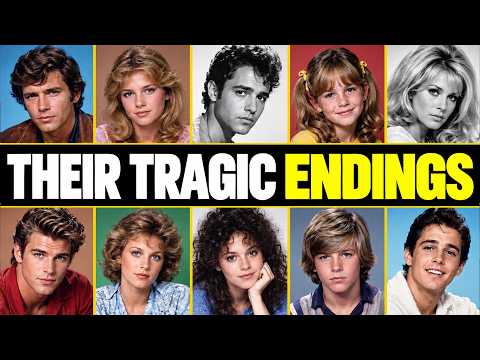
They were the faces that filled our living rooms, the voices that became part of our family rituals. But for a shocking number of classic TV stars, the spotlight burned out far too soon. Car crashes, overdoses, senseless violence—these are the stories of 12 beloved performers who never got the chance to grow old in front of us.
John Belushi was on top of the world in the late 1970s. With Saturday Night Live, Animal House, and The Blues Brothers all hitting at once, he was a one-man cultural earthquake. But beneath the manic energy, a deadly addiction was tightening its grip. On March 5, 1982, he was found dead in a bungalow at the Chateau Marmont, killed by a speedball. He was 33.
Belushi’s story is a blur of brilliance and excess. From his first SNL broadcast to his death was less than seven years—a span in which he became the defining comic voice of a generation. Watching footage now, you can see the exhaustion under the laughter, a warning nobody caught in time.
Then there’s Rusty Hamer, the wisecracking kid from Make Room for Daddy. For 11 years, he was America’s TV son. But when the cameras stopped, Hollywood had no use for him. He drifted through odd jobs, haunted by chronic pain and a deep unhappiness. On January 18, 1990, he took his own life. He was 42.
Nick Adams finally got his shot at stardom with The Rebel, but his personal life was unraveling. Divorce, drinking, and a nervous disorder plagued him. On February 7, 1968, he was found dead of an overdose. He was 36.
And who could forget Trent Lehman, the adorable middle child on Nanny and the Professor? After the show ended, the roles dried up. By January 1982, despondent over a breakup and a burglary, he took his own life outside an elementary school. He was just 20.
Rebecca Schaefer was on the brink of movie stardom when a stalker knocked on her door. She was 21. Her murder sparked the nation’s first anti-stalking law.
Barbara Colby had finally landed a lead role on Phyllis when she was gunned down in a parking lot. The case remains unsolved.
John-Eric Hexum was CBS’s next big heartthrob until a tragic accident with a prop gun ended his life at 26.
Inger Stevens found fame on The Farmer’s Daughter, but private demons led to her death at 35.
Anissa Jones, everyone’s favorite TV orphan Buffy, died of a drug overdose at 18.
Sal Mineo, once nominated for an Oscar, was stabbed to death in a robbery gone wrong. He was 37.
Dana Plato struggled after Diff’rent Strokes, her life ending in tragedy at 34.
And Pete Duel, star of Alias Smith and Jones, took his own life at 31, leaving a hit show behind.
These are their stories—lives cut short, legacies that endure. But the question remains: why do so many of our brightest stars burn out so fast? The answers lie in the shadows of fame, in the pressures of the spotlight, and in the silence that follows when the cameras stop rolling.
But the question remains: why do so many of our brightest stars burn out so fast? The answers lie in the shadows of fame, in the pressures of the spotlight, and in the silence that follows when the cameras stop rolling.
For every story of addiction or violence, there’s another of simple neglect—an industry that chews up child actors and spits them out. Rusty Hamer and Trent Lehman never found their footing after the applause faded. Their earnings, protected only in part by the Coogan Law, vanished into the machinery of Hollywood, leaving them with little more than memories of a childhood spent on set.
Then there are the cases that defy explanation. Barbara Colby, gunned down in a parking lot for reasons no one could ever establish. Sal Mineo, stabbed in a robbery gone wrong, his sexuality wrongly blamed in early coverage. These weren’t overdoses or suicides—they were random, senseless acts that stole lives mid-sentence.
And what of the fans? We grew up with these faces, invited them into our homes every week, yet we rarely saw the cracks until it was too late. Dana Plato‘s final days, mocked on Howard Stern, laid bare the cruelty of a culture that builds up child stars only to tear them down.
Perhaps the most haunting is Pete Duel, who finally had a hit show but couldn’t outrun his demons. His death left Alias Smith and Jones to limp on without him, a constant reminder of what was lost.
These twelve names are more than a list—they’re a warning. Fame is a fickle guardian, and the spotlight doesn’t warm everyone it touches. Some it burns.
What links these twelve isn’t just tragedy—it’s the pattern. The child stars who never learned how to be ordinary. The leading men who couldn’t outrun the roles that made them. The ones who found fame late and lost it early. Hollywood has always been a town that loves a face and forgets a person, and these stories are the receipts.
Take Rusty Hamer and Trent Lehman again. Both were working kids in the 1950s and ’70s, both had their earnings locked away under the Coogan Law, and both discovered that a trust fund doesn’t buy a second act. Hamer spent decades as a bartender and machinist, refusing to see doctors about his chronic pain. Lehman was barely out of his teens when he died outside a school. Nobody in the industry called to check on them. That’s not a coincidence—it’s a business model.
And then there were the women who paid a different price. Rebecca Schaefer was killed by a man who pulled her address from DMV records because the law allowed it. Barbara Colby was shot in a parking lot after teaching an acting class to make ends meet. Inger Stevens carried a secret marriage and a decade of private struggle while playing a cheerful housekeeper on network TV every week. The public saw the smile. Nobody saw the cost.
What’s striking is how many of these deaths could have been prevented. John Belushi‘s friends knew his drug use was spiraling. Pete Duel had told a columnist his show was “a big fat drag” just weeks before he died. Dana Plato was mocked on national radio the day before her death. The warning signs were there—they were just easier to ignore than to act on.
And the industry kept moving. Phyllis recast Barbara Colby’s role. Alias Smith and Jones replaced Pete Duel with Roger Davis and cancelled the show a year later. Cover Up brought in Anthony Hamilton and lasted one season. The machine doesn’t stop for grief. It just finds the next face.
Maybe that’s the real story here. Not just the tragedies themselves, but how quickly the town that made these stars forgot them. Nick Adams chased leading-man status for years and got three years to enjoy it. Sal Mineo spent two decades rebuilding a career Hollywood had stopped offering him, only to be stabbed by a stranger who didn’t even know whose door he was standing outside. These weren’t just deaths—they were erasures.
So when we watch those old reruns, the ones where Buffy still clutches Mrs. Beasley and Hannibal Hayes still rides beside Kid Curry, it’s worth remembering what we’re really seeing. Not just characters frozen in time, but real people who gave everything to a business that gave almost nothing back.
That’s the uncomfortable truth hiding inside every nostalgic tribute. We mourn the characters, but we rarely ask what happened to the people who played them. The reruns keep looping, the merchandising keeps selling, and the industry keeps recycling the same promises to the next crop of hopeful faces.
California’s Coogan Law has been strengthened since the days of Rusty Hamer and Trent Lehman, and stalking statutes now exist in every state because of Rebecca Schaefer. Some of these deaths changed the law. Almost none of them changed the culture. The machine still loves a face and forgets a person.
So the next time a familiar theme song starts playing and a long-gone star smiles out from the screen, maybe the tribute isn’t just remembering them. Maybe it’s finally asking who was watching out for them when the cameras stopped.
Which of these stories hit you the hardest—and which one do you think Hollywood still hasn’t learned from? Tell us in the comments below.
Report this article
Select a reason for reporting:






