June 1940. London smelled of smoke and defeat. Winston Churchill stood at his office window in Whitehall, watching British soldiers shuffle through the streets below. These men had just returned from Dunkirk—a desperate evacuation that saved lives but cost them everything else. Their uniforms were torn, their heads down, most without rifles or helmets. They looked like men who had lost everything. And they had.
Across the English Channel, Hitler’s army massed 3,000 tanks. Britain had 14 working tanks left. The math was brutal: more than 200 German tanks for every British one. Churchill pulled out his pocket watch. It was 3:00 p.m. In exactly one month, German intelligence said, Hitler would launch Operation Sea Lion—the invasion of Britain.
That evening, the war cabinet met beneath Whitehall in concrete-reinforced rooms. Lord Halifax, the foreign secretary, spoke first, his voice calm and cold. “Prime Minister, we must face facts. Perhaps it is time to explore peace negotiations. Mussolini might serve as a mediator.” Several heads nodded. Churchill saw real fear in their eyes—some wanted to evacuate the government to Canada, to run away across the ocean and let Hitler have Britain without a fight.
Churchill stood up, hands flat on the table. “Gentlemen, I have received a report today. A report about troops who are ready to fight, fully equipped, fully trained, high morale. Do you know who these soldiers are?” The room went silent. How could there be fully equipped soldiers when the army had just lost everything at Dunkirk?
“The First Canadian Division,” Churchill said. “7,449 men who sailed across the Atlantic last December. While our boys fought in France, the Canadians trained here. They have their rifles. Their artillery. Their trucks. Everything our returning soldiers left behind on those beaches.” He walked to a map on the wall. “Right now, these Canadians are the best-equipped, most combat-ready force on this island. They are not tired. They are not defeated. They are angry they have not been allowed to fight yet.”
Lord Halifax shifted in his chair. “Colonial troops, Prime Minister? You would stake Britain’s future on colonial troops who have never seen combat?”
Churchill spun around, eyes blazing. “I would stake Britain’s future on men who crossed an ocean to stand with us. Men who could have stayed safe at home but chose to come here knowing they might die. While we debate surrender, they sharpen their bayonets. While we consider peace with Hitler, they dig defensive positions in the rain. They did not come here to watch Britain fall. They came here to make sure it does not fall.”
General McNaughton had positioned them at Oxford—the perfect location. Rail lines ran from Oxford to every invasion beach on the south coast. If the Germans landed, the Canadians could move fast to stop them. They were the mobile reserve, the strike force, the answer to Hitler’s tanks.
Churchill placed both hands on the back of his chair. “Here is what I know. The Empire has not abandoned us. While our own lads were stripped of their rifles and forced to swim home, the Canadians crossed an ocean to stand between Hitler and London. That tells me we are not alone. It tells me that free people everywhere understand what is at stake. And it tells me that if Canadians believe we can win, then by God we will win.”
Outside, the sun set over London, turning the sky red and orange. Barrage balloons floated above the city—silver sentinels against low-flying German planes. Soon those planes would come. Everyone knew it. The only question was whether Britain would still be free when the bombs stopped falling.
Churchill looked at each man around the table. “Tomorrow, I want to see these Canadian troops myself. I want to look them in the eyes. I want to know what kind of men sail across an ocean to fight for a country that is not their own. Perhaps they will teach us something about courage we have forgotten.”
The meeting ended. The men filed out slowly. Churchill stayed behind, staring at the map. His finger traced a line from Canada across the Atlantic to Britain. Such a long, dangerous journey. German submarines hunted those waters. But the Canadians came anyway. 7,449 reasons to keep fighting. 7,449 reasons to believe.
General Andrew McNaughton spread a large map across the table in his command post at Oxford. His finger traced railway lines running out of the city like spokes on a wheel—south to Southampton, southeast to Dover, southwest to Plymouth. Every major invasion beach Hitler might use was less than two hours away by train.
McNaughton looked at his officers. “Oxford is the key. If the Germans land on the Kent coast, we can be there in ninety minutes. Sussex, two hours. We stay mobile. We stay ready. We hit them hard before they can dig in.”
Outside, Canadian soldiers practiced loading artillery pieces onto trains. They had 150 guns of different sizes. Each crew knew their job perfectly: load the gun in four minutes, secure it in six, be ready to fire thirty minutes after arriving at any beach. The men worked fast, boots crunching on gravel, sweat dripping down their faces in the June heat.
Lieutenant James MacDonald from Saskatchewan watched his men lift a heavy machine gun onto a truck. They had trained for six months. They knew every road between Oxford and the coast. They had memorized maps and practiced fighting at night with no lights. They were ready—more than ready. They were hungry to prove themselves.
On June 28th, Churchill visited the Canadian positions. He walked between rows of tents where soldiers cleaned their rifles and checked their equipment. Everything was organized. Everything worked. The contrast to the returning Dunkirk forces was shocking. These men had boots that fit. Full ammunition pouches. Steel helmets that gleamed in the sun.
Churchill stopped to talk with a young private. “Where are you from, son?”
“Winnipeg, sir. Manitoba.”
“Long way from home.”
The private smiled. “No further than the Germans came to get here, sir. And we came to send them back.”
That evening, Churchill called another meeting. This time he brought a different idea. “Gentlemen, I want the Canadians to march through London on July 4th. A public display. Let the people see that we have defenders—real defenders, fully equipped and ready to fight.”
The room exploded. General Ironside, commander of Home Forces, slammed his hand on the table. “Absolutely not. Colonial troops marching through Westminster before our own reformed regiments? It would be an insult to every British soldier who fought at Dunkirk.”
Another general spoke up. “Prime Minister, these Canadians have never seen combat. They are peacetime soldiers playing at war. How can we parade them as heroes when they have not fired a single shot at the enemy?”
Churchill’s face turned red. “They crossed an ocean to be here. They did not have to come. Canada is safe. They could have stayed home, but they chose to stand with us. I say that choice alone makes them heroes.”
But the generals would not agree. The argument went on for an hour. Voices grew louder. Some men walked out in anger. Churchill felt his plan slipping away.
The next morning, a message arrived from Buckingham Palace. King George VI wanted to see Churchill immediately. The prime minister arrived at noon, wondering what the king wanted. George was a quiet man who rarely got involved in military decisions.
The king stood by a window looking out at the palace gardens. He spoke without turning around. “Winston, I heard about your plan for a Canadian march. I heard the generals said no.”
“Yes, Your Majesty. They feel it would dishonor British troops.”
George turned to face him. His voice was firm. “If Canadians are willing to die for London, London must see them march. I am ordering this parade to happen—as king, as commander-in-chief. Those men came here to defend my capital. My people will see them. That is final.”
Churchill felt relief wash over him. “Thank you, Your Majesty.”
“Do not thank me, Winston. Thank those Canadian boys who left their families to save ours.”
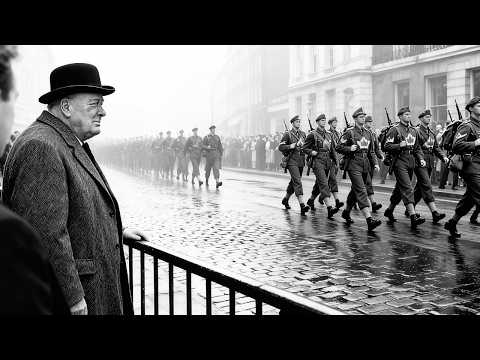
July 4th, 1940. Dawn clear and bright. At 6:00 a.m., Canadian soldiers began forming up in Hyde Park. 7,449 men in perfect rows. Their uniforms were pressed. Their boots were polished. Their rifles gleamed in the early sunlight. Each man wore full battle gear—helmets, gas masks, ammunition pouches, bayonets. They looked like an army ready for war.
At 8:00, they began to march. The sound of their boots hitting pavement echoed between buildings. Left, right, left, right. Like a giant heartbeat, like a drumbeat of defiance.
People lined the streets. At first, only a few dozen, then hundreds, then thousands. Londoners came out of their homes to watch. Old men who remembered the last war stood at attention and saluted. Women held their children up to see. Some people waved small Canadian flags. Others just stared in wonder.
These soldiers looked nothing like the exhausted men who came back from Dunkirk. These men marched with their heads high, their eyes forward, their steps strong and sure. They carried real weapons. They wore complete uniforms. They looked like they could actually stop Hitler’s army.
At Trafalgar Square, a woman started crying. Then another. Soon, dozens of people were wiping tears from their faces. For weeks, they had lived in fear. They had watched their army come home broken and defeated. They had heard the rumors about surrender. But now they saw something different. They saw hope marching past with maple leaf patches on their shoulders.
The parade turned down Whitehall toward Parliament. Churchill stood on Horse Guards Parade, the old military ground where British soldiers had drilled for hundreds of years. Beside him stood his aide, Major Hastings. Together they watched the Royal 22nd Regiment march past. These French Canadian soldiers from Quebec sang as they marched. Their voices carried over the crowd noise.
Churchill watched their faces—young faces, determined faces. Faces of men who had chosen to be here. No one forced them. No one made them cross the ocean. They came because they believed in something bigger than themselves.
He turned to Major Hastings. His voice was thick with emotion. “There marches the difference between capitulation and victory. When history asks who stood with Britain when she stood alone, the answer is marching before us.”
The parade continued past Buckingham Palace, past Westminster Abbey, past the Houses of Parliament where Churchill gave his speeches, past Downing Street where he lived and worked—past all the symbols of British power and tradition. And everywhere people cheered, clapped, waved, and believed again.
By noon, the last Canadian soldier had marched through central London. The city felt different. The air felt different. Something had changed. Britain had allies. Real allies. Allies who brought guns and courage and determination. Hitler might have his tanks and planes, but Britain had something too. Britain had friends who sailed across oceans to fight beside them. That was worth more than a thousand tanks.
After the parade, Churchill moved the Canadians everywhere. By July’s end, they stood on every beach along the south coast, digging trenches in the sand and aiming artillery out toward France. Fifty miles of vulnerable coastline now had Canadian troops guarding every foot where Germans might land.
More kept coming—23,000 by August, bringing their own trucks, food, and medical supplies. They needed nothing from Britain but a place to fight. On August 15th, as the great air battle raged overhead, Churchill stood near Dover watching Canadian crews fire six shells a minute. These men were the only mobile armored reserve in Britain. Everything depended on them.
Across the Channel, German intelligence studied the maps and paled. “Our invasion plans estimated a weakened, demoralized British army. Instead, we face fresh Empire troops with high morale and full equipment.” Hitler’s generals told him the truth: to invade now would require forty divisions. He had twenty. Operation Sea Lion was postponed—then postponed forever.
Goebbels mocked them on the radio as “farmers playing with toy guns.” But the Canadians knew the truth, and so did Hitler’s generals. Britain had survived—not by luck, but because free people chose to stand together when darkness fell.
What would you have done, standing on that London street in July 1940, watching hope march past with maple leaves on its shoulders?
Report this article
Select a reason for reporting:






