The sky was closing in. At 25,000 feet above the German town of Oschersleben, Major James Howard was alone. Below him, twenty-one American bombers flew without fighter protection—their Mustang escorts had vanished into the clouds. Thirty-plus Luftwaffe fighters rose to meet them from every direction.
Howard could have turned west. Every rule of air combat demanded it. He’d already completed his mission. No one in England would ever know the difference. Instead, he banked his Mustang and dove back into the fight.
For the next thirty minutes, the men inside those bombers watched a single American fighter do something impossible. They saw him attack from angles no lone aircraft could cover. He would disengage, climb, then return from the opposite direction—again and again, as if there were more than one pilot in the sky.
There was only one. And before that afternoon ended, his guns would fall nearly silent in his hands.
Three months earlier, the U.S. Army Air Force had learned exactly what happens when bombers fly into Germany without fighters escorting them the entire way. That lesson was written in the wreckage of 291 B-17 Flying Fortresses…
…that took off from English airfields on October 14, 1943, bound for the ball-bearing factories at Schweinfurt. Ball bearings seem small. They aren’t glamorous or dramatic, nothing like a battleship or a bridge. But every tank, every truck, every aircraft rolling out of a German factory needed them.
Someone in the Eighth Air Force planning rooms decided that if American bombers could smash the ball-bearing plants at Schweinfurt, they could cripple the German war machine at its smallest, most vital joint.
The principle behind the mission was called precision daylight bombing. Fly high, fly in tight formation, let the bombers’ own machine guns form a moving wall of defensive fire, and trust that no air force in the world could break through it.
For several months, that principle held—barely. On October 14, it didn’t hold at all.
American fighters—Republic P-47 Thunderbolts and twin-boom Lockheed P-38 Lightnings—escorted the bomber streams as far as their fuel allowed. Then, as they always did, they turned for home.
The moment the last friendly fighter headed west, German fighters rose to meet the bombers in numbers no one in London had anticipated. Focke-Wulf 190s, Messerschmitt 109s, and twin-engine Messerschmitt 110s armed with rockets under their wings. They tore into the unprotected formations for hours.
By the time the surviving bombers limped back across the English coast that evening, 60 were missing. Six hundred men were dead, captured, or unaccounted for. Another 17 aircraft were damaged beyond repair. One bomber in five sent to Schweinfurt that morning never came home.
The loss math was brutal and simple. A bomber crew had to complete 25 missions before rotation. At a 5% loss rate per mission, a crew’s odds of surviving all 25 were roughly one in four. At Schweinfurt’s 20% loss rate, those odds collapsed to almost nothing.
No air force could keep sending men into those calculations and expect them to keep climbing into aircraft. The Eighth Air Force did the only thing left. It stopped sending bombers deep into Germany until a fighter escort could reach the target and back.
In Berlin, inside the underground bunkers where Luftwaffe fighter controllers plotted the defense of the Reich, there was quiet satisfaction. The Americans had come. The Americans had learned the cost and pulled back. Everything now hung on a single question that German High Command believed it already knew the answer to.
Could the United States build a fighter capable of protecting its bombers over the heart of Germany? In October 1943, the honest answer was no.
The P-47 Thunderbolt was tough and fast at high altitude. Its .50-caliber guns could shred a Focke-Wulf in a single burst. But it weighed nearly seven tons and drank fuel like a farm horse drinks water. Even with external tanks, its range reached only western Germany, the Rhine, and the Ruhr—no farther.
The P-38 Lightning could fly farther, but at the altitudes where bomber escort had to operate, its Allison engines struggled in the cold. Turbochargers froze. Pilots returned from missions numb and shaking, having spent as much energy fighting their own aircraft as they had the enemy.
Neither fighter could reach Berlin. Neither could reach Leipzig. Neither could reach a town called Oschersleben, where a plant belonging to the AGO Flugzeugwerk was producing hundreds of Focke-Wulf fighters every month.
What the Eighth Air Force needed didn’t yet exist in any operational squadron. And the aircraft that would eventually fill that need had already been built more than three years earlier by a company no one expected to produce a war-winning fighter at all.
The Mustang’s story began almost by accident. In 1940, with Britain standing alone against Germany, British purchasing agents asked a modest American manufacturer called North American Aviation to build Curtiss P-40 fighters under license. The company’s president, James Kindelberger, told the British he could design something better from scratch in just over 100 days. He delivered a prototype in September 1940.
A long, low, aerodynamically clean airframe built around a wing design derived from laminar-flow research that American universities had only just begun exploring. On paper, it was one of the finest fighter shapes anyone had drawn. But it suffered from one critical flaw. Its Allison engine lost power above 15,000 feet—precisely the altitude where bomber escort missions had to be flown.
Below that altitude, the aircraft was exceptional. Above it, the turbocharger simply couldn’t maintain the horsepower flow. The U.S. Army Air Force tested the new fighter and decided it was no escort aircraft at all. They redesignated a version of it as the A-36 Apache and sent it to attack German columns retreating through Sicily and Italy.
By any logical measure, that should have been the end of the story.
Then in April 1942, a British test pilot named Ronald Harker took a Mustang up for a routine evaluation flight and landed convinced the airframe was being wasted. He told his superiors: “Put a Rolls-Royce Merlin in it.” The same engine already powering the Spitfire and the Lancaster bomber. See what happens.
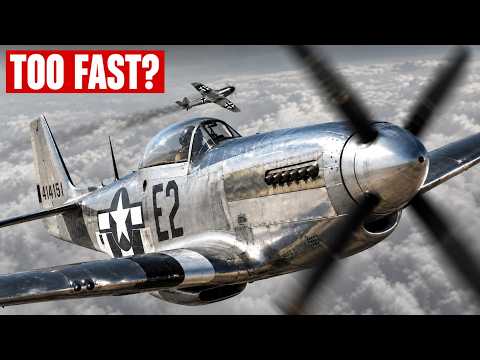
Someone finally listened. Fitted with a two-stage supercharged Merlin engine—built under license in Detroit by Packard Motor Car Company—the Mustang didn’t just improve at high altitude. It transformed entirely. Speeds over 440 miles per hour at altitude, a climb rate that matched the Messerschmitts, and with external fuel tanks, a range no other single-engine fighter in the world could approach.
The new version was designated the P-51B. And here the story takes a turn almost no one planned. Even with a fighter capable of solving the Eighth Air Force’s escort problem ready in the factories, the first P-51Bs weren’t sent to the strategic bombing campaign at all. They were allocated to the Ninth Air Force, a tactical command being built to support the ground invasion of France everyone in Allied High Command knew was coming the following year.
The Ninth’s job was to hit roads, bridges, rail yards, and enemy trucks in broad daylight. In the minds of the officers writing the assignment orders, the Mustang remained essentially a low-altitude attack aircraft. The pilots who would fly it in one of the war’s most extraordinary individual combats had no idea in the autumn of 1943 what aircraft they were about to receive.
One of those pilots had already lived a war most Americans his age had never come close to.
His name was James Howell Howard, and by January 1944 he had reached thirty years old. Howard had not grown up in the United States. He was born on April 8, 1913, in Canton, China, the son of an American eye surgeon named Harvey Howard who taught ophthalmology at a medical college there, and his mother Maude, daughter of Christian missionaries. Young James grew up speaking English at home and Chinese in the streets, running through the alleys of Canton and later Beijing, while empires on the other side of the world moved toward a war that would eventually reach him too.
When he was eleven years old, something happened that would shape the rest of his life. In 1925, in the lawless borderlands of Manchuria, a bandit gang kidnapped James and his father and held them for ransom. For ten weeks, the boy and his father were marched on foot from camp to camp in the mountains. Though uncertain from one dawn to the next whether they would be released or killed, they survived. His father later wrote a memoir of the ordeal. But the boy who eventually walked free was not quite the same boy who had been taken.
He had learned at eleven that the world would not protect him automatically, and that fear was something a person could learn to carry silently without letting it show on his face.
The family eventually returned to the United States. James attended Pomona College in California and graduated in 1937, then entered naval aviation training, earned his wings, and served aboard the USS Enterprise. In 1941, before the United States entered the war, he received an unusual offer.
An American general named Claire Chennault was quietly recruiting American military pilots, arranging their release from service so they could fly unofficially for the Chinese government against Japan. Howard joined and became one of the Flying Tigers, flying Curtiss P-40s with shark mouths painted on their noses during the desperate early months of the war in the Pacific, when nearly every piece of news reaching Washington was bad.
By the time the American Volunteer Group was officially disbanded on July 4, 1942, Howard had destroyed six enemy aircraft over China and Burma. He returned home a veteran warrior at twenty-nine and accepted a captain’s commission in the U.S. Army Air Forces.
After months of training on the small and unloved Bell P-39 Airacobra, he took command of a fighter squadron in a new unit bound for England—the 354th Fighter Group. He thought he would be leading P-39s into combat over Europe. He was wrong.
On November 1, 1943, the pilots of the 354th climbed down the gangway at Liverpool into a wet, bleak English winter and were trucked to an airfield called Boxted in Essex, close enough to the North Sea to feel its chill in the wind. Waiting for them on the tarmac were not the small, stubby P-39s they had trained on. Instead, they were slender, long-nosed, unfamiliar fighters with .50-caliber guns in their wings, long four-bladed propellers, and under the engine cowling, a sound none of them had heard before—the Rolls-Royce Merlin, built by Packard.
The 354th Fighter Group was about to become the first American fighter unit in the entire European Theater to use Merlin-powered Mustangs in combat. No one told the pilots they were making history. There was a war to fight, and the paperwork could wait.
They trained through November. Their first combat mission came on December 1, a fighter sweep over Belgium. Their first bomber escort mission followed on December 5 to Amiens, France. On December 20 over Bremen, Major James Howard shot down a Messerschmitt Bf 109, scoring his first aerial victory in the European war.
And here is a detail worth pausing on, because it defies everything such a story is supposed to look like. James Howard was not, and would never become, the 354th Fighter Group’s star ace. That title belonged to other men. Pilots who finished the war with far longer kill lists than his. Howard, with one victory in Europe added to his six in China, was a statistically ordinary pilot: competent, steady, respected by his men, but not a name anyone at Boxted would have picked as destined for greatness—which is precisely what makes the afternoon of January 11 so difficult to explain, and a worthy reason to tell it in full.
The order came on January 10, 1944. It called for the deepest daylight penetration into Germany the Eighth Air Force had yet attempted: 663 heavy bombers, three separate targets, and—for the first time—escorts ordered to stay with the bombers the entire way, out and back.
At Boxted before dawn, Major James Howard sat with a cup of bitter coffee and said little. He was thirty years old and had been fighting this war in one form or another since 1941. Fear, he had learned long ago as a boy of eleven marching through Manchurian mountains, was something you folded small and put away where it couldn’t reach your hands.
Forty miles south at Denathorpe, the young men of the 401st Bomb Group finished letters they didn’t quite admit why they were writing. In the briefing hut, when the curtain rose on the map, a quiet curse came from the back. This was the heart of Germany—deeper than Schweinfurt, deeper than anything they had flown.
By 8 a.m., engines were turning across half of eastern England. The weather had other plans. Over central Germany, clouds sealed into a solid wall. Two of the three bomb divisions were recalled. But the First Division, carrying the 401st toward Oschersleben and Halberstadt, was already too deep to turn back safely. It pressed on alone.
Around 11:00, the Thunderbolts reached their fuel limit and waggled their wings—a silent goodbye—and headed west. For a long, terrible stretch of empty sky, the 401st flew with no cover at all. Every man aboard had heard what happened at Schweinfurt.
Then from the far side of the sky came the Mustangs of the 354th Fighter Group. Ninety-four aircraft, olive-drab, wingtips stained with English rain, led by Major James Howard. His fighter carried the code AJ and, in bright red letters beneath the exhaust stacks, a name he’d painted on every aircraft since his Flying Tiger days: Ding Hao. Very good. Number one.
The fight began the moment the two forces met. A formation of twin-engine Messerschmitt 110s—heavy, slow, packed with rockets—moved to hit the lead bomber element. Howard saw them first, called the attack, and dove. The leading 110 fell into his sights. Four guns fired in a single burst. The German’s left engine erupted, the aircraft rolled onto its back and dropped into the clouds. One confirmed kill in seconds.
But Howard did something fighter pilots are trained never to do. He chased too far, stayed too long. When he leveled off and climbed back toward the bombers, the sky around him was empty. His wingman was gone. The rest of his squadron had vanished into the haze. Every pilot was fighting his own private war.
James Howard was alone at 25,000 feet over the heart of Germany with no one beside him. The sensible choice—the one any training manual would have dictated—was simple. Point the nose west, climb to a safe altitude, go home. He had already destroyed one enemy aircraft that day. His duty, by any fair measure, was done.
He began to climb, and then he saw them below. Thirty German fighters—maybe more—swarming the bombers of the 401st. Focke-Wulfs, Messerschmitt 109s, more 110s diving from above with rockets, and not a single American fighter anywhere near them. James Howard, thirty years old, alone at the top of his climb, was in that moment the only barrier between twenty-one Flying Fortresses and the weight of the Luftwaffe.
He banked his Mustang and dove back into the fight.
What followed over the next thirty minutes would become one of the strangest air combat events of the war in Europe. Howard didn’t wait above the bombers for threats to appear. He drove into the formation itself, guns firing, breaking away hard, then climbing, wheeling, and slashing back from the opposite side. From a gun turret, a nineteen-year-old gunner watched him cut across a Focke-Wulf’s path, pull his Mustang nearly vertical, roll, and dive on a Messerschmitt closing from the other side—all within seconds.
Inside the Fortresses, men who had spent the last hour bracing for the worst found themselves pressed to their gunsights and windows, watching in flat disbelief. The drone of engines and the shriek of wind through open gun ports made it almost impossible to hear anything outside the aircraft itself. But they saw everything. A single Mustang banking so hard its wingtip seemed to graze the cloud tops. Guns flashing, breaking off one attacker, reappearing seconds later on the other side of the formation, nose down, closing on another.
Major Allison Brooks, leading the 401st that day, watched the whole fight unfold through the glass of his lead ship while trying to hold his formation together. He said afterward that the lone Mustang seemed to be everywhere at once—across the formation, above it and below it, attacking from every direction imaginable. Of sheer determination and courage, he said it was the greatest exhibition he had ever seen. One American, he put it, against what looked like the entire German Air Force.
Brooks didn’t know the pilot’s name. He could read the code letters on the fuselage and the words Ding Hao beneath the cockpit, but he had no idea who was flying her. Over the radio and to his own crew, he gave the aircraft a name of his own. A one-man air force. The phrase would outlive the mission by decades.
Then something went wrong inside Howard’s cockpit. In the bitter cold and the constant high-speed maneuvering, the ammunition belts feeding his .50-calibers twisted and jammed. A malfunction that hit nearly every Mustang pilot who fought long enough in these conditions. Three of his four guns went silent. One remained firing.
Howard was now in the middle of a fight against more than twenty enemy aircraft, flying what amounted to a nearly unarmed fighter. He didn’t withdraw. He kept making runs—some real, some pure bluff—charging at full speed at German fighters lining up on the bombers, hoping the mere sight of a Mustang closing on their tails would be enough to make them break before they realized how little firepower was behind it.
And time after time, the bluff worked. A German pilot who saw tracers and a Mustang diving at 400 miles per hour had no way to know from that distance that only one gun was firing. They broke away rather than risk a fight they couldn’t read. And every time one did, a Flying Fortress survived that had been seconds from being torn apart.
There was no time in the middle of all this to feel fear the way one feels it sitting still. Instead, fear arrived as a narrow, humming focus. The world shrank to a windscreen full of tracer and gray shapes, and endless calculations of angle and speed and distance that might keep him alive for another six seconds or end him entirely. His hands ached from his grip on the stick. The cold at that altitude cut through his suit and gloves, while sweat poured down his back from the strain of throwing a five-ton fighter around again and again. Twice his aircraft shuddered from cannon fire that passed close enough to be rocket-like, and twice he never saw where the rounds came from.
Somewhere in the middle of it, his engine began to run rough. His fuel gauges were falling faster than he liked. His arms ached from wrestling the stick through turn after exhausting turn. His neck hurt from constantly looking behind him for the attack he couldn’t see coming. He kept flying.
Below, the bomb bay doors opened on the Fortresses, and high-explosive bombs began to fall through 20,000 feet of frozen air onto the aircraft assembly halls at Oschersleben and Halberstadt. The bomb run was complete. Now came the hardest part. Getting the formation out again.
The withdrawal is the moment bomber formations come apart. Bombs gone, fuel low, defenders pressing from every direction. Every mile home toward the coast was another mile in which the Luftwaffe could find a way to kill you. For the 401st, that mile-after-mile fight home was fought for long stretches by one exhausted man in a nearly disarmed fighter.
Howard’s last confirmed attack of the day came against a Focke-Wulf that had drifted off the main fight and was climbing toward a Fortress that had fallen out of formation. The German pilot never saw him coming. Howard’s single working gun fired for about three seconds. The Focke-Wulf’s canopy shattered and the aircraft fell into an uncontrollable spin toward the frozen fields below.
That was, in practical terms, the end of the fight—not because the German fighters gave up, but because Howard had nothing left to fight with. His fuel gauges had reached numbers that alarmed him badly. His ammunition was nearly gone. His sweat-soaked flight suit was beginning to feel cold and stiff against his skin in the frozen cockpit. He had been fighting, largely alone, for nearly thirty minutes.
He came alongside the lead ship one last time, waggled his wings in a silent farewell like the Thunderbolts had hours before, and turned west for the long ride home to England.
Behind him, the 401st Bomb Group fought its way back. The group lost four aircraft that day—the worst loss day in its short history. Across the entire First Bomb Division, forty-two Fortresses were gone: thirty-four from the force that hit Oschersleben and eight from the force that struck Halberstadt. It was a hard, costly day by any measure. It would have been far worse without the man flying Ding Hao.
Across the German border, Howard watched his mirror and his fuel gauge with equal attention, expecting at any moment a late fighter from behind and nothing to defend himself with. No one came. The sky behind him, which had been boiling with enemy aircraft an hour before, slowly emptied into gray winter haze. Somewhere over Holland, exhaustion finally caught him—that particular weariness that comes only after sustained combat. With hands trembling faintly on the controls and eyes struggling to focus on the gauges, he nursed the Merlin west across the coast, across the gray water of the North Sea, back into English airspace.
By the time the winter afternoon tilted toward evening, the ground crews at Boxted were watching the sky, counting the returning Mustangs—some limping, some shot through, some never arriving at all. Then Ding Hao appeared, flying low over the base fence. Howard dropped his gear, took his runway, and set the aircraft down gently, as if he’d spent the day on a routine patrol.
His crew chief walked the length of the fuselage looking for battle damage that every report reaching the base already described as extraordinary. He found one bullet hole. A single rifle-caliber round had punched through the left wing. That was the only physical record on the airframe of what had just happened above Oschersleben.
Howard climbed out, stiff and quiet, walked to the interrogation hut, and sat down across from an intelligence officer who had already begun receiving scattered, unverified reports from bomber bases across the network. Asked how many enemy aircraft he had engaged, Howard thought for a moment and said calmly that he believed he had destroyed two and possibly damaged a third. He did not yet know that forty miles away at Denathorpe, men who had just landed were telling anyone who would listen that a single American fighter had stood alone against what looked like the entire German Air Force for half an hour, and that some of them, trembling as they spoke, weren’t sure anyone would believe them.
Howard didn’t linger in the interrogation hut. He answered the questions put to him in the same calm, unhurried tone he used for most things, signed what needed signing, and walked out into the cold English evening without waiting to hear what the bomber crews forty miles away were saying about him. He was tired in a way that went beyond the ache in his arms and shoulders—the particular exhaustion of a man who had spent half an hour making split-second decisions while other men’s lives hung on every one. He did not yet know that the story of that half hour was already spreading faster than he was, moving from crew chief to intelligence officer to group headquarters, gaining detail and shape with every telling, on its way to becoming something far larger than the two quiet sentences he had just spoken at the interrogation table.
The Fortresses of the 401st came back to Denathorpe singly and in pairs through the afternoon—some on three engines, some carrying wounded men, one with a waist gunner dead at his post, still strapped in place, frozen where he had fallen. Ground crews waited in the wet English grass with fire trucks and ambulances. And when the surviving crewmen climbed down from their aircraft, shivering before they said a single word about targets or flak or damage, nearly every one of them wanted to say the same thing first. There was a Mustang. Just one. He stayed with us the whole way.
Colonel Bowman stood at the door of his headquarters and listened to report after report describing the same impossible half hour. He had flown combat missions himself. He knew how frightened men could exaggerate what they had seen. But the story didn’t change from crew to crew. A single P-51 with the code AJ, and a name painted on its nose. Some of them had been able to read the words Ding Hao—a pilot who hadn’t left when he easily could have, who had kept fighting even after his guns fell silent one by one, and who had, by every account, held their formation together. Bowman turned to his staff and asked the question that would occupy the next several days. Who was that pilot? And why had no one in his group known he was there?
Forty miles away at Boxted, Howard had finished his coffee and gone to sleep, unaware that his name was already the subject of phone calls up and down the chain of command between bomber groups and fighter groups that had never before had reason to speak to one another about a single pilot.
By January 13, the name was confirmed. Major James Howell Howard, 356th Fighter Squadron, 354th Fighter Group. A young Stars and Stripes war correspondent, Andy Rooney, not yet twenty-five, was told there was a story worth chasing in Essex. Rooney took the train, met the bomber crews who had watched the fight from inside their formation, and then sat down across from Howard himself. Howard didn’t particularly want to talk to him. He answered in short, plain sentences and let Rooney do most of the work of shaping the story. It ran in Stars and Stripes on January 19, 1944, and within days the New York Times picked it up and printed it across the United States. A nation that had spent more than two years absorbing hard news from every front clung to this story. One man, one aircraft, thirty minutes, and an entire bomb group brought home.
Howard was summoned to London to face a room of nearly a hundred reporters, camera flashes popping, questions overlapping faster than he could answer. He hated almost every minute of it. He was a squadron commander, not a public speaker, and the sudden attention sat on him like an ill-fitting uniform on a man used to plainer clothes. When one reporter pressed him to explain why he had risked his life for men he had never met, Howard looked at him for a moment and answered, with half annoyance and half exhausted humor, that he saw his duty and did it. The line stayed with him for the rest of his life.
And here is where the story, examined closely, resists the simple shape the newspapers gave it. Howard’s own combat report, filed the evening of the mission, was cautious and restrained. He claimed two enemy aircraft destroyed and noted a probable third, and was explicit that he could not confirm more given how fast and chaotic the fight had been. The bomber crews, watching from their turrets, adrenalized and in a fight that hadn’t paused long enough for careful counting, told interrogation officers they believed he had shot down as many as six. Between the two accounts, the Eighth Air Force eventually settled on an official score of two destroyed, one probable, and two damaged. When the paperwork was shown to him, Howard was said to have remarked that he suspected the figure was probably generous. He didn’t argue the point further. He was a soldier, and the record stayed as written.
But in later years, and finally in his published memoir in 1991, he remained firm on one point. He said plainly that he did not know exactly how many aircraft he destroyed that day, and that he doubted anyone could know with certainty, alone in the middle of a thirty-minute fight against dozens of enemy fighters.
On June 5, 1944, at Boxted, Lieutenant General Carl Spaatz placed the pale blue ribbon of the Medal of Honor around the neck of the newly promoted Lieutenant Colonel James Howell Howard. The date was not a coincidence. The next morning, June 6, was D-Day, and Howard spent it helping direct fighter cover over the beaches of Normandy for the largest amphibious invasion in history. For the rest of the war and every year after, he would remain the only fighter pilot in the entire European Theater to receive his country’s highest award for valor.
The last surprise in Howard’s own account of that day did not become public for decades. In his 1991 memoir, Roar of the Tiger, he wrote that as he climbed back toward the bombers over Oschersleben, he had not set out to become, in Major Brooks’s words, a one-man air force. In the first confused seconds after losing his squadron, he had assumed other Mustangs were right behind him, and that help was already on the way. By the time he realized no one else was coming, the fight had already begun, and going home would have meant leaving two hundred men to face the Luftwaffe alone. He wrote honestly, a man looking back across nearly fifty years at a much younger version of himself, that he suspected part of the reason he received the Medal of Honor at all was that the Eighth Air Force needed a hero. In January 1944, after Schweinfurt, after a autumn of losses that had nearly broken the strategic bombing campaign, someone had to be held up to the American public. It happened to be the pilot in the right cockpit on the day a reporter came looking. He never once said the medal wasn’t earned. He said only that he could think of other pilots who had shown similar courage on missions no reporter ever heard about.
The war went on for another sixteen months after that January afternoon. Six weeks later came Big Week, the sustained assault on German aircraft production between February 20 and 25, 1944. The Luftwaffe rose to defend its factories and was crushed by hundreds of Mustangs that could, for the first time, escort the bombers all the way to the target and back. By March 1944, American bombers were flying to Berlin in daylight with fighter cover the entire route—the very capability that had not existed when the bombers burned over Schweinfurt five months earlier. The problem that had nearly destroyed the Eighth Air Force in October had been solved, and the solution proved itself first in the most visible and dramatic way over the bombers of the 401st on January 11.
James Howard rose to the rank of colonel before the war ended, later served in the Air Force Reserve, and eventually retired as a brigadier general. He built a successful career in Missouri, raised a family, and waited nearly half a century before publishing his own account rather than rushing into print while the story was still on front pages. Even then, the tone of that account matched the quiet, direct manner Rooney had described in 1944—a man reciting facts rather than performing heroics. He died on March 18, 1995, at the age of eighty-one, and was buried five days later at Arlington National Cemetery.
Colonel Bowman survived the war. Andy Rooney moved from Stars and Stripes to a long career at CBS News, becoming one of the most familiar faces and voices in American television for four decades. He described Howard’s action over Oschersleben as the greatest fighter pilot story of World War II.
The German pilots who survived that evening, and those who returned to their airfields across the crumbling Reich, said later in their own accounts that they understood from that month on that the safe haven they had once relied on inside Germany no longer existed. Not because one Mustang defeated them on that afternoon, but because seeing that aircraft alone, fighting and coming back to attack again long after any sane pilot would have turned for home, told them that the range problem the Americans had suffered from for two years had finally been solved, and that there was no longer any place in German skies their bombers could not reach.
The newspapers called Howard a one-man air force. The truth, viewed from this distance, is quieter than the headlines but in its own way greater. A tired man in a cold cockpit, thirty years old, flying over a country full of people trying to kill him, found a formation of bombers with no one left to protect them, and decided in a few short seconds that he would not be the one to leave. Two hundred men came home to England that evening because he made that decision. The rest is paperwork, medals, and a name painted in red letters that no one at Halberstadt or Oschersleben ever came close to.
But the question that lingered in the quiet of that English evening, and in every retelling since, is this: when the moment came and no one would ever have known—when turning away was not only permitted but expected—what was it that kept him in that frozen sky?
Report this article
Select a reason for reporting:






