Dr. Rebecca Torres had seen thousands of old photographs in her 15 years as a digital genealogist, but something about this one made her pause. It was a Tuesday afternoon in February 2024, and she was working from her small office in Boston, Massachusetts, scanning through a collection of images submitted by the Hendricks family.
The photograph was dated 1898 and showed a family gathered on the porch of a Victorian house—a stern-looking father, a mother with a tight smile, and three children. But it was the baby in the mother’s arms that caught Rebecca’s eye. Something about the infant’s face seemed off, as if it didn’t belong.
She zoomed in, her heart rate quickening. The baby’s features were sharper, more defined than those of the other children. And the eyes—they seemed to stare straight through the lens, piercing and unsettling.
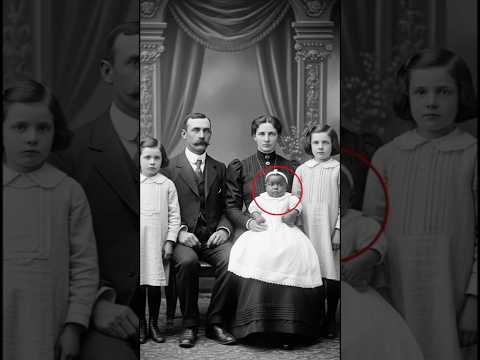
Rebecca had learned to trust her instincts. In her line of work, tiny details often unraveled the biggest mysteries. She saved the image and opened her genealogy software, cross-referencing the Hendricks family tree.
According to the records, the Hendricks family had only two children in 1898: a boy aged five and a girl aged three. There was no baby.
Her mind raced with possibilities. Had the photograph been altered? Was it a hoax? Or was there a darker secret hidden in the family’s past?
She decided to dig deeper. The Hendricks family had been prominent in Boston society, but their history was riddled with gaps. Rebecca pulled up old newspaper clippings, birth certificates, and even diary entries that had been digitized.
Nothing explained the baby. It was as if the child had appeared out of thin air.
Frustrated, she leaned back in her chair. The photograph was high-resolution, and the baby’s face was clear. She ran it through facial recognition software, comparing it to other images in her database.
The results were inconclusive, but one match stood out—a distant cousin of the Hendricks family who had died in infancy. But that child had been born in 1902, four years after the photograph was taken.
Rebecca’s pulse pounded. Could the photograph have been misdated? Or was there something more sinister at play?
She thought about the stories she’d heard—of families hiding secrets, of children swapped or lost. But this was 1898, and the Hendricks family was respected. Why would they lie?
Determined to uncover the truth, Rebecca reached for her phone to call her contact at the historical society. But before she could dial, a notification popped up on her screen: a new email from the Hendricks family.
The subject line read: “About that photograph…”
Her finger hovered over the mouse. For a moment she considered ignoring it—finishing her call first, keeping the discovery to herself. But the subject line felt like a door creaking open, and she couldn’t walk past it.
She clicked. The email was from Margaret Hendricks, the family’s elderly matriarch, who had submitted the collection three weeks earlier. It was brief, almost breathless in its phrasing.
“Dr. Torres—I saw the timestamp on the upload. I know you’ve opened the porch photograph. Please call me before you draw any conclusions. There are things about that image my family has never put in writing.”
Rebecca glanced at the clock. It was nearly five, and the February light had gone gray outside her window. She dialed the number in the signature.
Margaret answered on the second ring, as if she’d been holding the phone. Her voice was thin but steady, the voice of a woman who had rehearsed something for a very long time.
“You found the baby,” she said. It wasn’t a question.
Rebecca chose her words carefully. “I found a child who doesn’t appear in any of the records I can access. Two children are documented for 1898. Not three.”
A long pause. Then Margaret exhaled—a sound somewhere between relief and dread. “Her name was Eliza. She was my grandfather’s sister. And she was erased from everything—the tree, the church registry, even the family Bible.”
Rebecca grabbed a pen. “Erased how? By whom?”
“By my great-grandfather. The stern man on the porch.” Margaret’s voice tightened. “After Eliza was born, something happened. Something the family never spoke of directly. All I know is what my grandfather told me on his deathbed—that the photograph was the only proof she ever existed, and that he was ordered to burn it.”
“But he didn’t.”
“He didn’t. He hid it inside a clock case for sixty years.”
Rebecca’s eyes drifted back to the image on her screen. The baby’s unsettling stare, the sharp little features. “Mrs. Hendricks, I ran the face through recognition software. It matched a cousin who died in infancy—but that child was born in 1902. Four years after this was taken.”
The silence on the line stretched so long that Rebecca checked the connection. Then Margaret spoke, and her voice had changed. It was quieter now. Careful.
“That’s because the baby in the photograph isn’t Eliza. Not the Eliza who was born in 1898.”
Rebecca set down her pen. “I don’t understand.”
“Neither did I, for years. My grandfather said the child in the picture was a replacement. That the real Eliza died at three months, and the family—my great-grandfather especially—could not bear the shame of it. So they brought in another infant. A cousin’s child. A child they raised as their own and never spoke of again.”
Rebecca looked at the porch again. The mother’s tight smile. The father’s rigid posture. The three children standing in a row like evidence.
“So the photograph is a lie,” she said slowly.
“No,” Margaret said. “The photograph is the truth. It’s everything else—the records, the certificates, the family tree—that’s the lie. That’s why I sent it to you. I need someone to prove it before I die.”
Rebecca stared at the screen. The baby stared back. And somewhere in the back of her mind, a new question began to form—one she wasn’t sure she wanted answered.
“Mrs. Hendricks,” she said, “if that baby was a replacement, whose child was it? And what happened to the family that gave her up?”
The old woman’s reply came in a whisper.
“That’s the part I was hoping you could tell me.”
Rebecca let the silence settle before she spoke again. “Mrs. Hendricks, I’m going to need access to everything you have. Not just the photographs—the clock case, the Bible, any letters, anything your grandfather kept.”
Margaret agreed without hesitation. She explained that a storage unit in Somerville held the family’s remaining artifacts, untouched since her grandfather’s death in 1971. “There’s a trunk,” she said. “He called it the shame box. I’ve never opened it.”
Rebecca wrote down the address and the unit number, her pen pressing hard into the paper. A shame box. The phrase echoed in her mind as she hung up.
She spent the next hour studying the photograph again, this time with fresh eyes. If the baby was a replacement, then the family had gone to extraordinary lengths to conceal the swap. But why photograph the child at all? Why preserve the only evidence of a lie?
She enlarged the image and examined the background—the porch railing, the potted ferns, the lace curtains in the window behind the family. Then she saw it. A woman’s face, barely visible in the upstairs window, half-hidden by the curtain.
Rebecca’s breath caught. She adjusted the contrast, sharpening the pixelated blur. The woman was young, her hair pulled back, her expression unreadable. She was not dressed like a servant. She was not dressed like a Hendricks.
She saved the enhanced crop and opened a new search window. If this woman was the real mother—the one who gave up her child—then finding her identity might crack the entire story open.
The next morning, Rebecca drove to Somerville. The storage facility was a low brick building off McGrath Highway, the kind of place where people kept things they couldn’t bear to throw away but couldn’t stand to look at either.
Unit 214 was at the end of a dim corridor. The lock was rusted but gave way after a few hard turns. Inside, she found a single wooden trunk, its lid warped with age, and a stack of cardboard boxes labeled in faded marker.
She opened the trunk first. On top lay a folded christening gown, yellowed with time, and beneath it a bundle of letters tied with twine. The handwriting on the envelopes was cramped and hurried, the ink brown with age.
Rebecca untied the bundle and read the first letter. It was dated March 1898—two months before the photograph was taken.
“I cannot keep her,” the letter began. “You know why. If my husband finds out, he will kill us both. Please, for the love of God, take her and never tell a soul where she came from.”
The signature at the bottom was a single name: Bridget.
Rebecca read the letter twice. Then she pulled out her phone and called Margaret back. “I found the letters,” she said. “They’re from a woman named Bridget. Do you know who she was?”
The old woman’s voice trembled. “Bridget was my great-grandmother’s sister. She worked as a housemaid in the Hendricks house. And she disappeared in the summer of 1898. No one ever spoke her name again.”
Rebecca looked down at the letter in her hand. The handwriting was desperate, the paper worn thin from being read and reread. Bridget hadn’t just given up her child—she had vanished.
“Mrs. Hendricks,” she said slowly, “I think I know why. And I think the photograph wasn’t just proof of the swap. It was proof of a crime.“
Margaret’s silence was answer enough. When she finally spoke, her voice cracked. “Bridget. The upstairs window. My God—she was there the whole time.”
Rebecca nodded, though the old woman couldn’t see her. “She was watching. Not hiding—witnessing. She wanted proof her daughter was alive and well, even if she could never hold her again.”
She spread the letters across the trunk’s lid. The dates told their own story: Bridget’s desperate plea in March, the photograph in May, then silence by August. One final envelope, unopened, bore no stamp—only a name scrawled in a different hand: Mr. Hendricks.
Rebecca slit it open with trembling fingers. Inside, a single line: “She is gone. The child stays. Burn this.”
She sat back on her heels, the storage unit’s fluorescent light humming overhead. Bridget hadn’t abandoned her daughter. She had been erased—just like Eliza, just like the truth itself.
“Mrs. Hendricks,” Rebecca said quietly, “I’ll write the report. I’ll prove Eliza existed, and I’ll prove what happened to Bridget. But I need you to decide something. Do you want this made public?”
The old woman was silent for a long moment. Then, softly: “Yes. Let them all know. Every last one.”
Rebecca closed the trunk and locked unit 214 behind her. Outside, the February wind stung her cheeks, but she barely felt it. Somewhere in the gray Boston sky, two ghosts had finally been given back their names.
But one question still gnawed at her—the one Margaret had never answered. If Bridget vanished in 1898, where did she go? And did anyone ever find her?
What do you think happened to Bridget? Share your theory in the comments below.
Report this article
Select a reason for reporting:






