In 1890, a lumberman named James Haines built a wooden flume 54 miles long through the Sierra Nevada. It dropped 4,500 feet in elevation. Logs entered at the top and arrived at the bottom mill traveling at speeds reaching 60 miles per hour. One worker who accidentally fell in rode the flume for 18 miles before someone could pull him out. He survived. Most who fell in didn’t.
I’ve been through the records on these flumes—mill ledgers, county assessor maps, payroll sheets written in pencil on brown paper. The story that keeps coming back to me is how quiet these structures are in the history books and how loud they must have been in the canyons. A log flume running full sounded like a freight train that never stopped. You could hear one from two miles away at night. Water and green timber roaring through a wooden trough pinned to a cliff.
If you care about the men who built this country with their hands, the ones nobody put on a stamp, stick with me. Because what the flume builders pulled off in the Sierra Nevada and the Cascades still doesn’t quite fit in my head—and I’ve been looking for a long time.
James Haines was born in Vermont in 1830. He came west after the Civil War with a brother and a small bank draft. Worked a season in the mines around Virginia City, Nevada, and got out before the silver played out. By 1875, he was cutting timber on the eastern slope of the Sierra Nevada to feed the Comstock Lode. The mines ate timber the way cities ate bread. Shoring, stalls, cribbing, lagging. Every foot of shaft needed wood, and every stick of wood had to come down off a mountain that had no road.
Haines looked at the problem the way a lot of men looked at it in the 1870s. The timber stood at 7,000 feet. The mills and the mines stood at 4,500 feet and below. Oxen couldn’t make the grade with a full load. A railroad would have cost more than the timber was worth, and the grade was wrong anyway. But there was water. There was always water on those east-facing slopes. Snowmelt ran every spring until August, and in some canyons it ran all year.
So he drew up a flume. Not the first flume in the Sierra Nevada—his kinsman J.W. Haines had already built shorter ones in the 1860s, and the V-shaped design had been worked out by a man named James Flint a few years before that. But what James Haines drew was longer, steeper, and carried more timber per hour than anything anybody had tried. 54 miles from the high timber down to the railhead. A wooden river pitched at a grade a log could ride.
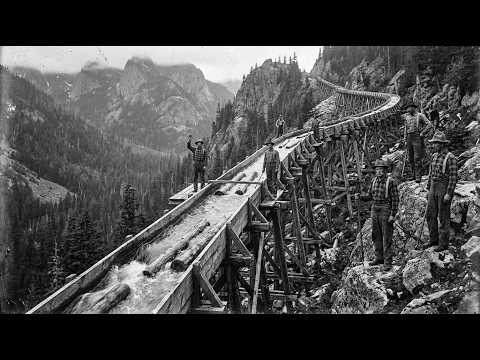
Here’s what a V flume actually was. Two boards, each one 16 inches wide, sometimes 24, set at a 90-degree angle to each other like a long trough tipped on its edge. The bottom of the V was a joint sealed with pitch. The top was open to the sky. You filled that trough with water pulled from a creek at the top of the mountain, and gravity did the rest. Logs floated in, rode the current, and came out the bottom an hour later where a man with a pike pole was waiting to pull them into the mill pond.
That’s it. That’s the whole machine. No engine, no boiler, no gears, no fuel bill. A flume that could move more timber in a day than 50 teams of horses could move in a month. And the only thing powering it was snowmelt the mountain was going to send downhill anyway.
I’ve stood next to a restored section of one of these troughs in a museum yard in California, and I’ve put my hand on the pitched seam, and I still cannot quite accept that somebody in 1878 ran a 54-mile wooden channel along the side of a cliff and trusted water to do the work.
Building it was another story entirely. Flume crews worked on slopes so steep they couldn’t stand up straight. They drove timber trestles into canyon walls to carry the flume across ravines 100 feet deep. In one section of the Haines flume, the trough ran along a granite face with a drop of 300 feet straight down into a boulder field. The bridge crew hung in rope harnesses to notch the anchors. A man slipped, and that was the end of the man. They buried him where they could and cut another beam.
I want to tell you about two of the men who worked the Haines line. Their names came out of a payroll book from the Carson and Tahoe Lumber and Fluming Company, cross-referenced against a county burial list in Alpine County, California, and a letter I found in a family papers collection at the University of Nevada.
The first man was Per Nygard, age 22, born in Telemark, Norway. He came to Minnesota with an uncle when he was 14, worked three seasons in the pineries around Stillwater, and drifted west to the Sierra in 1889 because a cousin had written him that the wages were better. Five foot ten, 170 pounds, pale hair bleached almost white by the sun. He hired on as a flume herder.
A flume herder was the man who walked the line. He carried a long hooked pole and a bucket of pitch. His job was to keep the flume running. If a log turned sideways and lodged in the trough, he had to lean out over the water and drive the hook in and wrench it free before the logs stacking up behind it took the whole section of flume off the mountain. If a seam split and water started pouring out over the cliff, he patched it with hot pitch from a brazier he kept on the catwalk. He walked 8 to 10 miles of flume a day in the rain, in the snow, on a board catwalk 18 inches wide with a drop to the rocks below that a man tried very hard not to look at.
Per Nygard made $2.50 a day. He sent half of it to a girl named Astrid in Stillwater who he intended to marry as soon as he had $300 saved. He kept a small notebook in his coat pocket. Three entries a week. Weather, distance walked, how much pitch he used. He was saving every penny.
In October of 1891, a log jammed at a bend where the flume swung around a granite shoulder at the 32-mile mark. The logs behind it piled in fast. Per Nygard got there, leaned out with his hook, and worked the jam. The second log came loose and kicked sideways. The tail end of it caught him above the hip and folded him into the trough. The water took him. He rode the flume for most of a mile before the current wedged him under a stringer, and he drowned there.
The crew recovered him the next morning. The Carson and Tahoe Company paid Astrid $40 and his last two weeks of wages. The notebook came with the money. Weather, distance, pitch. Three entries a week. His headstone in Stillwater was paid for by the Norwegian Lutheran Church, and it reads: Per Nygard, died in California, 1891.
That was one man. There were hundreds. Because the thing about flume work that doesn’t show up in the company reports is the speed. On the steeper sections of the Haines flume, green logs hit 60 miles per hour. A 20-foot log weighing 2,000 pounds moving faster than a galloping horse inside a wooden trough that was already trying to shake itself to pieces. When one of those logs hit a bend wrong, it punched through the side of the flume like a battering ram. Whole sections of trough would blow out in a spray of splintered pine. A herder on the catwalk had a second, maybe two, to find something to hold.
Before I tell you about the second man and before I tell you about the one who rode the flume on purpose, do me a favor. Hit subscribe. This channel lives on subscribers. The algorithm buries old industry stories unless people tell it we care. So tell it. One click and come back, because we are going up the hill with James Haines and his kinsman J.W. Haines, and we are going to ride a flume the way the Virginia City reporters did in 1875.
The Sierra Nevada flumes fed the Comstock Lode. That is the reason they were built on the scale they were built on. Virginia City, Nevada, in the 1870s, was consuming 80 million board feet of timber a year. Shoring for the square-set mine stopes that Philip Deidesheimer had designed in 1860. Cordwood for the boilers that ran the stamp mills. Lumber for the houses and the saloons and the opera house. All of it from the eastern slope of the Sierra Nevada. Twenty miles west and 4,000 feet higher than the mines.
J.W. Haines built one of the first serious flumes in 1868, running from Spooner Summit down toward Carson City. Twelve miles. Then the Pacific Wood, Lumber and Flume Company built a longer one. Then the Carson and Tahoe outfit built longer ones still. By the late 1870s, there were flumes running off every major canyon on the east slope. And the wood they delivered was keeping a state’s worth of mines from caving in.
A single flume could move more timber per day than 50 teams of horses working full out. I’ve seen the tonnage numbers in a Carson and Tahoe shareholder report for 1882: 500 cords of wood and 150,000 board feet of lumber delivered in one 14-hour working day from one flume. The horse equivalent would have been impossible. You could not have put enough horses on those mountains to do what the water did.
Which is the reason the second man I want to tell you about took the job he took. His name was Elias Warburton, age 37, born in 1854 in a mill town outside Portland, Maine. His father was a sawyer who lost his right hand in a circular saw when Elias was nine. The family moved west in 1870 because Maine was cut and there was nothing left to saw. Elias worked his way across the country one lumber camp at a time. By 1888, he was a bridge foreman for the Carson and Tahoe Lumber and Fluming Company.
A bridge foreman on a flume line was the man responsible for the sections where the trough crossed open air. Ravines, side canyons, creek bottoms. Warburton’s crew could build 150 feet of flume trestle a day across a 60-foot ravine using only the trees they felled that morning, notched with axes, pegged with oak trunnels, cross-braced with green fir that was still sweating sap. Stringers laid and then the trough pinned on top and water in it before the week was out.
These were not bridges the way we think of bridges. No steel, no concrete, no engineer in a white hat with a slide rule. The bridge foreman looked at the ravine, chose his anchors, and told his men to start cutting. If a trestle failed in the first winter, which happened, the company rebuilt it. If it lasted seven years, which was the usual target, they did not rebuild it because by then the timber above it was gone and the whole flume would be abandoned.
Elias Warburton is in this story because of what happened in August of 1892 and because he is one of the named men who rode a Sierra flume accidentally and came out alive. The log that hit him was a 24-foot sugar pine. He was inspecting a trestle joint at the 19-mile marker on the Haines line when a jam broke loose two miles up. He heard the roar and had two seconds to decide. The catwalk above him had already buckled. He jumped for the trough.
He rode that flume for 18 miles. His own account, which he gave to a reporter from the Reno Evening Gazette in 1893, and which I have read on microfilm, is the strangest thing I’ve ever read in a labor history. He said the water was cold enough to numb him in the first mile. He said the logs behind him kept catching up and he had to keep shoving off them to ride forward instead of being crushed. He said at one point the flume swung out over a canyon and he could see his own boots against the sky and the tops of pine trees 100 feet below him. He said he thought of his wife. He said he prayed the plank prayer, which he described as “Lord, hold the boards.”
The boards held. At the 37-mile mark, the flume grade flattened and the current slowed enough that a pitch crew at the Clear Creek delivery yard saw him coming, jumped into the trough themselves, and hauled him out onto the bank. He had lost one boot, most of his clothes, and the skin off both forearms. But he lived. He went back to work three weeks later. He worked 11 more years for the Carson and Tahoe. He died in 1904 of what the doctor called “exhaustion of the lungs,” which was probably pneumonia compounded by a cold August ride in 1892 he never quite shook.
Most of the men who went in didn’t come out that way. There were three others on the Haines line alone in a five-year span whose names I pulled out of Alpine County Coroner’s records. One, a Chinese laborer whose given name was never recorded, only the company’s notation “Ah Lee, pitch hand, drowned 14 mile, winter 1889.” One, a 15-year-old catwalk boy named Tommaso Ricci, whose mother ran a boarding house in Gardnerville and who sent her his pay in an envelope every second Friday until the Friday the envelope did not come. One, a Paiute worker named Jim Sam, who had built flume sections for four different companies and drowned at the mouth of the Clear Creek delivery on a morning when the river ice let go upstream and a wall of cold water hit the yard before anybody could whistle. They are buried in three different cemeteries and none of their graves has a marker that mentions the flume. You can stand over any one of them and not know what killed the man beneath your feet.
I keep coming back to the engineering. How did those trestles hold? Because the answer is most of them held. And the ones that didn’t hold killed the men who were on them when they let go. A 100-foot trestle across a ravine was calculated to survive about 10 to 15 years, which was roughly the life of the timber stand the flume was built to drain. Some lasted longer. A few sections of the old flume number one on the east slope were still standing in 1930 when a fire took them.
The V-shape was the genius of it. A rectangular trough would have required careful leveling, would have dragged logs on a flat bottom, and would have needed a lot more water to move a load. The V let logs ride high in the water, touching only the seam, almost frictionless. A flume running at a 2% grade would carry a log at walking pace. A flume running at a 6% grade would carry a log faster than a horse could gallop. Haines calculated the pitch of each section of his 54 miles by eye and by test. He ran small logs through new sections before he trusted big ones. If a section ran too fast, he shimmed up the trestle under one end to flatten it. If a section ran too slow, he rebuilt the trestle lower and tried again.
Day-to-day life on a flume line was its own particular kind of hard. The bridge crews lived in shanty camps stretched along the line, one camp every five or six miles. Each camp a cluster of canvas tents and a cookhouse made of flume boards the company couldn’t use. Up at 5:00, breakfast of flapjacks and beans and coffee black enough to stand a spoon in. Out to the line by lantern. The pitch crew heating tar all day over a brazier that smoked the sky for half a mile. The axemen notching bents. The rigger chief calling grades off a level made out of a glass bottle of water. Noon meal came out on a handcart running on the catwalk planks. Stew, bread, dried apple pie on Sundays if the cook felt like it. Ten minutes to eat, back to the beam. Quitting time when it got too dark to see the notch line. Men walked back to camp on the catwalk itself, boots on the planks, the trough running full of water under the boards to their right, and nobody looked down if they could help it. Saturday was payday in most camps. Sunday was off if the foreman allowed it. Mail came up on the last handcart on Saturday and went out on the first one Monday morning. I have read letters from the Haines line camps that were folded so many times the ink had worn through at the creases. Dear Astrid, I am well. The mountains here are higher than any mountain in Norway. Tell your mother I have her recipe in my coat. I will be home in the spring. Per.
What the flumes built is worth stopping on. Because the men paid for it with their bodies and the mountains paid for it with their oldest trees. And I think we owe them the courtesy of knowing what we got. We got the Comstock Lode, which is to say we got most of the silver that backed the American dollar in the last third of the 19th century. We got the cities of the California interior that framed themselves out of sugar pine and ponderosa floated down wooden channels. We got the railroad trestles on the Central Pacific line east of Truckee. We got a significant part of the building stock of San Francisco before the 1906 fire took half of it.
The flumes carried so much timber down off the eastern slope that the slope itself is a different mountain now than it was in 1870. Whole canyons of old growth sugar pine went through the Haines flume in the span of 15 years. The second growth that came back was smaller, thinner, and mostly fir. The slope on the Nevada side has still not recovered the canopy it had when James Haines first rode up it with a survey chain.
Most flumes only lasted 10 to 15 years. That is the number I keep coming back to because it is the number that explains why you have never heard of these structures. A flume was built to drain one timber stand. When the stand was gone, the flume was abandoned. The company pulled the best boards off the nearest sections to sell and the rest was left to weather. In five years a Sierra flume was sagging. In ten years the trestles were dropping. In twenty-five years you could walk a canyon where a flume had carried 200,000 board feet a day and find only the occasional square cut board under the pine duff.
Which brings me to what’s left. And before I get to that, one more ask. If you want more of this kind of history, the real work, the real men, the stuff that is not in the school books, subscribe. That is the whole pitch. I will keep finding these stories as long as you keep telling the algorithm you want them.
You will be driving some afternoon on a forest road on the east slope of the Sierra Nevada or in the Cascades of Oregon or Washington. The road will cross a small creek. You will look upstream and see nothing but timber and granite. But if you get out of your truck and walk 50 yards up that creek and you look carefully at the banks on either side, you will sometimes see a notch cut into the granite. A square notch, 18 inches wide, three inches deep. It will be filled with moss. You will almost miss it. That was a flume anchor. In 1882 or 1891 or 1905, a bridge crew drove an iron pin into that notch and bolted a timber bent to it. And from that bent they strung a wooden trough that ran along the cliff for half a mile. Sugar pine logs rode that trough at 40 miles an hour. A man named Per or Elias or Jim Sam walked the catwalk beside them with a pike pole. Another man heated pitch in a brazier at the next anchor down. All of them are gone. The flume is gone. The sugar pine is gone. But the notch is still there. The iron stain is still in the rock. And if you push the moss aside, sometimes you will find the stub of a pin still driven into the granite.
I have put my hand on those pins. Nobody stopped to mark the spot. No plaque, no marker. Just the notch in the cliff and the men who rode a wooden river down a mountain and are not in any book. 54 miles of wooden flume. 4,500 feet of drop. Logs at 60 miles per hour. Hundreds of flume herders and bridge builders and pitch men. Fifteen years and then gone. That was the great log flumes of America, 1870 to 1910. That was the work that fed the mines and framed the cities and cleared the mountains you drive through today.
I think about James Haines sometimes standing at the top of his line in the first spring of operation watching the first log drop into the trough and go. I think about the foreman beside him checking his pocket watch. I think about how short a time that flume ran before the slope was bare and the trough was rotting and the men had scattered. And I think about how little of that story anybody remembers now.
I’m glad you stayed with me. Tell me in the comments if one of your own people worked a flume or a mill on the Sierra east slope or in the Cascades. I read every comment. I’ll see you in the next one.
Report this article
Select a reason for reporting:






