In the winter of 1901, northern Maine lay buried under four feet of snow, and tens of thousands of felled pine logs lay stranded in the frozen woods. If they didn’t move before the spring thaw, they would rot—worthless. The logging industry faced bankruptcy. Horse teams were dying by the dozen, and the old ways were failing fast. But one man’s untested machine would dare to do what muscle and hoof could not. This is the story of a desperate season, a deadly invention, and the birth of the track-driven age.
The men in the camps knew the score. Even the strongest Percherons and Clydesdales sank to their bellies in the deep snow, their iron-spiked shoes slipping on the ice. “A single misstep could snap a leg, and there was no rescue—just a bullet and a shallow grave in the woods,” one old-timer recalled. Camps kept a grim tally: 12 to 18 horses lost in a single season was common. Each one cost $100—a fortune equal to months of a man’s wages, more than $2,500 today. With mills up to 50 miles away, a dead team meant lost money, wasted feed, and growing risk that the spring thaw would turn the snowbound logs into a worthless mess.
Alvin Orlando Lombard was not a man of blueprints and theory. Born in Waterville, Maine, he had spent decades as a machinist and blacksmith, repairing and building whatever the mills or the woods demanded. He watched the horses fail year after year—the waste, the broken animals, the men stranded in snow drifts with nothing but a shovel and a hope that spring wouldn’t come too soon.
Lombard’s answer came not from a textbook, but from the way snowshoes spread a man’s weight so he could walk where boots would sink. If animals bogged down because their hooves pressed too deep, why not build a machine that floated? He started with a wooden model: front runners like sleds, and at the back, a set of endless tracks, each link studded with cleats to grip the snow. The idea was simple: distribute the weight. Let the machine crawl rather than roll. That was the breakthrough.
In November 1900, Lombard filed for a US patent. The application described a vehicle adapted to move upon snow and ice without slipping, laying out the core principle: spread the load across a broad surface, just like a snowshoe. The patent was granted on May 21, 1911—US patent number 674,737. With it, Lombard didn’t just protect his invention; he put the solution to winter’s deadlock into the hands of the logging industry. The next step was to build it full scale and see if steel and steam could do what muscle and hooves could not.
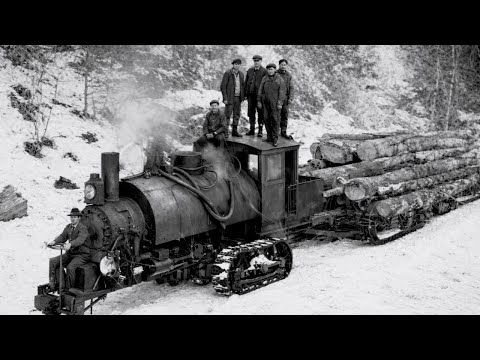
Steam was the heart of Lombard’s machine. A vertical boiler set mid-frame burned wood or coal to bring water to a rolling boil, building pressure up to 200 pounds per square inch. That pressure drove two vertical pistons, each linked by a heavy crankshaft to the tracks behind. The pistons’ back-and-forth motion turned the shaft, which in turn powered the endless chain tracks—one for each side, each about five feet wide.
The tracks themselves were a marvel. Steel links fitted with cleats, or lags, that bit into snow and ice. Unlike wheels that spun and sank, these tracks spread the hauler’s 18,000-pound empty weight across a broad surface. Ground pressure dropped to just a few pounds per square inch—less than the foot of a man in snowshoes. The hauler, 30 feet long and 10 feet wide, crawled forward at a steady 4.5 mph, dragging a line of loaded sleds behind. The front of the machine rode on a pair of long skis, 10 feet from tip to tail, pivoting on a central pin. Steering came from a lever in the operator’s hands, shifting the angle of the skis to guide the bulk of the hauler.
The real breakthrough lay in the track geometry. Each track could flex and oscillate over bumps and drifts, always keeping maximum contact with the snow. The steel cleat gripped, the weight floated, and for the first time, a machine could cross the winter woods without bogging down. But the same power that made this possible—steam at high pressure—was always waiting to punish any mistake in the firebox or boiler. Pressure management wasn’t a detail. It was survival.
Night after night, deep in the Maine woods, crews stepped out into the darkness with axes, lanterns, and water carts. The ice road wasn’t just a path; it was a living project, built and rebuilt every evening. Men chopped holes through lake ice, filled barrels, and hauled water by sled to the logging lanes. By midnight, teams worked in bitter cold, spreading water over packed snow that froze into a mirror-smooth track by dawn. This nightly flooding turned rough trails into icy highways—hard, fast, and slick enough that a Lombard hauler could tow a train of loaded sleds where horses would have floundered.
Each sled in the train stretched 30 feet, built from thick oak planks and steel runners, designed to carry 10 or 15 tons of green pine or spruce. Chained together in lines of 10, 20, sometimes even more, they formed a rolling freight line that could move as much as 100,000 board feet in a single run. But everything depended on the road. A rough patch, one spot where the ice broke or the snow drifted too thick, could snap a chain or shatter a sled, wasting a day’s work. That’s why patrol men walked the routes, shoveling, patching, and watching for weak spots, while operators and conductors kept a close eye on the train’s rhythm.
The pay reflected the risk and skill involved. Operators and firemen earned double or triple the wages of a camp laborer. Their judgment kept the hauler moving and the logs flowing. One wrong move could stall the train, wreck the road, or bring disaster to the crew. Each night’s labor on the ice road was an investment—one that paid off only if the logs reached the river before the thaw.
On March 3, 1907, the stillness over Lake Esanaba shattered. The Lombard hauler’s relief valve began to scream—a noise every camp knew meant trouble. In the next instant, the boiler ruptured under 200 pounds of steam pressure. Steel split apart with a violence no man could outrun. Operator Charles Reed died instantly, thrown from the cab amid flying shrapnel and scalding vapor. The fireman was hurled clear, his back broken, landing yards away on the frozen lake. Bits of the machine scattered across the ice, mingling with splintered sleds and spilled timber. For the men who heard the blast, there was no time for shock—just the cold fact that a hauler could kill as quickly as it could move logs. Companies brought in a replacement within days. The log still had to move, and the work went on.
But the men who ran the haulers did not forget. Charles Reed’s name was spoken in the camps for years afterward, usually in a low voice, usually followed by a long silence. Every operator who climbed into a cab after that day carried the same knowledge: the boiler was a living thing, and it demanded respect. “She’ll sing you a song,” the old firemen said. “Listen close, and she’ll tell you when she’s angry.”
And listen they did. The best of them—men like Big Jack Morrison, Henry Bejornson, and Thomas Kernney—learned to read the machine the way a sailor reads the sea. Morrison once crawled out onto the tracks with a sledgehammer, clearing a jam in the middle of a blizzard while the boiler hissed and the sled train waited behind him. Bejornson, it was said, could sense a thrown chain or a cracked cleat by the shift in the engine’s song, and he would pull back the throttle before anyone else even noticed trouble. Kernney worked through a storm so fierce the snow stung like needles, muttering, “If the boiler sings, the snow will bite.”
Their skills kept the hauler moving when others would have stopped. But the machine was changing more than the work—it was changing the men themselves. A camp that once needed forty teamsters and two hundred horses now ran on a handful of operators, firemen, and mechanics. The blacksmith’s shop grew quiet. The horse barns emptied out. Some men adapted, learning to tend the boiler and read the gauges. Others drifted away, their trade erased by steel and steam.
By the winter of 1911, the Lombard hauler had become a fixture of the northern woods. More than a hundred of them crawled along the ice roads of Maine, New Hampshire, and beyond, hauling timber that horses could never have touched. The patent, granted that May, made Lombard a wealthy man—but it also made him a target. Competitors rushed to build their own track-driven machines, and lawsuits followed. Lombard spent as much time in courtrooms as he did in workshops, defending the idea he had carved from wood and stubbornness.
Yet the machine’s true legacy was already written in the woods. The track-driven hauler had broken winter’s deadlock. Logs that once rotted where they fell now reached the mills on schedule. The spring thaw no longer meant ruin—it meant the river drive, the final leg of the journey. And for the first time in the industry’s history, the men who cut the timber could plan for the future instead of praying for the weather.
Still, the old-timers noticed something shifting. The camps grew quieter, less crowded. The songs that once rang out over the ice roads faded, replaced by the steady chuff of the boiler and the clatter of steel tracks. “The horses are gone,” one old teamster wrote in his journal. “And with them, a whole way of life.”
But progress does not pause for nostalgia. By the 1930s, diesel and gasoline engines had taken over—lighter, faster, no firemen needed. The steam haulers were left to rust where the woods swallowed them up, their boilers cold, their tracks frozen in place. Yet every modern track-driven machine, from the bulldozer to the snowmobile to the tanks that crossed the frozen steppes, owes its existence to that first Maine winter. Proof that necessity still drives real invention—and that the will to adapt remains our truest engine.
One of those rusting hulls was pulled from the woods near Chamberlain Lake decades later, its boiler split, its oak sleds long rotted away. Volunteers hauled it out piece by piece, and today it sits in a museum, silent but stubborn—a monument to the season that nearly broke an industry and the man who refused to let it.
Visitors run their hands along the cold steel tracks and try to imagine the noise: the hiss of steam, the clatter of cleats, the shouted warnings across the ice. “It doesn’t look like much,” a curator likes to say, “until you remember it did what a hundred horses couldn’t.”
Alvin Lombard died in 1937, his name half-forgotten, his patents long expired. But every winter, when the snow piles deep and the roads turn to glass, something in the north still remembers. The machine that floated. The invention born of desperation. The proof that when the old ways fail, someone always finds a way to crawl forward.
So the next time you see a snowmobile carve a drift or a bulldozer churn through mud, think of that frozen Maine winter—and the stubborn blacksmith who looked at a snowshoe and saw the future. What old problem in your own life is just waiting for a new way to float? Tell us in the comments below.
Report this article
Select a reason for reporting:






