In 1979, a court order was issued against a 65-year-old man that forbade him from wearing a mask. Not a costume, not a trademark—a mask. The specific black domino he had worn on television 25 years earlier. The company that had bought the rights wanted him to stop because they were making a new film and he was confusing the public.
He did not stop. He bought a pair of wraparound sunglasses, kept turning up to supermarket openings and children’s hospitals as the character, and fought it for five years until he got the mask back. By then, he had also stopped answering to his own name.
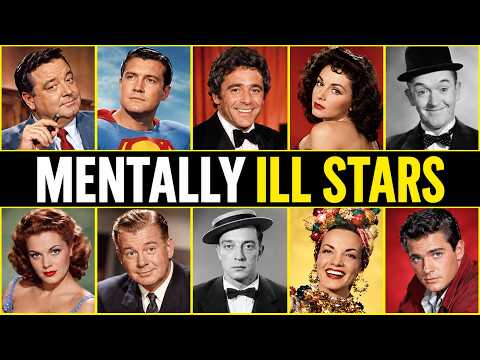
That man was Clayton Moore, and for millions of children, he was the Lone Ranger. But he wasn’t the only star who blurred the line between who they played and who they were. Some paid a price for it. Others paid with everything.
Every story on this list has something on paper behind it—a hospital record, a coroner’s finding, a court file, or the person’s own published account. And several of them are still unresolved.
These are 12 more classic stars who stopped being able to find the line.
Number 12: Clayton Moore. Moore played the Lone Ranger on television from 1949. By the time the series ended in 1957, he had done something no other actor of that era managed: he fused himself to a fictional person so completely that the fiction became the load-bearing part.
He spent the next 40 years making personal appearances in the mask—thousands of them—at rodeos, supermarket openings, state fairs, and children’s hospitals. He did it under rules he set himself. He would not be photographed out of character. He would not accept a part that involved drinking, smoking, or swearing. He would not give an interview in which he broke character.
In 1979, the company that owned the property obtained a court order barring him from appearing publicly in the mask. Moore’s response was to buy a pair of enormous wraparound sunglasses and carry on exactly as before. The letters ran overwhelmingly against the studio. The film came out in 1981 and was one of the more spectacular failures of the decade. The order was lifted in 1984, and he wore the mask for the remaining 15 years of his life.
When he died in 1999 at 85, every account from people who knew him describes a courteous, gentle, and completely sincere man. And none of them describes a man who could have told you where the actor stopped.
Number 11: Rudy Vallée. Vallée was the first modern pop star in America. Before Crosby and long before Sinatra, he was the man with the megaphone whose radio program ran for a decade and whose arrival at a theater required police.
But he is remembered now for something else: the street. Vallée lived on Pyramid Place in the Hollywood Hills, and from the 1960s onward, he petitioned the city of Los Angeles to rename it Rudy Vallée Place. He did this repeatedly. The council declined repeatedly. He came back with new applications, new supporting letters, and new arguments about his standing in American cultural history. He was still pursuing it in his 80s.
That means he spent roughly 20 years of an extremely successful life attempting to get a hillside road renamed after himself. When he died in 1986 at 84, his widow said he had raised it again near the end.
He had been an authentically enormous star—a genuine innovator in how a voice could be used on a microphone—and none of that was ever in dispute by anybody except him.
Number 10: Nick Adams. Adams was a working actor with a real claim on a bigger career, and what happened to him is one of the clearest cases on this list because it is all in the trade press. He had The Rebel, a western series he co-created and starred in from 1959. In 1963, he gave a genuinely strong performance in Twilight of Honor and was nominated for an Academy Award for it.
He then campaigned for the award in a manner that even in that period was considered extraordinary—taking out his own trade advertisements and working the town personally. And he lost.
What followed is documented in interviews he gave over the next five years. Adams became convinced that he had been cheated, then that the loss had been arranged, then that there was a standing agreement inside the industry to keep him out. He named people. He told reporters that his phone was not ringing because of specific decisions taken by specific executives.
And the more the work thinned, the more coherent the explanation became. He was also in a long and bitter custody dispute over his two children following his divorce, which drained him financially. By the mid-sixties, he was taking work in Japanese monster films because it was what was available—and telling anybody who asked that this was a deliberate international strategy.
He had been close to James Dean, and he told a number of stories about that friendship in his final years that people who had been present disputed.
In February 1968, he was found dead at his home in Coldwater Canyon at 36. The coroner found paraldehyde and other sedatives in his system, and the finding was left undetermined between accident and suicide—which is where it has stayed. He had an audition scheduled. He had come from a long way back.
Adams was born Nicholas Adamshock in Nanticoke, Pennsylvania, into a Ukrainian coal-mining family. He arrived in Los Angeles at 18 with almost nothing and talked his way into work through sheer persistence, which everybody who met him remarked on. He was in Mister Roberts and No Time for Sergeants. He was a friend of James Dean’s on the Rebel Without a Cause shoot, and close enough to Elvis Presley in the mid-fifties to be part of the Memphis circle.
By 1965, he was in Japan making Frankenstein Conquers the World for Toho—and giving interviews describing it as a strategic move into the international market.
Number 9: Carmen Miranda. In 1945, Carmen Miranda was the highest-paid woman in the United States, which almost nobody now remembers. She had gotten there by taking a Brazilian stage act and letting Hollywood turn it into a headdress full of fruit. The cost of that is documented in detail on both sides of the equator.
In Brazil, she was attacked in the press for having sold out—for the accent she had adopted, for becoming an American cartoon of a Latin woman. When she returned to Rio in 1940, she was received coldly at a concert by an audience that had decided she no longer belonged to them. She wrote about that night for years afterward as the worst thing that had happened to her.
In America, she was locked into the same role in film after film and could not get out of it. And she knew exactly how narrow the part had become. She was taking amphetamines to work and barbiturates to sleep in escalating quantities from the mid-forties onward.
In 1954, she collapsed and was taken to hospital in a severe depressive state, and she went back to Brazil for most of a year to recover. By the accounts of her family, she was not recovered when she returned. She came back to work in 1955 anyway.
On the 4th of August, she taped an appearance on Jimmy Durante’s television program. She is visibly unwell in the footage, and she stumbles during a number. She went home and died of a heart attack in the early hours of the next morning at 46.
Her body was flown to Rio, and something like half a million people came out for it—which is the part that is hard to sit with, because it was the same country whose rejection she had never gotten over and had never stopped explaining to interviewers who had not asked.
The image is so fixed now that the work behind it disappears. Miranda arrived on Broadway in 1939, already a major recording star in Brazil with dozens of hits behind her. She was not a Hollywood invention, and the headdress was a stylization of a real Bahian costume tradition that she had introduced herself.
The Gang’s All Here in 1943 is the one to watch if you want to see what she actually had, because Busby Berkeley built an entire sequence around her and she is the only thing in it that is alive. She supported a large extended family on the earnings throughout, which is part of why she could not stop.
Number 8: Buster Keaton. Keaton is one of the two or three greatest filmmakers America has produced, and he lost about five years of his own life—which he then wrote about himself, plainly, in a book in 1960.
The collapse has a clear cause. In 1928 he made the single worst business decision in film history by giving up his independent studio and signing with MGM, which then took away his control of his own pictures, assigned him writers, and forbade him from doing his own stunts. His marriage to Natalie Talmadge ended in 1932, and she took the house, the money, and the children—and changed the boys’ surname.
He started drinking at a level that is documented by everyone who worked with him, and he was fired by MGM in 1933. In 1937, he was committed to a psychiatric ward and put in a straitjacket. He said afterward that he got out of it using a technique he had picked up from Harry Houdini, who had been a friend of his father’s—which sounds like a story except that the escape is in the record.
The part that belongs on this list specifically is the missing time. Keaton said in his autobiography that there were long stretches of the mid-thirties he could not account for at all, and that the clearest example was his second marriage, to a nurse named Mae Scriven in 1933, which he stated he had no memory whatsoever of entering into and only learned about afterward. That marriage lasted about two years and ended expensively.
He stopped drinking around 1940, married Eleanor Norris, stayed married to her for 26 years, and worked steadily for the rest of his life—in television, in commercials, in Beckett, and in a Canadian short in 1965 that is one of the best things he ever did. He died in 1966 at 70, still working.
He was the only person on this list who both lost years and got them documented in his own hand. His childhood explains the physical fearlessness and possibly the rest. Keaton was put into his parents’ vaudeville act as a toddler, and the act consisted of his father throwing him around the stage and into the scenery night after night for years. The family story was that Harry Houdini gave him the nickname after watching him fall down a flight of stairs without crying. He never had a day of schooling to speak of.
The General in 1926 is now routinely listed among the greatest films ever made, and it was a commercial failure that helped cost him his independence.
Number 7: Arthur Godfrey. In 1953, Godfrey was the most powerful individual in American broadcasting. He built it all on one quality: he sounded like he was telling one person the truth. Then he fired Julius La Rosa on air, live, without warning—and explained afterward that the problem had been a lack of humility.
The public turned fast, because the thing they had liked about him was that he seemed decent, and he had just shown them he was not. Rather than reading the reaction, he concluded a press campaign had been organized against him. He named columnists on air. He buzzed a control tower and lost his license. The TV shows were gone by 1959.
He was still laying out the case for what had been done to him in 1953 decades later. But in 1959 he was found to have lung cancer, and he did something almost unheard of: he discussed it publicly and said the cigarettes he had spent years advertising had done it. He spent his last two decades on conservation causes. He died in 1983 at 79.
Number 6: Marie McDonald. On January 4, 1957, she reported that two men had kidnapped her, held her for hours, and abandoned her in the desert. The story went around the world—then came apart. Investigators found inconsistencies and never charged anyone. McDonald never varied her account, repeating it in the same detail for the remaining eight years of her life. That is what puts her here: a stunt gets dropped when it stops working, and she never dropped it.
She died in 1965 at 42 of an overdose. Her seventh husband died by suicide in the same house three months later.
Number 5: Stan Laurel. After Oliver Hardy died in 1957, Laurel refused ever to perform again—there was no act without Hardy, and he meant it. But he did not stop working. He sat in a small Santa Monica flat every day and wrote new Laurel and Hardy routines for a partnership that had one living member. He kept doing it until weeks before his death. The pages exist.
He listed his number in the directory and answered it himself, talking to strangers for half an hour. He spent eight years writing for a man who was not there, knowing perfectly well Hardy was dead, and he did it anyway every day, because it was the only work he recognized.
Number 4: Susan Cabot. A Universal contract player and Roger Corman lead, she walked away from acting at 32. In 1964 she had a son, Timothy, with a rare form of dwarfism, and she devoted herself to his experimental hormone treatment completely. She stopped leaving the house. By the 1980s it was filled to the ceiling with refuse, and she would let no one in.
In December 1986 she died at the house at 59. Her son, then 22, was convicted of involuntary manslaughter and sentenced to probation rather than prison—which tells you what the court concluded. It followed 25 years in which a seriously ill woman was left entirely alone with a child, and nobody with any authority looked in.
Number 3: Chuck Barris. He invented the dating game, the newlywed game, and the Gong Show—then in 1984 published an autobiography stating that throughout all of it he had also been a contract assassin for the CIA, and had killed 33 people. The CIA issued a flat public denial. Barris never withdrew a word of it, repeating the account for the next 33 years.
What makes it a genuine case rather than a gag is the duration and the cost—he stood by a claim that made him a laughingstock for a third of a century. The collapse had a trigger: his 1980 Gong Show film failed, the series was cancelled, and the book came four years later.
Number 2: George Reeves. He had been in Gone with the Wind, and what he got in 1952 was Superman at a few hundred a week. It made him the most recognizable man in America to anybody under 12 and destroyed everything else. At a public appearance, a small boy produced his father’s loaded service pistol and aimed it at Reeves’s chest to see the bullets bounce off. Reeves talked him into handing it over by explaining the bullets would ricochet and hurt the other children.
In the early hours of June 16, 1959, he died of a gunshot wound at 45. Police ruled it suicide within days. His mother refused the finding and spent the rest of her life trying to get it reopened. It never was.
Number 1: Jackie Gleason. The biggest comic star on American television spent his own life convinced the visible world was the smaller part of the story. He collected roughly 1,700 books on parapsychology, UFOs, and the occult, and left them to the University of Miami under the name he gave them: the golden apples of the sun. He consulted psychics before professional decisions and refused to rehearse, on the basis that something worked through him and rehearsal interfered with it.
His father walked out when he was 8, leaving a short note and no explanation. He said openly that he had spent his whole life looking for evidence that there was an order behind events rather than nothing at all. He found 1,700 books worth—and died in 1987 at 71, still looking.
So there they are: twelve people who found the line and could not find their way back across it. Some were swallowed by a character. Some built their own explanation and lived inside it. And a few, like Laurel, kept working for someone who was no longer there.
Which of these twelve do you think crossed the line first—and which one, if any, do you think was telling the truth all along? Tell us in the comments.
Report this article
Select a reason for reporting:






