The cell was cold, the air thick with the smell of damp stone and regret. Hermann Göring, once the most powerful man in Germany after Hitler, sat across from his interviewer, his uniform wrinkled, his face a mask of forced calm. “I live like any other prisoner,” he said, a thin smile playing on his lips. “But I detest when they pry into personal matters.” The trial, he called a farce. Yet behind the bravado, a storm brewed—a desperate attempt to control the narrative, to shift blame, to preserve a legacy already in ruins.
This was Nuremberg, 1946. The war was over, but the battle for history had just begun. In a series of secret interviews, the architects of the Third Reich—Göring, Kaltenbrunner, Ribbentrop, and Dönitz—spoke candidly, their words a chilling mix of denial, deflection, and twisted logic. What they revealed would shock the world and ignite a debate that continues to this day.
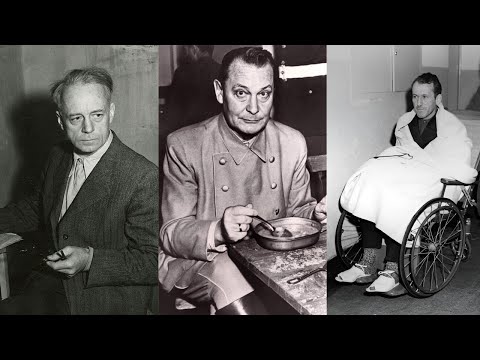
Göring leaned back, his eyes narrowing as he discussed the Jews. “It was because of their influence,” he claimed, his voice steady. “In Berlin, they controlled all the theaters and cinemas.” He spoke of culture, of art, of a Germany that once thrived—until, in his view, extremists like Goebbels ruined everything. “If Streicher had been in charge instead, history would have been different,” he mused, as if rewriting the past were as simple as swapping actors on a stage.
But the interviewer pressed on. What about the camps? The gas chambers? Göring’s expression hardened. “I knew nothing,” he insisted. “Those numbers are impossible to imagine.” He admitted to establishing concentration camps in 1933, but only for political enemies, never for extermination. “I never approved the death penalty for women,” he added, as if that were absolution.
The conversation shifted to Hitler. Göring’s voice softened, almost reverent. “He was a genius,” he said, “a man of iron will.” He described two Hitlers: the charismatic leader before France, and the paranoid, trembling figure after Russia. “If he hadn’t lost the war,” Göring claimed, “today, many of those who criticize him would be raising their arms and saying ‘Heil Hitler.’” The interviewer asked about the Holocaust. Göring’s jaw tightened. “That is not my nature,” he said. “I can justify reprisals, but never the mass murder of innocents.”
Yet the evidence would contradict him. Documents bearing his signature, orders for deportation, the plundering of Jewish assets—all painted a different picture. But here, in this cell, Göring was not a defendant; he was a storyteller, weaving a narrative of loyalty and ignorance.
As the interview drew to a close, Göring’s mask slipped. “I accept my responsibility for what happened under the regime,” he said, “but not for crimes I had no knowledge of.” He spoke of Hitler’s suicide, of Eva Braun, of the final days in the bunker. “He didn’t want others to pay for him,” Göring said. “I am here to take on that responsibility.” The words hung in the air, hollow and defiant.
The interview ended, but the story was far from over. Next would come Kaltenbrunner, the man behind the Gestapo, then Ribbentrop, the diplomat of death, and finally Dönitz, the admiral who claimed ignorance. Each would offer their own version of events, their own justifications, their own lies. And as the world watched, the question remained: How could men who orchestrated such horror sit before their accusers and speak of duty, honor, and ignorance?
The answer, perhaps, lay not in their words, but in the silence that followed—a silence that spoke volumes about the darkness of the human soul.
The door to Kaltenbrunner’s cell opened with a groan. Ernst Kaltenbrunner, the man who had led the Reich Main Security Office after Heydrich’s death, entered with a measured stride. His face was scarred, his eyes cold and calculating. He sat down slowly, as if weighing every movement. “The structure was very complex,” he began, his voice flat and clinical. “To understand it properly, one must consider the political context of Germany from 1933 onward.”
He spoke of the RSHA as if describing a machine—the Security Police, the Criminal Police, the Gestapo, the SD. His words were precise, almost academic, as though he were lecturing at a university rather than defending his role in a murderous apparatus. “I joined Hitler’s direct service in 1938,” he said, “but I did not assume leadership of the organization until 1943.”
The interviewer pressed him on the atrocities. Kaltenbrunner’s expression did not change. “Much of what I know today about these crimes I only learned here in Nuremberg,” he claimed. “Before assuming my position in Berlin in 1943, I was unaware of the magnitude of the atrocities being committed.” He insisted he had been ignorant of the gas chambers, the mass killings, the systematic extermination. “I was completely ignorant,” he repeated, as if repetition could make the lie true.
But the documents told a different story. Reports bearing his signature, orders for deportations, detailed memoranda on the Einsatzgruppen—all of it contradicted his claims. When confronted, Kaltenbrunner shifted his defense. “The diagram presented by the prosecution is incorrect,” he said, pulling a pencil from his pocket. “I drew my own.” He began sketching, his hands steady, his mind clearly sharp. It was a performance—a desperate attempt to confuse, to obscure, to bury the truth in a labyrinth of organizational charts.
He spoke of Himmler and Heydrich with a strange detachment. “Heydrich was extremely intelligent, manipulative, and skillful,” he said. “His ambition for power knew no bounds.” Of Himmler, he was more measured. “He was not exactly sadistic, but rather petty. He had that strict schoolmaster mentality.” The interviewer asked about the nickname ‘the hangman.’ Kaltenbrunner almost smiled. “It was accurate,” he admitted. “Heydrich was a sadistic man.”
The conversation turned to the war. Kaltenbrunner argued that Germany had been surrounded by enemies, that the invasion of the Soviet Union was a defensive necessity. “The Soviets had concentrated between 150 and 300 divisions on the border,” he claimed. “No ally acts like that.” He criticized the trial as biased, complaining that the defense had been denied the right to question witnesses. “This is not justice,” he said. “It is a procedural strategy to silence us.”
As the interview drew to a close, Kaltenbrunner’s composure remained intact. He had admitted nothing, denied everything, and blamed others. “I was part of the structure,” he said, “but my personal knowledge was very limited.” It was a familiar refrain—the same one Göring had used, the same one Ribbentrop and Dönitz would use. The machinery of the Third Reich, it seemed, had been operated by men who claimed to know nothing.
Kaltenbrunner was led away, his footsteps echoing down the corridor. The interviewer sat in silence for a moment, staring at the empty chair. The next interview would be with Ribbentrop, the diplomat who had negotiated the pact with Stalin and watched his world collapse. But for now, there was only the cold stone, the dim light, and the lingering question: How many more would claim ignorance before the truth was finally told?
Joachim von Ribbentrop entered the cell with the stiff posture of a man who had spent his life in ballrooms and embassies. His suit was rumpled, his collar loose, but he carried himself as though he were still the Reich’s foreign minister. He sat down, folded his hands, and waited. “Since I was a child, I had an excellent memory,” he said, when asked about his youth. “It made it easy for me to learn languages.”
He spoke of Canada, of the Cantilever Bridge over the St. Lawrence, of the tuberculosis that took his right kidney and later his brother. “My mother died young from that same disease,” he said, his voice trailing off. For a moment, the diplomat’s mask slipped, revealing something almost human beneath.
But the interviewer steered him back to the heart of the matter. How had anti-Semitism grown so monstrous within the regime? Ribbentrop’s answer was revealing in its evasions. “Part of Hitler’s radicalization came from his external influences,” he claimed, citing Roosevelt’s Jewish advisers. “This fueled his perception that there was an international conspiracy.”
He described his first meeting with Hitler in 1932—the severe face, the intense blue eyes, the commanding presence. “He would speak non-stop for twenty or thirty minutes,” Ribbentrop recalled. “You could not reason with a dictator. With Hitler, one only listened.”
When asked about Hans Frank’s diary—the revelations that Frank had boasted of killing Poles and been congratulated by Hitler—Ribbentrop’s composure cracked. “That shocked me,” he admitted. “But more because of the recklessness of putting it in writing.” He could not accept that all Germans had known. “I cannot accept that we all knew about or approved such acts,” he insisted. “That simply is not true.”
The conversation shifted to Moscow, to the non-aggression pact, to the banquet where Stalin and Molotov had toasted the future. “Stalin ruled Russia with absolute authority, just as Hitler did in Germany,” Ribbentrop said. “Both dictators had their peoples in the palm of their hands.” He described the Nazi system of deliberate ignorance—each minister knowing only what related to his own sphere. “I was not informed about the invasion of Norway until twenty-four hours before it began,” he said. “The same happened with the invasion of the Soviet Union.”
He reflected on the Treaty of Versailles, on Hitler’s rise as a direct response to what he called a great injustice. “In 1928 I warned my French and English friends,” he said. “They did nothing, and the result was what we all know.” As for the trial, he was dismissive. “It does not matter if they condemn Göring, me, or others. The message sent to the German people is what really matters.”
The interviewer asked whether the world’s opposition to Nazi Germany was solely the result of a Jewish conspiracy. Ribbentrop hesitated. “Hitler assured me he only sought the Sudetenland, the Polish corridor,” he said. “But later he deviated.” He recalled telling Hitler that he had seen no Jews in command in Russia except Kaganovich, a cordial man. “But Hitler ignored my words,” Ribbentrop said. “For him, the Jews were responsible for the war.”
His voice grew bitter as he spoke of the July 20th assassination attempt. “He even accused me of trying to arrange a secret peace in Sweden,” Ribbentrop said. “That hurt me deeply. I was his most faithful follower, and yet he distrusted me.” He shook his head slowly. “Hitler was an enigma, a mixture of kindness and brutality.”
The interview ended with Ribbentrop staring at the floor, his hands still folded. He had offered no remorse, only explanations—a lifetime of explanations. The guard led him away, and the interviewer turned to the final name on the list: Karl Dönitz, the admiral who had inherited a ruined Reich and claimed to know nothing of its crimes.
Dönitz entered with the weary gait of a sailor who had weathered too many storms. “I desired only to serve my country at sea,” he said, his voice gruff but steady. He insisted the Navy was an island, untouched by Nazi ideology. “I did not know what was happening to the Jews,” he claimed, “I did not see it.”
He spoke of his brief chancellorship after Hitler’s suicide, of his desire to surrender to the West, not the Soviets. “Someone had to prevent chaos,” he argued. “I am not linked to atrocities.” The interviewer asked about the evidence, the orders, the testimonies. Dönitz’s jaw tightened. “This trial is a farce,” he muttered, echoing Göring.
As the interviews concluded, the pattern was clear: denial, deflection, blame. Each man had built a fortress of lies, but the documents, the photographs, the survivors’ testimonies—they spoke louder than any excuse. The Nuremberg trials would deliver justice, but the words of these men revealed a deeper truth: the banality of evil, the human capacity to rationalize the unthinkable.
What do you think—can justice ever truly be served for such crimes, or do these interviews prove that some darkness can never be fully understood?
Report this article
Select a reason for reporting:






