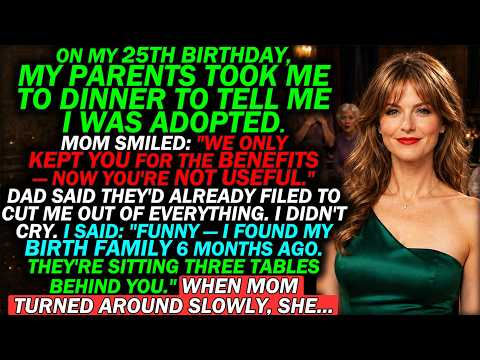
My mother smiled when she said they’d only kept me for the benefits. The words landed like a slap, but I didn’t flinch. I just sat there, staring at the manila folder in front of me, knowing that six months earlier, I’d found the family who actually wanted me. And they were sitting three tables away.
That night at Vantair, my parents thought they were delivering the final blow. They had no idea I’d already read the last page. “We only kept you for the benefits,” she repeated, slower this time, trying to draw blood. But the second time, it just sounded like a confession—not about me, but about her.
I didn’t cry. I didn’t scream. I just took a slow sip of water and set the glass down without a sound. My mother’s face flickered with disappointment. She’d written this scene with a sobbing girl in the lead, and I wasn’t playing the part.
Behind her, at table 9, a woman with my exact chin turned her head and went still. My birth mother, Susan, had been watching the whole time. She’d kept her seat, just like I asked, waiting for me to come to her.
My father slid the paperwork across the tablecloth—a waiver designed to cut me out of everything. He thought he was so clever. But I’d spent four years as a paralegal reading documents like this. They had filed against the wrong instrument. The will they were so proud of cutting me from was irrelevant. The real power was in Nana’s trust, and it was scheduled to pass to me on my 25th birthday—tonight.
I let them finish. I let them believe they’d won. And then I opened my folder and laid the three pages out on the white cloth: the retainer letter, the trust’s distribution schedule, and my original birth certificate with Susan Hail’s name in the mother’s line.
My mother’s eyes went to the trust schedule first. I watched the color leave her face as she read the words: “The caregiver distributions to Wesley and Diane Mercer shall terminate upon the beneficiary’s 25th birthday, whereupon the remainder shall pass to my granddaughter, Paige.”
“Mom,” I said gently, because I could afford to be gentle now. “You filed against the wrong family. The one you cut me out of was always the smaller one.”
She reached for my hand, her voice suddenly soft and wet and maternal. “We’re still your parents. Whatever’s in those papers, that doesn’t change what we are. We’re family.”
I didn’t take her hand. Instead, I stood up, folder against my chest, and told her the truth she’d been performing in front of all evening without knowing it.
“My birth family is sitting three tables behind you.”
I watched my words land. I watched her begin, very slowly, to turn around in her seat.
Susan met her eyes first. She didn’t glare or gloat. She just looked at the woman who had raised her daughter on one candle and a calculator, then looked at me, and her whole face opened like a window in spring.
Pearl was already on her feet, napkin folded neatly by her plate. Danny had stopped pretending to look at his phone. The three of them stood—not to confront, not to make a scene, just to be standing when I crossed the room, the way you stand for someone arriving after a long flight.
My mother’s mouth opened and nothing came out. For the first time in my life, Diane Mercer had no script.
I walked past her. Past Renee, whose mouth had finally run out of the word blood. Past my father, who lifted his eyes to me as I passed, then dropped them again, choosing comfort one last time.
Fifteen feet. Three tables. Twenty-five years.
When I reached them, Pearl took my face in both her hands the way Nana used to, and Susan pulled out the fourth chair—the one they’d asked the host to set even though their reservation was for three.
“We saved you a seat,” Susan said. “We always did.”
I sat down in it. In the seat that had been waiting my whole life at the table that had wanted me before they knew if I’d ever come.
That was when my mother lost the one thing she’d never lost in front of people. Her composure.
I heard her chair scrape, heard her stand, heard the front-table calm she’d worn all evening crack straight down the middle. “After everything we paid for,” she said, and it wasn’t quiet anymore. It carried across the dining room, sharp and rising. “After everything we did for you—the schools, the roof, the years—you do this to us in public? You humiliate your family over money?”
Heads turned openly. A man at the bar set down his drink. Renee was tugging at my mother’s sleeve, hissing, “Diane, sit down. People are looking.”
But my mother was past the reach of her own handler for the first time in her life, because the script was gone and all she had left was the truth coming out sideways.
“We gave you everything,” she said to a room full of strangers.
And I noticed she said gave, not loved. Even now, even cornered, the word love would not come—because it had never been in the inventory.
I stayed in my seat. I didn’t stand to match her. I didn’t raise my voice to meet hers. Susan’s hand found mine under the table, and I just held it and let my mother be loud, because the loudness was doing my work for me.
Every person in that restaurant was watching a calm young woman seated quietly with people who clearly adored her, and a furious older woman shouting about everything she’d paid for. And there is not a human being alive who hears a parent screaming about money and thinks, Ah, there’s the real family.
My father never stood at all. He just put his face in his hands.
I let her run out of words the way a storm runs out of rain. And when the quiet came back, I did one last thing before I gave the rest of my attention to my actual family.
I stood, walked the three tables back to the front, and set a single page down on the white cloth in front of her—the trust’s distribution schedule, face up. I didn’t need it anymore. My attorney had the originals, and I wanted my mother to have something to read on the longest evening of her life.
“You can keep this one,” I said. “You’ll want to understand what ended today and what didn’t.”
She stared at the page. Wesley reached for it, then didn’t. And I looked at the two of them—my mother, who had priced me at one candle, and my father, who had loved his own mother too much to honor what she’d asked of him—and I said the only sentence I’d prepared in advance, the one I’d decided I’d only use if I earned it.
“You kept me for the benefits,” I said. “They kept a seat for me.”
Then I turned around and walked back to table 9, and I did not look behind me again. Not once. Not when Renee called my name. Not when my mother said something I couldn’t hear and didn’t want to.
I sat back down beside Susan. Pearl had ordered me a slice of chocolate cake while I was gone, and Danny had stuck the little restaurant candle in it—a single candle, lit. For one second, the symmetry of it caught in my throat.
Then Susan leaned over and said, “Blow it out, sweetheart. Make the wish.”
And I realized I didn’t have one. I already had it.
I blew out the candle anyway, and the smoke curled up between us, and Danny clapped, and Pearl said something about how chocolate cake at nine o’clock at night was a scandal and a half, and Susan just squeezed my hand once, hard, and let it go.
We didn’t leave for another hour. My parents’ table emptied quietly behind us—I heard the scrape of chairs, the soft hurry of coats, Renee’s furious whisper, Brett’s footsteps. The front of the restaurant went dark and still while the back of it stayed warm.
At some point the manager came over, a woman about my age with a neat bun and a careful expression, and asked if everything was all right. Pearl told her the cake was the best she’d had since 1974, and the manager laughed and said it was on the house, and I understood that she had watched the whole thing and had chosen a side with a slice of cake.
That was the night, but it wasn’t the end of it. Because the next morning, the phone started ringing.
My mother called seven times before noon. I let each one ring through to voicemail, then played them back over coffee while Susan sat across my kitchen table, not asking, just present. The first three were furious. The fourth was quiet and careful in a way that scared me more. The seventh was my father’s voice, not hers, saying only, “Paige. Call me. Please.”
I didn’t call. I forwarded everything to my attorney and went to work, because the world doesn’t stop for the day after your life cracks open, and I had three estates on my desk that needed distribution schedules by Friday.
Two weeks later, the certified letter arrived. My parents were contesting the trust. They’d hired a lawyer who claimed Nana lacked capacity when she signed, that the notarized document was the product of undue influence, that a granddaughter who’d barely visited in her final year couldn’t possibly have been the intended beneficiary.
I read it twice, then laughed out loud in my empty apartment. They were arguing I hadn’t been around enough at the end—when the reason I’d missed those last visits was that they’d stopped telling me when she was sick.
The hearing took eleven months. I sat in a courtroom that smelled like lemon polish and old carpet and watched my mother testify that Nana had been confused, forgetful, easily led. My father sat beside her, silent, nodding when the lawyer prompted, and I thought about a woman in a gray cashmere sweater who had once told a crying twelve-year-old that she was chosen, not collected.
The judge ruled in forty minutes. The trust stood. The remainder was mine, and it was more than I’d ever let myself calculate—enough that I could have quit my job, bought a house, disappeared into comfort. I didn’t.
I kept the paralegal job. I kept the small apartment. I used a portion of Nana’s money to set up a scholarship in her name for kids aging out of foster care, because she’d have liked that better than flowers on a grave. And I sent my parents one final letter, hand-delivered by my attorney, that said only this: I am not contesting your will. I am not asking for anything. I am simply done. Please do not contact me again.
They didn’t. Not for a long time.
Three years later, I got a text from an unknown number. This is Brett. Aunt Diane is sick. She’s asking for you.
I sat with that text for a full day. Then I typed back: I hope she gets better. I won’t be coming. And I meant it without cruelty, which surprised me. Somewhere in those three years, the anger had worn itself out, and what was left was something quieter—a plain, settled knowledge that I had already grieved the mother I never had, and the woman in the hospital bed was a stranger who’d once signed paperwork.
Nana’s trust is still mine. Susan still calls every Sunday at four. Pearl taught me her grilled cheese, and Danny sends memes that make no sense and I laugh at anyway.
And sometimes, on quiet evenings, I think about that white tablecloth at Vantair, and the folder I carried for six months like a quiet engine, and the moment my mother turned around and saw the family who’d been saving me a seat.
Being wanted was the one thing I’d never had. It took me twenty-five years and one terrible dinner to learn that anyone who only keeps you for the benefits has already told you, in the plainest language there is, that they were never your family at all.
So here’s my question for you: if you had one folder—one page—that could change everything at your family’s table, would you open it? Or would you keep carrying it, the way I did, until you were ready to turn the key? Tell me in the comments. I read every single one.
Report this article
Select a reason for reporting:






