November 1944. A young German woman stared at her second bar of soap in a week—more than her entire family back home had seen in a year—while guards served her bacon, white bread, and real butter for breakfast. She had been told Americans were weak, degenerate, barely civilized. So why did her enemies feed her better than her own government ever had?
Greta was 23, a radio operator for the Wehrmacht, her gray uniform mended so many times she could barely see the original fabric. The last time she tasted real butter was 1942. Now she ate soup from potato peels and bread so hard it hurt her teeth. Every night, the radio insisted Germany was winning, that Americans were soft men led by Jewish bankers. She believed it—everyone did. How could the Führer be wrong?
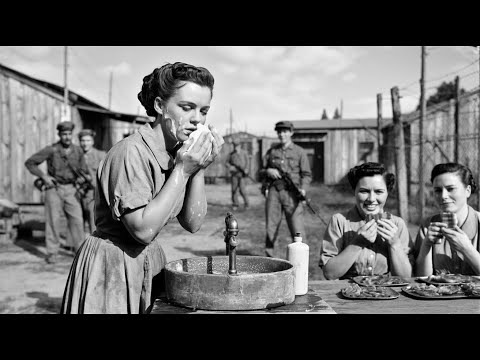
In September 1944, Allied forces shattered that world. Greta’s hospital unit was surrounded. American soldiers swarmed the area, and she braced for brutality—the propaganda films had shown them as animals. Instead, a young red-haired soldier pointed at her and the other women, his voice not angry. They were loaded onto trucks, then a train, then a ship. Guards gave them blankets and water. No one hit them. Where was the torture they had been warned about?
They arrived at a camp in Georgia—clean buildings, trees, cool November air. After showers with real hot water, Greta picked up a white bar of soap, smooth and perfect. She had not held real soap in three years. She almost cried.
Then came the dining hall. The smell of real food hit her first. On her plate: white bread, a pat of yellow butter, three strips of crispy bacon, scrambled eggs, coffee with sugar and milk. She could not move. This had to be a trick—fattening them for interrogation, or poison. But a young guard saw her fear, smiled, and mimed eating. He did not hit her. He just walked away.
Greta took a bite. The taste exploded—rich, warm, real. Around her, women wept. One whispered, “This is better than Christmas dinner at home before the war.” They were prisoners in an enemy country, yet they had just eaten better than German soldiers, better than German families, better than they had in years.
The days that followed were stranger still. Every morning: fresh bread, pancakes, oatmeal with raisins—raisins she had not seen since before the war. In the laundry, she touched a machine that did the work of ten women. “We were told America had no industry,” Ilsa whispered. Thursday brought ice cream—a full bowl of vanilla, tasting like childhood. A red Coca-Cola truck arrived; each prisoner got a bottle. A dentist used real pain medicine. Letters home felt like lies—she could not write of butter and soap while her mother ate turnip soup.
At night, women debated: Was this a trick? But Elsa asked quietly, “What if this is just normal for them?” The room went silent. Greta watched guards throw away half-eaten sandwiches. In Germany, wasting food was a crime. Here, it was nothing.
Thanksgiving came. Tables with white cloths, roasted turkeys, mashed potatoes, pumpkin pie. Guards sat at their own tables eating the exact same food. No difference between captor and captive. Greta picked up her fork, but her hands shook. She thought of German soldiers begging for food packages, of her brother asking what butter tasted like. She put her head down and sobbed. The guards let her cry—then brought more food.
That night, she stared at the ceiling. If America was this strong while fighting a war across two oceans, what did that say about Germany? About the promises? The master race? A master who cannot feed his people is no master at all. Real strength is serving turkey to your enemies. Something inside her was cracking—and she did not know how to stop it.
In December, the camp began showing educational films twice a week. Greta sat in the dark and watched American factories as big as towns, assembly lines making a bomber every hour. Every single hour. Another film showed farms stretching to the horizon, giant machines harvesting wheat, silos bursting with grain. The narrator said America grew more food than it could eat—that was why they could feed prisoners turkey and still send shipments to England and Russia.
Greta started attending English classes. The teacher, a patient woman from a nearby town, brought cookies for German prisoners. She taught them words, but also told them about elections, newspapers that criticized the government, churches and clubs where people gathered freely. None of it made sense. How could a country work if people were allowed to disagree? But it did work. America was thriving while fighting a war on two fronts.
One night, Elsa sat on Greta’s bunk. “I feel more human here than I did at home,” she whispered. “I am a prisoner, but I have enough food, clean clothes, medicine. People treat me like a person. In Germany, I was free but I was nothing.” Greta understood. The guards knew her name, asked about her toothache, smiled when they saw her. Behind barbed wire, she had dignity.
The war ended in May 1945. In early 1946, repatriation letters arrived. Before leaving, each prisoner received a package: clean clothes, a blanket, a bar of soap. Greta wrapped the soap in paper and placed it at the bottom of her bag. She could not explain why, but she knew she would keep it forever.
The ship back was crowded, but they had food and water. Elsa asked, “Are you afraid?” Greta nodded. “I do not know what I am going back to.” Elsa was quiet, then said, “We saw something most Germans did not. What will we do with that truth?”
Hamburg was gone. Not damaged—gone. Rubble, empty spaces, sunken ships in the harbor. People moved like ghosts, faces gray, children with stick-thin arms. Greta climbed the cracked stairs to her family’s apartment. Her mother opened the door—bird-bone hands, dress hanging loose. “Greta, is it you?” Her father, once a big man with a loud laugh, was small and quiet. Her brother, fifteen, looked like a child, every bone visible. “You are fat,” he said, not mean, just confused. “You look healthy.”
That night, Greta opened her bag. Chocolate, real coffee, the soap. Her mother pressed the coffee to her face and wept. Her father held the chocolate like gold. Her brother asked, “This is chocolate? I have never had chocolate.” They shared the bar, each tiny piece melting slowly. Her father chewed with his eyes closed. When it was gone, they sat in silence. The chocolate had shown them what they had lost.
Greta tried to talk about the camp, but neighbors grew angry. “You were a traitor living softly while we suffered,” one woman spat. An old man said she had been brainwashed. No one wanted to hear that Germany had been wrong. But some listened—young people, those who wanted to rebuild. Greta’s English was good now. She got a job with the occupation forces, translating, helping with aid distribution. When the Marshall Plan began, she worked with Americans to rebuild Germany.
Years passed. Greta married, had children. She taught them English and told them about America—not to love the enemy, but to show what civilization looked like. Her daughter asked, “Mama, what was the war like?” Greta said, “I learned more about being human from my enemies than from my own government. Real strength is not how much you can take—it is how much you can give.”
Her son found the soap one day, old and yellowed, still wrapped. “Why do you keep this, Mama?” Greta held it carefully. “This soap showed me the truth. They had everything. Germany tried to rule through fear, but you cannot rule the world when you cannot feed your own children. Power is not about who you can hurt. It is about who you can help.”
Decades later, in 1985, Greta’s granddaughter prepared for a student exchange to America. Greta gave her the soap. “Take this. Not to use—just to remember. This soap crossed the ocean twice. Once with a prisoner who thought she knew everything. Once with a young woman who will learn what I learned.” The granddaughter held the old soap carefully, not fully understanding—but she would, just like Greta had, sitting in a camp in Georgia, eating turkey and crying.
But the story did not end with that soap in a granddaughter’s hands. Because the truth Greta carried had a darker twin, one that waited patiently in the rubble of Hamburg for its moment to return.
In the years after the war, as Germany rebuilt, a quiet amnesia settled over the country. People spoke of the war as a storm that had come from outside, a misfortune, a catastrophe—anything but a choice. “We did not know,” they said. “How could we have known?” Greta heard this phrase so often it began to sound like a prayer.
But she had known. Not everything, not the camps in the east, not the full horror—but she had known enough. She had known the bread was sawdust and the soap was clay. She had known the radio lied. And she had said nothing, because saying something was death.
One evening in 1958, her son came home from school with a history book. He was eleven, proud of his new knowledge. “Mama, the teacher said the Americans dropped bombs on us for no reason. She said we were only defending ourselves.” Greta set down her knife and looked at him for a long moment.
She took the book from his hands and opened it to the chapter on the war. The pages were clean, careful, scrubbed of names and guilt. The Führer appeared only as a distant figure, a man who had “led the nation into conflict.” There were no photographs of the camps, no mention of the six million. There was no word for what had happened.
“This book is a lie,” Greta said quietly. Her son stared at her, confused. “But the teacher—” “The teacher is repeating what she was taught. And she was taught by people who want to forget. But forgetting is how it happens again.”
That night, Greta began to write. Not for publication—she was too afraid for that—but for her children. She wrote about the soap. About the turkey. About the guards who knew her name. She wrote about the radio, and how she had believed it, and how the believing had been the deepest betrayal of all—not of Germany, but of herself.
She wrote a single sentence at the top of the first page, underlined twice: We did not lose because we were weak. We lost because we were wrong.
Her daughter read the pages years later, as a young woman, and asked the question Greta had been dreading. “Mama, if you knew—even a little—why did you not speak?” Greta looked at her hands, old now, spotted with age. “Because I was afraid. And because everyone around me was silent too. And silence, my child, is a kind of permission.”
She paused. “That is why I keep the soap. Not to remember how good they were to me. To remember how easily I stopped thinking for myself. The soap is a mirror, not a medal.”
The granddaughter, now grown, carried that mirror with her to America in 1985. She walked the wide streets of a college town, ate in dining halls with endless food, and understood for the first time the strange, heavy gift her grandmother had given her. Abundance was not the lesson. The lesson was what abundance could hide.
She wrote to Greta from her dormitory. “Grandmother, everyone here is kind. But they do not know what it cost to be kind. They think it is natural.” Greta read the letter twice, then sat by the window and watched the rain over Hamburg. She thought of the guards who threw away sandwiches without a second thought. Kindness without memory, she knew, could curdle into carelessness.
She wrote back: “Kindness that does not remember cruelty is only luck. Build a country that remembers.”
She sealed the envelope and set it by the door. Outside, the new Germany hummed with factories and cars and busy people walking past the old stones. Somewhere in the city, a teacher was opening a history book. Somewhere, a child was asking a question. Greta did not know which way it would go—whether the truth would be spoken or buried again.
She only knew that she would keep speaking, keep writing, keep the soap where she could see it. Because the war had ended, but the forgetting had only just begun.
Greta died in 1991, and her granddaughter—now a history teacher in Hamburg—placed the soap on her desk, where students could ask about it. One afternoon a boy pointed and sneered, “Why keep a bar of enemy soap? We owe them nothing.” She let the silence stretch, then said softly, “That soap fed my grandmother’s soul before it fed her skin. It taught her that the enemy who feeds you is more human than the leader who starves you.”
The boy looked away. He did not apologize. But the next week he returned, quieter, and asked to borrow her grandmother’s pages. Some lessons can only be learned by seeing the impossible—and choosing to believe it.
So the soap waits on a desk in Hamburg, yellowed and wrapped, asking every child who passes: when your enemy is kinder than your own people—who is truly the master?
What would you have done, holding that soap?
Report this article
Select a reason for reporting:






