The American general arrived at the Australian forward operating base in Phuoc Tuy province in the spring of 1968, expecting obedience. He had flown in by helicopter—fast, loud, and visible from three kilometers away—the way American senior officers always moved in Vietnam. He came with a direct request from Military Assistance Command Vietnam, backed by the full weight of US Army authority: two Australian commando companies, the men of the Special Air Service Regiment and a reinforced infantry company, were to be redeployed immediately to support an American operation 90 kilometers north in War Zone D. The Australians had intelligence the Americans needed, firepower they wanted, and tracking skills no American unit could replicate.
The general laid out his operational timeline. He explained the strategic importance. He finished speaking and looked across the table at the Australian Task Force Commander, expecting the conversation to be essentially over. What happened next would be discussed in classified cables between Canberra and Washington for the next four months.
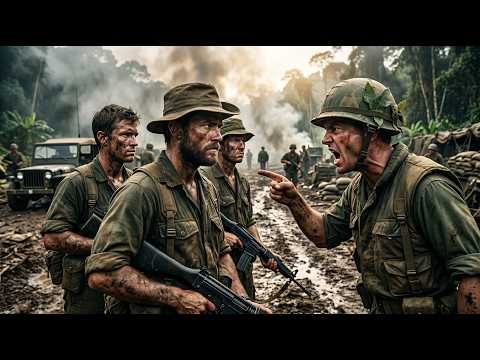
The Australian commander listened to every word. He nodded politely. He thanked the general for his time. And then he told him, in language that was perfectly professional and absolutely immovable, that Australian forces operated under Australian command, answered to the Australian government, and were deployed in Phuoc Tuy province for a specific purpose that redeployment to War Zone D would directly undermine. He could not help. He would not help. And there was nothing—not rank, not alliance politics, not the full institutional weight of the United States Army—that was going to change that answer.
The American general left the way he arrived, fast and loud. But this time, the noise felt different.
Here is what you need to understand before anything else. Australia in 1968 had fewer than 8,000 military personnel deployed across the entirety of Vietnam. The United States had over half a million. In raw numbers, in firepower, in helicopter assets, in artillery rounds fired per day, the Australians were a rounding error in a war that measured everything in statistics. And yet the single most feared allied fighting force in the country—feared by the enemy, studied by the Americans, quietly envied by every other allied contingent on the ground—was not a US Marine division. It was not an airborne brigade. It was a task force of Australians operating out of a red dirt base in Phuoc Tuy province, running operations so different from anything the Americans were doing that Pentagon analysts would spend a decade trying to understand the gap.
A declassified assessment written in 1971 by a senior MACV intelligence officer who had observed Australian operations firsthand contained a conclusion so blunt it was almost uncomfortable. He wrote that the Australians had not simply developed a different way of fighting the Vietnam War. They had, in his precise language, rediscovered a way of fighting that modern American military culture had systematically forgotten. He never elaborated on what he meant. He didn’t have to.
You are about to find out why a nation that contributed one-sixtieth the American troop strength consistently outperformed American forces in every measurable counterinsurgency metric in their operational area. Why Viet Cong commanders issued specific standing orders telling their units to avoid Australian-controlled territory whenever operationally possible. Why the North Vietnamese Army, who understood the American way of war well enough to plan around it, found the Australian way of war genuinely disturbing in a way they struggled to articulate in their own operational documents. And why the story of Australian commandos in Vietnam is ultimately not a story about tactics or training or even courage, though there is extraordinary courage in it. It is a story about what happens when a small country decides that its soldiers will fight smart or they will not fight at all. And what happens when that decision runs directly into the institutional ego of the most powerful military force on Earth.
Stay with me, because before you can understand what the Australians did in Phuoc Tuy province, you have to understand what the Australians remembered that the Americans had never had to learn. Somewhere in the institutional memory of every Australian soldier who served in Vietnam was a date: February 15th, 1942. You could find it in the way Australian officers talked about command independence, about operational flexibility, about the absolute refusal to subordinate tactical judgment to foreign authority, regardless of rank or alliance politics. You could find it in the selection criteria for Australian special operations, in the training doctrine, in the standing orders that governed how Australian forces operated in Southeast Asia.
That date was Singapore, and Singapore was not just a military defeat. It was a specific kind of catastrophe, the kind that permanently changes the culture of the institution that survives it. 130,000 Allied troops, among them 15,000 Australians, surrendered to a Japanese force that should not have been able to take the fortress at all. The defenses were designed for a naval assault. The Japanese came through the jungle. British commanders, trained in European doctrine and European terrain, had looked at the Malayan Peninsula and seen something their doctrine told them to see: an impenetrable natural barrier. The Japanese looked at the same jungle and saw a highway. 8,000 Australians died in Japanese captivity. The survivors came home with something that no military college could teach and no doctrine manual could replicate. They came home understanding, at a cellular level, that following another nation’s command structure without operational independence in Asian jungle terrain was not a strategic risk. It was a death sentence.
The men who designed Australian military doctrine for Vietnam were not theoreticians working from textbooks. They were, in many cases, the same men who had survived Malaya, who had then fought in the long, patient, grinding counterinsurgency of the Malayan Emergency, who had then deployed to Borneo during the Indonesian Confrontation, and refined everything they knew about jungle warfare in conditions that would have broken most conventional military formations. They had learned, through fifteen years of hard-won operational experience, that jungle counterinsurgency was not about finding the enemy and destroying him with firepower. It was about becoming so thoroughly embedded in the environment that the enemy could not operate without your knowledge, could not move without your awareness, could not plan without the certainty that somewhere, invisible and patient and absolutely lethal, an Australian patrol was watching.
That was the doctrine Australia brought to Vietnam, and it was a doctrine that could not function under American command, because American command would have dismantled everything that made it work.
When Australia committed combat troops to Vietnam in 1965, the political pressure from Washington was to integrate those troops into American formations under American command, following American operational procedures. The first attempt at this arrangement—one Australian battalion attached to the American 173rd Airborne Brigade at Bien Hoa—lasted nine months before the complaints started flowing back to Canberra. In language that senior officers rarely used in formal cables, Australian company commanders filed after-action reports describing operational approaches so fundamentally at odds with their training that the word counterproductive appeared with remarkable frequency.
American units would insert by helicopter in company and battalion strength, the noise of the rotors announcing their presence across a radius of ten kilometers. They would conduct sweep operations through areas where the Viet Cong had been present twenty minutes ago and would return twenty minutes after the Americans left. They would expend enormous quantities of ammunition and aviation fuel and record the results in body count statistics that measured activity without measuring progress. Australian platoon commanders watched this and experienced something that one of them described in a private letter as the specific horror of watching professionals do everything exactly wrong.
The discomfort was mutual. American officers found the Australian approach tentative, almost passive. They did not understand that what looked like passivity from outside was from inside the most aggressive form of warfare the jungle environment permitted.
The Australian government made its decision in early 1966. Rather than continue attaching battalions to American formations, Australia would deploy an independent task force to its own tactical area of responsibility. The task force would have two infantry battalions, later three, with supporting arms, its own artillery, its own armor, its own aviation, and critically its own Special Air Service squadron. It would operate in Phuoc Tuy province, east of Saigon, accessible by sea for independent resupply. And it would operate under Australian command, answer to Australian authority, and fight using Australian methods. The command relationship with MACV would be coordinative rather than directive. The Americans could tell the Australians what was happening in adjacent operational areas. They could not tell the Australians what to do.
The distinction, which American commanders initially treated as a bureaucratic technicality, would prove to be the single most consequential structural decision of the entire Australian commitment.
The selection of Phuoc Tuy province itself was a statement of intent. The Americans had suggested areas near the Cambodian border where heavy enemy activity would require close integration with US forces and constant reliance on American fire support assets. The Australians declined, politely but without negotiation. They wanted a province they could control independently. Phuoc Tuy was densely contested—the D445 provincial mobile battalion and multiple local force units had effective control of most of the rural area beyond a five-kilometer radius of the provincial capital—but it was the right size, the right geography, and the right distance from American operational centers to allow the Australians to work without interference. They were not looking for an easy assignment. They were looking for an assignment they could own.
The first thing the Australians built at their main base at Nui Dat told you everything about how they intended to fight. American bases in Vietnam were cities—tens of thousands of troops, permanent structures, restaurants, clubs, helicopter landing zones the size of airfields, and a perimeter defended by the logic of overwhelming force. If enough Americans were present, no enemy commander would be foolish enough to assault. Nui Dat was not a city. It was a fortress. The Australians cleared a four-kilometer radius around the base, forcibly resettled all Vietnamese civilians within that perimeter, established interlocking fields of fire, sowed minefields, ran constant patrols through every approach route, and designed the entire defensive architecture around a single assumption that no American base designer would have built in: the assumption that the base might actually be attacked and needed to be held by the troops physically present, without calling for reinforcement.
This design philosophy did not come from doctrine manuals. It came from Malaya. It came from fifteen years of operating in environments where the cavalry was not coming, where self-sufficiency was not a virtue but a survival requirement, and where a base that could not defend itself was simply a killing ground with better signage.
But the base was almost secondary to what the Australians were doing in the jungle around it. And to understand what they were doing, you have to understand the unit at the center of it.
The 3rd Squadron, Special Air Service Regiment, deployed to Phuoc Tuy in 1966, was not special operations in the American sense. Five-man patrols inserted by helicopter, then walked ten to fifteen kilometers to defeat enemy monitoring of landing zones. Radio silence for days. Three weeks in the field without resupply, moving sometimes two hundred meters an hour through dense jungle, choosing silence over speed at every decision point.
The difference between a three-day American reconnaissance patrol and a twenty-one-day Australian SAS operation was not duration. It was epistemology.
And here the story takes a turn that rarely makes the official histories. When the SAS selection process was refined through the 1950s, its architects went looking for instructors outside the military entirely—in the Aboriginal communities of the Western Australian desert and the Northern Territory. Men whose families had navigated the harshest terrain on Earth for forty thousand years. An Aboriginal tracker could determine the age of a footprint by measuring moisture differential in disturbed soil, identify individuals by the pattern of their gait, predict movement by reading which way vegetation was settling.
Viet Cong units began reporting something strange in late 1966. Patrols that should have been undetectable were being ambushed in positions that made no tactical sense. Supply caches hidden with sophistication were being found. The D445 Battalion command began to understand they were being watched in ways they could not see and could not counter. It produced paranoia. And paranoia in a guerrilla command structure was operationally catastrophic.
The battle that announced what the Australians were capable of happened on August 18th, 1966. Delta Company, 6th Battalion, Royal Australian Regiment—108 men—walked into a prepared ambush in a rubber plantation at Long Tan, held by elements of the 275th Main Force Regiment and the D445 Battalion. Conservative estimates put the enemy at between 1,500 and 2,000 men. The Australians were outnumbered somewhere between fourteen and eighteen to one. Caught in open terrain during a monsoon so heavy visibility dropped to meters. Kilometers from base. No immediate reinforcement.
By every conventional calculation, Delta Company should have ceased to exist within thirty minutes. What followed over four hours has been studied in military colleges across four continents. They did not collapse. They did not break contact and run, which would have been the operationally defensible choice. They held. They called artillery so close to their own positions that it wounded Australian soldiers—and called it anyway, because it was the only thing standing between them and annihilation. When armored personnel carriers finally arrived, they found Delta Company not retreating but attacking, pushing into the Viet Cong positions rather than waiting for extraction.
Eighteen Australians died at Long Tan. The Viet Cong lost a battle their commanders had every mathematical reason to believe they would win—and lost it so comprehensively that D445 Battalion would not conduct major offensive operations in Phuoc Tuy for three months.
The Americans who read the after-action report had a complicated reaction. Genuine respect, certainly. But also a question headquarters could not entirely suppress: how had a company-sized force, without American fire support, without American helicopters, without the vast machinery of American combat multipliers, not only survived but won? The answer Australian officers gave—that their men were trained to function independently, to make decisions at the lowest possible level, to fight without the expectation of rescue because their doctrine had never promised rescue in the first place—did not translate easily into American military culture. The difference sounds philosophical until you are in a rubber plantation in a monsoon with two thousand men shooting at you. At that point, it becomes very concrete.
General William Westmoreland visited the Australian task force in early 1967. He toured the base, observed the operational pattern, reviewed the statistics, and made a comment that became one of the most quoted moments in Australian-American military relations in Vietnam. He described the Australian approach as “very inactive.” He said this publicly, in front of Australian officers, at a time when Australian forces had conducted continuous operations throughout Phuoc Tuy for eight months, achieved a kill ratio exceeding ten to one, sustained the lowest casualty rate of any comparable allied force in the country, and degraded enemy main force capability to the point where Viet Cong units were beginning to avoid contact rather than seek it.
Westmoreland looked at all of this and saw troops who weren’t killing enough people. The Australian Task Force Commander, Brigadier Stuart Graham, responded through official channels in language that was scrupulously formal and barely concealed fury. His force was not in Vietnam to generate statistics for American consumption. His force was in Vietnam to make Phuoc Tuy province ungovernable for the Viet Cong and livable for the Vietnamese population. By every measure relevant to that mission, Australian operations were succeeding. By the only measure Westmoreland appeared to apply—bodies produced per day—they would never satisfy American expectations, because Australian doctrine considered body count an almost entirely meaningless metric that incentivized exactly the wrong operational behavior.
This argument captured something essential. The Australians valued the alliance deeply and had no interest in unnecessary conflict with Washington. But they had decided, at the highest levels, that the value they could add was not additional trigger-pullers blending into the American order of battle. Their value was demonstrating an alternative. That demonstration required operational independence. And operational independence required the willingness to say no.
When the Tet Offensive shattered the military situation across the country in January 1968 and American forces were stretched desperately thin, Australian forces did deploy outside their province. They fought at Coral and Balmoral in May, engaging regular North Vietnamese Army formations in sustained combat. It was savage and close—North Vietnamese regulars who did not melt into the jungle but stood and traded casualties at ranges measured in meters. Australian artillery fired over eleven thousand rounds. The North Vietnamese lost, conservatively, five hundred men killed. Australian losses were in the dozens. But when the American requests came to keep the force deployed in that operational area, the Australians declined and returned to Phuoc Tuy. Their province. Their mission. Their way.
The SAS operations that ran throughout this period represent the peak of what Australian capability in Vietnam actually looked like. When a patrol found a Viet Cong trail network, they did not immediately call in fire support and destroy it. They watched it. For days, sometimes weeks. By the time they finished watching, they did not know where one supply column was. They knew the entire logistical architecture of the enemy’s Phuoc Tuy operations. And they knew where to position an ambush that would not just kill the soldiers in one column but collapse the confidence of every Viet Cong commander who depended on that route—because the ambush would happen in a location that should have been perfectly safe, at a time when no conventional patrol should have been present.
The psychological dimension was something American observers found almost impossible to categorize. Enemy positions were entered silently overnight, equipment subtly rearranged—not taken, not destroyed, simply moved in ways that could not be explained by random chance. Bodies were positioned in ways that carried specific significance in Vietnamese cultural tradition. Playing cards, the ace of spades, understood across Vietnamese culture as a death omen, were left at ambush sites not as a greeting but as a message. The goal was not to make the enemy afraid of Australian firepower. The goal was to make the enemy afraid of the possibility that they were being watched at every moment, that their security was an illusion, that the jungle they thought they controlled was not theirs at all.
The captured documents from 1969 and 1970 show this campaign working beyond what Australian planners had hoped. The D445 Battalion issued standing instructions telling unit commanders to avoid engagement with Australian patrols when possible, to treat Australian-controlled areas as persistently hazardous rather than temporarily occupied, and to assume that any position within twenty kilometers of Nui Dat was under potential observation at any time. They called the SAS patrols jungle ghosts. The term appears repeatedly across multiple captured documents from different units, different time periods, different levels of the Viet Cong command structure. It was not a compliment. It was the specific operational language of men who were afraid of something they could not see and could not counter.
By 1969, the statistical results in Phuoc Tuy had become the kind of numbers that looked impossible in the context of the broader war. Enemy-initiated incidents had dropped by over seventy percent compared to baseline levels when the Australians arrived. Viet Cong main force units had been effectively expelled from most populated areas. Route 15, the main highway connecting Vung Tau to Saigon, which had been ambushed regularly for years, was carrying traffic with a security profile that would have been unimaginable in 1966. Villages firmly under Viet Cong political control were contested, then government-influenced, then in some cases genuinely pacified—in the sense that the civilian population was making economic and political decisions without the constant physical coercion of armed communist cadres.
None of this appeared in American body count statistics. None of it generated the daily metrics American headquarters found meaningful. It generated something more durable, something American doctrine in Vietnam almost entirely failed to produce: a genuine measurable change in who controlled the physical and political environment.
Operation Marsden in 1969 stands as the single best illustration. Acting on intelligence gathered over months of SAS reconnaissance—patient, systematic, invisible observation of enemy movement patterns in the May Tao mountains—Australian forces located a Viet Cong supply complex and command infrastructure of a scale that exceeded any single intelligence find in the entire history of the Australian commitment. Rather than immediately assaulting, they sealed the approaches. They established observation posts. They waited. Over six weeks, they intercepted enemy forces approaching the complex, gathered additional intelligence from prisoners, tightened their cordon progressively without triggering a general alarm, and finally assaulted with a precision that left the complex’s defenders with no effective option.
Inside they found weapons sufficient to re-equip two full Viet Cong battalions, medical supplies for a major field hospital, and intelligence documents—operational orders, communications logs, personnel records, unit assessments—that illuminated the command structure of Viet Cong operations across the entire region in ways that took analysts months to fully process. The D445 Battalion, the unit that had contested Australian authority since the first days of the task force, was effectively shattered as an operational formation. It would not recover its pre-Marsden capability before Australian forces began withdrawing.
The operation succeeded not because the Australians outgunned the enemy. They succeeded because they outthought them, outwaited them, and outknew them in territory they had spent three years learning with a patience no time-pressured American operation could have replicated.
Lieutenant General Julian Ewell visited Phuoc Tuy in late 1969 and declared it a disappointment. His specific criticism was that Australian body count statistics did not meet his expectations. He said this having just reviewed figures showing a seventy-plus percent reduction in enemy-initiated violence, improved population security across the province, and a Viet Cong main force capability reduced to a fraction of its 1966 strength. He measured success by a single metric, and by that metric the Australians were underperforming.
Australian officers responded privately in terms not transmitted through official channels. One lieutenant colonel wrote to a colleague in Canberra that the fundamental problem with American generalship in Vietnam was the confusion of process with outcome. The Americans measured what they did. The Australians measured what they achieved. That the Americans could look at a genuine shift in the balance of control between government and insurgency and call it a failure because it did not produce enough bodies revealed, in this officer’s assessment, everything that was wrong with American strategy in Vietnam. He was not wrong.
The cost must be spoken honestly, because to omit it would be to do exactly what propaganda does: take a complex and painful human experience and reduce it to the parts that serve the narrative. The Australian soldiers who served in Phuoc Tuy paid a price that the statistics of their success obscure. There was no rear area in the Australian sense. If you deployed to Nui Dat, you were a combat soldier or you were supporting combat soldiers. The comfortable, air-conditioned rear echelon existence that absorbed large numbers of American personnel simply did not exist at Australian scale. You were in the field, in the jungle, operating at continuous tempo in an environment of sustained lethal threat.
The psychological weight of this—the constant vigilance, the extended isolation of SAS patrols, the knowledge that no cavalry was coming and that the patrol’s own capabilities were the only resource between the mission and catastrophe—produced trauma that took years, and in some cases decades, to surface. Australian Vietnam veterans would eventually be found to have higher rates of post-traumatic stress disorder than American veterans, despite serving in smaller numbers and sustaining fewer combat casualties. The continuous operational tempo, the absence of genuine safe spaces, the small-unit dynamics that placed enormous psychological burden on individual soldiers—all of it extracted costs that came due long after the last Australian soldier left Vietnamese soil. The men who fought as jungle ghosts in Phuoc Tuy did not escape haunting. They just got haunted differently.
When Australian forces began their phased withdrawal in 1970, consistent with the Nixon doctrine of handing the war progressively to the South Vietnamese, they left behind a province measurably more secure than the one they had arrived in four years earlier. Enemy activity remained suppressed. Government infrastructure remained functional. The security gains were real, documented, and durable for as long as Australian presence sustained them. After final Australian withdrawal in 1972, the strategic picture in Phuoc Tuy deteriorated along with the rest of South Vietnam—because the gains the Australians had made were the product of their specific presence and their specific methods, not of a self-sustaining political settlement that could survive without them.
This is the honest limitation of what the Australians achieved. They proved that their methods worked better than American methods in counterinsurgency. They did not solve the political question that underlay the entire conflict. No military force did.
But the lesson endured. In the decades that followed, American military doctrine would slowly, painfully, and often reluctantly rediscover what the Australians had demonstrated in a red dirt province east of Saigon: that in counterinsurgency, patience beats firepower, understanding beats statistics, and a small force that knows its terrain and trusts its judgment can achieve what a vast army cannot. The Pentagon analysts who spent a decade trying to understand the gap eventually concluded what the 1971 assessment had said all along. The Australians had not invented something new. They had remembered something the Americans had never had to learn.
And the question that assessment left unanswered—the one it never had to elaborate—is the one that still hangs over every coalition war since: when the most powerful military on Earth asks a smaller ally to fight its way, and the smaller ally refuses because it knows a better way, who is really the stronger force?
Report this article
Select a reason for reporting:






