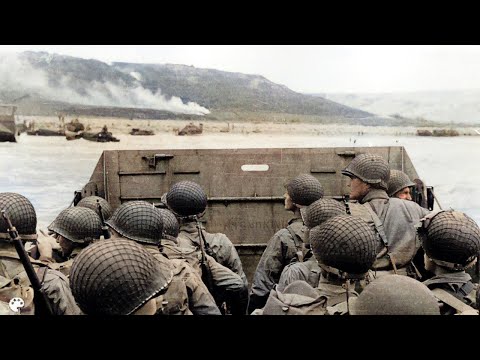
June 6, 1944. Juno Beach, Normandy. The cold ocean spray lashed the faces of 14,000 Canadian soldiers as their landing craft pitched through ten-foot waves. It was 7:45 AM. Through the thick fog and smoke, they could see the gray concrete fortifications of Hitler’s Atlantic Wall. German machine guns were already firing. Tracer rounds lit the morning sky like deadly fireflies. The Canadians were about to hit the most heavily fortified beach of the entire D-Day invasion.
Major-General Rod Keller stood on the command ship, watching his men approach the kill zone. He knew the numbers. Twenty-one thousand German guns waited behind those concrete walls. The beach was covered in mines. Barbed wire stretched in dense tangles. Guns pointed directly at the waterline. Every expert said it would be a massacre, and Keller knew they might be right.
Two years earlier, the Canadians had attempted a raid on the French coast at Dieppe. That operation followed all the rules. It used standard amphibious assault doctrine taught by armies. The commanders were cautious. They were methodical. They followed the textbook, and 68% of the Canadian soldiers were killed or wounded. Over half the force was killed, wounded, or captured in just nine hours. The memory of Dieppe loomed over every Canadian approaching Juno Beach like a black cloud.
The conventional wisdom was clear. When attacking a fortified beach, you move slowly. You wait three minutes between waves of troops. You let each group establish a position before sending the next. You must be careful. You must be vigilant. You must minimize risk. That’s what the manual said. That’s what the experts taught. And at Dieppe, following those rules had led to disaster.
But the problem was bigger than that. Now, the German defenses at Juno were far stronger than they had been at Dieppe. Intelligence reports showed concrete fortifications eight feet thick. The Germans had 88mm guns that could pierce tank armor. They had mortars, machine guns, and rifle positions covering every inch of sand. They had spent four years building these defenses. They called it the Atlantic Wall, and they believed it was impregnable.
American and British commanders looked at the Canadians with suspicion. Many described them as colonial troops. They said the Canadians lacked real combat experience. Some American officers whispered that the Canadians should have been given an easier sector. But by the end of this day, those same American generals would say something entirely different when they watched the Canadians fight.
British commanders were polite but skeptical. They had seen what happened at Dieppe. They wondered if the Canadians were ready for this. Rod Keller was not the personality anyone expected for a brigadier. He was 42 years old and had spent most of his career in unglamorous postings. He didn’t come from a famous military family. He hadn’t graduated at the top of his class. Other generals boasted of their medals and spoke in grand strategic terms. Keller was blunt. He was practical. And he had learned something from Dieppe that the textbooks hadn’t taught.
Keller realized that the problem at Dieppe wasn’t that the Canadians were too aggressive. The problem was that they weren’t aggressive enough. They had followed the slow, methodical approach. They had stopped. They had tried to consolidate, and while they paused, the Germans tore them apart. The kill zone on the beach is no place for caution. It’s a place that must be crossed as fast as possible.
Keller spent months studying the Dieppe disaster. He talked to survivors. He studied the timings meticulously. He realized something that defied everything the military establishment believed. The most dangerous place in a beach assault is not the waterline. It’s the area between the waterline and the enemy fortifications. That area is where the Germans have perfect firing angles. That area is where soldiers are most vulnerable. And the longer you stay in that area, the more men you lose.
His conclusion was radical. Instead of three-minute intervals between waves, he wanted 30-second intervals. Instead of letting troops gather and consolidate, he wanted them to keep moving forward. Instead of caution, he wanted speed. Instead of following military doctrine, he wanted momentum.
When Keller presented his plan to the Allied command, the response was immediate resistance. American advisers said it violated basic amphibious assault principles. British observers said it would cause chaos. Troops would bunch up, they warned. Formations would collapse. It would be a disaster worse than Dieppe. But Keller had one crucial supporter: Admiral Percy Nelles, head of the Royal Canadian Navy, believed in the plan. Nelles had studied Dieppe too. He had seen the failure of the conventional approach. He used his influence to allow Keller to train his troops in this new aggressive style.
For six months, the 3rd Canadian Infantry Division trained. They practiced moving fast. They practiced ignoring the instinct to seek cover. They practiced pushing forward even when it felt wrong. The soldiers knew this approach was different. Some were afraid. Others thought it was madness. But they trusted Keller, and they remembered Dieppe.
Now, as the landing craft approached Juno Beach, Keller watched the first wave touch the sand. It was 7:55 AM. The German guns opened fire with everything they had. The noise was deafening. Explosions erupted in towers of sand and water. Machine gun fire formed a solid wall of lead. Men fell, but the Canadians didn’t stop. They didn’t hesitate. They surged forward through the smoke and fire. After 30 seconds, the next wave hit the beach. Then another, then another. Keller stood on the command ship watching his theory become reality. Everything depended on the next few minutes. Either his vision was right, or he had just sent 14,000 men into a slaughter worse than Dieppe.
The technical details of Keller’s plan clashed with everything the military manuals taught. Standard doctrine required three-minute gaps between landing waves. This gave troops time to secure defensive positions and commanders time to assess the situation. Keller’s modified assault formations cut this to 30 seconds. The boats would arrive almost on top of each other. The beach would be flooded with men in a continuous stream rather than carefully separated groups. On paper, it looked like madness.
And on the ground, it meant the Germans couldn’t concentrate their fire on isolated groups. The Canadians had another advantage that morning. They had brought 80 specialized tanks known as “Hobart’s Funnies.” These weren’t ordinary tanks. Some had giant rotating drums on the front to detonate mines. Others carried massive bundles of wood to drop into trenches and make bridges. Some had flamethrowers. Others had huge mortars. The Canadians had more of these specialized vehicles than any other beach on D-Day. American commanders had rejected most of them for Omaha and Utah, calling them unnecessary. The Canadians took everything they could get.
The leading Canadian units, the Regina Rifles and the Royal Winnipeg Rifles, reached the sands of the small town of Courseulles at exactly 8:00 AM. The waves were the highest of any landing beach that day. Ten-foot swells tossed the landing craft like toys. Several boats capsized before reaching shore. Men weighed down with sixty pounds of equipment struggled in the cold water. But those who made it to the beach didn’t stop. They ran forward.
The specialized tanks launched from their boats and went to work immediately. Mine-clearing tanks advanced, their drums spinning and detonating buried mines. Behind them came regular tanks firing at the concrete strongpoints. Then came the flamethrower tanks, sending streams of fire at German positions. The infantry followed right behind, moving through the corridors the tanks had carved. It was organized chaos, but it was working.
At 8:15 AM, just 30 minutes after the first landing, forward scouts sent back an astonishing report. The Canadians had pushed two miles inland. This was unprecedented. On Omaha Beach, American forces were still pinned at the waterline. On Utah Beach, the Americans had barely crossed the seawall, while the Canadians were already racing toward the French countryside. The American military advisers watching from the command ships couldn’t believe what they were seeing. They sent urgent messages warning that the Canadians were moving too fast. They said formations would collapse. They said troops would become cut off from supply. They said this violated every principle of amphibious warfare. But no one paid attention to the messages. The Canadians kept pushing forward.
The key to success was continuous momentum. German machine gunners found it extremely difficult to aim effectively. By the time they zeroed in on one group of soldiers, another group had already passed them by. The 30-second spacing meant the beach was never empty, but it was never crowded either. It was like a river of troops flowing steadily inland. The Germans had prepared for isolated groups they could destroy one by one. They weren’t prepared for this unstoppable flood.
By 8:30 AM, exactly 45 minutes after the first landing, Canadian engineers had cleared six separate paths through the German defenses. They used Bangalore torpedoes to blast barbed wire. They threw explosive charges into bunkers. They marked safe routes with white tape. More troops poured through them. The specialized tanks had done their job. Seventy percent of the German fortifications in the immediate landing area had been destroyed or abandoned.
Admiral Percy Nelles watched from his ship with a grim smile. He had fought hard to get approval for this plan. British admirals had called it reckless. American generals had said it would fail. But Nelles had studied the same reports Keller had. He had reached the same conclusions. Speed meant survival. Hesitation meant death. And now, watching the Canadians surge inland, he knew he had been right to back Keller.
The Canadians were using only 50% of the landing craft allocated to the American sectors. They had fewer boats, fewer men in the first waves, and a shorter timetable, yet they achieved results faster than anyone had predicted. The resource constraints that should have slowed them down had instead forced them to be more efficient. Every boat mattered. Every minute counted. There was no room for waste or delay.
At 9:00 AM, the Regina Rifles reached the center of Courseulles. The town had strong German defenses. Concrete bunkers covered the streets. Snipers hid in buildings. Machine gun nests protected every intersection. The usual conventional approach was to surround the town and clear it slowly, building by building. But the Regina Rifles didn’t do that. They charged straight down the main street, with tank fire pounding the buildings and infantry running behind them. The Germans, stunned by the speed and aggression, began to surrender.
The sound was incredible. The roar of tank engines mixed with rifle fire. Explosions echoed and echoed off the stone buildings. German artillery shells screamed overhead. The smell of gunpowder and burning wood filled the air. Dust and smoke made visibility difficult beyond 50 feet. But the Canadians kept advancing. Officers shouted orders. Sergeants pushed men forward. No one stopped.
By 9:30 AM, 90 minutes after the first landing, something remarkable happened. The German 716th Infantry Division, which was defending this sector, began to collapse. Soldiers surrendered individually, then in groups, then in whole platoons. The relentless Canadian attack gave them no time to regroup or reorganize. Every time they tried to establish a new defensive line, the Canadian tanks and infantry were already upon them.
The first real measure of success came at 10:00 AM. Forward Canadian positions now reached five miles inland. They had broken through the Atlantic Wall completely. They had captured or destroyed over 200 German fortifications, and their casualties, though significant, were nearly half of what planners had predicted. The aggressive approach that was supposed to cause devastating losses was actually saving lives.
By 10:30 AM, engineers began building temporary bridges over the Seul River. This river ran behind Juno Beach and was supposed to be a major obstacle. The Germans expected it to slow any Allied advance for at least a full day. The Canadians reached it in less than three hours. Specialized bridge-laying tanks moved into position. Within 40 minutes, infantry and regular tanks began crossing.
By 11:00 AM, 21,400 Canadian soldiers had landed on Juno Beach. The sector that was supposed to be the hardest became the breakthrough point. The sector that worried American commanders was now advancing faster than any other Allied force. From their command posts, American and British generals began to realize that the Canadians might, just possibly, know something they didn’t.
The data that came in throughout the day told an amazing story. Pre-invasion planners expected Juno Beach to see casualty rates similar to Dieppe. They expected 60 to 70% losses in the first wave. The actual numbers were very different. By noon, Canadian casualties were about half of what was expected, around 30 to 35% instead of the anticipated 60 to 70%. Men were still dying. Men were still falling wounded. War is never clean or easy. But the aggressive momentum that military experts said would cause a massacre was actually saving lives.
The contrast with other beaches became clear as the day went on. At Omaha Beach, American forces were still struggling to get past the seawall by noon. They had advanced about five miles by the end of the day. At Utah Beach, the Americans pushed about six miles inland. At Gold and Sword beaches, British forces made good progress but remained relatively close to the coast. The Canadians at Juno Beach advanced nine miles inland by nightfall. They had pushed deeper into France than any other Allied force on D-Day.
By 1:00 PM, the full scope of the Canadian success began to dawn on everyone watching. General Omar Bradley stood on the deck of the USS Augusta, his command ship, with his binoculars fixed on the Canadian sector. Bradley was one of the most experienced American commanders. He had planned operations in North Africa and Sicily. He knew amphibious warfare, and he was watching something he had never seen before.
Bradley lowered his binoculars and turned to his staff officers. The scene he had just witnessed seemed impossible. The Canadian troops weren’t just holding their beachhead. They were racing inland. Their tanks were already disappearing into the French countryside. Their supply vehicles were moving freely on the beach. The Germans were retreating. Bradley shook his head slowly. He had been skeptical of the Canadian plan. He had believed their aggressive approach was naive. Now he wasn’t so sure.
One of Bradley’s colonels, a man named James Rudder, spoke quietly. The exact words were later recorded in military documents. Rudder said to his staff: “The Canadians are fighting like they have something to prove.” It was meant as an observation, not an insult. But it touched on something important. The Canadians did have something to prove. They had been dismissed as colonial troops. They had suffered greatly. They had carried the burden of being underestimated, and that burden had turned into fuel.
The sounds of battle changed by the afternoon. In the morning, the beach was filled with the roar of naval guns and the crackle of continuous machine gun fire. Now the heavy fire was moving inland. You could hear it in the distance, fading. On the beach itself, the sounds were different. Bulldozers clearing obstacles, engineers shouting instructions, landing craft engines bringing more supplies. The beach had transformed from a battlefield into a supply depot in less than six hours.
The smell had changed too. The sharp chemical smell of explosives was fading. Now the salt air of the ocean mixed with the smell of vehicle fuel and turned earth. Medics moved among the wounded. Chaplains said prayers over the dead. But the flow of troops and supplies never stopped. Wave after wave of reinforcements arrived on the beach, and each wave immediately headed inland.
At 2:00 PM, something unprecedented happened. A German officer approached the Canadian lines under a white flag. He was a major in the 716th Infantry Division. Through an interpreter, he said he wanted to discuss surrender terms. The Canadian commander who met him was surprised. Surrender negotiations usually took days. The major explained that his entire battalion, over 800 men, wished to surrender. They were utterly exhausted by the Canadian attack. They had never seen such ferocity. He said they had fought British and American forces before. But this was different. The Canadians attacked like men possessed.
The German major’s surrender was not an isolated incident. Throughout the afternoon, German units in the Juno sector began surrendering. By 3:00 PM, over 2,000 German soldiers had surrendered to Canadian forces. Entire defensive positions were abandoned. The 716th Infantry Division, which was supposed to hold the coast for days, collapsed within hours.
British forces on neighboring beaches noticed the Canadian success and tried to adjust their tactics. But changing plans in the middle of a battle was not easy. The British had trained for months using conventional methods. Their officers knew those methods well. Their soldiers expected to follow those methods. Trying to suddenly adopt the Canadian aggressive momentum caused confusion in some units. Things went better when British commanders simply ordered their troops to keep up with the Canadians advancing on their flanks.
German commanders were trying desperately to counter the Canadian breakthrough. They sent in their reserves. The 21st Panzer Division, equipped with powerful tanks, moved toward the Juno sector, but the German tanks faced a problem. The Canadians had already pushed so far inland that the Panzer tanks couldn’t take up good defensive positions. Instead of fighting from prepared positions, the Germans were forced to attack while moving. And moving attacks against entrenched infantry supported by tanks rarely succeed.
By 4:00 PM, 340 of the 574 fortified German positions in the Canadian sector had been neutralized. Some were destroyed by Canadian tanks or artillery. Others were overrun by infantry. Others were simply abandoned as German troops retreated. A nine-mile-wide gap had been torn in Hitler’s Atlantic Wall, which he had boasted was impregnable.
The sky began to clear in the late afternoon. The clouds and smoke that had covered the battlefield all morning began to dissipate. For the first time, you could see clearly across the landscape. Canadian soldiers looked back toward the beach and saw an incredible sight. The ocean was filled with ships as far as the eye could see. Hundreds of landing craft moved back and forth. The beach itself was covered with vehicles, supplies, and troops, and stretching inland were columns of Canadian soldiers and tanks pushing deeper into France.
One unexpected consequence of the Canadian success became clear around 5:00 PM. The rapid advance had created supply problems. Logistics officers had planned for a slower, more methodical push inland. They expected troops to remain near the beach at the end of D-Day. Instead, forward Canadian units were nine miles inland. Getting ammunition, food, and medical supplies to them required rapid adaptation. Trucks that were supposed to arrive the next day had to be put into service immediately. Supply lines that should have taken a week to establish were created in hours.
Another unexpected consequence involved French civilians. The rapid Canadian advance meant they reached French towns and villages much faster than planned. In places like Courseulles, Bernières-sur-Mer, and Saint-Aubin-sur-Mer, French people who had lived under German occupation for four years suddenly found themselves liberated on the first day. They poured into the streets. They brought out hidden French flags. They offered wine and food to the Canadian soldiers. These scenes of joy weren’t supposed to happen until days or weeks after D-Day. But Canadian speed changed the timeline.
By 6:00 PM, the sun was dropping in the sky. The long June day was finally ending. Canadian soldiers began digging their night trenches. They had been fighting for over 10 hours. They were exhausted. Many hadn’t eaten since before dawn, but they held their positions nine miles from the beach. They had achieved something military experts had called impossible. They had broken through the Atlantic Wall using methods that defied conventional doctrine. And in doing so, they forced the entire Allied command to reconsider everything they thought they knew about amphibious warfare.
The impact of what happened at Juno Beach did not end at sunset on June 6, 1944. In the days and weeks that followed, military commanders across the Allied forces began studying what the Canadians had done. Staff officers requested detailed reports. Training instructors requested tactical analyses. The aggressive momentum approach that had been dismissed as reckless before D-Day was now being studied as a potential doctrine.
Within two weeks of the landing, British units began incorporating elements of Canadian tactics into their own operations. When the Allies pushed toward the city of Caen, British commanders ordered their troops to maintain forward pressure. The order stated that they were not to stop to consolidate unless absolutely necessary. Keep the Germans off balance. The lessons of Juno Beach were spreading through the Allied armies like ripples in a pond.
American forces took longer to adapt, but they too began to change. By July 1944, American training manuals were being rewritten. Sections on amphibious assault were revised. Old guidance about 30-minute gaps between waves was questioned. A new emphasis was placed on momentum and speed. Officers who had criticized the Canadian approach were now studying it carefully. Some admitted they had been wrong. Others simply adopted the tactics without acknowledging their source.
By August, as Allied forces broke out of Normandy and raced across France, the Canadian aggressive style of war had become common throughout the armies. Units that kept moving, maintained pressure, and refused to let the enemy regroup consistently outperformed units that followed the old cautious methods. The transformation was dramatic. What had been considered reckless in June had become standard practice by September.
Official recognition of the Canadian tactics came in 1946. Military academies in both America and Britain updated their curriculums. Both Fort Benning in the United States and Sandhurst in England began teaching what instructors called the momentum doctrine. They didn’t always call it the Juno Beach method. Sometimes they used other names, but the core principles came directly from what the Canadians had proven on D-Day. Speed through the danger zone. Continuous pressure. Never give the enemy time to reorganize.
Brigadier Rod Keller, the man who developed and championed these tactics, did not live to see this recognition. On July 8, 1944, just over a month after D-Day, Keller was severely wounded during the battle for Caen. A German artillery shell exploded near his command post. Shrapnel tore through his leg and back. He was evacuated to England and spent months in the hospital. His combat command was over.
When Keller had recovered enough to travel, he returned to Canada. The war in Europe was still raging, but Keller’s fighting days were done. He was assigned to administrative positions. He attended ceremonies. He gave speeches, but he no longer led troops. The injury had ended his field career at the moment of his greatest triumph.
In the early post-war years, Keller received surprisingly little public recognition. Canada celebrated its D-Day veterans. There were parades and medals and memorials, of course, but Keller himself faded into the background. He wasn’t a gifted speaker. He didn’t write a memoir. He didn’t seek fame. Many Canadians knew the story of Juno Beach, but they didn’t know the name of the general who had planned the tactics that made success there possible.
It was American commanders who first began publicly crediting Keller and the Canadian approach. In 1948, Omar Bradley published his wartime memoirs. He devoted several pages to what he had witnessed at Juno Beach. Bradley admitted that he had been skeptical of Canadian methods before D-Day. He described how he had watched through his binoculars as the Canadians advanced faster and farther than anyone had predicted. He wrote that the experience had taught him that innovation sometimes comes from unexpected places. Sometimes the people everyone underestimates are the ones who change everything.
Other American officers followed Bradley’s lead. They gave lectures at military colleges describing the Canadian tactics. They wrote articles in professional journals. The historical record slowly began to give proper credit to what had happened at Juno Beach.
By the 1950s, military historians were describing the assault as one of the most successful amphibious attacks in history. The broader lesson went beyond just tactics. What happened at Juno Beach proved something important about innovation and human nature. Often the people most willing to try radical new approaches are those who have the most to prove. The Canadians had been dismissed as colonial troops. They had suffered the disaster at Dieppe. They had carried the burden of low expectations. That burden hadn’t crushed them. Instead, it had driven them to find a better way.
This pattern appears throughout history. Often the outsiders, the underdogs, and the underestimated become the innovators. They have less investment in the old ways of doing things. They have more to gain from trying something new. They are willing to take risks that established powers won’t take.
The Canadians at Juno Beach weren’t the first to prove this principle, and they won’t be the last. The lessons of Juno Beach remain relevant today. Modern military doctrine still emphasizes momentum in offensive operations. The idea of speed through the danger zone is now taught in every military academy in the world. But the applications go beyond warfare. In business, in science, in art, the same principle applies. Sometimes the fastest way out of a difficult situation is to move straight through it, not to avoid it. Sometimes maintaining forward momentum is safer than stopping to be careful.
The story also teaches us about the danger of underestimating people. The American and British commanders who dismissed the Canadians as inexperienced colonial troops were proven wrong within hours. Their assumptions about who could innovate and who couldn’t were shattered by the reality on the ground. Today, we still fall into the same trap. We assume innovation comes from prestigious institutions or well-known experts. We overlook the people on the margins, the ones with something to prove. Juno Beach reminds us to question those assumptions.
Rod Keller died in 1954 at the age of 52. His health had never fully recovered from the wounds he received at Caen. At his funeral, his coffin was carried by a small group of veterans from the 3rd Canadian Division. They were the men who had stormed Juno Beach 10 years earlier. They knew what Keller had done for them. They knew his tactics had saved their lives. They knew he had given them a chance when others had predicted failure.
In the decades since, historians have continued to study D-Day. They have written thousands of books and articles. They have analyzed every aspect of the invasion. And increasingly, they point to Juno Beach as the tactical masterpiece of the entire operation. Not because it was the bloodiest, not because it involved the most troops, but because it proved that courage combined with innovation could overcome obstacles that seemed impossible.
The final lesson of Juno Beach is perhaps the most important. National pride, when channeled correctly, can be a powerful force. The Canadian soldiers on that beach weren’t just fighting for victory. They were fighting to prove that their nation belonged among the great powers. They were fighting to show that underestimating them was a grave mistake. They were fighting for respect. And that desire for respect, that determination to prove themselves, gave them an advantage that no amount of equipment or training could provide.
Sometimes having something to prove is the greatest tactical advantage of all. The Germans at Juno Beach had better fortifications, more artillery, and years of preparation. But they faced an enemy that refused to stop. They faced soldiers who would rather die moving forward than live with the shame of failure. That spirit, that determination, that refusal to accept limits is what changed the course of history on June 6, 1944. And it is a lesson that remains worth remembering.
So what does Juno Beach teach us about facing our own impossible obstacles today? When the world tells you to be cautious, could the braver path actually be the one that saves you?
Report this article
Select a reason for reporting:






