The radio crackled with two words that seemed to carry a rebuke: “Where are they?” The Huey pilot had just set his skids on wet elephant grass on a hillside in the shadows of Nui May Tau, and he couldn’t see a soul. The rule he was breaking had been written seven weeks earlier by Major Stafford: no aircraft on the ground for more than 30 seconds, and the ground team must pop smoke before the approach. Stafford had his reasons—a transport had been shot to pieces in a rice paddy the month before, waiting for a team that never came. A stationary aircraft is a target with a fixed address. But the pilot had no choice. He was sitting in a landing zone above a valley with armed men closing in, and the only information he lacked was the one thing that mattered.
The answer was 11 meters from his left skid, and they had been there all along. Four men lay motionless in the vegetation, faces covered, rifle muzzles wrapped in sun-bleached burlap, their faces smeared with six days of sweat and dirt. They hadn’t moved when the Huey crossed the ridge. They hadn’t moved when the skids touched earth. They were waiting for the rotor wash to flatten the grass—because standing up before it settled meant becoming a visible disturbance in an exposed corridor under the eyes of a ridge 300 meters above.
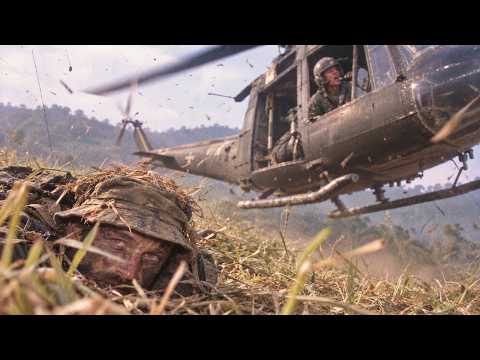
The first rule of Australian SAS extraction was simple: the ground force never leaves cover for the aircraft. The aircraft creates the cover with its downwash, then the ground force uses it. That’s what the pilot’s question really revealed, and it’s worth pondering before the next 90 seconds unfold.
There were two clocks running on that hill, and they weren’t the same clock. In the cockpit, the clock counted fuel and exposure—Stafford had set it at 4 minutes, and every second past 30 was a second the aircraft became a stationary, exposed target. In the grass, the clock counted observation, set by the men on the ridge, and it wouldn’t start until something on the hill moved in a way an observer could notice.
The pilot wanted the men on board immediately. The patrol wanted to board at the exact moment the grass bent—and those weren’t quite the same moment. The difference between them was the heart of the disagreement.
There was a second element to this dispute, sitting unused in a pouch on the patrol commander’s belt. Standing orders required smoke before landing, and the patrol had a smoke grenade—but they deliberately didn’t throw it. An orange smoke grenade on a west-facing grassy hill in late afternoon would pinpoint the landing zone for anyone with a line of sight. And those with the best line of sight weren’t inside the aircraft. They were higher up on the ridge, moving down the patrol’s route. Throwing smoke early would tell the tracking force exactly which 100 square meters of grass to aim at, before the Huey even passed the dead tree.
The patrol had done that calculation on the ground with information no one in Nui Dat had, and they decided the rule written to protect the aircraft would do the exact opposite that evening. Stafford didn’t know that yet.
What Stafford did know, sitting at the operations table with his grease pencil and his card and his fuel status board, was that one aircraft had been assigned to this mission, and it had been on the ground far longer than his instructions allowed, at a location where the nearest usable strip was 18 kilometers farther than he liked to think about. He had limited the mission to one aircraft for reasons he considered sound, and he would later have to defend it in writing—which meant no second aircraft circling the valley, no gunship on station to deal with the ridge.
Everything that would happen in the next 90 seconds on that grassy hill would happen to one aircraft, a crew of four, and four men in the grass who had been living on the last of their water since the morning of the fourth day.
Six nights before the pilot asked his question, those same four men had stood on a pierced steel plank at Nui Dat in the last hour of daylight, running the simple calculations that decide who goes home. Weight was the whole conversation. The patrol operating in the eastern border region carried everything needed for the entire mission because there were no resupplies that wouldn’t compromise their position. The difference between a man who can move silently at the end of six days and one who can’t is measured in kilograms on his back.
The patrol commander, a sergeant in his second tour, had two items on the mat in front of him and room for only one. The first was a spare battery for the patrol radio—standard insurance against a device that drains power in humidity faster than the tables suggest. The other was a collapsible water bladder. It held a little over four liters when full. The kind the squadron supply sergeant issues in small numbers and doesn’t like getting back.
He chose the water.
His decision wasn’t reckless, and it was recorded in his patrol report later in a single sentence preserved in the Australian War Memorial’s released patrol files without comment. The mission area contained no water source the patrol could use. The headwaters of the Song Rai were the obvious drinking spot—which meant they were the obvious spot for anyone else to drink, too. And a patrol that goes to fetch water in enemy territory is heading to the one piece of terrain under constant observation.
Six days without resupply in the dry season, on a hill that holds heat until nightfall, meant about nine liters per man. The weight of the second battery equaled one day’s consumption of that water. The sergeant estimated his radio would hold up, and that thirst would endanger his men before the electronics did.
There was a second decision made at that site, quieter and simpler, but more important than anyone might imagine. The valley system below Nui May Tau was known to be poor radio country. The ridges ran the wrong way, and the era’s radios operated line-of-sight and didn’t bend over terrain. As Terry O’Farrell described the problem in his account of the regiment’s patrols in that province, a patrol that can’t be heard is a patrol that can’t be rescued. The men on the ground considered communications failure the most likely reason for their disappearance.
So the patrol’s signals officer and the operations staff agreed on an additional frequency before departure—one that wasn’t in the task force net or the daily schedule, chosen to work via air relay instead of returning to base. The frequency was written on a card, memorized, and set on the backup comms dial. It was insurance against terrain, and it was expected never to be used.
The insertion itself was done the way the regiment did everything in that country: by deception. A group of helicopters executed a series of dummy landings along the valley, touching down in three separate clearings and lifting off again, with the patrol disembarking at only one while the aircraft maintained the same pattern at the other two. Anyone listening from the high ground heard a helicopter land and leave three times, and had no way of knowing which landing had left men behind.
The patrol stayed motionless for 40 minutes at the edge of their area, not moving, letting the noise of their arrival fade into the surroundings before taking their first step.
What they found in the next 48 hours didn’t match the briefing they’d received. The porter trail they’d been sent to observe wasn’t just a path. It was a road in every sense except its surface—over a meter wide in places, hard-packed, with vegetation trimmed above to allow loads to pass, and cutting marks old enough to have turned gray. The intelligence estimate had described the supply line as night-use only. The patrol watched the trail witness midday traffic. Groups ranging from eight to 30 people moved along it in broad daylight, unhurried, pushing bicycles and carrying goods slung on poles, and the patrol counted a side guard moving parallel to the route on both sides—the behavior of men who consider the land their own.
That turned the mission from reconnaissance into a trap of the patrol’s own making. The trail cut across their withdrawal line. Moving by day meant moving within earshot of it, and moving by night meant crossing a trail that was also used after dark.
The sergeant did the only thing available: he put the patrol in an observation position inside a bamboo and secondary growth thicket on the shoulder of the hill, about 120 meters above the trail. And there, the patrol stayed.
They stayed through the second day, the third, and the fourth. They watched, counted, and wrote, and they couldn’t move because every direction out of that thicket intersected a trail in use.
Waiting in a hide is a part of the work no film has ever captured. Four men in a space smaller than a tent floor, facing outward in a circular distribution, each with his own arc, no one standing, no one speaking above a whisper, with rations limited to what can be eaten cold and silently from its wrapper. Urinating into a container. Waste collected in bags and carried with them. The heat under the vegetation at midday exceeds 30 degrees Celsius, with no air movement at all inside the thicket.
David Horner’s history of the regiment’s service in Vietnam records patrols in that province that remained in one hide for days with the enemy routinely within 100 meters, and notes that the discipline required for this was the hardest thing the selection and training system had to produce. The men weren’t chosen for it in Perth because it looked dramatic. They were chosen because almost no one can do it.
The price was water. The ration calculations the sergeant made in his notebook assumed movement, and movement assumed a patrol walking a route and coming out roughly on schedule. Four days of static observation in that heat consumed water at a rate no plan had covered. By the morning of the fifth day, the four men were sharing what remained in two water bags, and had begun a simple discipline of moistening the mouth instead of drinking, holding each sip in the mouth until it warmed before swallowing.
The extra water bag the sergeant had favored over the battery had been emptied on the third day, folded flat inside the side of his pack because the regiment left nothing behind in that country. No wrapper, no bag, no boot print in soft ground if it could be avoided.
On the afternoon of the fifth day, the patrol was offered an exit. There was a scheduled extraction window prepared by task force operations staff with an aircraft available and a slot in the last daylight. The landing zone offered was the grassy saddle because it was the only landing zone ever offered. The sergeant looked at it from where he lay—something no planner in Nui Dat could do—and refused it.
His reasons for refusal entered the record in a form that caused immediate displeasure at base. At that hour of the afternoon, the saddle lay in full light while the ridge above it was already in shadow, meaning anyone standing on the high ground would look down at a bright, exposed, flat piece of grass with the sun behind him. And the aircraft would be a silhouette climbing through the valley with nothing to hide it. The geometry was entirely in the observer’s favor.
The sergeant requested an earlier slot the next day when the light would be flatter and the shadow on the other side, and he requested it knowing exactly what it cost. Another night and most of another day on the hill with water effectively gone and a tracking problem worsening with every hour his patrol stayed in one place.
Stafford read that refusal at the operations table and narrowed his eyes at it. His objection wasn’t to the tactical argument—which he wasn’t in a position to judge—but to what the refusal did to his air plan, which he was. A refused window doesn’t pass without cost. It consumes an airframe allocation. It pushes the mission into the next day’s tasking schedule. And it forces the support element to find the same assets twice for one patrol.
Air support available at Nui Dat in that period was limited in ways that are hard to convey now. The 135th supported a force deployed across the entire province, and one-aircraft taskings were the norm, not the exception. So he applied his doctrine honestly, and the result was painful. He set the mission for the next day with one aircraft and one attempt only. No second aircraft circling as backup. No light fire team positioned above the valley. His reasoning was internally consistent and documented in the air support annexes. A patrol that chooses to withdraw outside the planned time withdraws within the “risk margin,” and the task force cannot allocate a reserve for that margin. If the single aircraft can’t complete the transfer within the allowed time on the ground, the patrol returns to the brush and waits for the next flight.
The margin was the patrol’s choice. And the consequences of that margin, in his records, fell on the patrol too.
At midday the next day, while the new slot was still three hours away, the country made the decision for everyone. The patrol heard the command before they saw anything—that’s how it always comes. A dog somewhere above and to the left barked twice and went silent when someone hushed it. Then sounds on the ridge, distributed along a line, moving with the deliberate rhythm of men sweeping a path rather than walking it. They were in the same position the patrol had occupied four nights earlier, moving downhill, and they were close enough that the sergeant heard the double metallic clack of someone tapping a rifle butt to signal the man beside him.
The patrol’s signaller didn’t reach for the scheduled frequency. He went for the other one, the dial set at Nui Dat and never used, because the base net from the bottom of that valley was utterly dead, and there was no longer time to climb for a better connection.
The contact report went out on the unscheduled channel via the air relay in under 20 seconds. We are compromised, tracking force above, request immediate extraction, grassy corridor, daylight.
The request reached the duty officer. It also meant that from that moment, the only voice link between the four Australians and the aircraft coming to save them existed on a frequency not on anyone’s schedule. To a corridor no one could pinpoint, with one aircraft in daylight, with the shadow of the upper ridge already beginning to crawl.
The aircraft that answered the call was squatting on the pierced steel at Nui Dat with its crew under the rotor shadow, and it came east through the valley floor instead of over the peaks—a decision in itself. Altitude meant safety from small arms, and altitude also meant announcing your position. A Huey at 1,500 feet over the Nui May Tau hills can be heard working its way across the country for minutes before anyone can pinpoint it. And the men on the ridge above the patrol had that entire time to look at the grass and determine where an aircraft at 1,500 feet might be heading.
So the pilot flew the valley. Low enough to keep his skids skimming the treetops, while the sound bounced sideways into the hills instead of down. And he reached the mountain corridor without telling the region which corridor he meant. Then he overflew it once anyway.
He had the coordinates and the patrol’s description relayed over the air net, and neither told him what he needed—whether the dead tree on the upper edge stood above the grass or was submerged in it. And how much room existed between that dead tree and the lower treeline for a rotor disc a little over 14 meters across. So he passed over the corridor once along its axis, slowly and offset to the south, with his crew chief and door gunner hanging from their harnesses to look at the surface, and he looked at the tree with his own eyes for about 3 seconds—all the time available.
Three broken branches, the highest at about the level of a hovering aircraft’s head, and grass surrounding its base completely. That maneuver cost him 20 seconds he would need later. It also told him the only thing that made the landing possible. He couldn’t land over the upper edge at all. He had to come up the valley from below, hold his speed longer than any pilot likes near the ground, then execute a late, hard braking maneuver with the tail swinging toward the treeline to reach a hover with the tree in front of him and not under his rotor.
Pilots of the 135th Assault Helicopter Company, whose history records that it flew the eastern border missions for Phuoc Tuy for the Australian task force during that period, described this technique in their reports as putting the aircraft into a hole backward. The hole in this case was unpaved, undefined, and invisible.
What was supposed to happen next, according to every standing instruction in the field, was that the ground troops would pop a smoke grenade and the aircraft would comply with the color it saw. The patrol commander, lying 11 meters from where the aircraft would put its skids, had the smoke grenade in his hand throughout the first maneuver and didn’t pull the pin. He could hear the reason. The tracking force was still above him, working its way down for about an hour. And the one thing the sergeant couldn’t determine from his position on the grassy saddle was how close they were to the bottom of the hill. Smoke would settle that question for everyone immediately—and it would settle it for the men with the height advantage first.
Orange smoke on a western mountain corridor in bright midday light doesn’t dissipate discreetly. It stands out of the grass like a flag, visible 15 to 20 seconds before the aircraft arrives—the time a man with a rifle on a ridge 300 meters away needs to take a shooting position and aim at the one spot he now knows the helicopter will inevitably land.
So the patrol guided the aircraft using only the sound of its engine. This is the part no plan anticipated, and it worked only because of a note written on a card six nights earlier and placed on a backup comms dial. The valley walls had already cut them off from the task force net. The unscheduled frequency working through the air relay was the only channel a man lying in tall grass could use to speak directly to the cockpit, and for the next 90 seconds, that frequency carried the entire operation.
The signaller held the handset to his cheek, his face still covered. The sergeant gave directions, and he didn’t give them based on what he saw—because he saw only grass stems and a strip of sky—but on the position of the engine sound relative to his body. A patrol that had spent six days on the edge of a mountain learning the nature of sounds in the area it was holed up in. The sergeant knew which ridges reflected the echo and which absorbed it. As the aircraft came back up the valley, following the sound, and when the tone shifted from a flat pulse to a hard crack—the sound a Huey’s main rotor makes when it’s close and loaded—he gave the pilot a correction of about 50 meters left and told him he was passing the position. Then he ordered him to raise the nose when he heard his voice. It was a primitive navigation technique available to a professional air force in 1970, and it was the only way on that mountain corridor that didn’t require someone to reveal to the enemy where the shooting would come from.
In the cockpit, the aircraft commander accepted it. That was the decision the entire afternoon had been building toward, and it was made in about 4 seconds. He had an undefined landing zone ahead, a solid obstacle on the rising edge, a tail rotor he couldn’t see clearly, a fuel level already reduced by a reconnaissance pass he’d decided to make, and corrections coming from a voice on a frequency not on the task force schedule, belonging to men he’d never seen and couldn’t see now. He executed the corrections. He flew the aircraft through the valley keeping the skids low, then steadied it, and pulled the nose up hard and late while the tail dropped toward the treeline. The aircraft’s speed bled off into a shiver through the control stick, and the obstacle passed the right side of the windscreen at a distance the crew chief later described as close enough to count branches. Then the aircraft settled, and the grass rose around it, and he couldn’t see anything at all.
The elephant grass was taller than the cargo floor. The men inside the helicopter on that mountain corridor were looking out the open doors at a green wall. The tips of the skids dug into the vegetation and found soft, wet ground beneath, so the pilot kept the aircraft light on its skids with the engine running, because loading weight onto unknown ground is what makes an aircraft roll onto its side. Then the two words came over the intercom, and this is what they actually meant.
They were a question about fuel, because the remaining margin was 4 minutes, and he’d spent part of it looking at a tree. They were a question about the tail rotor, because the only exit from that corridor required either a vertical climb it didn’t have the power for at that weight, or a pedal turn—and turning with men in the grass behind him was unthinkable. And they were also a question about crew safety, because the door gunner was pointing his machine gun toward the descending treeline and couldn’t fire in any direction Australians might be.
Until the four men were located relative to the aircraft, the aircraft couldn’t maneuver, defend itself properly, or leave. It was a stationary, exposed target with a hot engine on a bare mountain corridor—the exact situation the standing instructions had been written to prevent.
The men weren’t being rude. They were behaving correctly. The rotor wash was doing something beneath the aircraft the pilot couldn’t see from his seat, and it was what the patrol had been waiting for since the aircraft started up the valley. Two-meter elephant grass doesn’t bend the instant the helicopter arrives. It bends, ripples, then lays flat in rings expanding outward from the disc, and it takes a measurable number of seconds. The man who stands before the grass settles is a man pushing through standing vegetation in the open, slowly, his head and shoulders drawing a visible line across the saddle for anyone above. The man who stands after the grass settles is a man running across a mown field for 11 meters, with the aircraft between him and the treeline, and the whole saddle in a storm of grass seed and red dust.
They waited through the bending. Then the first two men appeared out of the grass at the pilot’s eleven o’clock, close enough to the nose that he saw them emerge from under the cockpit’s chin bubble rather than the windscreen, which is why the question had seemed reasonable and the answer had seemed to come from nowhere. They didn’t come to the door upright. They came fast and low with their packs slipped off one shoulder, threw the packs on the floor ahead of them, and came in behind them. The third man came from slightly farther out carrying the radio and the signals bag with the headset and antenna secured while he slammed flat into the rotor wash. He had the mine bag and the rest of the demolition equipment from the edge of the assembly area, because the patrol had brought everything with them. The last man didn’t run. He backed up.
He came out of the grass facing downhill with his self-loading rifle on his shoulder and the camouflage cloth strips on the barrel flattening against his body in the wind. And he walked backward across 11 meters of flat saddle with his eyes on the treeline below, feeling with his foot for the skid behind him. This is the last man’s training, and it exists because the moment a patrol boards an aircraft is the only moment in six days when every member of it has his back to the country. One man carries that risk so the other three don’t have to. He found the skid, took one hand off his weapon, and stepped up onto it sideways while the crew chief’s hand held the back of his harness.
The entire sequence from skid contact to the crew chief’s count of four took nearly 90 seconds. The instructions allowed 30. The difference wasn’t hesitation, or Australian deliberation, and it wasn’t about anyone’s ethics. It was the calculation of two clocks that had been running on that saddle since the aircraft first appeared in the valley, and which of the two clocks the 90 seconds belonged to mattered more.
The cockpit clock measured exposure and fuel, and it had already exceeded the allowed time. The grass clock measured observation, and it hadn’t started yet because nothing on that saddle had moved in a way the clock could register until the grass bent. Then the grass bent in a circle 30 meters across, and stayed bent. The cover that had hidden four men all afternoon had been consumed to load them, and it wouldn’t stand back up for hours.
Anyone coming across that ridge now had a pale green, flat, exposed disc to look at, with a helicopter squatting in the middle of it, resting on its skids, its floor covered with wet matting and grass seed, and the reek of four men who hadn’t washed in six days and hadn’t drunk water in nearly two.
The aircraft was heavier by four men and four packs than it had been on approach. The dead tree was in front of the nose. The treeline it was sitting below was 30 meters down the slope, and there was no exit from that saddle except over it. The pilot pulled power before anyone had strapped in. There was no time for the crew chief’s count to mean anything beyond the number of bodies on the floor, and the aircraft rose out of its hole with the grass laying flat in a ring, and the dead tree swinging past on the right as the nose came around toward the slope.
A Huey at that weight and in that heat can’t climb vertically out of the saddle. It has to slide forward to make the air move over the disc, which meant the aircraft had to cross the treeline 30 meters below it at no more than 10 feet in a shallow, accelerating dive that exposed the entire underside of the machine to anyone standing on the ridge.
The first shots came the instant the skids cleared the trees.
The rounds tore through the tail boom and the cargo floor. One bullet punched up through the aluminum between the Australians, leaving a jagged silver hole with daylight streaming through. The door gunner opened up with the M60, long bursts into the treeline. The crew chief felt the control stick shudder—four pulses per revolution, the tail rotor damaged.
Hydraulic pressure dropped. The pilot nursed the Huey down the valley, slow and low, trading altitude for distance. The fuel gauge told the truth no one wanted: Nui Dat was out of reach. He turned toward a fire support base, called ahead on the artillery net, and landed on the red dirt with the fuel warning light glowing.
The patrol didn’t wait for the rotors to stop. They carried their wounded man out, and the gunners helped. Two liters of water—the last they had—washed his wound in the air. The leg was saved.
Stafford arrived the next morning with a measuring tape. He measured the bullet holes, reconstructed the geometry, and found the truth: the shots had come from the ridge above, not the treeline. The patrol’s silence had saved them.
The new standing orders were issued eleven days later. The last line read: “The ground force will not leave cover to reduce the aircraft’s exposure to risk.” The pilot’s after-action report had six lines. The remarks section was blank.
What would you have done—obeyed the rule and popped smoke, or trusted the men on the ground?
Report this article
Select a reason for reporting:






