You’ve been lied to about Vietnam. Not about the bombs or the helicopters or the maps redrawn each morning in air-conditioned rooms. You’ve been lied to because inside that loud war was a quieter one—a war the Pentagon couldn’t describe, couldn’t measure, couldn’t control. In that war, the jungle wasn’t just terrain. It was a witness, a sensor, a weapon. And the Australians didn’t just fight differently. They broke every rule that made the American system feel safe.
This is the story of how a small force of Australian SAS operators turned the jungle into a psychological weapon—and why their success became an embarrassment the Pentagon couldn’t stomach.
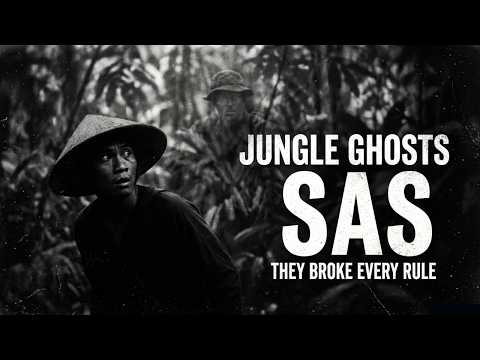
The Australians built their base at Nui Dat, deep in Phuoc Tuy Province, not as an attachment to American units but as an independent task force. They chose a patch of contested territory—rainforest, grassland, mountains, villages threaded with Viet Cong cadres—to fight their own way. And their way was built on doubt, not certainty. Assume the enemy is watching. Assume the ground is lying. Assume your own impatience will get you killed.
American doctrine sought to find, fix, and destroy with overwhelming firepower. The Australians brought a philosophy that threatened the entire machine. Because if the quiet method worked better in the jungle, what did that say about the loud one?
Picture the first time a US liaison walks with an SAS patrol. It’s not the cinematic stuff that hits him. It’s the silence—not radio silence, but a deeper quiet where men don’t clear their throats, don’t whisper jokes, don’t let metal touch metal. The kind of silence that feels like someone turned the world’s volume down and left only your heartbeat behind.
And then the real shock: the Australians don’t move like soldiers. They move like a decision the jungle made. They don’t advance so much as dissolve. When they stop, they don’t crouch. They disappear. They become dirt. They become shadow.
The liaison realizes something that makes him cold: in this environment, speed isn’t aggression. Speed is exposure. That’s the first rule they broke. Americans were trained to attack the situation—move fast, seize initiative, keep momentum. But in triple-canopy jungle, momentum becomes a loud confession. The Australians didn’t win by moving faster. They won by moving less.
They timed their steps with the wind. They placed their boots like a safecracker feels a dial. They treated a snapped twig like an alarm trip, a disturbed leaf like a flare. The liaison wants to ask questions, but the Australians won’t talk—because talking is a signature, and signature is death. He learns by watching, by suffering, and by realizing they aren’t being cautious. They’re being final.
That’s when the second rule breaks. They don’t take the shot when the shot is there. American doctrine says contact is a chance to win—see the enemy, seize the moment, neutralize the threat. Australian doctrine says contact is a price tag. Every trigger pull buys you attention. Every casualty buys you pursuit. Every fight buys you a larger fight.
Imagine lying in wet leaf litter while a small enemy element walks across your front. Easy targets, clean kills—a moment an American unit would happily take. The Australians don’t fire. They don’t even look excited. They’re not hunting the men. They’re hunting the pattern behind the men—the route, the schedule, the network. When the larger element arrives, carrying supplies and radios and leaders, that’s when they choose violence. Not because they’re bloodthirsty, but because they’re accountants. Maximum effect for minimum exposure.
This scalpel logic is cold, and it makes big institutions nervous because it can’t be mass-produced. You can train marksmanship. You can issue equipment. But you cannot easily manufacture predatory patience at scale.
And that was only the beginning. The Australians were about to break the rule that terrified the Pentagon most: they would weaponize stillness itself.
Stillness, in Australian SAS doctrine, was not the absence of action. Stillness was action. It was the act of choosing not to reveal yourself, of telling your body it was no longer in charge. The jungle tried to force motion—sweat dripping into eyes, mosquitoes biting the soft skin behind ears, ants crawling into sleeves, leeches searching for warmth. The urge to adjust gear became overwhelming because the human body is not designed to be silent for hours while staying alert.
American observers found this alien. Their training celebrated explosive action, speed, aggression, violence of action—the adrenaline burst. The Australians trained for the opposite: a long period of controlled suffering followed by a short period of violence so decisive it felt unfair. That’s why the Viet Cong called them ghosts. A ghost is not just a killer. A ghost is a presence that appears on its own terms and leaves you questioning reality.
Then came deception. The Australians didn’t only hide their presence—sometimes they performed the opposite. They broke the always-be-silent rule on purpose, just enough to be noticed. If you want to catch a tracker, you don’t hide perfectly. You show him something to follow. You give him confidence. You bait his pride. Then you decide where the fight happens.
They left traces just sloppy enough to trigger predatory instinct but not so obvious that they screamed trap—a broken branch, a wrapper, a footprint at the edge of a trail. Then they pulled the enemy into a place they already owned. The jungle stopped being neutral space. It became a kill box.
This is where the Pentagon’s discomfort spiked again. Now it wasn’t just stealth—it was manipulation. And manipulation in war is always morally hot. It’s also incredibly effective, because the enemy begins to question evidence. A footprint might be bait. A dropped object might be theater. A mistake might be a performance. Every tracker became slower. Every patrol became hesitant. Every commander became less confident. And in guerrilla war, confidence is logistics. Confidence is mobility. Confidence is survival.
Then there was the underground world. Vietnam wasn’t only fought in trees—it was fought in dirt. When Americans encountered tunnel systems, the instinct was to treat it as a close-quarters battle problem: men go down, clear, fight in the dark. That created heroism, casualties, and a psychological tax that destroyed units from the inside.
The Australian mindset treated tunnels as an engineering problem, an intelligence problem, a denial problem. Where does it breathe? Where does it exit? Where does it connect? Which parts matter? They didn’t accept the battlefield the enemy wanted. They redesigned it. They weren’t just hunters in the trees. They were forensic investigators of war.
And then came the final reason the Pentagon hated them—the one that stings deepest. The Australians weren’t only good at killing. They were good at not killing. They had restraint—not moral restraint, operational restraint. The ability to watch a target pass because the bigger target was behind him. The ability to see a patrol and not engage because it would compromise a larger mission. The ability to hold still for an hour because the cost of moving was too high.
To the American system, that looked like passivity. But in the jungle, it was dominance. Because dominance is not who shoots first. Dominance is who decides when the shooting happens. And once the Australians controlled when contact occurred, they controlled everything else.
The Americans brought an army. The Australians brought an idea. And the Pentagon hated it for the same reason the Viet Cong feared it. Because once you accept that the jungle can be yours, once you accept that patience can be aggression, once you accept that control matters more than contact, then you have to admit something terrifying: the rules you’ve been living by were never laws. They were habits. And habits get men killed.
The Pentagon didn’t hate the Australians because they were reckless. They hated them because they were disciplined in a way that made American discipline look performative. Because the Australians didn’t just avoid mistakes. They engineered situations where the enemy’s instincts became mistakes. And once you understand that, the whole ghost myth stops sounding like superstition and starts sounding like a system.
Imagine a Viet Cong unit that has done everything right by guerrilla standards. They’ve built tunnels. They’ve set trip wires and bamboo traps. They’ve mapped the trails. They’ve learned the American patterns—helicopters in, artillery softening, platoon moving loud, radios talking constantly, then extraction before the jungle closes again. They know that if they can just endure the noise, they can survive it, because the noise always leaves.
And then one night, the jungle does something it’s not supposed to do. It goes quiet. Not no-shooting quiet. Quiet like the insects keep singing because nothing feels wrong. Quiet like the birds don’t lift. Quiet like nobody is coming.
Except someone is already inside the perimeter.
That’s the first escalation that breaks the enemy’s mind. Because guerrillas rely on early warning. They rely on time. They rely on hearing you before they see you. The Australians stole that time away. They showed up with no announcement. And when you steal warning time from a guerrilla, you steal his greatest advantage.
Now picture the aftermath of a hit that isn’t meant to be a firefight. It’s meant to be a message. The bodies aren’t just casualties. They’re a broadcast. And the broadcast says one thing: your forest doesn’t belong to you anymore.
That message spreads faster than bullets. It spreads because it doesn’t need a survivor to deliver it. It doesn’t need radio traffic. It doesn’t need paperwork. It just needs one patrol to walk into a scene that doesn’t make sense. One man to look at his friend and feel deep in his gut that the jungle has become hostile in a way he can’t negotiate with.
And that is where the Pentagon’s discomfort becomes visible. Because this kind of warfare is effective precisely because it’s intimate. It’s close. It’s human. It reaches inside morale and squeezes. A superpower can admit it bombed a hill. It can admit it lost men in a firefight. Those are war facts. But it struggles to admit out loud that an ally won by frightening the enemy into paralysis—because that sounds too close to the thing we accuse insurgents of doing.
So the Pentagon frames it as unconventional effectiveness. It studies it. It borrows what it can. And it keeps its distance from the parts that feel morally radioactive. But the Australians didn’t keep their distance. They leaned into the psychology because they understood a truth that big war doctrine hates: the enemy isn’t only a target. The enemy is an audience. Every engagement is theater, whether you want it to be or not. The question is whether you control the theater or the theater controls you.
The Australians controlled it. They didn’t just kill men. They killed assumptions.
And then they did something even more dangerous. They proved you could dominate an area without clearing it. That’s a concept that sounds simple until you realize how much bureaucracy it destroys. Because clear is a word the Pentagon loves. Clear means measurable. Clear means lines on a map. Clear means you can brief it upstairs and justify resources. Clear means you can show progress.
But the Australians weren’t clearing. They were denying. They were making terrain psychologically expensive. They were making movement costly. They were making routine unsafe. They were turning the jungle into a place where the enemy could still exist but could no longer function.
And if you’re a commander trained to win by mass and momentum, that’s terrifying—because it implies you don’t need a battalion to control a valley. You need a handful of men who can sit in the dirt long enough to learn its secrets.
The Australians weren’t superhuman. They were systematic. They broke the rule that says stealth is passive. Their stealth was predatory—avoid contact not because we fear it, but because contact is currency, and currency is spent only for strategic return.
They would watch a trail for hours and do nothing. Then watch it another day, through rain, heat, insects, cramps, thirst—through the slow creeping doubt whispering inside every human brain: this is pointless. We should move. We should do something.
Then the Americans started asking for the method. Liaison officers requested joint patrols to learn how the Australians moved, waited, controlled the jungle without announcing themselves. And the Pentagon had to decide whether to endorse a weapon that didn’t look like one.
They couldn’t. So they filed it away, borrowed the tactics, stripped the psychology—and taught the world everything except the part that mattered.
So here’s the question that should keep you up at night: if silence was the most dangerous weapon in Vietnam, what noise are we making today?
Report this article
Select a reason for reporting:






