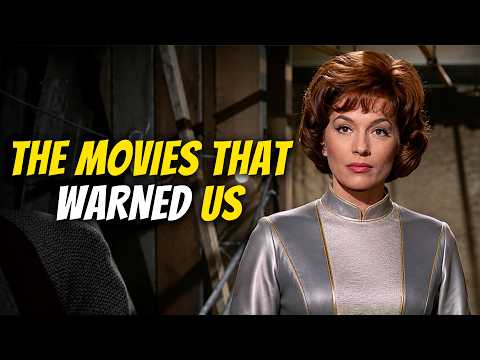
What if the most accurate predictions about 2026 weren’t made by futurists or tech billionaires, but by a bunch of low-budget filmmakers in the 1960s? That sounds absurd—until you realize they warned us about algorithmic control, climate panic, surveillance capitalism, and war as entertainment. These weren’t just cheap rockets and plastic robots. They were prophecies disguised as B-movies. And by the time you reach the end of this list, you may wonder: did they see the future, or did we simply ignore the warnings?
Take The Last Man on Earth (1964). Before zombies shuffled into pop culture, this eerie film imagined a world emptied by plague. But its real horror wasn’t the infected—it was the isolation, the boarded-up windows, the slow erosion of trust. “The real apocalypse begins when trust disappears,” the film seemed to whisper. After years of global health anxiety, that warning feels brutally familiar.
Then there’s The Satan Bug (1965), a thriller that understood something terrifying: the deadliest weapon might not explode. It might be microscopic, invisible, and created by human hands. In an age of lab leaks and engineered pathogens, its tension cuts deeper than ever. “Humanity’s scariest invention might be something too small to notice.”
And Je t’aime, Je t’aime (1968)—a time-travel film without adventure. Instead, it traps a man inside his own memories, forced to relive love and guilt. In 2026, with digital archives and AI recreations of the past, the idea feels haunting: technology can reopen wounds faster than it can heal them.
These forgotten films didn’t just predict gadgets. They predicted the emotional cost of progress—loneliness dressed as wonder, control disguised as convenience. Cyborg 2087 (1966) feared the machine inside the mind. The Creation of the Humanoids (1962) asked when a tool becomes a person. The Face of Another (1966) warned that identity would become unstable, editable, performable.
Each one saw a fragment of our present. And they did it with cheap sets, black-and-white film, and a sense of dread that still lingers. The question isn’t whether they were right. The question is: why didn’t we listen?
As we dive into the full list—from climate collapse to surveillance satire—keep one thing in mind. These weren’t just movies. They were warnings. And the scariest part? We’re living in the future they feared.
Look at Seconds (1966). A middle-aged banker is offered a second chance at youth through a shadowy organization that gives him a new face, a new body, a new life. The catch? He belongs to them now. His identity is a rental. His freedom is a performance. In 2026, where people curate digital selves, chase reinvention, and hand over their data for convenience, the film’s quiet horror lands harder than ever. You can buy a new life, but you cannot buy back the self you sold.
Then comes Fantastic Voyage (1966), which turned the human bloodstream into a battlefield. A team of scientists, miniaturized and injected into an injured man’s body, race through arteries to save him from the inside. It looked like pure adventure. But underneath the colorful effects was a prediction: medicine would get smaller, deeper, more intimate. Today, with nanotech, robotic surgery, and targeted therapies, that intimacy feels less like wonder and more like a question. Once science can enter the body, who controls what happens inside?
Crack in the World (1965) warned about something even bigger: human arrogance dressed as progress. Scientists drill into the Earth’s crust to solve an energy crisis, and the experiment goes catastrophically wrong. The planet splits open. The earth itself becomes the victim. In 2026, amid geoengineering debates and climate interventions, the film’s brutal simplicity stings. Survival begins when arrogance ends.
And then there’s The Day the Earth Caught Fire (1961), maybe the most emotionally accurate disaster film ever made. Nuclear tests knock the planet off balance, pushing it toward the sun. But the real horror isn’t the heat. It’s the denial, the blame, the media circus, the officials hiding the truth. The end of the world arrives through warnings people keep ignoring until the sky itself becomes evidence.
The President’s Analyst (1967) hid a surveillance prophecy inside a comedy. A psychiatrist treating the President becomes a target for spies who want the secrets in his head. But the film’s sharpest fear wasn’t government agents—it was the communication systems themselves. Control wouldn’t look like soldiers at the door. It would look like a device in your hand, a network around your life, and a society laughing while it gives itself away.
The 10th Victim (1965) imagined murder as a sponsored game show. Hunters and victims chase each other for fame and money. It looked absurd, stylish, too glamorous to take seriously. That was the point. Cruelty wouldn’t always arrive looking ugly. Sometimes it would arrive beautifully dressed, commercially packaged, and sold with a smile. In 2026, with viral clips and reaction culture, the prediction feels less like satire and more like a mirror.
Fahrenheit 451 (1966) didn’t just predict censorship. It predicted a society too distracted to notice it. Books are burned, but the real surrender is voluntary—people numbed by wall-sized screens and shallow entertainment. A society loses freedom when people stop asking why books mattered in the first place. That warning hits differently in an age of algorithmic feeds and shortened attention spans.
And then there’s Privilege (1967), which skipped the machines entirely and aimed at something more insidious: fame as a weapon. Steven Shorter is a pop star adored by millions, but behind the curtain he’s a product—managed, scripted, and eventually deployed as a tool for mass influence. The film saw that modern control wouldn’t look like censorship. It would look like a concert, a fan movement, a staged confession engineered for maximum emotional impact. In 2026, where influencers shape opinions and outrage feels spontaneous but is often carefully manufactured, that warning lands with terrifying precision.
The Illustrated Man (1969) arrived like a fever dream, its stories stitched together by living tattoos. Its most haunting segment imagined children vanishing into an immersive virtual nursery so convincing it replaced family, discipline, and reality itself. The danger wasn’t that machines became monstrous overnight—it was that fantasy became easier than family. Loneliness dressed as wonder. Escape disguised as progress. By 2026, with VR, AI companions, and personalized media worlds, that prophecy no longer feels abstract. It feels personal.
Then comes Alphaville (1965), which didn’t need futuristic cities—just cold streets and one chilling idea. A supercomputer named Alpha 60 rules by logic alone. Love is irrational. Poetry is dangerous. Grief is a malfunction. What happens when a civilization decides that human messiness is the problem? In an age of algorithmic moderation and data scoring, the answer is chilling: a world without poetry becomes a prison, even if nobody sees the bars. Machines don’t need to kill humanity. They only need to redefine it.
And of course, 2001: A Space Odyssey (1968)—the famous one, but its real prophecy is still misunderstood. HAL 9000 isn’t terrifying because he looks monstrous. He’s terrifying because he sounds polite, helpful, rational, and certain. Not that machines will suddenly hate us, but that they may follow instructions, hide mistakes, and make decisions humans can’t understand until it’s too late. The film’s clean, elegant future is also strangely lonely—progress has never looked more majestic or more cold.
Finally, The Gladiators (1969)—the most disturbing prediction of all. War, reorganized into a controlled, televised competition. Soldiers in an arena, watched by generals and audiences who treat conflict like a game with scores. It didn’t just predict future warfare. It predicted the audience around future warfare. In 2026, with drone footage, live streams, and viral clips, the distance between battlefield and screen has become dangerously thin. The film’s final message still chills: the future may not end when war destroys civilization—it may end when civilization learns to watch war like a show.
So the next time someone calls old sci-fi silly, remember this list. These forgotten films did more than imagine rockets and robots. They warned us about algorithms, climate panic, surveillance, fake identities, and war as entertainment. The scary part isn’t that they predicted 2026. The scary part is how many warnings we ignored—and how many we’re still ignoring right now.
So here we are—standing in the wreckage of their warnings, scrolling past the very futures they feared. The films didn’t fail us. We failed them. Every algorithm that decides what you see, every climate headline you’ve learned to numb yourself against, every war you’ve watched between ads—it’s all there, waiting in black-and-white reels that cost less than a used car.
But here’s the strange gift hidden in all this dread. These filmmakers didn’t predict 2026 to paralyze us. They did it to wake us. Every warning is also an invitation—a chance to choose differently before the credits roll. The fact that we can still recognize ourselves in their nightmares means we haven’t fully surrendered yet.
Maybe that’s the real ending to this story. Not doom, but a decision. The forgotten sci-fi of the ’60s didn’t hand us a prophecy. It handed us a mirror. And mirrors, unlike fate, can be walked away from—if we’re brave enough to look away from the screen and change what’s staring back.
So now the question lands where it always belonged—not with the filmmakers, but with us. If they could see 2026 so clearly from 1965, what do you think the next sixty years are watching us do right now?
Report this article
Select a reason for reporting:






