On the morning of August 7, 1915, on a strip of dirt no larger than three tennis courts, 234 Australians were killed in approximately 15 minutes. They were not nameless soldiers. They were farmers, factory workers, and teenagers who had never left home until they boarded ships for a war on the other side of the world. They had names, mothers waiting for letters that would never arrive, and commanding officers who watched the slaughter unfold in real time—knew it was suicide—and sent the next wave anyway.
The whistles blew four times that morning. Four times, Australian men climbed out of a trench into certain death with unloaded rifles and fixed bayonets, ordered not to fire, running toward machine guns they could not shoot back at. Not because they didn’t know what waited, but because the man beside them was going. And an Australian doesn’t let his mate go alone.
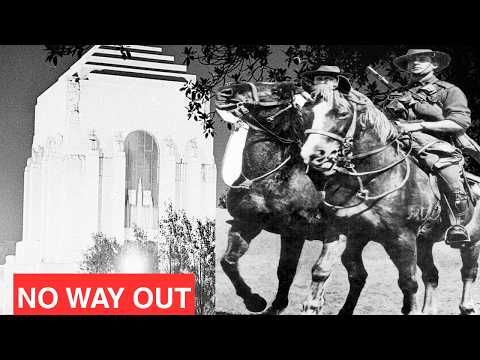
That is the Nek. That is Gallipoli. That is what we remember every Anzac Day—not a victory, not a triumph, but something rarer and harder and more permanent: the courage of ordinary men asked to do the impossible who did it anyway.
Before we talk about what happened at the Nek on August 7, 1915, we need to talk about who was there. Because it is easy, 100 years later, to reduce men to numbers. 372 casualties, 3rd Light Horse Brigade, August Offensive. Those words fit neatly into history books. They don’t tell you anything about the men who climbed out of that trench.
The 8th and 10th Light Horse Regiments were not professional soldiers. Most had never fired a weapon at another human being. They were stockmen from Western Australia who knew every water hole between stations, wheat farmers from Victoria who read weather before maps, young men from Perth and Adelaide who had worked in shops and offices, played cricket on weekends, and signed up because everyone else was going and the recruiters said it would be over by Christmas.
It was not over by Christmas. The average age of the men in the Light Horse at Gallipoli was 22. Think about that. Most had been in school less than a decade earlier. They were still at the beginning of everything when the war found them.
They had arrived in Egypt in late 1914, trained through the brutal desert heat, and landed on the Gallipoli Peninsula in May 1915. By August, they had been there for three months. They had buried friends. They had learned the geography of a landscape built for dying—steep ridges, narrow gullies, ground that gave no cover and offered no escape. They had learned to sleep through artillery and eat rations with the smell of death in the air. They were not naive by the time August came. Three months on Gallipoli cured a man of naivety faster than anything on Earth. They knew exactly what this place did to men, and they came anyway.
Every one of them had volunteered. Not one had been conscripted. Australia would not introduce conscription for overseas service during the First World War. The men at the Nek chose to be there. That matters. It matters because when we remember them, we are not remembering victims of a system that gave them no choice. We are remembering men who walked toward the hardest thing they could imagine, and kept walking even when the hardest thing kept getting harder.
By the summer of 1915, the Gallipoli campaign was in serious trouble. The initial landings on April 25 had not achieved what British High Command expected. The plan assumed Anzac forces would push inland quickly, seize the high ground of the Sari Bair range, and cut off Ottoman supply lines. It didn’t happen. Within hours, Australian and New Zealand troops were pinned down in the steep country above Anzac Cove, and the Ottoman defenders had stabilized their lines.
For four months, the campaign settled into the particular hell of trench warfare on terrain that made the Western Front look generous. The ridges above Anzac Cove were narrow spines of rock and scrub where front lines were sometimes separated by less than 10 meters. Men lived in trenches cut so close to the Ottoman positions that they could hear conversations on the other side at night. Snipers made daylight movement a death sentence. The heat was relentless. Flies covered everything. Dysentery moved through the trenches like a second enemy.
By July, casualties on both sides were catastrophic, and neither had moved significantly. The British commander, General Sir Ian Hamilton, needed a breakthrough. The campaign was being questioned at the highest levels of government, and there were voices calling for evacuation. The August Offensive was his answer. A large-scale British assault would land at Suvla Bay to the north, drawing Ottoman attention away from the Anzac sector. Simultaneously, Anzac forces would launch a major night attack on the Sari Bair Ridge. New Zealand troops were to capture Chunuk Bair during the night of August 6, then descend onto Baby 700 from the rear, while Australian Light Horse attacked from the front. A pincer that would crush the Ottoman position between two forces.
It was coordinated, ambitious, and deeply complicated. The kind of plan that requires everything to go right, on schedule, in the dark, against an enemy who had spent four months fortifying his positions. The Nek was one piece of this larger puzzle—a narrow saddle of ground connecting the Anzac position on Russell’s Top to the Ottoman position on Baby 700, described by historian Chris Coulthard-Clark as the strongest position at Anzac.
The 3rd Light Horse Brigade, commanded by Colonel Frederick Hughes, was assigned to take it. The plan was straightforward in concept. A sustained artillery bombardment would suppress the Ottoman defenders until the last possible moment. At 4:30 a.m. on August 7, four waves of light horsemen, two minutes apart, would cross the open ground and take the Ottoman trench. There was one condition that made the entire plan viable: the New Zealanders had to have taken Chunuk Bair during the night so they could descend onto Baby 700 from behind while the Light Horse attacked from the front.
By the morning of August 7, that condition had not been met. The New Zealand advance had been held up in the darkness and broken country. They had not reached Chunuk Bair. The rear attack that the Light Horse charge depended on was not coming. Major General Alexander Godley, commanding the New Zealand and Australian Division, knew this. He ordered the attack to proceed anyway. That decision, made before a single Australian climbed out of the trench, is where the real story of the Nek begins.
The bombardment began in the darkness before dawn. For the men of the 8th and 10th Light Horse waiting in the assault trenches on Russell’s Top, it was the sound of preparation—the sound of the plan working. Every shell that landed on the Ottoman position was a machine gun that couldn’t fire, a defender whose head was down, open ground made slightly less impossible. They could feel the concussions through the ground under their boots. Some checked their watches. Some talked quietly to the man beside them. Some said nothing at all and simply stood in the dark and waited.
Before they went over, they had been given their orders. Rifles were to remain unloaded. Bayonets fixed. No shots were to be fired without an officer’s authority. The plan assumed they would be across the open ground and into the Ottoman trench before rifle fire became necessary. Speed and shock were the weapons—the bayonet, not the bullet. They were going to charge machine guns with unloaded rifles.
The bombardment was scheduled to lift at exactly 4:30 a.m., the precise moment the first wave would go over the top. It stopped at 4:23. Seven minutes early. The cause was a synchronization failure. The watches of the artillery officer and the assault officer had never been properly matched. Nobody caught it in time. The guns simply stopped firing seven minutes before they were supposed to.
On the Ottoman side of that open ground, the change was immediate and unmistakable. The defenders had been keeping their heads down through the bombardment. They were experienced soldiers who understood the rhythm of artillery fire as well as any soldiers alive, and they understood with absolute clarity what it meant when the guns went quiet before an assault. It meant the infantry was coming. It meant it was time to get back to your position.
They climbed back to their firing positions. They checked their machine guns. They settled in behind their weapons, aimed at the open ground in front of their wire, and waited. For seven minutes, Ottoman machine guns sat loaded and ready while in the Australian trenches below, men who had no idea the bombardment had ended early checked their watches and waited for the signal they thought was still four minutes away. Then three. Then two. Then one.
At 4:30 a.m., the whistles blew. The men of the first wave, led by their commanding officer, Lieutenant Colonel Alexander White, climbed over the parapet and ran with unloaded rifles, with fixed bayonets, toward machine guns they had no way to silence. They were cut down almost immediately. The Ottoman machine guns were already manned and aimed at exactly the ground the Australians had to cross. There was no cover. There was no suppressing fire. There was no element of surprise. There was nowhere to go except forward and no way forward that didn’t go directly through the fire.
The first wave was destroyed within thirty seconds. Colonel White died with his men. The men who survived pressed themselves flat or fell back into the trench bleeding. The open ground was already covered with Australian dead and wounded. Men who a minute ago had been standing in the trench beside their friends were now lying in the dirt, and the machine guns that had killed them were still manned, still loaded, still aimed at the same ground.
Two minutes after the first wave went over, the whistles blew again. The second wave stood up and ran. The result was the same. Almost all of them were cut down before they reached the halfway point. The ground in front of the Ottoman wire was now layered with Australian bodies.
Officers at the forward command post could see what was happening. Runners were sent back with urgent messages. The assault had failed. The Ottoman line was fully manned. There was no possibility of success for any further waves. The messages went up the chain of command. The chain of command had two problems. Their names were Godley and Antill.
Major General Alexander Godley had already made the foundational decision that morning—ordering the attack to proceed without the New Zealand flank it depended on. The men climbing out of the trench were doing so because Godley said they should, knowing the strategic justification had already collapsed. The men who served under him had a name for what happened at the Nek. They called it Godley’s Abattoir.
But in the trench, in the immediate decisions being made wave by wave, the man holding the authority was Lieutenant Colonel John Antill, acting commander of the 3rd Light Horse Brigade. Antill received the reports after the second wave. He understood what they were telling him—that the attack had failed, that the Ottoman line was intact, that both waves had been destroyed without reaching their objective.
He sent the third wave anyway.
His justification was this. He had received reports that Australian marker flags had been spotted in the Ottoman trench. Some men from the first wave had reportedly made it through and were holding on, waiting for reinforcement. That report was real. A Turkish account published after the war confirmed that a couple of Australian soldiers had briefly reached the Ottoman trench and raised a flag before being killed within seconds. But Antill did not go forward to verify whether the flags were still there or whether anyone was still alive. He took the report at face value and issued the order.
Lieutenant Colonel Noel Brazier, commanding officer of the 10th Light Horse, went to Antill directly. He told him the attack was over. That the men were dying for nothing. He called it, in words that have not faded in the century since, \”Nothing but bloody murder.\”
Antill ordered the third wave to go.
The third wave of the 10th Light Horse went over the top with unloaded rifles, with fixed bayonets, into the same fire that had already destroyed two waves before them. They died the same way.
Colonel Hughes finally ordered the attack called off, but the message arrived too late. In the forward trench, an officer made a movement with his hand—a wave, or something that looked like one. The men on the right flank of the fourth wave read it as the signal to go. They went over the top. And because Australian soldiers do not watch the men on their right go forward alone, the rest of the fourth wave followed.
They knew. They had stood in that trench and watched three waves go before them. They had heard the machine gun fire. They had heard the silence that followed. A wave of a hand in the smoke, and they went anyway. Not entirely because of the order, and not entirely in spite of it, but because the men beside them were going. And that was the only calculus that mattered in that trench on that morning.
By 4:45 a.m., the attacks at the Nek had stopped. Four waves, approximately 15 minutes. The Nek was still in Ottoman hands. In the silence after the last wave, the men still alive in the Australian trenches tried to absorb what they had just witnessed. The 8th Light Horse had lost 234 men. The 10th Light Horse had lost 138. 372 casualties in approximately 15 minutes on a strip of ground the official historian Charles Bean later described as the size of three tennis courts.
When burial parties returned in 1919, the bones of the Light Horsemen were still lying thickly on that small piece of ground. Most were unidentifiable. They were interred in a mass grave beneath the very earth on which they fell. The Nek Cemetery stands there now. Of the 316 Australians buried there, only five could be individually identified.
Charles Bean described the charge at the Nek as one of the bravest actions in the history of war. He did not write that lightly. He had seen enough of war to know the difference between bravery and waste. He meant it as the most serious thing a man who had witnessed that morning could say.
Those men gave up everything. Not gladly. Nobody who has read their letters home could use that word. They were not dying for glory. They were young men in a terrible place holding on because the man beside them was holding on, and that was enough.
Every Anzac Day, Australians stand in the cold and the dark and think about men they never met who made choices they may never be tested to make. In the corner of a Turkish ridge that became Australian sacred ground, the men of the 8th and 10th Light Horse are buried in their rows. They knew what was waiting. They fixed their bayonets. They left their rifles unloaded. They stood up. They charged anyway.
Lest we forget.
When you stand in the dark this Anzac Day and hear the Last Post, what will you be remembering—the failure of the generals, or the courage of the men who went anyway?
Report this article
Select a reason for reporting:






