There is a place in New Guinea that should never have been taken. Look at it from the air and you understand why. A razorback ridge stretching north to south across the Finisterre Range, six and a half kilometers long. Its highest point rises 1,497 meters above the sea. Clouds cover it like a blanket. When they part, you see its true nature: the spine of a blade. A narrow strip of land between two valleys, slopes falling away on both sides, and on its crest a goat track barely wide enough for one man. A man walking forward with nothing on his right and nothing on his left. And ahead of him, carved into the rock like fangs in a jaw, a Japanese infantry regiment waits.
They called it Shaggy Ridge. The name came from an Australian officer, Captain Robert Clampett of the 2/27th Battalion, nicknamed “Shaggy Bob.” His platoon was the first Allied unit to slip in and take a look. The name stuck. Soldiers do that. They take a piece of ground trying to kill them and give it a name as if it were a dog. Shaggy. As if naming it will make it smaller. It cannot be made smaller.
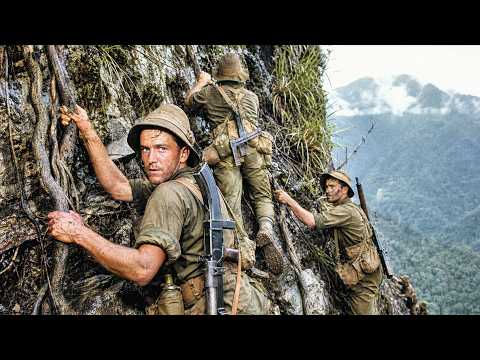
By late 1943, the Australian 7th Division had pushed through the Markham and Ramu valleys, following the Japanese as they withdrew from the coast. The Japanese kept falling back until they reached the Finisterre Range, and then they stopped. They climbed Shaggy Ridge and fortified it. The 78th Infantry Regiment seized the high ground, built shelters from logs and earth, dug machine-gun pits and mortar positions covering every approach, and waited.
They knew what they held. They had a piece of ground that would grind infantry down rifle by rifle. The slopes were too steep to climb under fire. The crest was too narrow to deploy a full platoon. There was no room to maneuver. No flanking. There was one track along the top, and there were the cliffs.
The Australians spent two months watching it. From late October through November and most of December, patrols crept along the track but were forced back. Artillery shelled the Japanese positions; the Japanese disappeared underground, then reappeared later. Airstrikes swept the ridge, burned the scrub, left the bunkers intact. Then the Australians did what they had been trying to avoid. They decided to climb it and take it on foot.
Now the place needs a mental map. Picture the ridge running north to south. At the southern end, where the track first climbs onto the crest, the Australians named the first knoll “Green Top.” Beyond Green Top, along the ridge, a bump they called “The Pimple.” The Pimple was the key. A rocky outcrop on the spine of the ridge, it had to be crossed before anything else could move. North of the Pimple, another bump, Green Sniper’s Pimple, and behind it the highest point in the entire range, McCaughey’s Knoll, named for the lieutenant whose platoon reached it first.
Keep walking north and the ridge bent toward two more features. They sat almost on top of Kankiryo Saddle, which the Australians called Prothero 1 and Prothero 2. East of the ridge, another formation ran called the Faria Ridge, where Shaggy Ridge and the Faria Range met. At Kankiryo Saddle was the prize, the hinge of the entire Finisterre defense. The piece of ground the Australians had to own if they were going to cross the mountains and link up with the 9th Division.
Climbing along the coast: Green Top, The Pimple, Green Sniper’s Pimple, McCaughey’s Knoll, Prothero 1, Prothero 2. Six rocky teeth in the upper jaw of a single mountain. Each one a fortress.
Imagine yourself now at dawn on 27 December 1943. You are with B Company of the 2/16th Battalion. You have been on this ridge for weeks. You have watched men come back down in stages, watched the clouds pour over the Japanese positions every afternoon. This morning the clouds are high and the air is clean from overnight rain. You can see the ridge clearly. You can see along it to where the Japanese sit and watch you.
And from somewhere behind you, you hear the artillery. The 24/4th Field Regiment. They are firing 25-pounders. The shells pass overhead with that ripping sound 25-pounders make. You watch them land. 3,500 shells, one after another, on every part of the ridge above you. Then you hear the Australian aircraft coming in low, angry, with American Kittyhawks behind them. You watch the bombs explode and the ridge jump. You feel the ground shake even here in the valley where you are gathering. You think nothing could survive that. You are wrong, but you do not know that yet.
The climb starts at nine. At exactly nine, your platoon commander gives the signal, and you stand up and start. The first part is not too bad. It is a slope, a steep slope, but a slope with tree roots and grass to grab. You climb on the balls of your feet because climbing on your heels will do you no good. Your rifle is slung on your back. You have grenades in your pockets and on your belt. You have water for the day, and you have learned enough in your third year of fighting to know what enough is.
The slope steepens. It steepens until it is no longer a slope. It is a rock wall. Shale sliding like plates under the boots of the man above you. Bamboo roots. The engineers had built bamboo ladders for this. Light ladders lashed together for men to climb. The ladders are in the valley behind you. You did not bring them. There was nothing to rest them on. You climb on your hands and knees. On your hands and knees. On your hands and knees. The rifle bangs against the back of your skull every time you reach forward. Your palms cut on the bamboo. Your knees tear through your trousers and start to bleed.
The man above you is two meters up the slope. You can see the sole of his boot. There is a crack in the left heel. You stare at that crack and climb. You do not look down. Above you, somewhere on the edge of the rock, a Japanese machine gun is firing. Not at you, not yet. It is firing at the platoon on your right on the other side of the slope, sweeping their line as they climb. You hear the bursts and you do not look. You climb. Looking is what will kill you here. Looking takes a second, and a second on this wall is a second when your hand does not find the next hold.
Your sergeant is on the slope to your left. He calls a name. The name is the man who was three meters above you, and you watch the sole of his boot go still and then slide, then pass you going the other way very fast without making a sound, and you hold onto the rock and let him go. You do not know if he is dead or wounded or just fell off the wall. You do not turn your head. You keep climbing.
You reach the lip. You roll over it. You are on a piece of ground the size of a kitchen floor. And there is a Japanese bunker eight meters in front of you, its roof of logs, its firing slit pointing the wrong way, and you can hear them inside. You can hear them talking. You pull a grenade from your belt, pull the pin, count to two, and throw it. The man beside you throws his, and the man behind him throws his. Then you move forward at a run.
That is how The Pimple began to fall. B Company’s attack on The Pimple was not a heroic act, nor a brave one. It was four hours of men climbing on their hands and knees, grenading a Japanese bunker that engineers then blew apart with high explosives, after the riflemen had failed to break through the defenses of a forward platoon that had reached the middle of the rocky outcrop and then had to fight for every inch to reach what was left. The Australian attack stalled near the top when a strong Japanese bunker sat directly across the only entrance.
The next morning, 28 December, the engineers brought their explosives. They blew the bunker. By noon, The Pimple was in Australian hands. The cost was small. Three men of B Company killed. Eight wounded, and 28 Japanese dead on the position. The numbers were so small that staff officers at headquarters, reading them off the signal board, thought they were wrong. They were not wrong. They were small because the artillery and the first airstrike had done their job. And because B Company had climbed that slope with a kind of patient ferocity that does not show up in casualty returns.
D Company replaced them in the afternoon. D Company kept pushing. By the night of the 28th, the Australians had taken two more positions along the ridge. The second was taken in a swift attack by four men led by a lieutenant named McCaughey, whose name would mark the highest point on the ridge. McCaughey himself was killed by Japanese artillery a few days later on the position that bore his name.
The Japanese counterattacked that afternoon. They came with about 80 men, climbing the ridge toward the new Australian positions. Australian artillery caught them in the open at exactly 2:22 p.m. Their attack failed before they reached the new wire. Then the front went quiet for a while. Quiet the way it goes when both sides have hurt each other badly and both know the real fight has not started yet.
The Australians sat on the ridge and looked north. North along the crest lay Green Sniper’s Pimple and the rest of McCaughey’s Knoll. Then the sharp bends climbing up to Prothero 1 and Prothero 2 and Kankiryo Saddle. The Japanese held those positions and looked south. Between them stretched three kilometers of ridge too narrow for a company of eight men to deploy.
Command changed the troops on the line. The 21st Brigade, which had taken The Pimple, went back into reserve. Two new brigades were called in. The 15th Brigade took over the defense. The 18th Brigade was given the job of taking the rest of the ridge.
Brigadier Frederick Chilton commanded the 18th Brigade. Under him were three battalions: the 2/9th, the 2/10th, the 2/12th. With them was the 2/2nd Pioneer Battalion as support. He had artillery from the 24th Field Regiment, air support from the RAAF and the Americans, and supplies hauled by jeep to a place called Guy’s Post. He looked at the ridge, then at its heart where the 2/9th would have to fight along the narrow track. He looked at the Faria Ridge to the east where the 2/10th would have to climb and break through from the flank. And he looked at the western shoulder of Prothero 1, where if a battalion could cross the river and break through the country behind the saddle, it could get into the rear of the entire Japanese position.
He gave that climb to the 2/12th Battalion. He called it Operation Cutthroat. The name was not attractive, and the plan was not attractive either. The plan was three battalions on three different slopes, climbing on three different mornings, attacking three different parts of the Japanese line at the same time, so the Japanese could not concentrate. The 2/9th would push the heart of the line, while the 2/10th pushed the Faria Ridge from the east. The 2/12th had to commit the worst error. It had to cross the Miniti River under heavy rain, climb the eastern side of Kaning Saddle, and traverse country no human had crossed in the history of this campaign, to reach the back of Prothero 1 where the Japanese had decided no one could ever come.
The 2/10th and the 2/12th began their moves on 19 January 1944. The 2/12th had to cross country that put it two days behind the other battalions. It was supposed to attack on the morning of the 21st. On the 20th, the 2/10th advanced toward Kam Saddle. It met fierce resistance. It was stopped. It tried again. The day ended without the saddle taken, but with the battalion in a good position for the next morning. That night, the 2/12th, lying under the rain on Kaning Saddle, knew what waited for it at sunrise.
Imagine yourself again at exactly nine twenty-nine on the morning of 21 January 1944. You are with the 2/12th Battalion. You have spent the last two days getting here. You crossed a flooded river. You climbed a mountain pass in the dark. You have not slept. The rain stopped at three in the morning, and steam is rising from the ground. Now a pale sun shows in the sky, and you can see above you the slope leading up to Prothero 1. It does not look like a slope. It looks like a wall, like the side of a building. In places where the rock is loose, you cannot use just hands and feet. You grab a vine. The vine is as thick as your wrist. You pull. The vine holds. You pull again. You climb. The man next to you does the same on his own vine, three meters away. You are forty men on this wall. You are spread across it like beads.
You climb in silence. It was silence. Bayonet fixed. Round chambered. Safety off. Climb. The Japanese do not know you are here. This is the part you will never get used to. That they do not know. That you are climbing up the back of a position the Japanese built to be approached from a different direction. That every step you take up this slope is a step the enemy did not plan for. There is a kind of held breath across the whole battalion. And as you climb, you feel the held breath as if you were creeping through a sleeping house in the dark.
You cover 100 meters. You cover 200. A man below you slips and starts to slide. He grabs a vine. The vine holds. No one breathes. He pulls himself back to the wall. You keep climbing. You can see the lip of Prothero 1 now. You can see the top of the bunker line. You can see the muzzle of a Japanese mountain gun sticking out of one of the bunkers. A 75mm gun mounted in the back opening of a bunker, covering the slope that is now below you. It is not pointing at you yet. It is pointing south toward Shaggy Ridge, where the 2/9th began its attack this morning. From its position, this gun has spent the morning savaging the 2/9th as they advanced along the slope. They have taken heavy losses because of it. They do not know you are about to come out of the edge of the bunker behind it.
You are 80 meters from the lip. The platoon commander is Lieutenant Charlie Braithwaite. He gives the signal you have been waiting for: Advance. Advance. You go from climbing to crawling. You can hear the men in the position now. You can hear a Japanese voice giving an order. You can hear a machine gun, the type the Australians called a “woodpecker” for its sound, firing on a fixed line toward the south. The crew has not seen you. The sentry at the back of the position has not seen you.
You are 60 meters from the lip. A head appears above it. A Japanese soldier looking down. You see his face. He sees your face. Half a second passes with nothing happening. Then his mouth opens and he shouts. The mountain gun shudders on its base. You see the men around it lift it aside. You see them swing the gun. You see its muzzle turn toward the slope below them, toward you. And you start running up the rock. You start climbing in great, heavy strides because the gun is going to fire at point-blank range. And there is no cover on this wall. Nothing. Nothing but the angle of the slope.
The gun fires. The first round passes over your head. You feel its heat. You feel the air shake. You hear behind you and below you a sound that is not a sound, more like the earth opening, and you do not look back. The gun fires again. This time it does not pass over your head. This time it cuts through the men on the slope. They go down. You have no other word for what happened. They go down. You keep climbing. Lieutenant Braithwaite is on your left. His pistol is in his hand. He is shouting, but you cannot hear what he is shouting. There is a soldier named Richard Logie climbing on your right, going up the rock like an animal with his Owen gun slung on his belt, eating the slope, and you climb with him because climbing with him is the only thing left.
The gun fires a third time. You are on the lip of the bunker. You roll over it. You are inside the Japanese position. The mountain gun is two meters to your right. Its crew is preparing to fire again. Logie is behind you. He stands on the edge of the support box where the gun is mounted. He fires a burst from his Owen gun into the firing slit. The gun stops. He fires another burst into the slit to make sure it will not fire again. Braithwaite is at the gun. The gun crew has time to wait. Australian rifles gather around the gun in a half circle. The crew goes down. The gun is taken.
This gun killed 50 men of your battalion before it was taken. 50 dead and wounded combined. Among the wounded was your commander, Lieutenant Colonel Charles Bourne, hit by a splinter on the slope. Among the dead was a soldier named Roy Parnell. They called him “Tex Parnell.” He was badly wounded when the medic reached him on top of Prothero 1. The medic said the arm had to come off. Parnell, who had climbed the slope with a wound that had already drained half his blood, said, “All right, Doc, cut it off.” The medic cut it off. There on the position, with night coming and Japanese counterattacks starting from the north, Tex Parnell died the next day.
The 2/12th Battalion ended 21 January with 13 killed and 48 wounded on Prothero 1. They had taken the gun. They had taken the bunker. They had a back door into the Japanese lines. They held high ground that no one, 24 hours earlier, had believed a battalion could reach.
And now go back to the heart of the mountain. At the same time the 2/12th was climbing Prothero, a company of the 2/9th was climbing something the Japanese were certain could never be climbed at all.
Green Sniper’s Pimple was the next bump north of the Australian line on Shaggy Ridge. It sat between the Australians and the empty ground of McCaughey’s Knoll, and it had held for two months. The Japanese placed the position assuming any attack must come along the spine of the ridge, where their machine guns pointed. The eastern flank was a near-vertical slope of rock ledges and scrub. They put a single observation post on that flank because they judged it impossible to climb.
The 2/9th decided to climb it. The patrol that reconnoitered it came back with a sketch. The sketch showed the ledges. It showed the dead ground. It showed that by climbing in stages, a platoon could reach the flank of the position without being seen.
The plan was an indirect approach. While the rest of the company made noise along the slope to draw the Japanese, a small force would go up the cliff.
Under a barrage, they went. The Japanese were still looking south. They never turned. The first they knew was the sound of Owen guns behind them. The position fell that day.
Green Sniper’s Pimple, considered impossible for 60 days, fell because the Japanese decided a slope steeper than 40 degrees could not be climbed by infantry, and the Australians decided it could.
By the night of 21 January, at three points along Shaggy Ridge, the Japanese line had been broken. The 2/12th held the back door at Prothero 1. The 2/9th held Green Sniper’s Pimple. The 2/10th, having forced Kam Saddle the next day, was pushing along the Faria Ridge toward Kankiryo from the east.
The Japanese tried that night to take it all back. They came from the north, in the dark, onto Prothero. They came in patrols, then in companies. The 2/12th, still battered from the day, met them at the wire. Twice the Japanese entered the position. Twice they were thrown out. Lieutenant Colonel Bourne lay on a stretcher, wounded, refusing evacuation until the position was secure. Australian artillery, firing from inside the captured bunker line, patrolled the approaches every 15 minutes through the night, breaking up formations before they could re-form.
By dawn, the Japanese had spent themselves, and Prothero 1 stayed Australian.
22 January was another day of savage fighting. The 2/12th pushed south along Shaggy Ridge from Prothero 1. The 2/9th pushed north from Green Sniper’s Pimple. Between them stretched a kilometer of ridge, with the remaining Japanese garrison trapped between two Australian battalions on the only ground a company could fight on.
The Japanese still held Prothero 2. They still held McCaughey’s Knoll. They still held the high ground at the saddle. But they lost it all that day, and the next, when a small patrol from the 2/2nd Pioneers, working ahead of the main force, slipped past the Japanese flank and took a position on the eastern end of Kankiryo Saddle that the Japanese had never expected anyone to reach.
The 2/12th took Prothero 2. The 2/9th, after a small patrol climbed the steep sides of McCaughey’s Knoll under cover of a artillery program, took the highest point on the entire ridge. By midday on 23 January, the 2/12th and the 2/9th met across the crest. The whole of Shaggy Ridge was in Australian hands.
The 2/10th, attacking along the Faria Ridge, was a kilometer and a half from the saddle. One Japanese position remained. It was called Crater Hill. The old regimental headquarters, a cleared area northeast of the saddle, and the strongest position of all. Of all the fortifications the regiment built anywhere on the Finisterre Range, the 18th Brigade looked at this one and decided not to attack it.
They had seen what the mountain gun did to the 2/12th on Prothero. They had seen what one defensive line in the right ground could cost. Instead, they besieged Crater Hill. Patrols isolated it. Artillery worked it night and day, observers on Prothero 1 and 2 watching the position and dropping shells on every surface. Aircraft flew and bombed it. No supply could reach the Japanese inside Crater Hill. No reinforcement could reach them. There was only hitting them, again and again.
On 1 February, a company of the 2/9th and a company of the 2/10th climbed Crater Hill expecting a fight. They found no one. Crater Hill. The Japanese had slipped away in the night and headed north into the country toward Madang, where Australian patrols would hunt them for two more months as the 18th Brigade advanced down to meet the Americans coming from the coast.
They had taken the ridge. The cost was 46 killed and 147 wounded. The Japanese cost was over 500 casualties, with 244 confirmed killed. The official Australian history, when it was written, described the ridge as one of the most difficult areas attacked by Australian troops anywhere in the war.
The 2/12th Battalion, whose climb at Prothero broke the back of the position, lost more men that day alone than it had at Tobruk. Many of the men who climbed Prothero had been at Tobruk, and at Milne Bay, and some had been at Buna where the 7th Division’s blood ran in the swamps to take a piece of coast the Americans could not take.
Sergeant Geoffrey Lowe of the 2/12th was one of them. He had seen what siege warfare looked like in North Africa, he had seen what the Japanese could do in the jungle, and he had seen the worst of two wars. When someone asked him later what Prothero was like, Lowe gave the answer that ended up in the regimental history. He said it was “a picnic compared to Brocks.” Not for comparison. As a judgment. It was a picnic compared to Brocks in his memory as he sat beside the mountain gun that had been firing at the 2/12th from the back door of a bunker at point-blank range on a slope so steep the men had to climb it with vines.
The total cost of the New Guinea campaign for the Australian 7th Division from September 1943 to April 1944 was 204 killed and 464 wounded in action. That number does not include the cost of disease. More than 13,000 men of the division were evacuated sick during the same period, most with malaria and other tropical diseases. For every man hit by a Japanese bullet on Shaggy Ridge, there were dozens who came down off the mountain shaking with fever and unable to stand. The ridge took its toll in blood and sinew, and it kept taking it long after the last shell fell.
It fell. But the crest was taken. Imagine, finally, what could not be imagined at the beginning. Imagine an Australian in a slouch hat and dirty green trousers, sitting on the highest point of the Finisterre Range, at McCaughey’s Knoll, where the clouds break in the late afternoon and you can see clearly to the north: beyond the next valley, beyond the river bends and the green tongues of forest, to where you can, on a clear day and clean air, see Madang, and the whole north coast, and the Bismarck Sea behind it as a thin gray line on the edge of the world.
Two months ago he was at the bottom of this crest, looking up. Three weeks ago he was on a rock wall, climbing on his hands and knees, shale sliding out from under him, the lives of the men above him in his line of sight, a Japanese woodpecker firing on a fixed line at the platoon to his right. Yesterday he was inside a bunker built to house a Japanese mountain gun. The mountain gun is Australian now, its breech open and its barrel beginning to cool. A soldier sits on its trail eating a tin of bully beef. Today he is on top of the ridge that was never supposed to be climbed, and the ridge is his.
The 2/16th Battalion began the climb on 27 December. The 2/12th broke the siege on 21 January. The 2/9th and the 2/10th finished the climb on 23 January. From the shelling at the base of the ridge to the empty bunkers on Crater Hill, it took 26 days. 26 days of climbing, 26 days of vines and crumbling rock and grenades and rain and the white noise of artillery walking the infantry forward.
It was not the longest battle of the New Guinea campaign. It was not the bloodiest. There were valleys to the east and beaches to the south where more Australians died in less time, by the count. But Shaggy Ridge was the battle where the geometry of the ground itself was the enemy. Where before the Japanese could be fought, the slopes had to be fought. Where men climbed a slope so steep that engineers built ladders for it and then abandoned them because they would not hold, and went on climbing on their hands and knees with their rifles banging against the backs of their skulls, where the infantry in the last hard months of the Pacific War did what infantry was never supposed to do, and took a mountain.
The track is still there. So is the ridge. So are the names. Green Top, The Pimple, Green Sniper’s Pimple, McCaughey’s Knoll, Prothero 1, Prothero 2, Kankiryo Saddle. The names sit on the ridge like markers. And once a year, a group of Australians, sometimes the descendants of the men who climbed, walks the track and stands on the crest where their grandfathers and great-grandfathers stood with their hands cut on bamboo and their knees torn through their trousers. They look north. They look at the slopes falling away. They try to imagine, and they cannot quite imagine what it was like to come up here under enemy fire.
What they can imagine is what Geoffrey Lowe said when he was asked. “A picnic.” That is what the men who took Shaggy Ridge said about the place they took. That is the phrase that carries it best. No comparison. No equivalent event. There is only the ridge, and the men, and the cloud that settles over them at the end of every afternoon, and the slow, patient ferocity of an Australian infantry brigade climbing where no one was supposed to be able to climb.
They took a mountain the Japanese had decided was theirs, and they walked up it step by step, vine by vine, bunker by bunker, until there was nothing left on Shaggy Ridge but the Japanese who could not be carried away. The ridge had a name. And by the end of January 1944, so did every Australian who climbed it.
So here is the question, and I want you to answer it honestly: if the ground itself is the enemy, and the map says impossible, what is it that makes a man climb anyway? Tell me in the comments.
Report this article
Select a reason for reporting:






