They were the children of monsters. Yet for many, childhood was a blur of garden parties, bedtime stories, and the comforting embrace of parents who kissed them goodnight. How could these same parents be responsible for the deaths of millions? For the sons and daughters of the Nazi elite, the answer would take decades to confront—and some never did.
Bridget Hürse, daughter of Auschwitz commandant Rudolf Höss, remembered her childhood as idyllic. The rows of prisoners in striped suits working in her garden were simply part of the landscape. She played among the flowers, unaware that just beyond the wall, gas chambers consumed thousands of lives each day. “I will never understand how human beings could behave in that way,” her brother Hans Jürgen confessed after a meeting with his father in 1977—a man he had idolized.
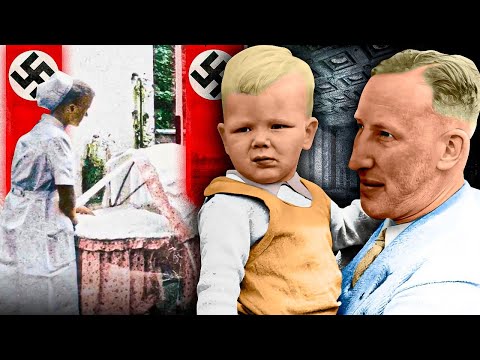
But not all heirs chose silence. Nikolaus Frank, son of Hans Frank, the brutal governor of occupied Poland, dedicated his life to exposing his father’s crimes. In his book My Father: A Reckoning, he called Hans an unrepentant criminal responsible for millions of deaths. “I hated that man who even dead continued to control me like a puppet,” he wrote. The publication sparked outrage within his own family—his siblings cut all contact.
For others, the burden of a surname became unbearable. Rolf Mengele, son of the infamous Angel of Death, met his father only once as an adult. The encounter was cold, irreconcilable. After Josef Mengele’s death in 1979, Rolf rejected his inheritance, abandoned his surname, and settled in Munich as a lawyer. He never spoke publicly about his father again.
Gudrun Himmler, daughter of SS chief Heinrich Himmler, took a different path. She devoted her life to defending her father’s image, claiming he was a misunderstood hero. In her only interview, she declared: “I want to change the historical perception of my father.” She joined Stille Hilfe, an organization that helped former Nazis escape justice, and remained unrepentant until her death.
The children of the Third Reich were trapped between love and horror. Some, like Nikolaus Frank and Rolf Mengele, chose to confront the truth. Others, like Gudrun Himmler, retreated into denial. Their stories reveal the terrifying power of family loyalty—and the long shadow of guilt that never fades.
For the Höss family, the war’s end brought not liberation but a slow unraveling. Hedwig, Rudolf’s widow, remarried and eventually moved to the United States, where she lived quietly in Washington until her death. Her children scattered. Klaus, the eldest, moved to Australia with his wife Lilo and daughter Christine, but his life ended in the 1980s, a victim of liver cirrhosis brought on by excessive drinking. Brigitte, the youngest daughter, fled to Spain in 1950, modeling for Balenciaga in Madrid. She never spoke of her origins.
In 1961, Brigitte married an Irish-American engineer and followed him across the globe—Liberia, Greece, Iran, Vietnam—before settling in Washington, D.C. It was there that her father’s memoirs surfaced, revealing the chilling details of his role in the Holocaust. “She considered herself a victim of circumstance,” her husband later said. Brigitte kept her secret for decades, working in high-end boutiques like Saks Jandel, her employers unaware of her connection to the Auschwitz commander.
Only once did she reveal the truth, after a night of drinking. Her boss, a Jewish woman who had fled Germany, met the confession with understanding. In 2013, at 80 and facing terminal cancer, Brigitte agreed to a single interview with journalist Thomas Harding. She spoke of her childhood, the soldiers who raided her home, and her fear of reprisals. “I kept a photograph of my parents on their wedding day,” she admitted. “A memory of simpler times.”
But the legacy of the Third Reich was not confined to its leaders’ families. The fortunes that prospered under Hitler—BMW, Volkswagen, Porsche, Hugo Boss—remained intact, their owners among the wealthiest in Germany. In February 1933, Hitler summoned twenty prominent businessmen to Berlin, securing their financial support. Years later, most claimed they had been forced to join the Nazi cause. Yet they profited from the forced acquisition of Jewish property and the use of slave labor.
Friedrich Flick, the richest man in Germany in the 1930s, was sentenced to seven years in prison for using slave labor and looting a factory in France. Released in 1950 after a sentence reduction, he reclaimed his position as the wealthiest person in the country by 1960, thanks to his majority control of Daimler-Benz. When he died in 1972, he remained one of the richest figures in the world. Other businessmen, like Günther Quandt and Ferry Porsche, served brief prison terms but retained most of their assets.
Harold Quandt, Günther’s youngest son, received a farewell letter from his mother, Magda Goebbels, while held captive in Benghazi. “Be loyal—loyal to yourself, loyal to the people, and loyal to your country,” she wrote before taking her own life alongside her husband and six children in Hitler’s bunker. Harold survived, inheriting a vast industrial empire along with his half-brother Herbert. Among their most valuable assets was a 14% stake in Daimler.
For Ricardo Eichmann, the son of Adolf Eichmann, the burden of his father’s name was a wound that never fully healed. Born in Argentina in 1955, Ricardo grew up knowing nothing of his father’s past. When he was five, his father was captured by Mossad agents and secretly transported to Jerusalem to stand trial. “At 13 or 14, I opened a magazine and saw a striking image—the noose that hanged my father,” he later recalled. “It was in that instant that I fully grasped who Adolf Eichmann had been.”
Ricardo chose a radically different path. He studied prehistory, classical archaeology, and Egyptology at the University of Heidelberg, participating in excavations in Egypt. From 1996 to 2020, he served as director of the Orient Department at the German Archaeological Institute in Berlin. He rejected his father’s beliefs and preferred that his life be defined by his academic work. Yet he never shared his anguish with his brothers, maintaining contact with only one of them. When asked what his siblings thought of him for speaking openly, he replied: “If you want to know what they think, it’s better to ask them yourself.”
Ricardo Eichmann’s silence toward his siblings was not unique. Across the families of the Nazi elite, a pattern emerged: those who broke ranks were often ostracized, their courage met with icy silence or outright hostility. For Nikolaus Frank, the cost was steep. His brother Michael fired back in a letter published in the weekly Stern, accusing Nikolaus of betraying the family. His other siblings denied the past entirely. Only Nikolaus and his sister Norma accepted historical responsibility. “My siblings cut all contact with me,” he admitted. “Childhood friends, too. They could not confront such an uncomfortable truth.”
Nikolaus regretted never confronting his mother about her role. He described Brigitte Frank as a cynical, frivolous woman fascinated by luxury—fur coats, chauffeur-driven Mercedes, SS escorts. “She often went to the local market accompanied by an SS driver to buy corsets made by Polish Jews,” he recalled. “Weakened by hunger and misery, they were forced to sell their products at pitiful prices.” His mother’s insatiable taste for opulence earned her the nickname “Queen of Poland” among the Nazi elite. After the war, she denied any knowledge of the camps. She lived in poverty in Munich until her death in 1959.
For others, the legacy was less about guilt than about money. Eda Göring, Hermann’s daughter, spent decades fighting for her father’s fortune. In 2015, she filed a legal request with Bavarian authorities demanding compensation for the inheritance that had been expropriated after Nuremberg. “This is about compensation for the expropriation of my inheritance,” she stated. “A modest sum to allow me to live with dignity.” The Bavarian Parliament unanimously rejected her claim. Yet Eda, once the “princess of the Third Reich” who sat on Hitler’s lap as a child, never abandoned her fight for the material and symbolic legacy of her father.
Gudrun Himmler’s devotion to her father’s memory took a darker turn. In 1955, she joined Stille Hilfe, an organization that provided legal and logistical support to Nazi criminals. The group helped figures like Josef Mengele and Adolf Eichmann escape to Latin America. Gudrun turned her apartment into a museum dedicated to Heinrich Himmler, collecting objects in his honor. She visited Anton Malloth, the cruel guard of Theresienstadt, regularly until his death in 2002, providing him refuge in a luxurious retirement home partially funded by German public money. She never showed remorse, never sought to break free from her father’s shadow.
But the next generation began to crack the silence. Katrin Himmler, Gudrun’s great-niece, married a descendant of a Jewish family and wrote The Himmler Brothers, a book reflecting on the family’s legacy. “The weight of guilt can transcend generations,” she wrote. Unlike Gudrun, Katrin made it clear that the atrocities of Nazism could not be excused. Her work was a quiet repudiation of everything her great-aunt had stood for.
For the children of the Third Reich, the path forward was never straightforward. Some, like Nikolaus Frank and Rolf Mengele, chose to confront the truth. Others, like Gudrun Himmler and Eda Göring, retreated into denial or fought for the privileges their fathers had stolen. Their stories reveal the terrifying power of family loyalty—and the long shadow of guilt that never fades.
Yet the silence was never complete. In 2013, Brigitte Höss finally broke her decades-long anonymity, granting one interview to journalist Thomas Harding. She spoke of the soldiers who raided her home, the fear of reprisals, and the photograph of her parents on their wedding day she kept as “a memory of simpler times.” She acknowledged her father’s central role in the machinery of extermination—but still questioned the number of victims. “The past is never truly buried,” Harding later wrote. “It waits.”
Katrin Himmler’s book became a quiet counterpoint to her great-aunt’s fanaticism. “The weight of guilt can transcend generations,” she wrote. Unlike Gudrun, Katrin refused to excuse the atrocities. Her work was a repudiation of everything her family had once stood for—a small act of reckoning in a lineage built on denial.
The fortunes of the Nazi elite endured, too. The Quandt family’s stake in Daimler, the Porsche and Piëch empires, the Flick conglomerate—all survived the war, their owners among the wealthiest in Germany. “Only one of these major businessmen was ever tried at Nuremberg,” historians note. The rest served brief prison terms, then reclaimed their positions. Their descendants inherited not just wealth, but a legacy of silence.
For the children of monsters, the path forward was never straightforward. Some, like Nikolaus Frank and Rolf Mengele, chose to confront the truth. Others, like Gudrun Himmler and Eda Göring, retreated into denial or fought for stolen privileges. Their stories reveal the terrifying power of family loyalty—and the long shadow of guilt that never fades.
But the question remains: when the heirs of history’s darkest chapter refuse to speak, does silence itself become a form of complicity? What would you have done—confront the truth, or bury it with the past?
Report this article
Select a reason for reporting:






