Imagine a family that ruled an empire stretching from Brazil to Japan, a dynasty so old that for nearly 800 years, Portugal and its monarchy were one and the same. Then, in a single morning, it all vanished. The flags came down, the palaces were seized, and the royal family sailed away on a borrowed yacht, watching their homeland shrink behind them. This is the story of the House of Braganza—but not just how they fell. It’s about what came after: the king, the queen, the princes, and a legacy that refused to die.
The end began not with a revolution, but with an assassination. On February 1, 1908, King Carlos I and his family were returning to Lisbon when two gunmen ambushed their carriage. The king died instantly, and his heir, Prince Luís Filipe, was fatally wounded. Queen Amélie threw herself over her younger son, Manuel, beating at the attackers with a bouquet of flowers. That desperate act saved his life—and made him king at just 18 years old.
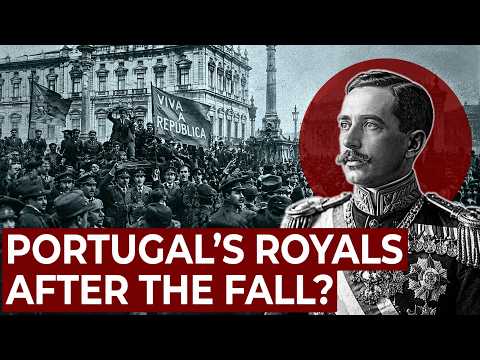
Manuel II was never meant to rule. Bookish and thoughtful, he had spent his life in his brother’s shadow. He tried to govern as a constitutional monarch, staying above politics, but the Republican movement had been gaining momentum for decades, fueled by economic crisis and national humiliation. In his two and a half years on the throne, he went through seven prime ministers. Nothing could stabilize the country.
On the night of October 3, 1910, the revolution erupted. Warships shelled the royal palace, and by morning, the monarchy was doomed. Manuel, his mother, and his grandmother fled to the coast, boarding the royal yacht Amélia IV. They hoped to reach Porto, but that city had also fallen. There was nowhere left to go. The last king of Portugal sailed into exile, never to set foot on Portuguese soil again.
Manuel settled in Twickenham, a suburb of London, where his mother had been born in exile decades earlier. There, he built a quiet life as a scholar and bibliophile, amassing one of the most important collections of early Portuguese literature. He became a beloved figure in his local community, even donating a stained glass window to his church. But he never stopped caring about Portugal.
When World War I broke out, Manuel offered his services to the Portuguese army, but the Republican government refused. Instead, he joined the British Red Cross, organizing fundraising drives and visiting wounded soldiers on the Western Front. He even intervened diplomatically when Portugal needed him, using his British connections to resolve a crisis. In exile, he remained a servant of his country—just without a crown.
Meanwhile, the republic that replaced him was a disaster. In 16 years, it saw 45 governments, eight presidents, and multiple coups. Monarchists saw their chance. In 1919, they seized Porto and proclaimed the restoration of the kingdom—but Manuel, from exile, refused to sanction the uprising. He believed the throne could only return through the will of the people, not violence. The revolt collapsed in 25 days.
Manuel died suddenly in 1932, at just 42, childless. His mother, Queen Amélie, lived on in France, refusing to abandon the country that had sheltered her during World War II. Her last words were, “Take me to Portugal.” And they did—she was buried alongside her husband and sons in Lisbon.
With Manuel’s death, the succession passed to the Miguelist branch of the family, descendants of the exiled King Miguel I. Duarte Nuno, the new claimant, married Princess Maria Francisca of Orléans-Braganza, reuniting the two rival branches after a century of feud. Their son, Duarte Pio, is the current Duke of Braganza—a king without a kingdom.
Today, Duarte Pio is a familiar figure in Portugal, attending state functions and representing the country abroad. He served as a helicopter pilot in the colonial war and was even granted citizenship by East Timor for his support of their independence. But the restoration of the monarchy remains a distant dream.
The House of Braganza did not simply fall. They fell, and then they kept going—through exile, war, and revolution. Their story is one of resilience, of a family that lost everything but refused to disappear. And that, in its own way, is a power no republic can take away.
But the story of the Braganzas does not end with Duarte Pio. It continues in a generation most people have never heard of, and in a place that would have seemed utterly alien to the kings of old.
Duarte Pio’s eldest son, Afonso, Prince of Beira, was born in 1996 and stands as the heir to a throne that no longer exists. He was educated quietly, largely out of the public eye, and has grown into a young man who carries the weight of a name that once commanded empires. He has no official role, no constitutional duty, and no political power—yet the title follows him everywhere.
His younger siblings, Maria Francisca and Dinis, Duke of Porto, have pursued their own paths. Maria Francisca has become a familiar face at royal gatherings across Europe, representing the family at weddings and ceremonies in Spain, Belgium, and beyond. Dinis, meanwhile, has kept a lower profile, studying and working far from the ceremonial spotlight.
And yet, the question that has haunted the family for over a century refuses to fade. What is a royal family without a throne? The Braganzas have answered it in their own way—by becoming something closer to cultural ambassadors than political claimants.
There is a detail from the family’s modern life that captures this strange position perfectly. In 2018, when the Portuguese government faced a delicate diplomatic situation involving the return of historical artifacts from Brazil, it was not a politician who was quietly consulted, but the Duke of Braganza himself. His opinion carried weight not because of any law, but because of the name he bore.
The Brazilian branch of the family has followed a parallel path. The descendants of Emperor Pedro II, who was deposed in 1889, still live in Brazil and maintain their own claims and traditions. In 2022, the two branches gathered together in Petrópolis for a joint ceremony commemorating the bicentennial of Brazil’s independence—a moment that would have been unthinkable a century earlier, when the families were still divided by old wounds.
But the most surprising chapter may be the one unfolding right now. In an age of republics and democracies, the Braganzas have found a new kind of relevance—not as rulers, but as symbols. They are invited to open hospitals, to bless ships, to stand beside presidents at commemorations. They are, in a sense, the living memory of a nation that chose to move on but never quite forgot.
And so the question remains, hanging in the air like the last note of a song: what happens to a dynasty when the crown is gone but the blood remains? The Braganzas have answered it not with a manifesto, but with their lives—quiet, dignified, and stubbornly persistent.
Their story is not over. It is simply waiting for the next chapter to be written.
That next chapter has already begun, and it is being written by a generation that never knew a king on a throne. Afonso de Bragança, the Prince of Beira, turned twenty-eight in 2024. He studied in Lisbon, trained in agricultural management, and has quietly taken over the management of the family’s estates in the Alentejo. He is, in every practical sense, a landowner and a farmer—not a pretender waiting for a crown.
Yet the title clings to him. When he walks through the streets of Lisbon, people still stop and stare. Older women curtsey. Journalists ask him about the monarchy. He answers with the same careful, measured tone his father perfected: respectful of the republic, proud of his heritage, never demanding anything.
His sister, Maria Francisca, has become something of a social media presence—not in the flashy, influencer sense, but as a quiet chronicler of the family’s charitable work. She posts photographs of hospital visits, of ceremonies at the Pantheon, of the family laying wreaths at the tomb of King Carlos. She has over a hundred thousand followers, most of them young Portuguese who seem genuinely curious about a history they were never taught in school.
But not everyone is charmed. In 2023, a left-wing member of parliament publicly questioned why the Duke of Braganza was being received at official state functions while Portugal remained a republic. The debate that followed was brief but revealing. The government defended the invitations as “cultural protocol,” and the controversy faded within a week. Most Portuguese, it seems, simply do not care enough to be outraged.
And that indifference may be the monarchy’s final, quiet defeat. Not a revolution, not a law of banishment, but the slow erosion of memory. A nation that once tore down its flags and seized its palaces now barely remembers the names of the kings who built them.
Duarte Pio, now in his late seventies, understands this better than anyone. In a rare interview in 2021, he was asked whether he still dreamed of restoration. His answer was disarmingly honest. “I dream of a Portugal that remembers,” he said. “The throne is not mine to reclaim. The memory is.”
And so the work continues—not in palaces, but in archives and churches and small municipal museums. The Braganzas have become custodians of a past that the republic has little time for. They fund the restoration of old manuscripts. They attend the funerals of the last surviving monarchists. They keep the flame alive, not because it will ever burn bright again, but because letting it go out feels like a kind of death.
There is one place where the old world still feels alive. Every year on February 1st, a small crowd gathers at the Terreiro do Paço in Lisbon. They lay flowers at the spot where King Carlos was shot. They stand in silence. They do not chant or demand. They simply remember—and in that quiet act of remembrance, the House of Braganza survives.
It is not a throne. It is not power. But it is something. And for a family that lost everything in a single morning, something may be enough.
And yet, even that quiet remembrance is changing. In 2024, the annual ceremony at the Terreiro do Paço drew fewer than fifty people. Most were elderly. A handful of curious tourists stopped to watch, unsure what they were seeing. The old monarchists are dying out, and their children have moved on.
Duarte Pio knows this. He has begun transferring the family’s archives to public institutions, ensuring that the documents survive even if the devotion does not. His son Afonso has reportedly shown little interest in the ceremonial duties, preferring the rhythms of the estate and the quiet of the Alentejo countryside. The next generation may be the first to simply let the claim fade.
Perhaps that is the true ending of the story. Not a dramatic fall, not a triumphant return, but a slow, graceful release. The Braganzas were kings for eight centuries. They have been exiles, scholars, farmers, and symbols for one. Maybe the final act is simply to become ordinary.
But then, on a cold February morning, someone still lays a single white rose at the spot where Carlos died. No cameras. No ceremony. Just a gesture, repeated year after year, by someone who refuses to forget. And that, perhaps, is the last word the Braganzas will ever need.
So here is my question for you: if a dynasty loses its throne, its power, and eventually its memory—does it still exist at all? Or does it only live on in the hands of those who choose to remember?
Report this article
Select a reason for reporting:






