The photograph had been forgotten in the archives of the Boston Historical Society for decades. Dated June 15, 1910, it shows the wealthy Matthews family posed formally in the salon of their Victorian home. Richard Matthews, a successful textile merchant, stood beside his wife Elizabeth, while their three children sat neatly in front of them. The family’s wealth was evident in their elegant clothing and the ornate furnishings surrounding them—a Persian rug, mahogany furniture, and gilded oil paintings reflecting their social standing in Boston’s elite.
In 2023, historian Dr. Eleanor Wells discovered the image while cataloging materials for an exhibition on Boston’s industrial families. With a PhD in American social history, Dr. Wells was known for uncovering neglected stories within traditional historical records. At first glance, the Matthews family portrait seemed like a typical formal portrait of the era—stiff poses, serious expressions, and precise composition reflecting early 20th-century American photography traditions.
However, when Dr. Wells examined the photograph under proper archival lighting and magnification, something unexpected caught her trained eye. By the window in the background stood another child, partially visible, perhaps eight or nine years old, staring directly at the camera. The image was slightly blurry, but his presence was unmistakable, watching the family scene with an enigmatic expression.
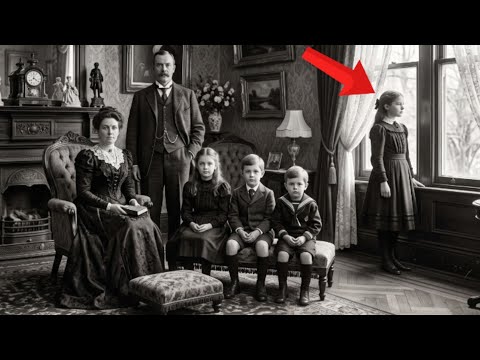
The child’s clothing was simpler than the luxurious garments of the Matthews children, and his position apart from the family group suggested a deliberate choice by the photographer. Dr. Wells noted in her research journal that according to all Matthews family records, there were only three children in the household at that time. The identity of this fourth child was completely undocumented in any family trees or social records she had examined so far.
Initial examination by conservation experts confirmed the photograph was an original from 1910, unaltered and untouched. The mysterious figure by the window was present when the picture was taken, raising questions about a potential undocumented member of the Matthews household. A hidden history waiting to be revealed.
Dr. Wells began her investigation by examining official Boston records from the early 20th century. The city’s meticulous documents provided a framework for understanding the Matthews family’s public identity. The 1910 census listed only five individuals in the Matthews household: Richard, 42, Elizabeth, 38, and their three children—William, 15, Margaret, 12, and James, 8. No fourth child was officially documented as a resident at the family’s Commonwealth Avenue address.
Birth records in the Massachusetts State Archives confirmed that Elizabeth Matthews had given birth to only these three children, with medical records noting complications after James’s birth that prevented further pregnancies. Parish records from the family’s Episcopal church also showed that only three Matthews children were baptized, confirmed, or attended Sunday school during that period.
Dr. Wells expanded her search to include city directories, school enrollment records, and neighborhood maps from 1908 to 1912. Her findings revealed that the Matthews family employed two live-in servants—an Irish cook and a Swedish housekeeper—and occasionally hosted relatives for extended visits, but none matched the age of the child in the window. The documentary evidence presented a clear contradiction with what was plainly visible in the photograph.
“Either this child was deliberately erased from official records, or he had another connection to the household that didn’t warrant documentation in traditional historical sources,” Dr. Wells explained to her colleagues at the Boston Historical Society.
A promising thread emerged from Elizabeth Matthews’s personal correspondence, preserved within the family papers. In a letter dated March 1910, Elizabeth mentioned that “arrangements for C” had been finalized, though no further explanation was provided in that particular document. The letter “C” appeared several more times in Elizabeth’s appointment books from the same period, often linked to meetings with her charitable organization.
The child’s deliberately marginal position in the photograph suggested he held an ambiguous status within the household—present but not part of the family. This visual positioning mirrored the documentary positioning: present in the physical space but absent from the official record. For Dr. Wells, such a contradiction was the beginning of a historical mystery requiring deeper investigation.
The photograph was sent to Dr. Thomas Anderson, a specialist in early photographic techniques at the Smithsonian Institution. With 30 years of experience analyzing historical images, Dr. Anderson approached the Matthews photograph with scientific rigor, using both traditional examination methods and advanced digital enhancement techniques.
After a week of meticulous analysis, Dr. Anderson confirmed that the figure was not a photographic flaw or optical illusion. The child was physically present when the photograph was taken, standing approximately six feet behind the family group near a prominent window in what appeared to be the family parlor. Digital enhancement revealed additional details that had not been clear before. The child had dark hair and wore simple clothing—neither the luxurious garments of the Matthews children nor the typical uniform of household staff. The clothing was of acceptable quality but noticeably less formal than the family’s attire in the photograph.
His posture indicated he had been placed there deliberately, not captured by chance while passing through. “Notice how the child looks directly at the camera,” Dr. Anderson noted in his detailed report. “This indicates awareness of the ongoing photography, given the long exposure times of cameras in 1910, which typically required several seconds of complete stillness.” This was a deliberate inclusion by the photographer and likely by the family as well.
Further analysis of the room’s shadows and lighting patterns confirmed the photograph’s authenticity. The shadow cast by the child matched correctly with the natural light source from the window, and the child’s reflection could be faintly seen in a decorative mirror on the opposite wall, eliminating the possibility of darkroom manipulation or later addition to the negative.
Most importantly, Dr. Anderson discovered a small detail on the windowsill next to the child—a handwritten note or card, too small to read even with magnification, but deliberately placed in the scene. This type of personal artifact suggested that the child’s presence had meaning beyond mere coincidence.
“This photograph tells a carefully designed story,” Dr. Anderson concluded. The child’s presence was intentional, but his separation from the family group was equally deliberate. In the visual language of early 20th-century photography, this spatial arrangement conveyed significant social information about relationships and status that would have been immediately clear to contemporary viewers.
Dr. Wells’s investigation took an unexpected turn when she discovered that Richard Matthews had been the subject of several newspaper articles in 1909. As a prominent businessman in Boston’s textile industry, his activities occasionally warranted mention in city newspapers, particularly the Boston Globe and the more labor-oriented Boston Daily Standard.
In the Boston Globe archives, she found coverage of a textile workers’ strike at one of Matthews’s factories in November 1908. The articles presented Matthews as a complex figure—described by business associates as progressive-minded, and by labor organizers as less harsh than most, though hardly a friend to the working man. Several articles mentioned Matthews’s reputation as a progressive employer who implemented safety improvements after a tragic accident at his mill in October 1908.
The accident, described in detail in an October 15 article, occurred when a spinning machine malfunctioned, killing three workers and injuring several others. Among the dead was a woman named Mary O’Malley, identified as a widow with one child, a daughter aged eight. The article noted the shock felt by the Irish immigrant community in Boston’s South End, where many of Matthews’s workers lived.
A follow-up article dated November 3, 1908, reported that Matthews had made arrangements for ongoing support for the affected families beyond standard compensation, though specific details were not reported. This unusual action had evidently helped mitigate tensions that might have led to more sustained labor unrest.
Dr. Wells also found a social column from April 1910 that briefly mentioned Elizabeth Matthews’s involvement with the “Children’s Aid Society,” a charity that placed orphans with families or in appropriate institutions. The column noted that her personal commitment to the cause had intensified over the previous year, and she had become a leading voice in the organization’s efforts to improve conditions for the city’s underprivileged children.
“The timeline aligns perfectly,” Dr. Wells wrote in her research notebook. The factory accident occurred in October 1908. Elizabeth’s charitable work intensified throughout 1909. The mysterious “C” appeared in correspondence by March 1910, and the photograph with the unknown child was taken in June 1910.
The breakthrough came from an unexpected source: the family’s account ledgers, meticulously kept by Elizabeth Matthews and preserved within their papers at the Historical Society. From November 1909 onward, a new recurring entry appeared: a monthly allowance for “C” of $18. This continued regularly through 1912, with occasional additional expenses for “C’s” clothing and medical needs.
In February 1910, a significant one-time expense was recorded: “room arrangements for C, $42,” indicating the preparation of living quarters within the house. Dr. Rachel Harris, an economic historian who assisted with the analysis, explained that $18 monthly in 1910 was equivalent to roughly $500 today—enough to cover a child’s basic necessities, but notably less than what was typically spent on a family member of their social standing.
Most revealing was a December 1910 entry: “Christmas gift for Catherine, doll, $3.50.” It was the first time a full name appeared in connection with the mysterious “C.” Later holiday entries included gifts for Catherine alongside those purchased for the Matthews children, though the amounts spent remained clearly different, reflecting a hierarchical relationship.
Elizabeth’s letters to her sister in New York gradually painted a portrait of the child’s place within the home. A letter dated December 18, 1909, was particularly revealing: “Catherine is beginning to settle in. She rarely speaks, but watches everything with those serious eyes. Richard believes maintaining distance is wise given the circumstances, but I find myself drawn to this child. The circumstances of her coming to us still weigh on my conscience, though I know we did what was right.”
By April 1910, the letters showed evolving family dynamics. “Margaret has shown unexpected kindness, teaching her sewing, and little James seems to have found a quiet companion for his reading.” The most significant letter, dated July 1912, revealed a turning point: “Richard has finally relented after seeing Catherine’s exceptional performance in her examinations. She will join Margaret at the Academy this fall. It is not an adoption—Richard is firm on this point—but it is a step toward giving her the opportunities her mother would have wanted.”
The company archives confirmed the final piece. Employment records showed Mary O’Malley, an Irish immigrant widow, had worked as a spinner for three years before the accident. The internal correspondence between Richard Matthews and his factory manager revealed the response: “The O’Malley child requires immediate attention. No relatives able to claim her in Boston. The orphanage seems the likely destination, though Mrs. Matthews has expressed reservations given the circumstances of her mother’s death.” A later memo directed: “Mrs. Matthews proposes a temporary arrangement in our home. Proceed discreetly. This matter must remain private to avoid setting a precedent.”
Dr. Wells sat back in her chair, the pieces finally assembled. Catherine O’Malley—the daughter of a woman who died in Richard Matthews’s factory—had been taken into the household as a quiet act of private atonement. She was never officially adopted, never fully acknowledged, yet she was educated, cared for, and given a chance at a life her mother could never have imagined. The photograph, with its deliberate positioning, captured this ambiguous truth: a child present but apart, seen yet unseen.
What other quiet acts of conscience might be hiding in the margins of history, waiting for someone to notice?
Report this article
Select a reason for reporting:






