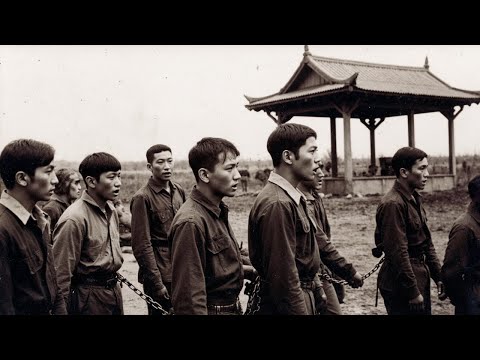
February 19, 1942. President Roosevelt signs an order that will imprison 120,000 Japanese Americans. Declassified FBI documents later reveal a chilling truth: they were targeted not just for their race, but because two-thirds of them were Buddhist. While Christian worship was encouraged in the camps, Buddhist priests were arrested first, labeled dangerous threats, their religion seen as proof they could never be truly American. What these imprisoned Buddhists did next—building makeshift temples from scrap wood, holding services behind barbed wire, fighting for their right to be both Buddhist and American—would test whether religious freedom could survive America’s darkest hour or expose it as a lie.
The smell of incense drifted through the wooden doors of the Buddhist temple on a quiet Sunday morning in San Francisco. It was 1941, and inside these walls, the world felt small and safe. Families in their best clothes sat on cushions, children fidgeting beside them. The priest’s voice rose and fell in a gentle chant that had been sung for thousands of years. Outside, cable cars clanged down the street. Inside, time moved differently.
Ten-year-old Masumi Kimura loved Sundays at the temple in California’s Central Valley. Her father was an important man there, sitting on the board, helping make decisions about festivals and classes. He had arrived in America twenty years ago with nothing but a suitcase and a dream. Now he owned a small farm where peach trees grew in neat rows. The blossoms in spring looked like pink clouds touching the ground. Her mother grew vegetables between the trees. They weren’t rich, but they had enough.
The Buddhist community in California was strong in those days. Over 60,000 Japanese Americans practiced Buddhism up and down the West Coast. They had built temples in nearly every town where Japanese families lived. These weren’t fancy buildings—most were simple wooden structures with peaked roofs and small gardens. But inside each one, families found peace. They celebrated births and mourned deaths. They marked the seasons with festivals where children danced in bright kimonos and old men played drums that sounded like thunder.
The temples served as more than places of worship. They were schools where children learned Japanese writing. They were meeting halls where farmers discussed crop prices. They were storage rooms where families kept photo albums and heirlooms. Buddhist priests married young couples and blessed newborn babies. They taught that suffering was part of life, but that peace could be found through understanding. They taught that all living things were connected.
Most Japanese Americans had never seen Japan. They were born in America—in hospitals in Los Angeles and Sacramento and Seattle. They pledged allegiance to the American flag in school. They played baseball and ate hamburgers and listened to jazz on the radio. But they also went to temple on Sundays. They also celebrated Obon festival in summer, dancing in circles to honor their ancestors. They also believed in the Buddha’s teachings. To them, being Buddhist and being American were not opposite things. They were the same thing.
The FBI did not see it that way. In secret offices in Washington, agents had been watching the Buddhist temples since 1936. They wrote reports about the priests. They made lists of names. They took photographs of who came and went. They believed that Buddhism made Japanese Americans loyal to Japan, not to America. They believed that Buddhist temples were dangerous places where people plotted against the country. They had no proof of this, but they believed it anyway.
The political mood in America was changing like storm clouds gathering on a summer day. Japan’s military had invaded China. Newspapers printed stories about Japanese cruelty. People began to look at their Japanese American neighbors with suspicion. Store owners refused to serve them. Children were called names at school. But life went on. The peach trees still bloomed. The temple bells still rang.
December 7th, 1941, started as an ordinary Sunday. Families were eating breakfast. Some were at church. Others were reading the newspaper. Then the radio announcements began. Japan had attacked Pearl Harbor in Hawaii. Bombs had fallen. Ships were sinking. Over 2,000 Americans were dead. President Roosevelt’s voice crackled over every radio in America. He called it a date that would live in infamy. He declared war on Japan.
Masumi Kimura ran home from a friend’s house when she heard the news. She found her house full of strange men in dark suits. Her mother sat frozen at the kitchen table. A man with cold eyes held a shotgun pointed at her mother’s head. Her father was on his knees in the living room. Two men were hitting him with their fists. His face was bleeding. He tried to protect his head with his arms.
The men were FBI agents. They had lists of names, and Masumi’s father was on those lists. He was a board member at the Buddhist temple. That made him dangerous. That made him an enemy. Masumi had to translate because the agents spoke no Japanese and her parents spoke little English. Her father’s hands shook as they put handcuffs on his wrists. They took him away in a black car. Masumi and her mother stood in the doorway and watched until the car disappeared.
That same day, in every city up and down the West Coast, FBI agents knocked on doors. They arrested Buddhist priests first. Before the sun set on December 7th, over 100 Buddhist leaders were in custody. They were taken to secret locations. Their families did not know where they went. The oldest priest arrested was 65 years old. He had lived in California for 40 years. He had taught Zen meditation to people of all races. He had broken no laws, but he was Buddhist, so he was taken.
The temples stood empty that night. Candles that should have been lit stayed dark. Bells that should have rung stayed silent. Inside their homes, Japanese American families whispered to each other in the dark. They wondered what would come next. Some of them had heard rumors. They had heard that the government might force them to leave their homes. They had heard the word camps, but they could not believe it. This was America. America had a constitution. America had freedom of religion. These things could not happen here.
But on February 19th, 1942, President Roosevelt signed Executive Order 9066. The order did not mention Japanese Americans by name. It just said that anyone deemed a threat could be removed from the West Coast. But everyone knew what it meant. 120,000 people of Japanese descent would be forced from their homes. 70,000 of them were American citizens. Two-thirds of them were Buddhist. And their religion, those declassified documents would later reveal, was a major reason they were marked as dangerous.
The notices appeared on telephone poles and shop windows in March 1942. They were printed in black ink on white paper. Every Japanese American family received one. The notices said they had one week to report for evacuation. They could bring only what they could carry. Two suitcases per person, nothing more. Families stared at these notices and tried to understand what was happening to their lives.
What do you pack when you can only bring what fits in two suitcases? What do you leave behind when you don’t know if you’ll ever come home? Families sold their farms for almost nothing. Cars worth $500 sold for $50. Refrigerators, washing machines, furniture passed down through generations—everything went for pennies. White neighbors stood in yards and offered insultingly low prices. They knew these families had no choice. Some neighbors promised to watch over houses and businesses. Most of those promises were lies.
The Buddhist temples opened their doors one last time. Families brought their most precious belongings: photo albums, wedding kimonos, hand-painted scrolls of Buddhist scripture, small Buddhist statues wrapped in cloth. The priests locked these treasures in basement storage rooms. They hoped the items would be safe. They hoped they would return. Some families buried their Buddhist altars in their backyards. They wrapped them in canvas and dug holes three feet deep. They covered the holes with dirt and planted flowers on top. If anyone asked, they would say nothing.
The trains came in April. Families lined up at stations with their suitcases and tags pinned to their coats. The tags had numbers on them. The people were no longer called by their names. Masumi Kimura was now number 18743. Her mother was 18744. They did not know where they were going. Armed soldiers with rifles stood on the platforms. The trains had windows, but the shades were pulled down. No one was allowed to look out.
The first stop was not the final destination. These were called assembly centers, but they were really livestock fairgrounds and racetracks. The Portland Assembly Center had been used for pigs and cattle shows. The Santa Anita Center in California was a horse racetrack. Families were given stalls where animals had lived. The smell of manure soaked into the wooden walls. No amount of scrubbing could get it out. The floors were dirt mixed with old hay. Some stalls still had metal rings where horses had been tied.
Masumi’s family got a stall that was 10 feet by 20 feet. It had been a horse stall three weeks earlier. Her mother swept the floor six times, but the smell remained. They hung blankets on the walls to create privacy. They laid thin mattresses on the ground. These mattresses were canvas bags stuffed with straw. The straw poked through and scratched their skin at night. Each stall housed an entire family. Sometimes two families shared one stall with a sheet hung between them as a wall.
The toilets were the worst part. They were in a long building with no dividers between them. Twenty toilets in a row with no walls, no doors, no privacy. Women and girls had to sit next to strangers. They learned to go late at night when fewer people were there. They learned to look at the floor and pretend they were alone. The younger children cried. The older ones stopped talking about it.
Food came from mess halls. Families stood in lines three times a day holding metal trays. The food was not like home cooking. Everything was boiled or fried in big industrial pots. Potatoes, canned vegetables, mystery meat. The meals were designed to feed thousands of people as cheaply as possible. Children who had eaten their mother’s cooking now ate from assembly lines. But at least there was enough food. No one went hungry.
In the assembly centers, families noticed something strange. Christian worship services were encouraged. The camp directors helped Christian ministers set up churches. They provided buildings and supplies. They announced service times over loudspeakers. But when Buddhist families asked to hold services, they were told no. Buddhism was still considered dangerous. Buddhist priests who had not been arrested were watched closely. Some families started attending Christian services just to have somewhere to pray. Some converted because they heard Christians were treated better. The rumors said Buddhists were being punished more harshly. The rumors said Buddhism would mark you as disloyal.
After months in the assembly centers, the families were moved again, this time to permanent camps in the desert. Ten camps scattered across seven states. Manzanar in California, Topaz in Utah, Heart Mountain in Wyoming, Minidoka in Idaho. These camps were built in the middle of nowhere, hundreds of miles from any city, surrounded by barbed wire fences. Guard towers stood at each corner with searchlights and machine guns. The guns pointed inward toward the prisoners, not outward for their protection.
The barracks were simple wooden buildings covered in tar paper. Each building was divided into six units. Each unit was 20 feet by 25 feet. In these 500 square feet, entire families lived, sometimes seven or eight people in one room. The walls were thin boards with gaps between them. Desert sand blew through the cracks. In summer, temperatures reached 110 degrees. The tar paper turned the barracks into ovens. In winter, temperatures dropped below zero. The thin walls did nothing to keep out the cold. Families stuffed newspaper in the cracks to stop the wind.
Masumi watched dust storms roll across the desert. The sky would turn brown. Sand got into everything. It was in their food, in their beds, in their hair and clothes. They tied bandanas over their faces, but still breathed in dust. Some people got sick from it. The old people coughed all night.
But here in these permanent camps, something unexpected began to happen. Buddhist families started to ask questions. If this was America, where was religious freedom? If they were citizens, where were their rights? They had been told they were dangerous because of their religion. They had been arrested, removed from their homes, and imprisoned behind barbed wire. And now, watching Christian services get support while Buddhist requests were denied, they began to understand something. Their faith was not just under attack. It was being used as proof they did not belong.
The question forming in their minds was simple but powerful: Could they be both Buddhist and American? Or would America force them to choose?
The turning point came on a cold Sunday morning in November 1942. Families in the Topaz camp in Utah woke to frost on the ground. The sky was gray and heavy. Masumi’s mother wrapped a blanket around her shoulders and said she wanted to pray. She wanted to honor her ancestors. She wanted to light incense and bow before a Buddha statue like her grandmother had taught her. But there was no temple. There were no priests. Buddhism was still being treated as the enemy religion.
That morning, a group of Buddhist families met in secret in one of the barracks. They sat in a circle on the floor. Someone had carved a small Buddha from a piece of scrap wood. It was only six inches tall and rough around the edges, but it was enough. They placed it on an empty crate covered with a cloth. An old woman lit a candle. Another woman began to chant in a voice that shook with emotion. The chant was one they all knew from childhood. The words spoke of suffering and compassion and the path to peace. Tears ran down their faces. These were not tears of sadness alone. They were tears of defiance.
After that secret meeting, the Buddhist families made a decision. They would not hide anymore. They would not pretend to be something they were not. If America promised religious freedom, then they would demand it. If the Constitution protected all religions, then it must protect Buddhism, too. They were American citizens. They were born here. They spoke English. They loved this country, even though this country had imprisoned them. And they would prove that being Buddhist did not make them any less American.
The Buddhists began petitioning the camp authorities. They wrote letters. They organized meetings. They asked for the same rights that Christians had. At first, the authorities said no. But the families kept asking—polite, but firm. They quoted the Constitution. They reminded the directors that two-thirds of the camp was Buddhist.
Finally, permission was granted. Bishop Ryotai Matsukage reopened the Buddhist Mission of North America and made a bold decision: he renamed it the Buddhist Churches of America. Mission sounded foreign and suspicious. Churches sounded American and familiar. It was a small change in words, but a giant change in meaning.
Buddhists began meeting on Sundays, calling their gatherings services, their priests reverend. They sang gathas from booklets that looked like Christian hymnals. At Heart Mountain, young Yoshiko Hyde sang the words in both English and Japanese—songs about freedom won not by prayer alone, but by action and understanding.
Families carved tiny Buddhas from scrap lumber. Reverend Nitakhan Murakita painted sacred texts onto desert stones, each brushstroke an act of resistance. At Manzanar, Buddhists and Christians built a white tower together—a monument to the dead, honoring every faith.
Masumi’s mother whispered at night: “Suffering can teach you wisdom. Religious freedom is not given. It is claimed.” The camps had not destroyed their faith. They had forged it into something unmistakably American.
So tell us—when fear rises again and a government targets a faith, will we speak up as they did?
Report this article
Select a reason for reporting:






