The roar of the engine cut through the salty air as the biplane dipped low over the water, its payload ready. But this wasn’t a bomb—it was something far more insidious. As the plane swooped over the naval warship, a valve opened, releasing a stream of volatile liquid that hit the ocean air and instantly erupted into a towering, dense cloud of white smoke. Within seconds, the mighty warship was swallowed whole, hidden from view. This wasn’t a scene from a science fiction film; it was a calculated military tactic from the 1920s, and the substance creating this surreal spectacle was titanium tetrachloride—a chemical so corrosive it could burn flesh and sear lungs.
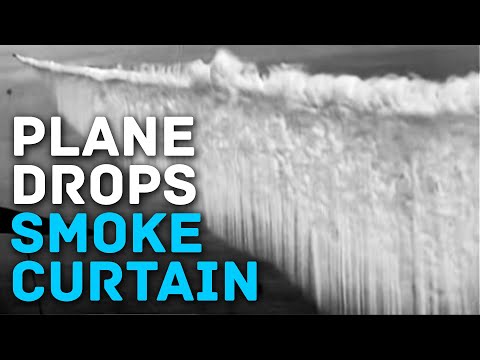
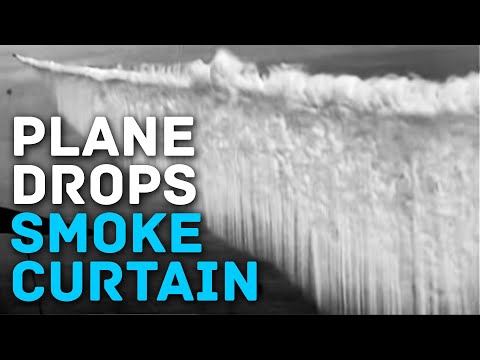
The footage, grainy and silent, shows the plane laying a smoke screen—or smoke curtain, as it was sometimes called—to conceal the ship from enemy eyes. “One reason that the air service would do this is to hide the bombing plane from the enemy ship, so the enemy ship couldn’t fire on it,” the video explains. But that was just one use. These screens were also deployed to shield ships from attacking submarines, allowing friendly bombers to swoop in undetected.
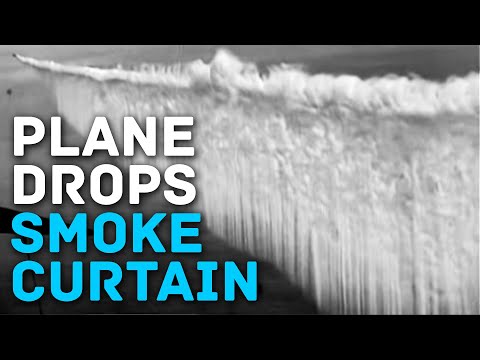
As the smoke billowed across the water, it formed a magnificent yet deadly cloud of titanium dioxide and hydrated hydrogen chloride. The hydrogen chloride immediately absorbed moisture from the air, creating an aerosol of hydrochloric acid that scattered light. The highly refractive titanium dioxide added to the effect, making the smoke impenetrable to the eye. Ships were probably advised not to go through the smoke since it’s highly corrosive. It wasn’t just a visual barrier; it was a chemical weapon in its own right. Breathing it in could damage lungs, irritate eyes, and cause surface skin burns.
Yet, despite the dangers, the tactic was effective. The smoke screen provided a surreal and stunning visual—a man-made cloud that could hide an entire warship. As the plane banked away, the smoke lingered, a silent guardian that could mean the difference between life and death in the unforgiving theater of war.
But the story of these smoke screens goes beyond mere concealment. The chemical reaction itself was a marvel of its time, harnessing the volatile nature of titanium tetrachloride to create a screen that was both a shield and a threat. “It’s not something you’d want to breathe in,” the narrator warns, underscoring the peril that lurked within the seemingly beautiful cloud.
As the 1920s progressed, navies around the world experimented with these techniques, refining the art of chemical camouflage. The footage captures a moment of innovation, where science and warfare collided to produce something both ingenious and terrifying. The plane, a small speck against the vast sky, held the power to cloak a massive warship in a toxic veil, altering the dynamics of naval combat.
Yet, the full extent of this tactic’s impact—and the stories of those who witnessed it firsthand—remains a chapter of history waiting to be explored. The smoke may have cleared, but the legacy of these chemical curtains lingered, a testament to the lengths to which militaries would go to gain an edge.
To understand how this eerie weapon came to be, one has to look back to the laboratories of the First World War, where chemists on all sides searched desperately for the next decisive advantage. Titanium tetrachloride was not new to industry—it had long been used to purify titanium and to create artificial smoke for theatrical stages. But the military saw something else in that billowing white cloud: a way to blind an enemy without firing a single shot.
The substance itself is a curious beast. In its liquid form it sits quietly in steel drums, fuming faintly whenever it meets moist air. Once released, it multiplies—one gallon of liquid can produce a smoke cloud vast enough to blanket several city blocks. For a warship trying to vanish beneath the waves, that ratio was nothing short of miraculous.
Naval strategists quickly recognized the potential. A destroyer could lay a curtain in minutes, then vanish behind it while a cruiser slipped past an enemy blockade. Submarines, forced to surface and fire their deck guns, suddenly found their targets swallowed by a wall of white. The attackers were left firing blindly into a chemical fog, their torpedoes wasted on empty water.
But the men who handled the stuff paid a price. Sailors loading the drums wore crude respirators and thick gloves, and even then, a single splash could leave a man with angry red burns across his forearms. “You didn’t want to be downwind when the valves opened,” one veteran later recalled in a dusty interview transcript. “It smelled like the devil’s own breath—sharp, burning, like acid on a hot stove.”
There were accidents, too. Ships caught in their own screens, crews blinded for days, lungs seared by the hydrochloric acid mist. The navy learned to time the releases carefully, to watch the wind and the humidity, to keep the curtain between themselves and the enemy—never over their own decks.
By the late 1920s, the tactic had become almost routine in naval exercises. Photographers captured the spectacle again and again: a lone biplane trailing a river of white, a battleship dissolving into the haze like a ghost. To the public, it looked like magic. To the admirals, it was a grim necessity—a way to survive in an age when artillery ranges had outgrown the horizon itself.
Yet even as the technique matured, new technologies were already creeping onto the scene. Radar, still in its infancy, promised to see through any cloud. Aircraft carriers were beginning to replace the battleship as the true queen of the sea. The smoke screen, for all its chemical ingenuity, was living on borrowed time.
Still, for a brief decade, titanium tetrachloride ruled the waters as the strangest of weapons—a shield made of acid, a fog that could blind an entire fleet. And somewhere in the archives, the grainy footage remains, showing a small plane weaving its toxic magic across the sea, a ghost of a war that never quite happened the way anyone expected.
The men who flew those smoke-laying missions were a breed apart. They flew low—dangerously low—often just a hundred feet above the waves, because the heavier-than-air vapor needed to be released close to the water to form a proper curtain. Too high, and the wind simply tore the cloud apart before it could thicken. Too low, and the plane itself risked flying straight into its own creation.
Pilots described the sensation as flying into a thunderhead that smelled of a chemistry lab. The cockpit filled with a faint, acrid sting even through the leather and canvas, and more than one aviator came back with watering eyes and a raw throat, cursing the stuff under his breath.
The technique demanded a strange kind of courage. There was no enemy fire to dodge during the run—at least, not at first. The danger was invisible. A sudden shift in the wind could push the cloud back over the plane, and the pilot would find himself blind, choking, and skimming the sea with no horizon to guide him.
Ground crews learned to hate the chemical as much as the airmen did. The drums corroded their storage racks, ate through canvas covers, and left a permanent white crust on the decks of the tenders. “Everything the stuff touched turned to rust or ash,” one mechanic wrote in a maintenance log now preserved in a naval museum. “We scrubbed those planes for weeks, and the fittings still crumbled in our hands.”
And yet the demand never slackened. As the 1930s approached, naval planners drew up elaborate diagrams showing exactly where a smoke curtain should be laid to screen a convoy, a landing, or a retreating fleet. The white cloud became a fixture of every major exercise, photographed and studied and refined.
But the same qualities that made titanium tetrachloride so effective also made it a nightmare to control. On one exercise in the Mediterranean, a sudden squall caught a curtain mid-formation and dragged it across the very ships it was meant to protect. Crews below decks sealed hatches and held their breath while the acid mist rolled over the funnels.
When the cloud finally cleared, the damage was counted in ruined paint, blistered steel, and a dozen men sent to the infirmary. The admirals took note. If the wind could betray you as easily as it could hide you, perhaps the smoke screen was not the invincible veil it had once seemed.
It was a lesson that would echo in the years to come, as the skies over the oceans began to fill with something the smoke could never hide from—the drone of engines and the silent sweep of radar, both of which cared nothing for clouds.
By the time the Second World War arrived, the white curtain still had its moments—a destroyer laying a screen to cover a convoy’s turn, a landing craft vanishing as it approached a hostile beach. But the game had changed. Radar operators could see through the haze, and carrier aircraft attacked from angles no smoke could blind.
The old footage, silent and flickering, became a relic almost overnight. “The smoke screen was a beautiful idea,” one postwar historian wrote, “but it was a solution to a problem that no longer existed.” The drums of titanium tetrachloride were drained, the storage racks scrapped, and the men who had handled the corrosive stuff quietly moved on.
Yet the chemical itself never truly vanished. It found new life in industry—purifying titanium for jet engines, seeding clouds for rain, even drifting across city skies as theatrical fog. The weapon had become a tool, the acid mist tamed into something harmless and ordinary.
Still, on quiet nights, some old sailors swore they could smell it again—that sharp, burning breath of the devil’s own fog, rolling across the water like a ghost that refused to fade. The smoke had cleared decades ago, but its memory lingered, a strange and toxic magic born of a war that never quite happened the way anyone expected.
What would you have done, standing on that deck as the white cloud swallowed the horizon—trust the screen to hide you, or hold your breath and pray the wind didn’t turn? Let us know in the comments below.
Report this article
Select a reason for reporting:






