The ramp dropped, and the world dissolved into a single, continuous roar. It wasn’t gunfire—not the countable pop-pop-pop the men had trained to expect. This was a tearing, a ripping of the air itself, so fast the ear couldn’t separate one shot from the next. Twenty rounds per second. The human brain, wired to parse rhythm, heard only a buzzsaw. And it did not stop.
On Dog Green Sector, Omaha Beach, 6 June 1944, 230 men of Company A hit the waterline at 0630. Ten minutes later, roughly 210 were down. Ninety percent of the company, gone before most had cleared the surf. They never saw the gun that killed them. They only heard it—a sound veterans would later compare to canvas ripping, a giant zipper pulled across the sky.
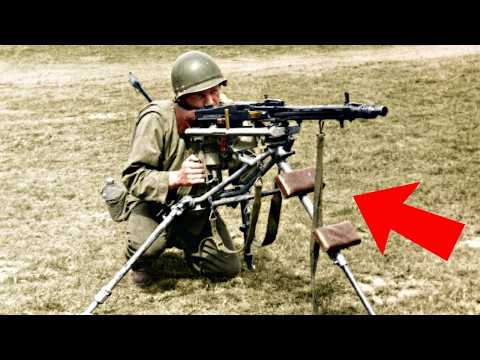
The weapon was the MG 42. And its story begins not with a gunsmith, but with a lantern maker.
By 1941, the German army had inverted infantry doctrine. The squad did not support the machine gun; the squad existed to serve it. Every rifleman carried ammunition for the gun. Every tactical decision flowed from where that gun could fire. The Americans brought firepower to help their men. The Germans brought men to feed their firepower.
But the MG 34, the weapon that made this doctrine possible, was failing. It was a precision instrument—150 man-hours per unit, scarce alloy steels, machining tolerances that demanded skilled labor Germany was running out of. It jammed catastrophically in mud, dust, and the Russian cold. Germany needed more machine guns than precision engineering could deliver.
The man who solved this was Dr. Ing. Werner Gruner, a mass-production specialist at Metall und Lackierwarenfabrik Johannes Großfuß AG—a company whose pre-war product line was sheet metal lanterns. Gruner had never designed a firearm. He enrolled in a Wehrmacht machine gunner’s course before he touched a drafting table because he wanted to understand what the man behind the gun actually needed.
His answer was to throw out the machinist’s playbook. The MG 42’s receiver and barrel jacket were stamped from a single sheet steel blank and spot welded. No milling, no hand fitting. Same as the MG 34, same belts, same tripod, same silhouette. Grüner preserved every point of familiarity so that a crew trained on the MG 34 could pick up an MG 42 and fight with it the same afternoon.
Design contest in ’37, functional model in ’38, first combat with the Afrika Korps by May of ’42. Production cost: 250 Reichsmarks and 75 man-hours. Half the price and half the labor of the weapon it replaced. That efficiency is why 408,000 were built.
But Grüner’s production shortcut created something he had not designed for. The MG 42 fired at roughly 1,200 rounds per minute. At 600 rounds per minute—the rate of Allied weapons like the Browning, the Vickers, and the Bren—the interval between shots is 100 milliseconds. The human ear resolves each report as a distinct sound. At 1,200 rounds per minute, the interval drops to 50 milliseconds, below the threshold where the brain can separate one shot from the next.
What soldiers heard was not gunfire. It was a continuous tearing roar. The MG 42 had crossed an acoustic line that no previous infantry weapon had crossed.
The gun devoured everything its crew could carry. A barrel burned out after 250 rounds of sustained fire—roughly 12 and a half seconds of trigger time. Crews hauled two to four spare barrels in asbestos-lined sleeves, swapping one in six to eight seconds. The entire rifle squad doubled as ammunition bearers.
On the east bank of the river Ingulez in Ukraine, 31 October 1943, heavy machine gunner Günter Koschorek dug two MG 42s into a hillock overlooking a shallow hollow. Soviet infantry came in waves, 50 meters away, driven forward by a commissar’s whistle. Koschorek wrote it down that night. From his diary: the first waves were cut down by fire from the two guns. Those behind fell back into the hollow. The commissar blew his whistle again, and again the men climbed. Anyone who made it over the edge could not get further than one or two paces before he was hit.
The geometry was absolute. The hollow was a natural kill zone. The hillock gave elevation, and two MG 42s firing interlocking arcs sealed every exit. This was the weapon in its designed role—a squad-level instrument that turned terrain into a death sentence.
Five months later at Monte Cassino, the first Fallschirmjäger division proved the MG 42 could do the same thing in rubble. On 15 February 1944, 1,400 tons of Allied bombs flattened the ancient monastery and created better defensive positions than the standing walls had ever been. MG 42s concealed in collapsed stone repelled four Allied assaults across four months. The British 1st Battalion Royal Sussex Regiment lost over 50% of a single company on the first attempt. In the final May assault, Polish 2nd Corps sustained the highest casualty rate of any Allied formation at Cassino—43%, 3,784 casualties, 860 of them killed.
You could not see the guns. You could not suppress what you could not find. You could only hear the tearing sound echoing off stone and know that it was pointed at you.
Then came the day the MG 42 broke an invasion beach.
At Widerstandsnest 62, on Omaha’s eastern flank overlooking Easy Red and Fox Green sectors, Gefreiter Heinrich Severloh of the 352nd Infantry Division manned a single MG 42 in a foxhole 170 meters from the seawall. Severloh was not an infantryman. He was an orderly assigned to artillery observer Senior Lieutenant Bernhard Frerking.
When the first landing craft dropped their ramps at 06:30 on 6 June 1944, Severloh began firing. He did not stop for nine hours. Approximately 13,500 rounds of MG 42 ammunition, 400 rounds from two Karabiner 98k rifles. Barrel changes he lost count of. Resupplied by an unknown sergeant who crawled belts forward from a nearby bunker.
When Frerking finally ordered the retreat at 15:30, Severloh grabbed the MG 42 to carry it out. The receiver was so hot it burned his hands, and he dropped it. WN 62 had fallen by 09:05 that morning to elements of Company G, 16th Infantry Regiment, led by Technical Sergeant Philip Streczyk, who earned the Distinguished Service Cross taking that position.
The gun’s true killing power was never the weapon alone. It was the geometry. Across Omaha, 85 machine gun nests in 15 Widerstandsnest created overlapping fields of fire so dense that no point on that beach lay outside the coverage of at least two guns. The MG 42’s rate of fire meant the window a man was exposed—rising from behind an obstacle, crossing open sand—was enough. The interlocking fire did the killing. The MG 42 was the instrument that made it possible.
In 1943, the US War Department had produced its answer to the terror: Film Bulletin Number 181, Automatic Weapons, American versus German. A 13-minute training film that opened on a green replacement pinned down by MG 42 fire while his veteran squadmates calmly prepared a flanking maneuver. The film’s concluding message to every soldier about to ship overseas: their bark is worse than their bite.
The National World War II Museum’s verdict on that claim is blunt. The War Department would have had a tough time selling that line to veterans of the landing at Omaha Beach.
By 1944, the actual Allied response had nothing to do with bark or bite. Both US and Commonwealth infantry doctrine shifted fundamentally. Rapid suppression with base-of-fire elements, smoke grenades, indirect mortar and artillery fire to neutralize MG 42 positions. In bocage country, a single MG 42 dug into a hedgerow embankment could pin an entire American company in a Norman field. The standard response became: wait for the Sherman. An institutional admission that infantry alone could not solve the problem the MG 42 created.
Severloh, for his part, claimed after the war to have personally killed between 1,000 and 2,000 men on Omaha Beach. The math makes this impossible. Total Allied casualties across the entire six-mile front—from all weapons, all strong points, all causes—were 2,374. Both American and German historians reject the claim. His round count and duration are credible. His kill figure is not.
And German doctrine itself acknowledged the gun’s hunger. The practical sustained rate was 154 rounds per minute, barely higher than the MG 34. The 1,200-round cyclic rate was the terror weapon. The doctrinal rate was the barrel survival rate.
In 1943, Saginaw Steering Gear, a division of General Motors, tried to copy the MG 42 in American .30 caliber. The first prototype fired exactly one round and jammed. The cartridge was 6.35 millimeters too long. The program died on the test range.
The MG 42 did not.
It was rechambered for NATO 7.62 millimeter, redesignated the MG 3, and served as the Bundeswehr’s standard general-purpose machine gun for over half a century. Still in front-line German service into the 2020s before supplementation by the Heckler & Koch MG 5 began. The Yugoslav M53, a direct copy in the original Mauser caliber, saw combat in the Balkan Wars of the 1990s. The feed mechanism reached American hands through the M60, whose first prototype was an FG 42 action with an MG 42 top cover bolted on. Over 40 nations fielded the design or its descendants.
Robert Smith, director of the Fort Riley Museums, summarizing what First Infantry Division veterans of Omaha told him across decades of interviews, distilled it to two things. Every German platoon had one of these weapons. And fear. Not the specs, not the caliber, not the barrel change time. The sound.
The town of Bedford, Virginia, population 1,300, lost 19 men on Dog Green sector that morning. Four more in the days after. The highest per capita loss of any American community on D-Day. The National D-Day Memorial stands in Bedford today.
Every man who survived Omaha remembered the same thing first. Not the cold water, not the steel obstacles. The sound. A tearing noise that started when the ramp dropped and did not stop.
That sound outlived the men who heard it. It crossed the Atlantic in the memories of veterans and settled into the doctrine of every army that followed. The MG 42’s descendants still fire today, and the lesson Gruner’s lantern factory taught the world has never been unlearned: a weapon is not merely a machine, but a message written in sound.
The Americans learned it the hard way on Dog Green. They answered with smoke, with Sherman tanks, with the grim patience of men who understood that courage alone could not cross a kill zone. They did not defeat the tearing sound. They learned to survive it.
And so the gun that a sheet-metal specialist built to be cheap became the most feared infantry weapon of the century, not because it was precise, but because it was relentless. It was never about the 250 Reichsmarks. It was about the twenty rounds per second that turned a beach into a butcher’s floor.
Bedford still remembers. The memorial still stands. The sound, for those who were there, never truly stopped.
So here is the question that remains: if you had been in that landing craft, hearing that tearing roar for the first time, would you have recognized it for what it was—or would your mind have refused to name it?
Report this article
Select a reason for reporting:






