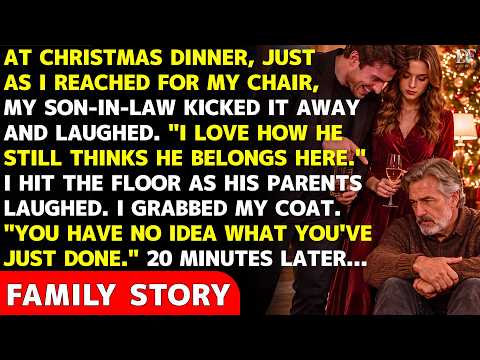
The moment my son-in-law’s boot connected with my chair, I knew this Christmas dinner would be different. But I never imagined how different—or how fast the truth would come crashing down on all of them.
I was just an old man holding an apple pie, standing in a warm kitchen that smelled of roast turkey and cinnamon. My daughter, Karen, had hugged me tight, and for a moment, I believed every word of her welcome. Fifteen of us gathered around the table, Corbin’s parents near the head, a few co-workers filling out the far end. I pulled out my usual chair—the one I always took at family dinners—and that’s when Corbin kicked it. Not a nudge. A real kick. His boot sent the chair sliding two feet across the hardwood, and I went down before I even understood what was happening.
My hip cracked against the floor. My breath left me in a rush. For one long second, nobody moved.
Then Garrett, Corbin’s father, burst out laughing. That deep, booming laugh of his. Adelaide followed right behind him, pressing her napkin to her mouth like she was trying to hold it in and failing. Corbin looked down at me, sprawled on the floor, and said it loud enough for every person at that table to hear: “I like how he still thinks he belongs here.”
“Corbin, get him a hand up,” Adelaide said between giggles, not moving an inch from her own chair.
“He’s fine,” Corbin said. “Look at him. He’s fine.”
One of Corbin’s co-workers, Pete, half rose from his chair. “That wasn’t funny, man.”
“Sit down, Pete,” Corbin snapped. “He’s fine.”
Pete sat back down, his face going red, but nobody moved to help me either. My ears were ringing. My hip was screaming. But none of that hurt as much as what happened next. Or rather, what didn’t happen. I looked past Corbin, past his laughing parents, straight at my own daughter.
“Karen,” I said.
She sat frozen, hands folded in her lap, staring at the tablecloth. She didn’t answer me. She didn’t stand up. She didn’t say one word. That look on her face did more damage than the fall ever could.
I pressed my palms against the cold floor and pushed myself up. My left knee throbbed. My pride throbbed even worse. I brushed off my slacks and walked to the coat rack without looking at anyone else.
“Come on, EMTT. It was just a chair,” Garrett called after me, still grinning.
“Dad, wait,” Karen finally said, her voice small, but she still didn’t leave her seat.
I turned back around, buttoning my coat with fingers that wouldn’t quite stop shaking, and looked Corbin dead in the eye. “You have absolutely no idea what you just did,” I told him.
“Neither do you, old man,” Corbin shot back, smirking, and Garrett laughed again like I’d told a joke instead of a dead serious warning.
I picked up my apple pie from the counter and walked out that front door without saying goodbye to a single soul. The porch light caught the snow falling sideways in the wind. I stood there a moment, my chest tight, listening through the window as Garrett’s laughter rolled on like nothing at all had happened.
I got in my truck, hands gripping the cold wheel so hard my knuckles went white, and thought about all those years of Christmas dinners, all those years of showing up without fail, while my daughter sat frozen, never once rising to help me.
I pulled out of the driveway and didn’t drive straight home. I turned left instead of right at the four-way stop, toward the one empty place I knew I could sit alone before I did something I could never take back.
I picked up my phone.
The gas station lot was empty except for a truck idling near the propane cage and a kid inside sweeping the floor behind the register. Snow kept falling past the street light, thick white flakes catching in my headlights before disappearing into the dark. I sat there with the engine running, the heater humming, my thumb hovering over the banking app on my phone.
I thought about every dollar I had handed that family over the years. The down payment on their house. The furnace repair the winter it broke at 2 in the morning. The property taxes when their escrow account came up short. The new roof after that spring hailstorm tore through half the neighborhood. The car lease I co-signed because Corbin swore it would lower the payment. The credit card I had given Karen for emergencies, the one I never once thought to check closely enough.
My chest was still tight from the fall, but something else had settled in underneath it. Something colder and steadier than anger.
I opened the app. I found the backup card first, the one tied to my name that I had given Karen for emergencies. I locked it. Then I scrolled through my recurring payments, cancelling the ones I could stop with a single tap right there in the truck. My thumb moved fast, deliberate, like I had been planning this for years without knowing it.
I set the phone down in the cup holder and just breathed for a minute, watching my own breath fog up the windshield.
It did not take long. Less than 20 minutes after I locked that card, it buzzed against the plastic. A text from the bank. Transaction declined.
I stared at those two words for a long moment before another notification stacked right on top of it. Second transaction declined.
I could picture it clear as day. Corbin standing at some checkout counter, his card getting rejected in front of a cashier and whoever else happened to be in line behind him, his face going red the way it always did when things did not go his way.
My phone lit up. Corbin’s name flashed across the screen, the call ringing through the quiet cab of my truck. I let it ring itself out. Thirty seconds later, it started again. I did not touch it. A third call came in, and this time, I flipped the phone face down against my leg so I would not have to watch his name light up over and over.
When it finally stopped, a voicemail notification popped up instead. I hesitated, then pressed play. Corbin’s voice came through tight and clipped. “EMTT, call me back. Something’s wrong with the bank. I need you to fix this.”
Not one word about the chair. Not one word about the floor.
The gas station kid finished sweeping and disappeared into a back room. Snow kept falling. My hands had finally stopped shaking.
Then my phone buzzed one more time, a text this time, and I turned it back over out of habit before I could stop myself. It was Karen.
“Dad, please call me back. Something’s wrong with the card.”
I read those words twice. Something’s wrong with the card. Not something’s wrong with what happened tonight. Not I’m sorry about the chair. Dad, are you hurt? Just the card.
That told me everything I needed to know about where her mind had gone first. My throat tightened and my eyes went hot and stinging right there behind the wheel of my own truck. I pressed the back of my hand against them and let out a breath that shook on its way out.
“Not tonight, Karen,” I said out loud to an empty truck, my voice cracking on her name.
I set the phone back down, screen dark, and I sat there in that gas station lot until my hands felt steady enough to drive. My hip still ached where I had hit the floor. My pride ached worse. All evening I felt something that was not shame or anger climbing up my throat. I felt clear.
Ten years I had spent making myself useful to that family, convinced that being needed was the same thing as being loved.
I turned the truck’s heater down and put it in reverse, easing out of the gas station lot onto the empty road home. The porch light was still burning when I pulled into my own driveway, snow drifting sideways past the bulb the way it always did this time of year.
I sat in the truck a moment longer, staring at my dark, quiet house, and I made myself one promise before I ever stepped inside.
“Whatever comes next,” I whispered, my hands finally still on the wheel, “I am done paying for my place at that table.”
I climbed the porch steps, my breath clouding in front of me, my knee aching with every stair. Inside, the house felt colder than the truck, colder than the night itself. It was not until I stood in my own kitchen, coat still on, hands finally steady, that I remembered the statement I had not looked at in months.
Tomorrow morning, I told myself firmly, jaw tight, I was going to open it and read every single line, no matter what it showed me.
Morning light cut through the blinds of my office at Culvin Lawn and Garden, and I sat down at my desk with black coffee going cold beside me and the credit card statement I had been avoiding for months. My hip still ached from the fall the night before—a dull throb that reminded me with every shift in my chair that Christmas dinner had actually happened, that I had not dreamed the whole ugly evening.
I scrolled past the first few charges without much thought. My eyes still tired, my mind still replaying Corbin’s boot connecting with that chair leg. Then my eyes caught on one line, then another, then a third, and my stomach dropped lower with every single one. A $400 dinner at a steakhouse downtown. $312 at an electronics store. A monthly wine subscription I had never once heard mentioned. A weekend spa charge that alone was more than I spent on groceries in a month.
I kept scrolling, and the total kept climbing. By the time I reached the bottom, the number staring back at me was over $9,000. $9,000 I had never approved, never questioned, never once thought to check closely.
My hands were shaking again by the time I picked up my phone and called Karen.
“Dad,” she answered on the second ring, her voice tight with worry. “Is everything okay? Corbin said his card got declined last night, and then this morning ours got flagged, too. I didn’t know what to think.”
“I need to ask you something,” I said, cutting her off gently. “How many times have you used that credit card I gave you, the backup one for emergencies?”
There was a pause on the line before she answered. “Twice, maybe. Once for a prescription and once for part of the water heater repair. Why, Dad? What’s going on?”
“Twice,” I repeated, my throat tightening. “Karen, I’m looking at a statement right now with dozens of charges on it. A steakhouse, an electronics store, a spa, some kind of wine club that bills every single month.”
“But that’s not me,” she said quickly, and I could hear the panic climbing into her voice. “Dad, I swear that’s not me. I would never spend like that without telling you.”
“Then who’s been using it, Karen?” I asked, keeping my voice as level as I could manage. “Because somebody has, every month for a while now by the looks of it.”
“I don’t know,” she said, her breath catching. “I honestly don’t know, Dad.”
“I want to believe you,” I said, and I meant every word of it.
“You have to believe me,” she said, her voice cracking. “Please, Dad. I don’t even know half those places.”
I read her three more charges off the screen, one by one, my finger tracing down the list. Each time she denied it a little more forcefully than the last, until her breathing on the other end of the line had gone ragged and uneven. Then she went quiet for a long moment, and when she spoke again, her voice had dropped almost to a whisper.
“A few months ago, Corbin borrowed my wallet,” she said slowly. “He said he needed to check something on my insurance card for the SUV. I didn’t think anything of it at the time.”
My chest went tight and cold all at once. “How long did he have it?”
“I don’t know, Dad. Ten minutes, maybe fifteen. I was making dinner. I wasn’t watching the clock.” Her voice broke on the last word. “Dad, please tell me you don’t think Corbin would do something like this.”
I closed my eyes and pressed my thumb against the bridge of my nose, feeling something heavy and sick settle low in my stomach. “I hope you’re right, too,” I told her quietly.
“He wouldn’t,” she said again, faster this time, like saying it twice might make it more true. “He wouldn’t do that to us, Dad. There has to be another explanation for all of this.”
“I hope so,” I said again, because I didn’t have the heart to argue with her. Not yet. Not until I had more than a hunch and a stack of strange charges to go on.
“Are you going to call the bank?” she asked, sniffling.
“Right now,” I said. “I want someone to walk me through every single transaction line by line today. And if they ask you anything, you tell them the truth. That’s all any of us can do right now. Okay?”
“Okay,” she said, her voice still shaking badly. “Dad, I’m scared.”
“I know,” I told her softly, my own voice tight. “So am I, sweetheart.”
We hung up a few minutes later, and I sat there quietly at my desk with the statement glowing on my screen, my coffee gone cold, my chest aching with a fear I could not quite name yet. Whatever this was, it felt bigger than one bad night at a Christmas dinner.
I picked the phone back up and dialed the number for my bank’s fraud department. My finger hovered over the call button for one long second before I finally pressed it, my heart pounding harder than it had any right to over a simple phone call. A recorded voice picked up first, then a hold song, tiny and looping, before a real woman finally came on the line.
“Fraud department, this is Denise. How can I help you today?”
“My name’s EMTT Culvin,” I said, reading off my account number from the top of the statement with a shaking hand. “I’m looking at a card statement with thousands of dollars in charges I never made.”
“I’m pulling that up right now, Mr. Culvin,” Denise said, her keyboard clicking on the other end. “Can you confirm the last four digits of the card for me?”
I read them off. She went quiet for a moment, typing, and then her voice changed—sharper, more careful. “Mr. Culvin, I want to flag something for you,” she said. “Earlier this morning, before you called, we had someone contact this office claiming to be you, trying to get the mailing address on this account changed and asking for a replacement card to be sent out.”
My stomach turned over slow and cold. “That wasn’t me.”
“We didn’t think it was,” Denise said. “The caller couldn’t answer our security questions correctly, so the request was denied and the account got flagged. That’s actually part of why I already had some of this pulled up before you even called in.”
“What time was that call?” I asked, my mind already racing through the morning, trying to place where everyone had been.
“A little after 8 this morning,” Denise said. “The caller left a call-back number. Since it’s your account, I can read it to you. It ends in 3067.”
I wrote those four digits on the back of the statement. They meant nothing to me yet. Eight in the morning. Corbin usually left for work well before eight. I felt my jaw tighten, but I kept that thought to myself for now, not ready to voice a suspicion I couldn’t yet prove.
“Somebody’s trying to get into my account,” I said, more to myself than to her, my voice hollow in my own ears.
“That’s what it looks like from here,” Denise said. “I’m going to walk you through every transaction on this statement one at a time, and you tell me which ones are yours. Sound good?”
“Sound good,” I said, and for the next twenty minutes, that’s exactly what we did—line by line, charge by charge—until the true picture sat there, ugly and undeniable, in front of me.
“I’m closing this card completely and issuing you a brand new number,” Denise said finally. “I’m also flagging your account for extra verification on anything going forward. Do you want me to open a fraud case for the disputed charges?”
“Yes,” I said. “Open it. Every single charge on there.”
“Done,” she said. “You’ll get a case number by mail within five to seven business days. Is there anything else I can help you with today, Mr. Culvin?”
“No,” I said. “Thank you, Denise. You’ve been more help than you know.”
We hung up, and I sat there staring at my phone, my coffee stone cold beside me, my mind circling back to the words: Someone contacted this office claiming to be you. Somebody out there had my name, my account number, enough of my information to try walking straight through my own front door.
My phone buzzed again—an email notification this time. I opened it with a thumb that still hadn’t stopped trembling. Security alert: new sign-in detected. A login attempt on my personal email account, flagged as unfamiliar, timestamped for 9:40 that morning from a device I did not recognize. I stared at the little map showing a location twelve miles from my own house—a location I never visited, on an account I rarely even used for anything beyond old photos of my late wife, Margaret, and receipts from the shop.
I changed the password immediately with hands that would not stay steady, then sat back slowly in my chair, my eyes fixed on that little map.
A knock at my office door pulled me out of it. Dale Puit stood there, one of my longtime shop hands, holding a clipboard. “You look like you’ve seen a ghost, boss,” Dale said.
“Somebody’s been trying to get into my accounts,” I said. “The bank, my email—all in one morning.”
Dale set the clipboard down. “Then you need eyes on this place. I can pick up a camera on my way in tomorrow and mount it over your office door.”
“Do that,” I said. “And Dale, keep an eye on things out front for me. I’ve got a strong feeling this is only the very beginning.”
Dale had mounted a small camera above my office door the morning after Denise’s warning. I figured it couldn’t hurt. I had no idea yet how right that instinct would turn out to be.
Corbin walked in around ten, all smiles, like nothing at all had happened five days earlier. “EMTT! There you are,” he said, spreading his arms like we were old friends reuniting. “I’ve been meaning to come by. I owe you an apology for Christmas.”
“Do you now?” I said flatly, not moving from behind the counter.
“I do,” he said, dropping his voice into something softer, more practiced. “I was out of line. Karen’s been on me about it all week. Water under the bridge.”
“We’ll see,” I said, giving him nothing.
“Come on, EMTT,” he said, laughing a little, rocking back on his heels. “You’re really going to hold a chair against me forever?”
“That chair put me flat on the floor in front of fifteen people,” I said. “So yes, I very well might.”
He wandered closer, hands in his coat pockets, eyes drifting toward the back hallway that led to my office. “So,” he said, too casually, “everything’s squared away with the bank and all that? You locked down your accounts, okay?”
“Already handled it,” I said.
“Good, good,” he said, nodding along like the answer mattered more than he wanted to let on. “What all did you end up locking exactly? Cards, the online stuff, all of it?”
“Corbin, I don’t need to walk you through every detail of my finances,” I said, watching his jaw tighten before he covered it with another smile.
“Just looking out for you,” he said. “Anyway, I should let you get back to it.”
He lingered by the register another minute, making small talk with a customer. Then I stepped out to the lot to help a customer load a mower. When I came back in, Corbin’s truck was gone.
I didn’t think much of it until Dale came to find me an hour later, wiping his hands on a shop rag, his face pulled tight with something he clearly didn’t know how to say.
“Boss, you got a second?” Dale asked.
“What is it?” I said.
“I was out back by the propane cage,” Dale said, lowering his voice even though we were alone. “Corbin was out there too, on his phone. Didn’t see me. I couldn’t make out what he was saying—his voice was real low—but EMTT, his face looked wrong. Tense, like whatever he was hearing, he didn’t like it.”
“Could you make out anything at all?” I asked.
“Not really,” Dale said, shaking his head. “A few words here and there, nothing that made sense strung together, but something about it didn’t sit right with me.”
“Nothing you could make out at all?” I pressed, needing something—anything—to hold on to.
“Not a single word I could swear to,” Dale said. “I wish I could tell you more. I really do. I just know it left him rattled.”
“You did the right thing coming straight to me with this,” I said. “Thank you for telling me,” I added quietly, my chest tightening with a heavy feeling I couldn’t quite name.
“You want me to keep an eye on him if he comes back around?” Dale asked.
“I do,” I said. “Quietly, though. Don’t let him know you’re watching.”
The rest of the afternoon passed in a blur of customers and invoices, my mind circling back again and again to Dale’s face when he described Corbin on that call—the way his voice had dropped when he told me how rattled Corbin looked. By the time I locked up for the night, my curiosity had turned into something closer to dread.
I sat down at my desk, pulled up the footage on my laptop, and started scrubbing back through the day. There—10:20 that morning, while I was out on the lot—Corbin slipped into my office when he thought no one was watching. My stomach dropped as I watched him ease open my desk drawer, the one where I kept the spare set of keys, and lift them out without a sound.
“You son of a—” I muttered under my breath, leaning closer to the screen. He slid the keys into his coat pocket. Then he pulled his phone out and, holding it over a stack of papers on my desk, snapped photo after photo, his hands moving fast and sure like he’d done this kind of thing before. He worked quickly, glancing toward the doorway every few seconds, clearly aware he had only a narrow window before someone walked in on him.
I sat there alone in the dark office long after the footage ended, my hands cold as ice, my jaw clenched so tight it ached. “What are you looking for, Corbin?” I said out loud to the empty room, my voice rough and low, though I already had a sick, sinking feeling deep in my gut that I knew exactly what the answer was going to be.
I closed the laptop slowly and sat there with my own thoughts churning for a long, heavy moment. Then I reached for my phone to check one final thing before I left for the night—whether that spare key was still sitting exactly where it belonged.
I pulled open the desk drawer myself, the one I’d watched Corbin ease shut on the footage not ten minutes earlier, and ran my hand along the back corner where the spare set had always sat. Nothing. My fingers found empty wood and nothing else. I sat back slowly in my chair, my heart hammering hard against my ribs, and stared at that empty drawer like it might somehow explain itself if I looked long enough.
He’d taken it after all. Somehow, on the footage, I’d missed the exact moment his hand closed around it, but there was no other explanation left standing. I was not going to sit here and wait to find out what he planned to do with a key to my own building—thirty-one years I had spent building this place up from nothing, one lawnmower repair at a time, and I was not about to let anyone slip through my own front door on a key I didn’t even know was missing until tonight.
I picked up my phone and called the only 24-hour locksmith I knew of in three counties. “Cole’s Lock and Key. This is Ray.” A gruff voice answered on the second ring.
“Ray, it’s EMTT Culvin out at the lawn and garden shop on Route 9,” I said. “I need every lock in this building changed tonight. Front door, back door, the office—all of it.”
“Tonight?” Ray asked, a note of surprise creeping into his voice. “That’s a lot of hardware on short notice, EMTT.”
“I know it is,” I said. “I’ll pay whatever the rush costs. This can’t wait until morning.”
“All right, then,” Ray said, a little softer now, like he’d heard something in my voice worth taking seriously. “Give me a rough count on the doors while I load up the truck.”
“Front entrance, back delivery door, and my office,” I said. “Three doors, all new hardware if you’ve got it.”
“I’ve got plenty,” Ray said. “Consider it done. Everything all right over there?” he asked.
“No,” I said honestly. “But it will be once those locks are changed.”
“I can be there in forty minutes,” Ray said. “I’ll bring enough cylinders for the whole building.”
“I’ll be here,” I said, and hung up before he could ask anything else.
I spent those forty minutes doing the only thing I could think to do. I gathered every piece of paper that mattered—the deed to the property, the insurance policies, the folder of receipts I’d started keeping the moment I found that statement—and locked them inside the old fireproof safe bolted to my office floor, the one Margaret had insisted we buy years ago for exactly a moment like this, though neither of us could have imagined it then. My hands moved fast, sorting through drawers and file folders I hadn’t touched in months, tossing anything that felt even remotely important into the growing stack beside the safe. Every few minutes, I stopped and glanced toward the front window, half certain I’d see Corbin’s truck easing into the lot, though the road stayed dark and empty the whole time.
Ray showed up right on time, his truck’s headlights sweeping across the dark parking lot, tool bag slung over one shoulder. “Rough week?” he asked, setting his bag down by the front door.
“You have no idea,” I said.
“Don’t need to know the details,” Ray said. “Just point me at the doors.”
He worked fast and quiet, moving from the front entrance to the back, then to the office door last of all. I stood in the dark shop while he worked, arms crossed, watching the parking lot through the front window, half expecting headlights to sweep across it any minute. The whine of his drill cut through the empty building over and over, sharp and grinding—the only sound in a shop that usually sat silent long after closing. Each time it started up again, I felt my shoulders tighten a little more, like the sound itself was a countdown to something I couldn’t yet see coming.
“Last one,” Ray called out from the office, and a few minutes later, he appeared in the doorway, holding out a small ring of brand new keys. “Every lock in this building’s been swapped. Nobody’s getting in here tonight without one of these.”
“What do I owe you?” I asked, already reaching for my wallet.
“We’ll settle up Monday,” Ray said. “Get some sleep, EMTT. You look like you need it.”
“I’ll try,” I said, though we both knew that was a lie the moment it left my mouth.
“Whoever’s got you spooked enough to change every lock at midnight,” Ray said, pausing at the door, “I hope you get it sorted out.”
“So do I,” I said quietly, and meant it more than he could have known.
I locked the door behind him, tested it twice with my own trembling hand just to be absolutely sure, and stood there alone in my dark shop a long while before finally heading home, the new keys—cold and unfamiliar—in my palm.
Two nights later, my phone lit up on the nightstand at a quarter past midnight. The camera app. Motion detected. Front entrance. My hand was already reaching blindly for my boots before my mind had even finished catching up with what I was looking at. I pulled my boots on, grabbed my truck keys off the hook by the door, and drove the ten minutes to the shop with my heart pounding harder than it had any business doing at that hour.
I didn’t pull into the lot. I parked half a block up the street instead, killed my headlights, and opened the camera app with hands that wouldn’t quite hold still. There he was, right there on my screen in grainy black and white—a man standing at my front door, working something into the lock. I watched him try once. Nothing happened. He jiggled it, tried again, his shoulders hunching with frustration I could practically feel through the phone screen. He stepped back, looked up at the building like it had personally betrayed him, glanced quickly over both shoulders at the empty street, and tried a third time—harder this time, his whole body leaning into the door.
Ray’s new hardware held firm and steady. Whatever old key he was holding, it wasn’t opening a single thing tonight.
The figure finally gave up, shoving whatever he’d been holding back into his coat pocket, and turned to walk away from the building. I leaned forward in my seat, watching the small screen so closely my eyes started to water. He crossed under the street light at the edge of the lot, and that’s when I saw it—that particular walk, the slight hitch in his right step from the knee surgery he never let anyone forget about, the way he always favored that leg just a fraction when he thought no one was paying attention. I would have known that walk anywhere on Earth. Thirty-seven years old, and he still moved like a man twice that age whenever his knee started acting up on him.
“Corbin,” I said out loud, alone in my truck, my voice barely more than a whisper.
I watched him climb into a dark sedan parked around the corner—one I didn’t recognize at all—and pull away slowly without ever once looking back toward my building. My hands were shaking against the steering wheel by the time his taillights disappeared down the road. I sat there a long moment, my chest heaving like I’d run the whole way instead of driven it, before I finally picked up my phone and called Dale, needing to hear another voice more than anything.
“EMTT?” Dale answered, his voice thick with sleep. “It’s after midnight. Is everything okay?”
“Somebody just tried to get into the shop,” I said. “The cameras caught it.”
“What? Are you there right now? Did they get in?” Dale’s voice sharpened instantly, wide awake now.
“I’m parked down the street,” I said. “And no, they didn’t get in. Your locks held, Dale. Ray did good work.”
“Thank God,” Dale said. “Did you see who it was?”
I closed my eyes, picturing that walk again—that particular hitch in his step under the street light. “Yeah,” I said quietly. “I saw exactly who it was.”
“Corbin,” Dale said, not even a question.
“Corbin,” I confirmed, my voice flat and heavy in my own ears.
“Are you sure, EMTT?” Dale asked. “Really sure? That’s a serious thing to say about your own son-in-law.”
“I’m sure,” I said. “I’ve watched that man limp around a Fourth of July barbecue on that same knee for years. I’d know that walk anywhere, Dale, day or night.”
“EMTT, that’s attempted burglary,” Dale said, his voice rising. “You need to call the police.”
“I know what it is,” I said. “I need a little time to think about how I want to handle this.”
“He tried to break into your business in the middle of the night,” Dale said. “What’s there to think about?”
“There’s a lot to think about,” I said, my throat tight. “He’s still my daughter’s husband, Dale. Whatever I do next is going to land on her, too, whether she deserves that or not.”
“That’s a lot to carry on your own,” Dale said, his voice gentler now. “You don’t have to figure it all out tonight.”
“I know,” I said. “But I’m not going to be able to sleep either way, so I might as well start thinking it through.”
“I hear you,” Dale said, quieter now. “But you be careful. A man desperate enough to try something like this twice isn’t going to just stop.”
“I know,” I said. “Get some sleep. I’ll see you in the morning.”
I hung up and sat there in the dark cab of my truck a long while, watching the empty street where his taillights had vanished, turning something heavy and cold over in my mind. This wasn’t about a few thousand on a credit card anymore. This wasn’t about spa charges or steakhouse dinners or a wine club he never mentioned. A man didn’t drive clear across town well after midnight and try three separate times to break into his own father-in-law’s locked building unless he was chasing something a whole lot bigger than that.
“This isn’t about overspending anymore,” I said out loud to the empty street, my breath fogging in the cold night air. And for the first time since that chair hit the floor on Christmas, I felt something colder than anger settle deep into my chest.
Karen showed up at the shop the next afternoon without calling—her face pale, her coat buttoned wrong, like she’d thrown it on in a hurry. “Dad, Dale called me,” she said the second she walked through the door. “He said something happened last night. What’s going on?”
“Come on back to the office,” I said. “You need to see this for yourself.”
“See what?” she asked, following me down the hallway, her voice already trembling. “Dad, you’re scaring me.”
I pulled up the laptop and sat her down in front of it. “Two clips,” I said. “Watch them both before you say anything.”
I played the first one—the office footage from a few days back. Corbin easing my desk drawer open, photographing papers off my desk like he’d rehearsed it. Karen’s hand flew to her mouth halfway through. “That’s your office,” she whispered. “That’s your desk.”
“Keep watching,” I said quietly.
I played the second clip—the one from last night. The figure at the front door working a key that no longer fit, trying three times before giving up and disappearing around the corner under the street light.
“That could be anyone,” Karen said, though her voice had gone thin and unsteady. “The picture’s grainy, Dad. You can’t even see a face.”
“Look at the walk, Karen,” I said gently. “You’ve watched that man limp around every Fourth of July cookout for years. Tell me you don’t recognize it.”
She stared at the screen a long moment, her jaw working, her eyes filling before she finally spoke again. “I don’t want it to be him,” she said, her voice cracking. “Dad, I need to hear him explain this. There has to be something we’re missing.”
“I understand wanting that,” I said. “But Karen, I need you to actually listen to whatever explanation he gives you. Not build one for him in your head before he even opens his mouth.”
“I’m not doing that,” she said quickly, defensively, her chin lifting.
“You told me twice he wouldn’t do that before you’d even heard him say a word about it,” I said. “That’s what I’m talking about.”
“That’s different,” she said, though her voice wavered on the words. “That was before I saw any of this.”
“You’ve been doing it since Christmas,” I said, my voice sharper than I meant it. “Every single time, there’s a reason, there’s a story, there’s some version where none of this is really happening.”
She flinched like I’d struck her, her eyes dropping to her lap, and the office felt heavy around us both for a long, aching moment.
“There’s something else,” she said finally, wiping at her eyes. “Something I keep thinking about. A few weeks before Christmas, Corbin asked me what I thought this property was worth. The shop, the land, all of it. I didn’t think anything of it at the time. I figured he was just curious.”
My stomach turned cold. “What else did he ask?”
“He mentioned a loan,” Karen said, her voice dropping. “Something about a business loan he was looking into. He asked if I thought you’d ever consider using the land as collateral if he needed it.”
“And what did you tell him?” I asked, my chest tightening.
“I told him you’d never do that,” she said. “I told him this place means everything to you. He just nodded and dropped it. I swear, Dad, I didn’t think it meant anything at the time.”
“Did he ever bring it up again?” I asked.
“Once,” she admitted, her voice barely above a whisper. “Maybe a week later. He asked if you’d ever thought about retiring, selling the land, taking it easy for once. I told him you’d never even consider it. And he changed the subject.”
“I would never consider it,” I said firmly. “Not now, not ever. It means a lot more now, knowing he asked.”
“What are you going to do?” she asked, her voice small again.
“Now? Listen to his answer when you finally get one,” I said. “Don’t make up the reason for him before he gives it to you. That’s all I’m asking, Karen. Just listen. Really listen to whatever comes out of his mouth.”
She sat there a moment longer, staring at the frozen frame of the grainy footage on the screen, her hands twisting together in her lap. “I need to go talk to him,” she said, standing up abruptly, gathering her coat around her shoulders.
“Karen—” I started.
“I need to hear it from him, Dad,” she said, cutting me off, her eyes red and swimming. “I can’t just believe a video and a walk. I need to hear him say it isn’t true.”
She picked up her purse from the corner of the desk and walked toward the door, her steps quick and unsteady on the old hardwood floor. I watched her go, my heart aching with every step she took away from me, wishing I knew some way to make her stay long enough to hear the rest of what I was afraid to tell her. The door clicked shut behind her, and I sat alone at my desk with the grainy footage still frozen on the bright screen, wondering how many more painful answers she was going to have to hear before she finally believed what was right in front of her the whole time.
If you’re still with me tonight, stay close. Because before I tell you what my daughter suddenly remembered from that Christmas night and why it changed everything I thought I knew, I need to know you’re still out there. Type the word TWIST in the comments—nothing else. And one more thing: the story ahead includes a few details that may not be entirely factual. If that’s not what you came for tonight, feel free to turn it off right here.
Karen came back to the shop the next afternoon, quieter than I’d ever seen her, and settled into the chair across from my desk without saying much of anything about how things had gone with Corbin. “You don’t have to tell me everything,” I said gently. “Just tell me you’re okay.”
“I don’t know what I am right now,” she said, staring down at her phone in her lap. “He denied all of it, Dad. Every single thing—the office, the phone call, even the key. He said I was letting you turn me against my own husband.”
“And what did you say to that?” I asked.
“I told him I saw what I saw,” she said, her voice wavering. “He got angry, Dad. Really angry—in a way I’ve never seen from him before. It scared me a little, if I’m being honest.”
“I don’t like hearing that,” I said, my jaw tightening.
“I’m fine,” she said quickly, though her eyes said otherwise. “I just needed somewhere quiet to sit for a minute before I drove home.”
Her phone buzzed in her hands—some notification lighting up the screen—and she glanced down at it out of habit. “It’s the family photo memories thing,” she said. “Comes up every year around this time.”
“What is it?” I asked.
“Pictures from Christmas,” she said, scrolling slowly. “Somebody in the group chat must have posted the album.”
I watched her face change as she scrolled—her thumb slowing, then stopping completely. “Karen, what is it?”
“Oh,” she said, her voice suddenly tight. “There’s a picture from right before dinner. Corbin’s leaning in close to his dad. I never noticed it before.”
“Noticed what?” I asked, leaning forward.
“I remember this exact moment now,” she said, her eyes filling fast. “Dad, I heard him say something to Garrett right before we all sat down. I didn’t think anything of it at the time. It was just noise in a crowded room.”
“What did he say?” I asked, my chest already tightening with dread.
“He leaned in and said, ‘Tonight, just let me handle him.’” She said, her voice cracking on the last word. “I thought he meant helping carry the turkey out or something. I swear I didn’t think anything of it.”
“Handle him,” I repeated slowly, the words landing heavy like stones in my stomach. “Karen, that wasn’t about the turkey.”
“I know that now,” she said, tears finally spilling over. “Dad, I’m so sorry. I heard it and I let it go.”
Something else clicked into place in my own memory—right then, something I hadn’t thought about since that night. “Garrett had his phone out before we even sat down,” I said slowly. “I remember thinking it was strange. He propped it up against the centerpiece, angled it like he was trying to get everyone in frame.”
“He was filming,” Karen said, her hand flying to her mouth.
“He was filming my chair,” I said, the realization settling cold and heavy across my chest. “Not the table, not the food. My chair, Karen—before Corbin ever touched it.”
“Dad, that means—that means somebody planned to catch it on camera,” I said. “Which means somebody planned for it to happen in the first place.”
She sat forward, gripping her phone so hard her knuckles had gone white. “Why would they want that on video? What could they possibly want with footage of you falling?”
“I don’t know yet,” I said. “But I intend to find out.”
“This can’t be real,” she whispered, shaking her head slowly like saying it out loud might undo it. “Dad, they planned this. They actually planned to hurt you and film it happening.”
“It would appear that way,” I said, my voice rougher than I meant it to sound.
“What kind of person does that to their own father-in-law?” she asked, her voice breaking entirely now. “What kind of person films it?”
“The kind of person who wanted proof of something,” I said slowly, thinking it through out loud as the pieces kept sliding into place. “Maybe proof I was frail. Proof I couldn’t be trusted to run this place, or make my own decisions, or live on my own.”
“Why would he need proof of that?” Karen asked, wiping at her eyes with the back of her hand.
“Why, I don’t know yet,” I said. “But a man doesn’t plan a moment like that and film it unless he thinks he’s going to need it for something down the road.”
“That’s terrifying,” she whispered.
“It is,” I agreed. “But it also means we’re not just dealing with a bad temper or bad manners anymore. We’re dealing with somebody who thinks ahead.”
I didn’t have any more answers than that. I sat there across from my own daughter, watching her come apart over a single overheard sentence from a photo she’d scrolled past a hundred times without ever once seeing it for what it truly was.
“That chair didn’t get kicked because he lost his temper that night,” I said quietly, my mind circling back through every second of that evening with new and terrible clarity. “It was staged—every part of it. The camera angle, the timing, all of it.”
“Not a coincidence,” Karen said, echoing the thought before I could even finish forming it myself.
“No,” I said firmly. “Not a coincidence at all.”
Wanda Kesler came into the shop around noon, browsing the mulch bags far longer than any person needed to, and I knew before she said a word that she hadn’t driven out here for lawn care. “EMTT, how are you holding up these days?” she asked, setting down a bag she clearly wasn’t buying.
“Fine, Wanda,” I said carefully. “Why do you ask?”
“No reason,” she said, though her eyes said otherwise. “Just heard some things around town, is all. Figured I’d come see for myself how you’re doing.”
“What kind of things?” I asked, setting down my clipboard.
“Garrett Ashworth’s been talking at the diner,” she said, lowering her voice like she was doing me a favor. “Saying you’ve been acting strange lately. Erratic was the word he used. Said something about you accusing family of things that never happened.”
My chest tightened. “Is that so?”
“He made it sound like you’d had some kind of breakdown,” Wanda said, studying my face now, like she was trying to decide for herself. “Of course, looking at you, you seem just fine to me.”
“I am fine,” I said, my jaw tight. “Whatever Garrett’s telling people, it isn’t true.”
“I figured as much,” she said. “But you know how this town talks, EMTT. A story gets repeated enough times, people start believing it whether it’s true or not.”
“Thank you for telling me,” I said. “I mean that.”
“What are you going to do about it?” Wanda asked, studying me with genuine concern now.
“I honestly don’t know yet,” I admitted. “But I’m not going to let a rumor like that go unanswered forever.”
“Good,” she said. “Because half this town’s known you since you were fixing bicycles as a teenager, EMTT. Don’t let one loud man rewrite that overnight.”
“I’ll try not to,” I said, managing a small, tired smile for her.
“Just watch yourself,” she said, picking her purse back up. “People are already asking questions.”
She left without buying a thing, and I stood there behind the counter a long moment, that cold feeling from the night in my truck creeping back into my chest.
Dale found me an hour later holding a printout of the day’s schedule, his face grim. “EMTT, we’ve had three cancellations already today,” he said. “The Hendersons, the Millers, and that big commercial job out on Fairview.”
“Three,” I said. “In one morning?”
“The Hendersons said they’d heard some things and wanted to go with somebody else for a while,” Dale said. “Wouldn’t say more than that.”
“And the Millers?” I asked.
“Same kind of vague excuse,” Dale said. “Said they’d circle back sometime—whatever that’s supposed to mean. And the Fairview job just cancelled outright. No explanation at all.”
“That’s thousands of dollars in work gone in one morning,” I said, doing the math in my head even as the dread settled deeper.
“I know,” Dale said. “It doesn’t feel like a coincidence to me either.”
“Heard some things,” I repeated slowly. “That’s exactly what Wanda Kesler said an hour ago.”
“Wanda was here?” Dale asked.
“She told me Garrett’s been talking me up as unstable down at the diner,” I said. “Accusing family of things, losing my grip—that sort of talk.”
“That’s not a coincidence,” Dale said, his voice hardening.
“That’s a campaign,” I said. “I’m starting to think you’re right,” I added, my mind working through it even as I said the words out loud.
“Why would they do that, though?” Dale asked. “What good does it do them to make you look crazy?”
I stood there a moment, staring out the front window at the empty lot where three trucks should have been parked by now. “Think about it,” I said slowly. “I’ve got video—him in my office, him trying my old key at midnight. That’s real evidence, Dale. The kind that doesn’t lie.”
“Right,” Dale said.
“So if he can’t argue with the video,” I said, “he’s got to argue with me instead. Make people doubt my judgment before they ever see a single frame of it.”
Dale’s eyes widened. “He’s building himself an excuse. So if this ever comes out, people already think you’re the unreliable one.”
“That’s exactly it,” I said, something cold and clear settling over the anger in my chest. “He’s not trying to explain away the footage—he can’t. So instead, he’s going after the one thing the video can’t touch.”
“Which is?” Dale asked.
“My competence,” I said. “Get this whole town used to the idea that I’m slipping. And when he finally says I can’t handle my own affairs, nobody will blink. Everything I’ve spent thirty-one years building, gone on the word of a rumor.”
“That’s a nasty way to fight,” Dale said, shaking his head slowly.
“It’s a smart way to fight,” I said, “if you don’t have the truth on your side—and right now, he doesn’t.”
“So what do we do?” Dale asked, his voice steady despite everything.
“We keep every scrap of proof we’ve got,” I said. “And we let him keep talking. Sooner or later, he’s going to say something he can’t take back.”
I looked back out at that empty parking lot—three trucks’ worth of work gone in a single morning—and felt the full weight of what I was actually up against settle into my bones. “He’s trying to create something the video simply can’t give him,” I said quietly, more to myself than to Dale, though I meant every single word of it.
Corbin showed up at the shop again two days later, hauling his own push mower out of the bed of his truck like he actually needed my help. “Blade’s not cutting right,” he said, setting it down by the service counter. “Figured you’d want the business, even from me.”
“Leave it by the bay,” I said, not looking up from my paperwork. “Dale will take a look when he’s free.”
“Uh, actually, I was hoping you’d look at it yourself,” Corbin said, lingering closer than he needed to. “You always did the best work on these old Briggs engines.”
“Dale’s just as capable,” I said, my guard already up.
My phone rang before he could push further—my accountant’s name lighting up the screen. “I need to take this,” I said, standing and heading toward my office. “Wait out front if you’re staying.”
I closed the office door behind me and answered. For the next several minutes, I walked my accountant through the disputed charges, the new fraud case number, and the growing pile of receipts I needed reconciled before month’s end. When I finally hung up and stepped back out, Dale was waiting by the register, his face tight with something urgent.
“EMTT, you need to hear this,” Dale said, pulling me aside near the paint aisle. “Corbin didn’t wait out front.”
“What do you mean?” I asked.
“He was right outside your office door the whole time you were on that call,” Dale said. “Ear practically against the wood. I caught him the second I came around the corner.”
My stomach dropped. “Are you certain?”
“Positive,” Dale said. “He jumped back so fast when he saw me, nearly knocked over the fertilizer display. Made some excuse about looking for the restroom.”
“Did you say anything to him?” I asked.
“I told him the restroom was clearly marked on the other side of the building,” Dale said. “He just laughed it off and walked back toward the mower like nothing happened.”
“How long do you think he was out there?” I asked.
“Long enough,” Dale said. “I don’t know exactly when he started, but I heard your voice through the door when I first walked past, and he was already planted right there listening.”
“The restroom’s on the opposite side of the building,” I said, my jaw tightening.
“I know,” Dale said. “That’s exactly why I came to find you.”
I walked back out front, and sure enough, Corbin was standing by his mower again, all casual smiles like he hadn’t just spent ten minutes with his ear pressed against my office door. “Everything all right?” he asked. “You look upset.”
“Dale tells me you were listening at my office door,” I said flatly, watching his face for a crack.
“I was looking for the bathroom,” he said, barely missing a beat. “Got turned around.”
“In a building you’ve been in a hundred times?” I said.
“Guess I wasn’t thinking straight,” Corbin said, shrugging like it was nothing at all.
“Take your mower and go, Corbin,” I said, my patience finally running out completely.
“Fine,” he said, hefting it back into his truck bed with more force than necessary. “You don’t have to be like this, EMTT. I was just being neighborly.”
“Neighborly doesn’t listen through closed doors,” I said.
“Whatever you say,” Corbin muttered, slamming his tailgate shut hard enough to rattle the whole truck bed. He drove off without another word, and I stood there in the parking lot with Dale beside me, the two of us watching his taillights disappear down Route 9.
“That’s twice now,” Dale said quietly. “The office and now this.”
“It’s not twice,” I said, the full weight of it finally settling over me. “It’s every single time, Dale. The bank call, the email, my finances, my accountant—all of it. He’s been tracking every financial move I make since Christmas.”
“Why would he need to know all that?” Dale asked, genuine confusion written across his face.
“I don’t know yet,” I said. “But I intend to find out before he learns anything else about this business.”
“You want me to keep a closer eye on things when he’s around from now on?” Dale asked.
“I do,” I said. “Anytime he sets foot on this property, I want to know exactly where he is and what he’s doing.”
“Consider it done,” Dale said, his voice firm with resolve.
We went back inside, and I tried to lose myself in the afternoon’s work—restocking shelves, running numbers, anything to keep my mind off that image of Corbin’s ear pressed against my own office door.
My phone rang again just before closing—an unfamiliar number with an area code I didn’t recognize. “Culvin Lawn and Garden,” I answered, expecting a wrong number or a telemarketer.
“Is this EMTT Culvin?” a man’s voice asked, cautious, almost hesitant.
“Yes, this is EMTT,” I said.
“This is Franklin Doyle,” he said. “We spoke a couple years back about the property out on Route 9. I’m calling because I think there might be some confusion I need to clear up with you directly.”
I sat down slowly at my desk, a cold, sinking feeling already spreading through my chest before he’d even finished the sentence. “What kind of confusion, Mr. Doyle?” I asked, though some part of me already suspected I wasn’t going to like the answer one bit.
“Well,” Franklin Doyle said, clearing his throat slowly like he wasn’t quite sure how to start, “a couple years back, I reached out to you regarding that stretch of land behind your shop. You turned me down flat—said it wasn’t for sale—and I respected that. Haven’t thought much about it since.”
“That’s right,” I said slowly. “I remember that call.”
“Here’s the thing,” Doyle continued. “Somebody reached out to my office three days ago, said he was speaking on your behalf. Said you’d changed your mind and wanted to reopen negotiations.”
My stomach turned to ice. “Who reached out to you, Mr. Doyle?”
“A man named Corbin Ashworth,” Doyle said. “Said he was your son-in-law. Said he handled some of your business matters these days. I figured, fine, maybe things had changed. Maybe you decided to sell after all. We had ourselves a pretty detailed conversation about numbers.”
“Numbers?” I repeated, my voice barely above a whisper.
“He threw out a figure,” Doyle said. “Said he thought you’d be willing to part with the land for around $400,000, maybe negotiate down from there, depending how motivated you were to close quickly.”
“Did he say why I’d be so motivated?” I asked, bracing myself for whatever came next.
“He mentioned something about wanting to simplify your affairs,” Doyle said. “Said you’d been talking about retirement, wanting less on your plate at your age. Made it sound like your idea entirely.”
“None of that came from me,” I said, my voice shaking now with real anger. “I have never once mentioned retirement to that man. Not one time.”
“I believe you,” Doyle said. “For what it’s worth, something about the way he talked didn’t sit right with me even before I hung up that first call. Too smooth, too rehearsed—like he’d practiced the whole pitch in a mirror beforehand.”
“That sounds exactly like him,” I said bitterly.
I sat there gripping the phone so hard my knuckles ached, my mind racing through everything Corbin had done in the past three weeks—the office, the key, the eavesdropping, all of it suddenly clicking into a single ugly picture.
“Mr. Doyle, I need to be very clear with you,” I said, forcing my voice to stay level. “I never authorized Corbin Ashworth to speak with you on my behalf. Not about this land, not about anything. I have no intention of selling that property now or ever.”
There was a long pause on the other end of the line before Doyle spoke again. “I had a feeling something wasn’t right. He got a little twitchy when I asked to speak with you directly to confirm everything. Kept saying you were hard to reach these days—that he was handling things for you while you sorted some personal matters out.”
“That’s not true,” I said, my hands trembling now. “None of that is true.”
“I figured as much,” Doyle said. “That’s exactly why I decided to call you myself before this went any further. Something about the whole conversation felt off to me, and I’ve been doing this long enough to trust that feeling.”
“I appreciate you calling,” I said, my voice thick with something between gratitude and fury. “I truly do.”
“Can I ask you something, EMTT?” Doyle said. “Why would a man claim authority he doesn’t have to sell land that isn’t his?”
I closed my eyes, the full weight of the answer settling over me even before I said it out loud. “Because he needs the money,” I said quietly. “Badly, from the sound of it. And he must have figured I’d never find out until it was already done.”
“That’s a dangerous game to play,” Doyle said. “Impersonating someone’s authority like that—you could have grounds to report that to somebody, you know. That’s not just a family squabble anymore.”
“I’m aware,” I said. “I’m going to need to think carefully about my next step.”
“Take your time,” Doyle said. “But don’t take too long. A man like that, cornered by debt, tends to get desperate the longer he waits.”
“You’re not wrong about that,” I said, thinking back to the shadow trying my old locks at midnight.
“If it helps,” Doyle added, “I kept the voicemail he left me setting up that first call. I can forward it to you if you think it might be useful down the road.”
“Then that would help a great deal,” I said, my mind already racing ahead to lawyers, to evidence, to everything I was going to need to lay out clearly if this ever came to a real reckoning.
“Well, for what it’s worth, I’ll tell you plainly,” Doyle said. “I’m not interested in doing business with anybody but you directly from here on out. If you ever do decide to sell, you call me yourself. Nobody else.”
“I appreciate that, Mr. Doyle. More than you know.”
“One more thing,” Doyle said. “He asked me to keep the conversation between us for now. Said he wanted to surprise you with the offer once the numbers were finalized. Struck me as strange at the time. Strikes me as a lot worse now, knowing what I know.”
“A surprise,” I repeated, the word tasting bitter in my mouth.
“That’s what he said,” Doyle confirmed. “EMTT, I’m sorry to be the one bringing you this news. I know it can’t be easy hearing it.”
“It’s not easy,” I admitted. “But I’d rather know the truth than keep walking around blind to it. You did the right thing calling me, Mr. Doyle.”
“Take care of yourself,” he said. “And watch your back with that one. A man desperate enough to negotiate away land he doesn’t own isn’t going to stop at one phone call.”
We said our goodbyes, and I set the phone down slowly on my desk, my hands still shaking, my mind spinning through everything I now understood about the past three weeks. Every piece slid into place at once, sharp and undeniable—the eavesdropping on my accountant call, the photographs of my financial documents, the desperate question to Karen about whether I’d ever consider using the land as collateral for a loan he claimed to be looking into. It had never been a hypothetical question at all. It had been reconnaissance.
Corbin wasn’t just angry or greedy or careless with money. He was drowning in debt deep enough that he’d convinced himself my land was already his to spend—that all he needed was enough time and enough of my trust to make the sale happen quietly before I ever found out what he’d done. I thought about the $400,000 figure Doyle had mentioned, and something cold and clear settled over me as I pictured Corbin sitting across from some buyer, negotiating away thirty-one years of my life’s work like it was nothing more than a number on a spreadsheet—like the shop had never meant anything to anyone but him and whatever debts he was trying to bury.
He hadn’t just wanted money from a credit card anymore. He wanted the whole foundation out from under me—the land, the business, everything Margaret and I had spent our entire married life building together, one repair job and one loyal customer at a time. I sat there at my desk long after the call ended, staring at the dark window, picturing Corbin somewhere across town, already counting money that was never his to count in the first place, already imagining a future built on land he had no right to touch. He had already spent that money in his own head.
A thick envelope from the bank’s fraud department landed on my desk three days after my call with Franklin Doyle, and I tore it open right there at the counter, eager for any answer at all. Copies of the disputed transactions filled the first several pages—dates and amounts I already knew by heart. But one page near the back stopped me cold. A repair invoice printed on letterhead I didn’t recognize, billed to my old card before it got flagged.
“Karen, can you come look at this?” I called, and she appeared in the office doorway a moment later, still in her coat.
“What is it?” she asked.
“SUV repair,” I said, sliding the invoice across the desk. “Almost $1,100—transmission work, it looks like.”
She picked it up, scanning it, and her face went pale. “Dad, that’s a silver Explorer,” she said. “That’s Corbin’s description, down to the mileage. This is our SUV.”
“You’re certain?” I asked.
“I’m certain,” she said, her hand trembling slightly as she held the paper. “He told me a few months back the transmission was acting up. Said he was taking care of it himself. Didn’t want to bother me with the details.”
Report this article
Select a reason for reporting:






