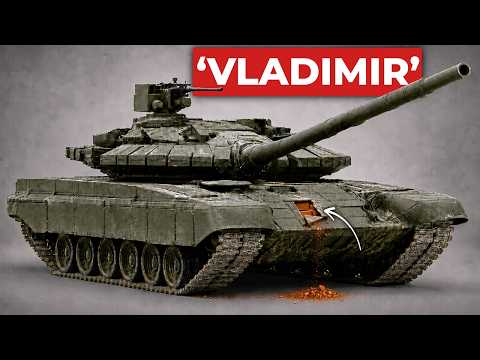
Korolivka, Kharkiv. The last week of September 2022. The ground was soft from a rainy autumn, and the fields east of the Oskil River had turned to mud the color of old iron. Colonel Pavlo Fedorchenko of the 92nd Mechanized Brigade stood at the edge of a field, staring at something that shouldn’t exist. A T-90M Proryv, Russia’s most advanced main battle tank, sat perfectly intact in the open, its nose pointed east toward the river—the direction it had been trying to go. No fire. No penetration. No blast crater. Just a single track thrown in the mud behind it. The crew had simply walked away.
This wasn’t a story about a tank left behind. It was a story about a state that could no longer build what it sold. And what Western engineers found when they finally opened it up wasn’t just fraud. It was something more corrosive than fraud. It took two years and a war to see it.
The logic behind that tank was sound. The men who designed it were professionals. Go back not to 2022, but to 1991 and the desert. In February of that year, during roughly 100 hours of ground combat, American and British armor destroyed Iraqi tank formations from distances the Iraqis couldn’t even see, let alone reply to. The lesson landed in Moscow like an artillery shell. The problem wasn’t that the Soviet tank was poorly built. It was that it was blind at night and outranged by day.
Four years later came the second lesson, closer to home, in the streets of Grozny. Armor without top and flank protection, sent into a city without infantry to protect it, was torn apart at close range by men with rocket launchers standing in basements and on balconies. Russia drew the right conclusions from both—not the conclusions we would have drawn, but the right ones within their own framework.
The answer wasn’t to build a Western tank. Russia looked at the Western tank and rejected it rationally. A Western MBT of that era weighed 60 tons and up. It drank fuel at a rate that required an army of tankers behind it. It couldn’t cross most of Russia’s inland bridges. It couldn’t be moved efficiently by rail across eleven time zones—and rail was how Russia had always moved its army. It was also ruinously expensive. Here was the arithmetic that governed everything the Kremlin did with armor for twenty years: a T-90 in export configuration cost around $4.5 million. A Western MBT of the same generation cost $10 million and up—before fuel, recovery vehicles, and trained maintenance technicians. For the price of one Western tank, you could run two Russian ones and still have money left for ammunition.
And it worked. Russia became the world’s second-largest arms exporter on that argument alone. India bought T-90S tanks and built them under license at Avadi by the hundreds, calling them Bhishma. Algeria bought them. Iraq bought them. Vietnam bought them. This wasn’t a technical curiosity. It was the mass-market tank for half the planet. The T-90M was the most advanced version. The design followed the cost logic: 48 tons, not 60. A crew of three, not four, because an autoloader in the turret basket replaced the human loader—which meant a lower turret, a smaller target, and one less man to train, feed, and pay in every tank in the army. A 125mm gun that could fire an armor-piercing dart or launch a guided missile out to 5,000 meters. And protection that was genuinely new: the T-90M carried Relikt, Russia’s third-generation explosive reactive armor. Not the old Kontakt-1 bricks from the 1980s, effective only against shaped-charge warheads. Not even Kontakt-5, the world’s first ERA capable of meaningfully disrupting a solid kinetic penetrator. Relikt was designed to defeat tandem warheads—two-stage missiles built specifically to beat older armor—and to cut a kinetic round’s penetration roughly in half. Add a digital fire-control system and an independent thermal sight for the commander, so he could hunt the next target while the gunner still killed the last one, and you had a tank that saw at night, fired on the move, and survived a hit that would have killed a T-72.
It wasn’t a crazy assessment. It was built on the data he had. The problem was that the data was three weeks out of date—and it was about the last war.
What the 92nd Brigade recovered from that field wasn’t just a trophy. It was a document. The tank belonged to the 27th Separate Motorized Rifle Brigade, part of the 1st Guards Tank Army—the formation Russia had spent a decade rebuilding to be the spearhead against NATO. It was abandoned near Korolivka around September 25, 2022, and photographed with a yellow number nine, the brigade’s own recognition mark. What the intact vehicle gives you is the whole point. A burned tank tells you only that it burned. You can measure the hole. You can guess the shell type. You can photograph the wreck. Analysts have done that thousands of times and learned a great deal. But a burned tank can’t tell you what its armor was made of, because the armor is gone. It can’t tell you what the sight could do at 3,000 meters, because the sight is scrap. It can’t tell you what the fire-control computer knows, how the radio is encrypted, or what the crew was actually trained to do when they heard a warning tone in their headsets. An intact tank tells you all of that. You can take samples of the composite. You can test the optics against a known target at a known range and get a hard number. You can unbolt the ERA capsule from the front, weigh it, open it, and see exactly what’s inside. You can read the software.
Andrew Galley of Janes put it simply when news of the capture went public. He said examining the vehicle provided a level of insight into its armor composition that was greater than anything before. That’s analyst-speak for: we can finally stop guessing. The tank was moved west, away from the fighting, and taken apart. Reports at the time from a security source indicated the work was done at an undisclosed site in western Ukraine or Poland, with technical reports sent to the United States and the United Kingdom. The actual hull’s arrival across the Atlantic was never confirmed, and I won’t tell you it happened—but something definitely did. In spring 2023, a Russian tank appeared on a flatbed trailer at a truck stop in Rayne, Louisiana, because the truck carrying it broke down. Photos went around the world in a day. The shipping label listed its destination: Building 358, Lanyard Road, Aberdeen Proving Ground, Maryland. The headquarters of the U.S. Army Test and Evaluation Command. The manifest listed the shipper as a multinational field assessment team. That vehicle was a T-90A, an older model, not an M. I want to be precise about that because much of what’s said about this story conflates the two, and the conflation does work the evidence doesn’t support. But the Pentagon confirmed it. Spokeswoman Sue Gough said the tank was being transported to Aberdeen when the truck had a mechanical breakdown, and she added one sentence almost offhandedly. She said the tank’s explosive reactive armor was inert. Stop on that sentence. You’ll come back to it later.
Fifteen months later, on January 13, 2024, near the village of Stepove in the Avdiivka sector, the argument stopped being theoretical. Two Ukrainian soldiers from the 47th Mechanized Brigade—a commander and gunner named ‘Sehi’ and a driver named ‘Oleksandr’—were crewing an American M2 Bradley infantry fighting vehicle. Sehi had returned from training on the vehicle in Germany just a month earlier. The Bradley is not a tank. It has a 25mm chain gun against the frontal armor of a T-90M. That gun is theoretically irrelevant. It cannot penetrate. Every table in every manual says so. They engaged one anyway at close range at night in fog, and they didn’t try to penetrate it. They hosed the front of that turret with bursts of cannon fire, one after another, walking the rounds onto the sighting systems, the gunner’s sight, the commander’s panoramic sight, the sensors, the vision blocks. They blinded the tank. The turret began to rotate randomly, searching for a target it couldn’t find because there was nothing left to find. As the tank reversed, blind, and backed into a tree, an FPV drone finished it. Sehi was asked afterward how he knew where to put the rounds. He said that since he was used to playing video games, he remembered everything—how to hit it and where to hit it. That is the entire war in one sentence. And it’s not a joke. It’s a statement about knowledge. Someone had worked out where the weak points were and told the crews, and the crews remembered. Men like the 47th’s crew who fought a point-blank engagement in an IFV against Russia’s best tank deserve to be remembered for it.
The examination produced three findings. Each one alone is embarrassing. Together they describe something that has nothing to do with a tank at all.
The first was in the sight. The gunner’s sight, the tank’s eye—the thing that let it fight at night and shoot on the move—was built around a thermal camera called the Catherine FC. French. Made by Thales. France had issued 76 licenses for military and dual-use goods to Russia since 2015, worth roughly 152 million euros—enough thermal cameras for over a thousand tanks. The sovereign Russian super-tank couldn’t see in the dark without a component from a NATO government.
The second was in the armor. Ukrainian crews began prying open the Relikt boxes on captured turrets. Many were light. Not damaged. Not spent. Empty—or filled with carefully cut rubber slabs to match the weight. Then in September 2024, a destroyed T-90M was photographed with its ERA boxes open to the sky. Inside was brick. Garden-wall brick. Someone between the factory and the front had emptied the explosives and replaced them with whatever was lying in the yard.
The third was the oldest and the one nothing could fix. The autoloader—the carousel under the crew, twenty-two rounds ready, no armored barrier, no blowout panels. A penetrating hit doesn’t just damage the tank. It throws the turret several tons clear of the hull. The T-90M never solved this. It couldn’t. It was the structure chosen in the 1960s, and everything else was built on top of it.
And the number underneath the whole argument: in February 2022, the IISS counted roughly 67 T-90Ms in Russian service. Sixty-seven. Not 6,700. You could park them in a supermarket lot. The tank that was the centerpiece of Rosoboronexport’s global catalog existed in modern form in numbers you could count on your fingers and toes.
The metal was real. There just wasn’t much of it, and what existed couldn’t be replaced with the parts Russia was now allowed to buy. The cost advantage that was the entire strategic case for the vehicle evaporated because someone built something cheaper than a cheap tank.
So we return to the field and the question the field asked. What was that thing standing intact in the mud that nobody bothered to destroy before they fled? It wasn’t a fake. The T-90M was a real tank, efficiently designed, clever in many ways. Relikt was a genuine development. The gun was a good gun. Ukrainian crews who captured them put them into service and used them—the only product review that ever mattered.
What it was, was a promise a state could no longer keep. Moscow counted tanks and could field 67 modern ones. Western analysts counted the supply chain behind each tank and found a French thermal sight, an imported machine tool, an ERA cassette sold on its way to the factory. Somewhere in the Urals, engineers did their jobs correctly, designed a genuinely modern turret and a genuinely modern armor array, then watched their work go to war with a garden wall bolted to the front and three young men told they were safe.
That is the answer to the question at Korolivka. The crew didn’t flee because their tank was bad. They fled because they stopped believing in it—and they weren’t wrong to stop. To Sehi and Oleksandr of the 47th, who charged into the fog at Stepove in a Bradley and blinded a super-tank. To Pavlo Fedorchenko and the 92nd, who walked up to Russia’s most advanced armor in an open field and drove it home. To the analysts in London and Kyiv who took it apart and told the truth about what they found, including the parts that were embarrassing. The tank was never the secret. The tank was the evidence.
If this is the kind of work you want to see more of, follow and subscribe—because the same question is now being asked about far more than one tank. So tell me: what other weapon system do you suspect is held together by rubber slabs and brick?
Report this article
Select a reason for reporting:






