Albert Speer, Hitler’s architect and confidant, walked out of Spandau Prison like a celebrity. The world watched in disbelief as the man who had prolonged the war for years, who had used slave labor and brought death to countless, was greeted by adoring crowds. “I can tell you, I am very happy to be here,” Speer declared, his voice steady, his conscience seemingly clear. To some Germans, he embodied the lost glory of the Reich; to others, he was a living museum of Nazism, a relic that should have been buried with the bunker.
But Speer’s release was only the beginning. He published his memoirs, became a fixture on talk shows, and died in London just before a broadcast, still justifying himself. “The extermination, for example, to achieve it,” he would say, as if the Holocaust were a mere logistical problem. His rehabilitation mirrored a larger trend: former Nazis were becoming judges, parliamentarians, even Chancellor. Kurt Kiesinger, a former member of the Nazi Party and a senior official in Hitler’s regime, rose to the highest office in West Germany. The world watched in shock as France welcomed him with full honors.
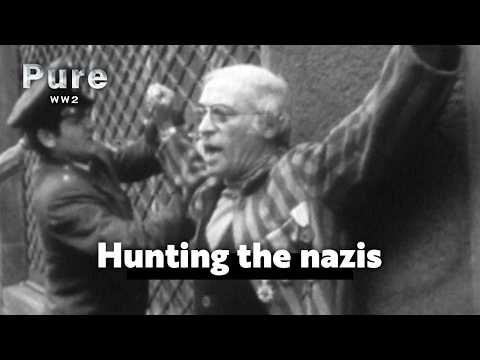
For the Klarsfeld family, this was intolerable. Beate and Serge Klarsfeld, French activists with a personal stake in the fight against forgetting, had dedicated their lives to hunting down Nazi criminals. Their son Arno was growing up in a world where the past was being whitewashed, where the perpetrators of the Holocaust were being reintegrated into society. “A generation wants to forget while the next generation wants to know,” Beate would say. And she was determined to make sure the world knew.
In 1968, Beate Klarsfeld traveled to Berlin, accompanied by a photographer, to attend the Christian Democratic Union conference. Chancellor Kiesinger was speaking. Beate, a Frenchwoman by marriage, walked up to the podium and slapped him across the face. “Nazi! Nazi!” she shouted. The guards hesitated, afraid to shoot into the crowd, and then grabbed her, dragging her away. Kiesinger’s eye was injured. Beate was arrested and sentenced to a year in prison without parole.
But Serge Klarsfeld was a brilliant lawyer. Beate, as a French citizen, fell under the jurisdiction of the French occupation authorities in Berlin. A deal was quickly struck, and she was returned to France to await appeal. The slap became a symbol. It was a wake-up call to a nation that had preferred to look away.
Emboldened by this success, Beate joined the German election campaign in September 1969. She ran against Kiesinger for a small left-wing party, causing a sensation by carrying her baby in her arms. Kiesinger joked, “The Klarsfeld child, if he tries to hurt me, he will bite me.” But it was no joke. Beate’s campaign and the movement she ignited helped defeat Kiesinger. He was replaced by Willy Brandt, a true resistor to Hitler. “You are now like an actress,” Serge warned her. “You have no right to stop anymore.” Beate bore the responsibility alone. It was a heavy burden. But she would not stop.
Every thread led to another. In the Kiesinger file, they found the name Ernst Achenbach, head of the political section at the German embassy in Paris during the war, and thus involved in deportations. He was now a member of the German Congress, and Berlin wanted to appoint him to the European Commission. Beate and the League against Racism and Anti-Semitism occupied his office as lawyers. Achenbach was not sent to Brussels. “No amnesty, no statute of limitations,” the Klarsfelds said. They were now tracking down the bureaucrats of deportation in France: the head of the Jewish Affairs Police, Hagen, and the Gestapo man Lischka.
They found Lischka’s address in Cologne, easily found in the phone book. The Klarsfelds decided to go to Cologne with a photographer. They were now in his neighborhood. Once again, a quiet Nazi living a comfortable life, riding the number 18 tram to his job in agricultural products. How was this possible? This was the result of the Paris Protocol signed after the war. Only France had the right to try Germans who had committed crimes within its borders. They could not be tried in Germany, and the West German constitution forbade the extradition of its citizens. Thus, these Nazi criminals enjoyed protection in Germany. Lischka had been sentenced in absentia in France to life imprisonment. Here in Cologne, he was safe—at least until the day the Klarsfelds appeared in his life.
Lischka had been present when Heydrich, head of the Gestapo, came to Paris to meet with Bousquet, the odious head of the Vichy police, to prepare for the infamous Vel’ d’Hiv’ roundup, where 13,000 men, women, and children were crammed into a stadium before being exterminated at Auschwitz. The Klarsfelds aimed to fight this kind of impunity, and through Lischka, to change the protocol. Serge Klarsfeld’s idea was not to harm him, but to kidnap him and take him to France for imprisonment. But that would have drained Mossad’s resources. His plan could not be executed. So, they had to inform the media to create an unbearable situation for German society and force it to confront the former deporters.
A Nazi murder. A murder. The case was referred to German courts, and foreign television channels like the BBC rushed to broadcast it. “Foreign speech. Foreign speech. Foreign speech.” Beate and Serge had a mission, and they would carry it out to the end. They also caught Herbert Hagen, an SS man, on his way to work as a sales manager. It was a moving moment when they confronted the head of the Gestapo’s executioners. When Paris was liberated, the French Interior Forces and a group of resistance policemen discovered the Gestapo cellar here. Their hostages, the Shadow Army, all the resistance fighters they had killed, left their handprints on the walls before falling under the German machine-gun fire.
“Leave me alone,” Hagen said. Beate lunged at him again. “You were in France in 1942.” “I was a soldier. I did my duty,” Hagen replied. “Were you not responsible for the arrests and executions?” Serge asked. “I want to live a quiet life,” Hagen answered. “How can you live a quiet life after everything you’ve done?” His wife and daughters interrupted, and Hagen managed to slip away. In a BBC interview, Hagen asked to be filmed from the side so as not to be easily recognized. He also justified himself, citing the early Nazi approach. But the Jewish homeland was Palestine, not Auschwitz in Poland.
French Jews were gathered at the horrific Drancy camp near Paris. There, one of the most brutal guards was SS Ernst Heinrichsohn. After 30 years, he became the mayor of Burgstadt, a small town in Bavaria. The second BBC question. He reveals his complete lack of humanity. Despite his tone, Serge Klarsfeld and his association of the children of Jewish deportees from France stormed the Cologne courts. This new trial in Germany was a victory. After 10 years of relentless fighting against the Paris Protocol, Klarsfeld gathered every Nazi document and ordered a website. All of them were conclusive evidence. Lischka was sentenced to 10 years. Hagen to 12 years. Heinrichsohn to only 6 years. Without the Klarsfelds, all three could have ended their lives in peace.
Outside the court, a crowd that could not enter. The children of the deportees, and even their grandchildren. Hunting Nazis was dangerous. Two assassination attempts nearly cost the Klarsfelds their lives. In 1972, with a letter bomb, and in 1979, with a bomb planted in their car. The perpetrators were still at large. The Klarsfelds were not deterred, nor were they deterred by the many obstacles of a life of struggle. Their mission was sacred. Beate said that the Mickey Mouse doctor shows…
…that the Mickey Mouse doctor shows children a world where good always triumphs, but the real world had no such guarantee. “We cannot leave justice to chance,” she told a small gathering in Paris. The fight had become her entire life. Arno, now a young man, had grown up in the shadow of his parents’ crusade, learning to read the names of the deported before he learned to ride a bicycle.
But the Klarsfelds were not the only ones watching. In the late 1970s, a new generation of German youth began to ask uncomfortable questions. University students dug through municipal archives, comparing names on old Gestapo payrolls with current telephone directories. “The murderers are among us,” became a rallying cry, scrawled on walls in Berlin and Munich.
Serge, ever the strategist, understood that the legal battles were only half the war. The other half was memory. He began compiling a comprehensive index of the deported—every man, woman, and child sent from France to the east. “Eleven thousand children,” he would say, his voice barely a whisper. “Eleven thousand. And not one of them had a trial.”
It was during this period that a young German prosecutor named Kurt Rebmann contacted the Klarsfelds. He had inherited a file—thick, yellowed, and forgotten—on a man named Alois Brunner, Eichmann’s chief operative in France. Brunner had been responsible for the deportation of tens of thousands of Jews from France, Greece, and Slovakia. After the war, he had vanished.
But Rebmann had a lead. “Brunner is in Damascus,” he told Serge over a secure line. “He’s been advising the Syrian government. The Mossad knows, but they won’t move.” Serge’s jaw tightened. Brunner was the last of the major deporters still alive, still free, still unrepentant. “Then we will make him visible,” Serge replied.
Beate was hesitant. “Syria is not Germany. There are no courts there, no journalists we can trust.” But Serge had already begun drafting a letter—to the United Nations, to the international press, to anyone who would listen. “If we cannot bring him to justice,” he said, “we can at least bring the world to him.”
The plan was audacious. Beate would travel to Damascus under a false name, accompanied by a French journalist and a hidden camera. Their goal was not to capture Brunner, but to confront him—to force him to speak, to record his arrogance, to show the world the face of a man who had sent children to their deaths and then sipped coffee in the Syrian sun.
As the plane descended toward Damascus, Beate clutched the armrest. She thought of the handprints on the Gestapo cellar walls in Paris. She thought of the eleven thousand children. “You have no right to stop,” Serge had said. She closed her eyes and whispered a prayer she had not spoken since childhood.
The Damascus apartment smelled of stale tobacco and jasmine. Beate sat across from Alois Brunner, her hidden camera humming softly beneath her blouse. He was old, paunchy, unremarkable—a retired clerk, not the monster of her nightmares. “I have nothing to say to you,” he muttered, but he did not leave. He could not resist the audience.
When the footage aired weeks later, the world recoiled. Brunner’s flat, bureaucratic voice denying the deaths of children became a global headline. Germany, shamed into action, issued a warrant. Syria refused to extradite, but the walls were closing. He would die in Damascus, alone and unmourned, but his name would never rest.
Beate returned to Paris exhausted. Arno met her at the airport. “Did you get him?” he asked. “No,” she said. “But now the world knows his face.” Serge embraced her. The fight was not over. It never would be.
Years later, the Klarsfelds stood in a Paris courtroom as the last Nazi deporters faced judgment. The handprints on the cellar walls had become a monument. Arno, now a lawyer, carried on their work. “We are the memory,” Beate whispered. And memory, she knew, was the only true justice.
But the question remains: when the last witness falls silent, who will remember the eleven thousand children?
Report this article
Select a reason for reporting:






