The darkness was absolute, broken only by the faint glow of instrument panels. Inside the cockpit, the pilot’s heart pounded against his ribs, each beat a reminder that failure was not an option. Below, the jungle canopy hid a team of Delta Force operators, their lives hanging by a thread. This was Operation Absolute Resolve, and the men flying the helicopters were the Night Stalkers—the 160th Special Operations Aviation Regiment.
For decades, the Night Stalkers had been the unseen hand of American special operations. Their reputation was built on a single promise: “We get you in, and we get you out.” But in Venezuela, that promise was tested like never before. The world would soon learn their name, but the story of how they became the most feared helicopter unit on the planet began long before.
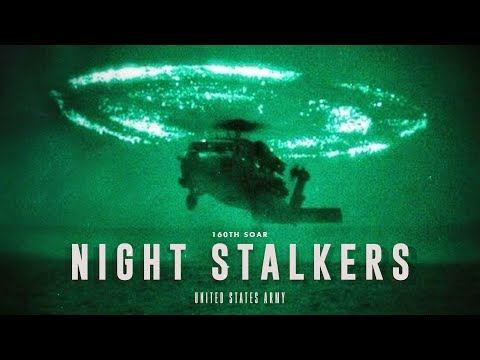
In 1980, a failed hostage rescue in Iran exposed a critical gap in America’s military capabilities. The Eagle Claw mission ended in disaster, and out of its ashes rose Task Force 158—a small group of elite pilots with a singular focus: night operations. They would fly where others wouldn’t, in conditions that would ground any ordinary crew.
From the beginning, the Night Stalkers were different. They trained relentlessly, mastering the art of low-level flight under the cover of darkness. Their helicopters, initially standard Black Hawks and Chinooks, were soon modified with advanced sensors, quieter rotors, and more powerful engines. Every upgrade was a response to a hard-learned lesson.
By the late 1980s, the unit had already seen action in Grenada, the Persian Gulf, and Panama. But it was the Battle of Mogadishu in 1993 that etched their name into history. Five Night Stalkers lost their lives in the fierce fighting, and the world watched as their Little Bird helicopters braved a hail of gunfire to rescue trapped soldiers.
That battle underscored the need for even greater survivability and endurance. The 160th responded with a new generation of aircraft: the MH-47G Chinook, the MH-60M Black Hawk, and the MH-6M Little Bird. Each was purpose-built for the unit’s unique mission—to penetrate denied airspace and deliver special operators to the world’s most dangerous places.
Today, the Night Stalkers are a far cry from their humble beginnings. Their helicopters are among the most advanced in the world, packed with digital cockpits, terrain-following radar, and defensive systems that can blind incoming missiles. They are the silent shadows that haunt the nightmares of America’s enemies.
But the story of how they got here is one of innovation, sacrifice, and an unyielding commitment to excellence. As the 160th SOAR continues to evolve, one thing remains certain: when the nation calls, the Night Stalkers will answer. And they will arrive in the dead of night, unseen and unstoppable.
The MH-47G was the first to touch down that night in Venezuela, its extended nose radome barely visible against the blackened sky. Inside, the crew relied on the multi-mode radar to paint a picture of the landing zone—a small clearing surrounded by triple-canopy jungle. The terrain-following system kept them mere feet above the treetops, invisible to ground radar.
Behind the Chinook, two MH-60M Black Hawks trailed in tight formation. Their Silent Night radar scanned the ground below, mapping every ridge and ravine. The pilots wore night vision goggles, but the degraded visual environment system was doing most of the work, fusing lidar and terrain data into a synthetic view that cut through the haze.
On the flanks, two AH-6M Little Birds darted like angry hornets. Their chin-mounted sensor turrets swept the jungle for heat signatures. Any threat would be met with a Hellfire before it could draw a breath.
The Delta Force operators in the lead Chinook checked their weapons one last time. The ramp lowered, and humid air rushed in. They moved out in silence, boots hitting the mud without a sound. Above them, the Night Stalkers held their positions, rotor wash flattening the undergrowth.
Then came the crackle of gunfire. A single shot, then a burst. The Little Birds pivoted instantly, their miniguns spinning up with a high-pitched whine. “Tango on the ridge, danger close,” came the call over the radio. The AH-6M nearest the threat banked hard, its sensor locking onto the muzzle flashes.
A Hellfire leapt from the rail and streaked into the darkness. The explosion lit up the jungle for a split second, revealing the chaos below. The Delta operators were already moving, their exfiltration route marked by infrared strobes only the Night Stalkers could see.
The MH-60Ms swooped in low, their DAP-configured stub wings bristling with rockets. They didn’t fire—not yet. Their job was to hover at the edge of the fight, a visible threat that kept the enemy’s heads down. One Black Hawk took a hit to its tail boom, but the CIRCM system blinded the incoming missile’s seeker at the last second. The helicopter wobbled, then held steady.
Inside the lead Chinook, the pilot watched his fuel gauge. The internal tanks held twice what a standard CH-47F carried, but the mission was far from over. He keyed the radio. “All stations, we are go for extraction. Two minutes.”
The Delta operators burst from the treeline, carrying a wounded comrade between them. The MH-6Ms descended first, their small frames slipping between the trees to land directly beside the team. Six operators piled onto the benches, and the Little Birds lifted off almost before they were secure.
The Chinook was next, its ramp already down. The remaining operators scrambled aboard as the MH-60Ms laid down a curtain of rocket fire. The jungle erupted, but the Night Stalkers were already gone—climbing steeply into the night, their engines screaming against the humid air.
Behind them, the jungle lit up with secondary explosions as the Hellfire’s fuel-air blast cooked off an ammunition cache. The shockwave buffeted the MH-60Ms, but the pilots held formation, their eyes locked on instruments. “Package is clean,” the lead Black Hawk reported. “All birds accounted for.”
But the mission wasn’t over. The wounded Delta operator was bleeding badly on the Chinook’s floor, and the flight surgeon aboard was already working. The pilot pushed the MH-47G to its limits, the upgraded T-55-GA-714D engines responding with a deep, throaty roar. They were climbing through ten thousand feet now, the jungle falling away beneath them.
That was when the radar warning receiver lit up. A Venezuelan Su-30 had scrambled from a forward airbase, its nose-mounted radar painting the formation. The Night Stalkers had trained for this. The Chinook’s crew chief punched the flare dispenser, and a cascade of white-hot decoys spiraled into the night.
The Su-30 launched a missile anyway. The MH-60M DAP nearest the threat broke formation, its stub wings already slewing toward the incoming round. “Fox two, fox two,” the pilot called, and a Stinger-style air-to-air missile leapt from the rail. It caught the Venezuelan missile just short of the Chinook, detonating it in a blossom of fire that lit up the cockpit.
The Su-30 banked away, suddenly aware that these weren’t ordinary transport helicopters. The Night Stalkers didn’t pursue. Their job was the package, not the kill. The formation reformed, tighter now, and pressed on toward the extraction point—an airstrip carved out of the jungle, where a C-130 waited with its engines running.
On the ground, the Delta Force commander watched the helicopters touch down one by one. The Little Birds came first, their rotors barely slowing before the operators jumped clear. Then the Black Hawks, their tail booms smoking but intact. Finally the Chinook, its ramp lowering to reveal the wounded man, now stabilized, and the crew who had flown him out of hell.
“That’s how it’s done,” the commander said quietly, watching the Night Stalkers shut down their engines. “No fanfare. No headlines. Just the mission.”
But the headlines would come anyway. Within hours, intelligence analysts in Washington were piecing together the raid’s success—and the role the 160th had played. The unit’s motto, “Night Stalkers don’t quit,” had never felt more earned.
As the sun rose over the Caribbean, the helicopters were already being refueled and rearmed. There was no time to rest. Somewhere else in the world, another crisis was brewing. Another team of operators was waiting for a ride into the dark. And the Night Stalkers would be there, as they always were—unseen, unstoppable, and right on time.
The flight surgeon finished stitching the wounded operator’s leg just as the C-130’s ramp groaned shut. The Delta commander shook the Chinook pilot’s hand, saying nothing. There was nothing left to say that the night hadn’t already spoken.
Back at the forward staging base, the crews debriefed under harsh fluorescent lights. The MH-60M with the damaged tail boom sat on the tarmac, its CIRCM pod still humming as technicians swarmed it. “She took a hit and kept flying,” the crew chief muttered, running a gloved hand along the scorched metal. “That’s the difference between a Black Hawk and a Night Stalker.”
The Little Bird pilots were already asleep in their cots, still in their flight suits. They had flown three sorties in six hours, slipping between trees and rooftops with a precision that defied the chaos around them. One of them had landed so close to a Delta operator that the rotor wash had knocked the man’s helmet off. He’d laughed about it later, but only after the mission was done.
By dawn, the after-action report was already on its way up the chain. It praised the 160th for their “exceptional airmanship under fire” and noted that every single helicopter had returned to base—a statistic that spoke louder than any medal. The Venezuelan raid would be studied for years, not for its politics, but for its execution.
And yet, the Night Stalkers didn’t celebrate. They never did. The unit’s creed was simple: “Night Stalkers don’t quit.” But there was another line, one they whispered among themselves. “We do the impossible every day. The miraculous takes a little longer.”
As the sun climbed over the Caribbean, the crews began prepping for the next mission. Somewhere in the world, a team was waiting. The darkness would come again. And the Night Stalkers would be ready.
What do you think—should the 160th SOAR ever operate in daylight, or is the night their only true home?
Report this article
Select a reason for reporting:






