July 10th, 1943. The Mediterranean Sea. Operation Husky, the largest amphibious invasion in human history, is about to unleash hell on the fortified beaches of Sicily. Over 3,000 Allied ships cut through the dark waters, carrying hundreds of thousands of men toward a brutal confrontation with the Axis powers. But behind the closed doors of the Allied High Command, the most vicious war was not being fought against the Nazis. It was being fought right inside the war rooms between the Allies themselves.
If you read the traditional sanitized history books, you were told that the Americans and the British were an unbreakable band of brothers marching shoulder to shoulder against fascism. That is an absolute lie. By the summer of 1943, the British military establishment viewed the American Army not as saviors, but as an acute embarrassment. To the battle-hardened British generals who had been fighting the Germans for years across the deserts of North Africa, the Americans were nothing more than loud, undisciplined, overpaid amateurs who simply didn’t know how to fight a real war. The humiliating American defeat at the Kasserine Pass earlier that year had only cemented this British prejudice.
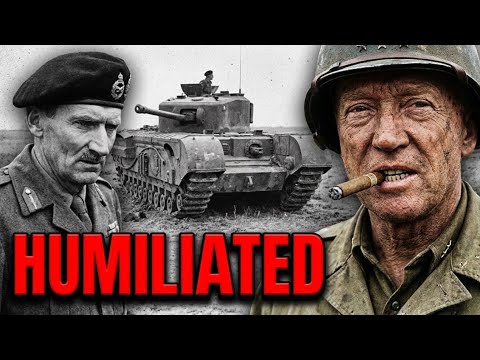
And nobody in the entire Allied coalition embodied this staggering, insufferable British arrogance more than General Bernard Law Montgomery. Monty was the undisputed darling of the British press, the victor of El Alamein, a man who possessed an ego the size of a continent, moved at a famously agonizing, crawling pace, and looked down his nose at absolutely everyone who wasn’t wearing a British uniform.
The master plan for the invasion of Sicily was almost entirely drafted by British commanders, and it was structured as a calculated, deliberate insult to the United States. General Montgomery used his immense political leverage to manipulate the theater commander, British General Harold Alexander, into giving the British Eighth Army the absolute best, most prestigious assignment of the entire campaign. Montgomery’s elite forces would land on the rugged eastern coast of Sicily. From there, they would simply take the direct, glorious, straight-line coastal highway north to the ultimate operational prize, the city of Messina.
Capturing Messina was the entire point of Operation Husky. It was the bottleneck that would cut off the German escape route to mainland Italy and decisively win the campaign. Montgomery wanted the glory, the front-page headlines in London, and the victory parade. So, where did that leave the Americans?
The United States Seventh Army, commanded by the aggressive, brilliant Lieutenant General George S. Patton, was handed the most humiliating objective imaginable for a combat commander. Montgomery and Alexander assigned Patton to land his army on the wide, exposed southern beaches of Gela and Licata, and simply serve as a massive flank guard. Patton’s entire army, hundreds of thousands of heavily armed American boys, were ordered to just stand in the baking Sicilian dust, protect Montgomery’s left side from German counterattacks, and watch passively while the British slowly marched to total victory. The Americans were explicitly forbidden from capturing major northern cities or driving on Messina. The British High Command had essentially relegated the United States military to the role of a heavily armed bodyguard, holding the door open so the real soldiers could win the war.
When George S. Patton read these operational orders in his command post, his reaction was explosive. Patton was a man who genuinely believed he was the spiritual reincarnation of ancient, legendary warriors. He carried custom-made ivory-handled revolvers on his hips and designed his own uniforms. He demanded aggressive, forward-moving violence at all times, preaching that the only way to win a war was to attack relentlessly. The very idea of playing second fiddle to a cautious, arrogant, slow-moving British general made Patton’s blood boil.
Patton knew exactly what Montgomery was trying to do. Montgomery wanted to prove to the entire world that the British Empire was still the superior military power, and that the Americans were just industrial muscle, a gigantic factory of tanks and planes without any real tactical skill or strategic intellect. Patton looked at his staff officers and made a silent, unbreakable vow. He was going to take this deeply insulting British battle plan, tear it completely to shreds, and use it to humiliate Bernard Montgomery in front of the entire world.
When the flat-bottomed landing craft finally hit the beaches of Gela and Licata in the early morning hours of July 10th, the Americans were immediately plunged into a nightmare. The British expectation was that the Italian coastal defenses would quickly crumble, and that the Americans could secure their beachhead without much difficulty. But the Axis forces had prepared a devastating surprise. The elite German Hermann Göring Panzer Division, one of the most lethal mechanized units in the Luftwaffe, was stationed nearby. Instead of retreating, they launched a massive, terrifying armored counterattack directly at the center of the American beachhead.
Dozens of heavy German tanks, including the terrifying Mark VI Tigers, which were practically invulnerable to early American bazookas and light anti-tank weapons, rolled down the Sicilian hillsides toward the Mediterranean Sea. Their objective was simple, push the amateur Americans back into the water and drown the Seventh Army on its first day. The American infantrymen of the First and 45th Divisions were pinned down in the sand dunes, heavily outgunned and lacking the heavy armor needed to stop the German steel behemoths. The situation was deteriorating rapidly, threatening to become an unmitigated disaster that would validate every single negative British stereotype about American fighting capabilities.
This was the exact moment the British High Command expected the Americans to break and run. But it was exactly the moment George S. Patton proved why he was the most dangerous, effective combat commander in the European theater. Patton didn’t orchestrate his defense from the safety of a radio room on a heavily armored battleship anchored miles offshore. He jumped into a small, exposed landing craft and waded ashore through the surf under incredibly heavy artillery and machine-gun fire. He arrived on the beach at Gela just as the massive German panzer counterattack was threatening to completely overrun the shallow American lines.
Standing upright in his immaculate, incredibly conspicuous uniform while 88-mm explosive shells detonated all around him, throwing geysers of sand, water, and lethal shrapnel into the air, Patton rushed directly across the beach. He found a group of terrified young infantrymen who were pinned down in a shallow ditch, completely paralyzed by the deafening roar of the approaching German tank treads and the relentless incoming fire. Patton didn’t coddle them. He didn’t offer words of comfort. He screamed at them, his famously high-pitched voice cutting through the deafening cacophony of heavy combat, demanding that they get up out of the dirt, pick up their rifles, and fight like Americans. His sheer, undeniable physical courage in the face of certain death was infectious. Seeing a 57-year-old three-star general casually ignoring artillery fire galvanized the troops.
Patton then rushed to a forward observation post to personally coordinate naval gunfire. He established a direct line of communication with the United States Navy cruisers sitting offshore, including the USS Savannah and the USS Boise. With surgical precision, Patton directed massive 6-in high-explosive naval shells to drop practically on top of his own American front-line positions in order to shatter the advancing German tank columns. The Hermann Göring Division, expecting to easily slaughter a bunch of panicked, green American troops, was suddenly ripped to pieces by a continuous, devastating wall of American naval steel and sheer, unyielding infantry aggression.
The Seventh Army did not break. They held the line, vaporized the German armored counterattack, and secured the massive beachhead in record time, proving their lethal capability. Meanwhile, over on the eastern coast, General Montgomery’s superior British Eighth Army had landed against significantly lighter opposition. Montgomery, remaining entirely true to his infinitely cautious, highly methodical nature, spent the next several days carefully organizing his vast supply lines, ensuring his logistical tail was perfect, drinking tea, and preparing for a slow, majestic, orchestrated advance toward Messina.
Montgomery foolishly assumed he had absolutely all the time in the world. He completely assumed that Patton was safely and obediently stuck in the southern dust, guarding the American flank just exactly as the British High Command had ordered him to do. But Montgomery had fundamentally and catastrophically misunderstood the psychology of his American rival.
By July 15th, Patton had thoroughly secured his sector and was eager to push inland. But the political situation took a dramatic turn for the worse. Montgomery, realizing that his own advance was beginning to bog down against hardening German resistance near Mount Etna, went directly to General Alexander and demanded that the boundary lines between the two armies be immediately changed. Montgomery demanded that the Americans give up Highway 124, the only decent road leading inland, so that the British could use it for their own advance. Alexander blindly agreed to Montgomery’s demands, officially ordering Patton to surrender the road, halt his forward momentum, and remain in a static defensive posture.
Patton received the new operational orders in his sweltering command tent. The explicit instruction to halt and give his road to the arrogant British was the final insult. Patton called his top division commanders, including the brilliant aggressive tactician Major General Lucian Truscott and the steady reliable Major General Omar Bradley. He pointed a riding crop at the massive map of Sicily spread across the table. Montgomery was effectively stuck on the eastern highway, slowly grinding his army to pieces against elite German paratroopers defending the mountainous terrain. However, the entire western half of the island, including the historic politically vital capital city of Palermo, was sitting completely wide open and virtually undefended.
The British High Command had explicitly not wanted Patton to take Palermo. They knew that capturing the capital city would generate massive bold headlines in American newspapers back home, overshadowing the British effort and completely stealing the media spotlight from Montgomery’s desperately slow advance. That was exactly why Patton decided he had to take it. He looked at Bradley and Truscott and issued an order that would profoundly alter the trajectory of the United States military forever. He informed them that he was not going to guard a flank for a man he despised. He was going to bypass the spirit of his orders, unleash his heavily armored divisions, and drive straight across the unforgiving mountains to the northern Sicilian coast. He was going to wage an entirely unauthorized, hyper-aggressive war of unmatched, terrifying speed. He was going to physically cut the massive island in half, take the capital city of Palermo by sheer unstoppable force of will, and then, in the ultimate act of defiance, he was going to turn his army around and beat Bernard Montgomery to Messina.
As the powerful engines of the American 2nd Armored Division roared to life, churning the dry Sicilian dust into a massive cloud and heading northwest into the blistering, unbearable summer heat, Patton set in motion one of the most incredible, daring military maneuvers in modern history. He was about to break every accepted rule of cautious Allied cooperation. He was about to physically push his men and machines beyond the limits of human sanity. And he was about to definitively prove to the arrogant British Empire that the United States Army was not a collection of secondary sidekicks, but the most lethal, devastating offensive fighting force on the face of the Earth. The race was officially on.
Montgomery, meanwhile, was still grinding through the volcanic ash around Mount Etna, demanding more bombers and refusing to believe the reports. “The Americans cannot possibly be at Messina,” he reportedly snapped at his staff. The maps said otherwise.
When his vanguard finally rolled into the city, they found Patton waiting in the piazza, boots gleaming, cigar lit. The British brigadier climbed down, saluted stiffly, and stammered, “It is a jolly thrilling thing to see you here, sir.”
Patton took a slow drag and delivered the line that would echo through history: “General, I have been here all morning. What took you so long?”
That single moment shattered the old hierarchy forever. The Americans were no longer juniors. They were the senior partner now. And Patton had proved it with nothing but speed, nerve, and defiance.
So tell me—was Patton a reckless glory-hound, or exactly the kind of commander the Allies needed? Sound off below.
Report this article
Select a reason for reporting:






