April 16, 1945. Northwest Germany. The sun rose at 6:47, but Margaret Hoffmann felt no warmth—only the cold certainty that today she would die. Canadian soldiers had surrounded the field hospital near Oldenburg, and inside lay 147 wounded German soldiers who could not walk or fight. Margaret, the head nurse, had spent twelve years in military service and believed every word of the Nazi propaganda: the Canadians would torture them, violate them, and execute all medical staff. So she had done what she was told—she hid poison pills in her pocket and whispered to the younger nurses, “Be brave. It will be quick.”
Beside her stood Elise Bauer, just twenty-two, a farm girl from Bavaria who had never wanted to be a soldier. Across the room, nineteen-year-old Anna Zimmerman fought back tears, her father dead in Russia, her mother vanished in the Berlin bombings. All three women watched a Canadian officer approach with a white flag, and Margaret’s hands shook as she burned patient records in the stove. She expected gunfire. She expected cruelty. She expected the end.
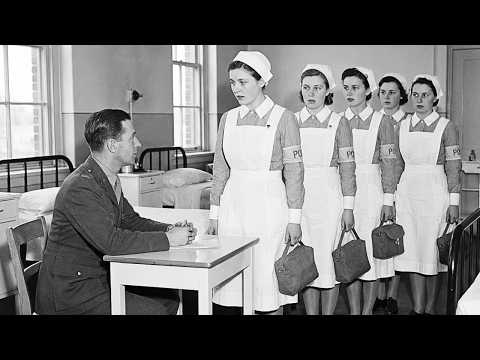
But when the Canadian lieutenant stepped through the door, he did not raise his weapon. He looked at the wounded, then at the nurses in their blood-stained uniforms, and said in clear German: “You’re still nurses. Medical personnel are protected under the Geneva Convention.” Margaret stared at him. This had to be a trick—the propaganda officers had warned that the enemy would pretend kindness before striking. She nodded slowly, said nothing, and waited for the mask to slip.
It did not slip that day. The Canadians brought food—white bread with real butter, canned meat, portions that added up to 2,400 calories per nurse. For a year, they had survived on 1,100. Anna secretly pocketed bread, convinced the Canadians were fattening them for slaughter. That night, the nurses whispered in the dark, certain that tomorrow the torture would begin.
But the next morning brought more food, more politeness. Canadian soldiers called them “Miss” and held doors open. A private picked up a dropped bandage and handed it back with a smile. For two days, the nurses continued caring for their wounded under Canadian guard—no beatings, no interrogations, no violations. Margaret’s certainty began to crack. “They are being polite,” Elise whispered to Anna. “I do not understand why they are being polite.”
On April 19, the Canadians loaded twenty-seven nurses into covered trucks—trucks with seats and canvas sides, not cattle cars. Two female guards rode with them and offered cigarettes. Margaret refused, certain they were poisoned; Anna smoked one and nothing happened. Through the canvas, they saw Canadian supply depots stacked four meters high with food and medicine, soldiers who looked strong and well-fed. Elise guessed they weighed 165 pounds on average. The German soldiers they had treated weighed 142—many less.
Margaret tried to explain it away. “This is American wealth, not Canadian strength,” she told the others, but her voice sounded weak even to herself. Elise leaned close to Anna and whispered, “If they wanted to kill us, why waste all this food and fuel moving us around?”
Two days later, they reached a train station—and again, Margaret was wrong. Passenger cars with real seats, a washroom, three meals a day. A Canadian nurse, Captain Dorothy Mitchell from Saskatchewan, answered their questions without anger. “Where are we going?” Margaret asked. Dorothy smiled. “To Canada. You will be safe there.” Canada—across the ocean. Margaret’s heart pounded. They were going to drown them at sea. That must be the plan.
But the ship that waited for them was no prison hulk. The HMS Letitia was a hospital ship, white with red crosses, and the guards led them to passenger rooms with real mattresses, flushing toilets, running water. A Canadian doctor examined each nurse with professional respect. Margaret could not understand it. Why give medical exams to people you plan to execute? Nothing made sense.
For ten days, the ship crossed the Atlantic, and the nurses processed everything they had seen. The journey to Canada had already begun to crack their certainty. Now they wondered what waited on the other side.
On May 4, the ship arrived in Halifax, and Margaret looked at the harbor and could not believe what she saw. Dozens of ships, organized docks, buildings that were not destroyed. Electric lights everywhere. Elise pressed her face to the rail and whispered, “Don’t they worry about bombs from the air?” Then she realized no enemy plane could reach Canada—the war had never touched this place.
The Canadians processed them through customs with paperwork and photographs, just like regular travelers. Each nurse received a prisoner of war card with her picture and the words “Prisoner of war, medical personnel.” They were assigned to something called Transport Unit Seven, bound for a place called Medicine Hat in Alberta. None of them had ever heard of it.
Another train waited—clean, heated, with passenger seats. As it pulled away from Halifax, Margaret looked back at the ocean. They had crossed from a destroyed continent to an untouched one. From a place where everything was broken to a place where everything worked. And she still did not understand why the Canadians had not killed them yet.
May 5, May 6, May 7, May 8. The journey covered 3,500 kilometers through Quebec, Ontario, Manitoba, Saskatchewan, Alberta. Elise pressed her face against the window and watched endless forests, then lakes so big they looked like oceans, then cities with buildings that stood straight and whole. She took out a small notebook and wrote: “May 6th, passed through a town called Montreal. No piles of broken bricks, no burned buildings. Children were playing in parks.”
The Canadians kept feeding them three meals every day—coffee that was actually coffee, bread, fruit. When Anna saw an orange on her breakfast plate, she just stared at it. She had not seen a citrus fruit since 1939. She held it in her hands like it was made of gold. That night she whispered to Elise, “How can they feed us like this if their country is starving from the war?” But when Anna looked out the window, she did not see a starving country. She saw farms with fat cows and fields full of wheat.
On May 8, the train stopped at Medicine Hat in southern Alberta. The prisoner of war camp sat fifteen kilometers outside the small town. There were 550 German prisoners total—523 men in one part of the camp, 27 women in a separate area. The women’s section had eight wooden buildings for sleeping, a building for meals, a building for activities, and a small medical office. Each building was heated and had good walls to keep out the cold. Every woman got her own metal bed with a mattress, a blanket, and a pillow. There were bathrooms with running water and toilets that flushed.
The activities building surprised Elise the most. Inside there was a library with books in German—real books that prisoners could read whenever they wanted. There was a radio that played music. There were supplies for making crafts. There was even a piano. Margaret looked at all of this and could not speak. In the German army, soldiers got punished for the smallest mistakes. Here, prisoners got pianos.
The next morning, May 9, the camp commander came to meet the nurses. His name was Major William Preston, forty-two years old, from Calgary. He stood in front of the twenty-seven women and said, “We have a problem. The hospital in Medicine Hat does not have enough nurses. Many Canadian nurses are overseas helping with the war. We need medical help.” He paused and looked at each woman. Then he said the words that made Margaret’s world tilt sideways. “You’re still nurses. Would you be willing to work at the hospital under supervision?”
The room went completely silent. Work at a Canadian hospital? Treating Canadian people? Major Preston explained more. The work would be voluntary. Nobody had to do it. They would get paid fifty cents each day. They would get better food. They would have more freedom to move around. Margaret could not move or speak. Her brain could not process what she was hearing.
Elise raised her hand immediately. She said, “Yes.” Anna raised her hand, too, but she asked, “What is the trick? What do you really want from us?” Major Preston shook his head. “No trick. We need nurses. You are nurses. You will work with Canadian supervisors. That is all.”
Six days later, on May 15, six German nurses started working at Medicine Hat General Hospital. The hospital had 247 beds for sick people. Margaret, Elise, and Anna were three of the six. The head nurse was named Katherine Ross, thirty-six years old, raised on a farm in Saskatchewan. She was tough and fair and did not waste words. On the first day, she assigned each German nurse to a different part of the hospital. Elise went to the children’s wing. Anna went to the surgery wing. Margaret went to the maternity wing where women had babies.
Elise could not believe she was treating Canadian children. Anna could not believe she was helping with surgeries on Canadian patients. Margaret stood in the maternity wing and felt like she was going crazy. She was helping Canadian women have babies. The Canadian nurses and doctors treated the German nurses like regular co-workers, not like enemies. The hospital had medicine everywhere—bottles and bottles of it. Clean bandages and sheets that smelled like soap. X-ray machines that actually worked. Lights powered by electricity. Refrigerators to keep medicine cold.
That night, Margaret wrote in her secret diary, hidden since the day she was captured. “May 15th. I dressed the wounds of an enemy soldier today. He thanked me. He called me nurse, not a bad name. What is this place?”
Over the next three months, the nurses discovered more impossible things. The hospital cafeteria let them eat as much as they wanted—unlimited bread, butter, milk, real meat. Anna stepped on a scale in June and realized she had gained eight kilograms in a single month. Her body was remembering what it felt like not to be hungry.
Elise wrote a letter home to Bavaria. The Canadians read all letters before sending them, but they let her write. “Mother, I eat three times every day. Real meat, vegetables. I am no longer hungry.” She did not know if her parents were even alive to read it.
Anna noticed that one supply closet at the hospital held more medicine than their entire German field hospital had seen during the whole war. Penicillin was not rare here. They used it all the time, like it was normal. A patient’s grandmother gave Margaret a knitted scarf as a thank-you gift. Anna became friends with a Canadian nurse who taught her English words.
But at night, back in the camp, the German prisoners argued. Some still believed in Nazi ideas and called the prisoners who worked traitors. Others said the war was over and they should accept reality. Margaret was torn in half. Everything she had been taught said Canada was weak and cruel. But every single day showed her the opposite.
Anna wrote a letter she never sent to anyone. “We were told they were monsters. They treat us better than our own army did.”
December 25, 1945. Christmas morning came cold and bright in Medicine Hat. Margaret had been a prisoner for eight months now. The war had ended on May 8, but the nurses could not go home yet. Germany was destroyed, and there was no way to send them back safely. So they stayed in Canada and kept working at the hospital.
The Canadian nurses invited the German prisoners to a Christmas party at the hospital. Margaret did not want to go. She told Elise it was wrong to celebrate with the enemy. But Elise said, “They are not treating us like enemies. Why should we treat them that way?” Margaret had no good answer. Finally, she agreed to go, but she promised herself she would not smile or enjoy anything.
The hospital cafeteria was decorated with a Christmas tree covered in lights. Paper chains hung from the ceiling and candles sat on every table. A radio in the corner played Christmas songs. The smell of pine branches mixed with cinnamon and coffee. Forty people sat together—Canadian doctors and nurses, German prisoners, and some patients well enough to join. The cooks brought out turkey with stuffing, cranberries, mashed potatoes, three different kinds of pie, coffee, and even wine.
Margaret sat at the end of one table and did not talk to anyone. She watched Elise laugh at something a Canadian nurse said. She watched Anna help carry food to the tables. She felt angry at them for forgetting what side they were supposed to be on. But when the food came, she had to admit it smelled wonderful. She had not eaten a meal like this since before the war started.
After everyone finished eating, the head nurse Katherine Ross stood up. She held a glass of wine and waited for the room to get quiet. Then she said, “I want to make a toast to our friends and family who are far away. To peace, to healing.” She paused and looked at the German nurses. “And to our German colleagues who have helped us save lives this year. Thank you.”
Everyone clapped. Margaret felt her face get hot. She did not know what to do. Then a man walked over to her table. It was Dr. James Murphy, one of the surgeons she had helped during operations. He was thirty-nine years old with gray in his hair. Margaret knew his brother had died on a beach in France on D-Day fighting against German soldiers. Everyone at the hospital knew this.
Dr. Murphy held out his hand to Margaret. “Nurse Hoffmann,” he said. “I want to thank you for helping me in surgery these past months. You are one of the finest nurses I have ever worked with.”
Margaret stared at his hand. She could not move. Her brain stopped working. This man’s brother died fighting Germans. She was German. She had believed in the cause that killed his brother. And now he was thanking her, treating her with respect, calling her one of the finest nurses. It made no sense. Nothing made sense anymore.
Tears started running down Margaret’s face. She could not stop them. The eight months of confusion and fear and slowly crumbling beliefs all came crashing down at once. She stood up quickly and ran out of the cafeteria. She heard Katherine Ross call after her, but she kept going.
Outside, the cold air hit her like a wall. It was minus fifteen degrees Celsius. Snow covered everything in white. The sky was black and full of stars. Everything was silent except for the sound of her boots crunching in the snow. Steam came out of her mouth with every breath. Behind her, she could see warm yellow light from the cafeteria windows. She could hear the faint sound of Silent Night playing on the radio—first in English, then in German.
The door opened and Elise came out. She walked over to Margaret and stood beside her without saying anything for a minute. Then she asked, “Are you okay?”
Margaret shook her head. “No. I am not okay. Everything I believed was lies. Everything we were taught was propaganda. They told us the Canadians would torture us and kill us. They told us we were superior and they were weak. They told us cruelty was strength.” Her voice broke. “It was all lies, Elise. All of it.”
Elise put her arm around Margaret’s shoulders. “Yes,” she said quietly. “And we survived long enough to learn the truth.”
The door opened again and Anna came out. She was carrying their coats. “You will freeze out here,” she said. She handed them their coats and stood with them in the snow. After a while, she asked, “What happens when we go home to Germany?”
None of them answered. They all knew what Germany looked like now—destroyed, starving, broken. And the truth they had learned here would not be welcome there. People who still believed the Nazi lies would call them traitors. People who had lost everything would be angry that they had survived while eating well in Canada. The truth was a gift and a curse at the same time.
Inside the hospital, someone started playing the piano. The sound drifted out through the walls—Silent Night again, slow and gentle. Margaret wiped her eyes and looked up at the stars. Somewhere across the ocean was what used to be her country. Here was a place that treated her better than her own government ever had.
She was not the same person who had been captured eight months ago. That person believed in propaganda and followed orders without question. This person standing in the snow knew what kindness looked like, knew what real strength was, knew the difference between lies and truth. She would never be that old person again.
If you were Margaret, standing in that snow with everything you believed shattered—would you have the courage to carry the truth home to a country that didn’t want to hear it? Share your thoughts below.
Report this article
Select a reason for reporting:






