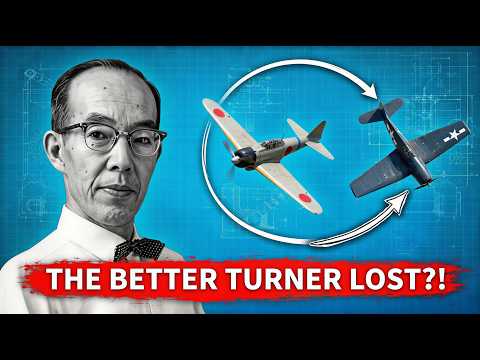
The radar operators saw them first—a wall of Japanese aircraft, the finest carrier pilots left in the empire, machines that had torn American squadrons apart for two and a half years. What happened next would be called the Great Marianas Turkey Shoot. In two days of combat, roughly 430 Japanese aircraft were destroyed. American pilots described it as a training exercise.
They were flying the Grumman Hellcat—a fighter deliberately built heavier and less nimble than its opponent. It became the deadliest carrier fighter in history. How? To understand, you have to grasp what the Hellcat was designed to fight. Not just the Mitsubishi Zero, but the philosophy behind it. Because those two things were never the same, and confusing them makes the entire story wrong.
The Zero was a genuine triumph. Japanese designers achieved what Western engineers had considered nearly impossible: a carrier fighter with the range, speed, and agility of a land-based interceptor. They did it by removing everything that added weight. No self-sealing fuel tanks. No cockpit armor. No structural margin. The Zero carried only what it needed to fly, fight, and turn. The result weighed about 4,000 pounds empty—half the weight of comparable American fighters—with a turning radius so tight that skilled pilots could change direction at will. In a low-altitude dogfight over the Pacific in 1941, the Zero had no equal.
But every advantage has a price. The hidden cost of the Zero’s agility became clear in 1942, one damaged aircraft at a time. When bullets pierced the unprotected wing, fuel ignited. When the airframe took a hard hit, it collapsed under loads it was never designed to bear. The speed that made the Zero invincible at low altitude became a liability at high speeds. Pilots diving hard in pursuit found the light controls freezing as aerodynamic forces overwhelmed a structure optimized for lightness, not strength. And through all of it, the pilot sat in a cockpit with nothing behind him to stop a bullet from the rear. The Zero was built on the assumption that if the aircraft was capable enough, the pilot would never be hit. That assumption cost Japan more than the aircraft ever won.
By 1942, the price was showing in reports from the Pacific. American pilots flying the Grumman F4F Wildcat were losing individual turning fights against the Zero. They knew it and said so. The Wildcat was heavier, slower, less maneuverable at low altitude. Against a skilled Zero pilot in a turning fight, the Wildcat pilot was at a real disadvantage. The early carrier battles of 1942—the Coral Sea in May, the grinding attrition over Guadalcanal starting in August—made those limitations painful and undeniable.
But the Wildcat pilots who survived those engagements kept noticing something specific. When they took hits, they often came home. When Zero pilots took hits, they usually didn’t. The armor plate behind the Wildcat pilot’s seat and the self-sealing fuel tanks that shrank around bullet holes created a disparity that maneuver performance alone couldn’t explain. That disparity accumulated. Repeated across dozens of engagements and hundreds of pilots, the pattern became impossible to ignore. The heavier, less elegant aircraft was keeping its pilots alive in situations where the more beautiful machine could not.
Carrier combat made this difference matter more than anywhere else. In those operations, pilots often faced superior numbers, frequently arrived at the engagement already exhausted from the flight out, and always operated over open water with no friendly airfield if the engine failed. The engineering of carrier air combat involved a baseline level of risk that agility alone could not eliminate.
In February 1942, a navy lieutenant named Edward “Butch” O’Hare launched from the USS Lexington in a Wildcat and single-handedly intercepted a formation of Japanese bombers threatening the ship. He shot down five. His aircraft took hits. He returned to base. O’Hare received the Medal of Honor and became the Navy’s first fighter ace of the war. The number of kills was the headline. The detail that mattered for what followed was that his aircraft survived damage that the machines attacking him could not have withstood. A Zero pilot subjected to similar fire would almost certainly never have landed back on a carrier.
A navy officer named Jimmy Thach developed a defensive formation tactic—pairs of fighters covering each other through coordinated turns known as the Thach Weave. The tactic worked, but it existed precisely because the Wildcat could not outmaneuver its opponent in equal circumstances. It was a formal acknowledgment, written into flight manuals and practiced over the Pacific, that the aircraft had limits pilots could not overcome through individual skill alone.
Those reports and lessons went to Bethpage, New York, to Grumman—a company already primed to read them a certain way. The Navy called Grumman the Iron Works. The nickname didn’t come from building the fastest or most elegant aircraft. It came from a consistent pattern across multiple designs: Grumman aircraft that took combat damage tended to come home. The F3F biplane. The F4F Wildcat. Leroy Grumman founded the company with a small group of engineers in 1929 and built his career on one conviction: an aircraft must reliably perform its function under harsh conditions, even after taking damage. That approach looked conservative in peacetime design competitions of the late 1930s. By 1943, it looked like the only principle that mattered.
The engineer who translated that philosophy into the Hellcat’s airframe wasn’t Grumman himself. It was Bill Schwendler, Grumman’s chief engineer. Quiet, methodical, he read combat pilots’ after-action reports the way a doctor reads diagnostic notes. He wanted to know exactly where current aircraft fell short of their pilots’ needs, and the Pacific front was providing increasingly clear answers. The man who turned Schwendler’s designs into aircraft produced by the tens of thousands was Jake Swirbul, Grumman’s production partner. Where Schwendler was technical and patient, Swirbul was aggressive and practical. He thought in factory floor plans, shift schedules, and monthly production targets. Their partnership—one designing the aircraft, the other inventing how to build it at industrial scale—was the beating heart of Grumman. Not just the name on the sign outside Bethpage.
In June 1941, the Navy issued specifications for a new carrier fighter, six months before Pearl Harbor. The requirement predated America’s full understanding of what the Zero could do in sustained ocean combat. What drove it was the recognized fact that the Wildcat was approaching the ceiling of what future development could deliver, that Japanese fighter capabilities were growing, and that carrier aviation was evolving faster than any single aircraft design could keep pace with. The specifications led to a design contract, and Schwendler’s team began building the new fighter around the most powerful American radial engine available: the Pratt & Whitney R-2800 Double Wasp, producing roughly 2,000 horsepower.
A 2,000-horsepower engine is a massive piece of machinery. It demands a large airframe to carry it. A large airframe can carry things smaller, lighter aircraft cannot. Schwendler’s team installed 212 pounds of cockpit armor behind the pilot’s seat—protection that added meaningful weight and dramatically increased the pilot’s odds of survival against threats from behind. Self-sealing fuel tanks designed to shrink around a bullet hole rather than leak fire through the wing. Structural elements deliberately built with strength margins beyond what strict performance optimization would allow, because the aircraft would eventually take hits that those margins would decide. A wide-track, low-slung landing gear, more stable than most contemporaries, designed specifically for carrier approaches where crosswinds or a pitching deck could destroy an aircraft not engineered for those conditions.
None of these choices were accidental. Each was a response to a documented operational problem. The other new American fighter in development at the time, the Vought F4U Corsair, was faster and more impressive on paper, but suffered from a persistent problem: its long nose blocked forward visibility during the critical carrier approach, and the aircraft tended to bounce dangerously on contact with the deck. Grumman watched that problem carefully. The Hellcat’s sightlines on approach, its lower and wider landing stance, its forgiving behavior in the final moments before touchdown—these were not compromises forced by engineering constraints. They were design priorities. Grumman understood that the most dangerous moment in carrier operations was often not combat. It was landing.
The Hellcat was not designed to outmaneuver anything. It was designed to come back from fights no one could entirely avoid. And here the famous story almost everyone tells appears. The popular account goes like this: America captured a nearly intact Japanese Zero in 1942, reverse-engineered it to learn its strengths and weaknesses, then built the Hellcat as a targeted response to everything the Zero did. It’s a satisfying, tidy story. It suggests history is made by decisive intelligence coups and rational engineering responses—the kind of clear causality historical narratives prefer. But there’s one problem. The timeline makes it impossible.
On June 4, 1942, a Japanese pilot named Tadayoshi Koga was killed when his Zero crashed on Akutan Island during the attack on Dutch Harbor. The aircraft fell into a marsh and remained there undiscovered. It wasn’t found until a Navy patrol located it on July 10, 1942. The aircraft was shipped to the United States, and its first test flight under American hands didn’t occur until September 20, 1942. The Grumman XF6F-1, the prototype that became the Hellcat, first flew on June 26, 1942—two weeks after Koga’s crash and sixteen days before anyone in America knew the aircraft existed. The Hellcat’s basic design was already flying before a single American hand touched the captured Zero.
What actually drove the Hellcat’s creation was something less dramatic and more interesting: combat reports from real battles, an engineering philosophy built across multiple previous aircraft, Navy specifications issued six months before the war began, and Schwendler’s persistent insistence on listening to the people who had been shot at. The analysis of the Zero found on Akutan did contribute to American understanding of the aircraft’s specific performance characteristics and structural limits, and that information was genuinely useful for tactics and training. But it did not create the Hellcat. The design existed before the Zero was found, and the philosophy behind it predated the war. The two things coincided. History chose the more satisfying narrative.
The XF6F-1 first flew with a Wright R-2600, underpowered. It performed adequately but fell short of the design’s promise. Switching to the Pratt & Whitney R-2800 transformed the machine entirely. When the XF6F-3 flew on October 3, 1942, with the Double Wasp, it was a different aircraft.
The R-2800 gave the Hellcat what the Zero could never match at altitude: raw power to climb, accelerate in a fight, and disengage from a bad situation with enough speed to return on different terms. That last point mattered. If a Hellcat pilot found himself losing a turning fight against a skilled low-altitude opponent—and that happened—he could push the throttle, drop the nose slightly, and leave. Escape. The Zero was structurally dangerous at high speed. Zero pilots who tried to follow a fleeing Hellcat into a steep, fast dive found their light controls fighting them while the airframe approached loads it was never designed to bear. The Hellcat pilot who chose to disengage had a real option. The Zero pilot who chose to pursue paid for it with structural stress the design could not always survive.
That was the hidden cost of the Zero’s greatest virtue. The lightness that produced exceptional maneuver performance was the same lightness that made it dangerous at high speed and lethal to its pilot when hit. The design that seemed dominant in 1941 carried within it the mechanism of its own defeat. Schwendler’s team understood this before they could fully articulate it.
Carrier battles were not land-based air combat. Pilots operated from flight decks under conditions land-based pilots never faced: cramped maneuvering space over task forces, salt air accelerating mechanical failure, pitching decks on landing, and the constant possibility of problems over open water with no nearby airfields. In that environment, pilots were bound to take hits. The question was not how to build an aircraft that avoided all damage. It was how to build one that survived the damage that couldn’t be avoided and returned its pilot home.
Returning the pilot was not sentiment. It was strategy. The experienced combat pilot who survived a bad engagement gained something no training program could provide: direct knowledge of what actually happened when things went wrong in combat. The aircraft that protected that pilot was protecting an investment that took years to build. The aircraft that sacrificed protection for agility destroyed that investment every time the philosophy met a determined opponent.
The design was complete. Now someone had to build it by the thousands. Jake Swirbul looked at the Bethpage factory and immediately understood that wartime requirements would exceed anything the existing facility could support. He expanded the floor plan, restructured the assembly sequence, and simplified wherever simplification didn’t compromise the structural integrity Schwendler had designed. The Iron Works philosophy applied to the production floor as much as to the airframe. Build it to work. Build it to be buildable, then build it faster.
The first F6F-3 was delivered in January 1943. By mid-1944, Grumman was producing over 500 Hellcats per month from a single plant, using a workforce that barely existed four years earlier—including thousands of women who entered industrial manufacturing during the war and built carrier aircraft to the same standard of structural quality that the Iron Works reputation demanded. At peak production, Grumman delivered a completed Hellcat to the Navy at a rate of roughly one aircraft per working hour around the clock. In 1939, the company had built a few dozen aircraft. Five years later, the same company was producing hundreds every 30 days without sacrificing the rugged airframe that had been the primary goal.
By war’s end, 12,275 Hellcats had been manufactured. Japan built approximately 10,000 Zeros throughout the conflict. The production gap was not just numerical superiority. It meant Hellcat strength was being replaced faster than combat could consume it, while Zero strength dwindled toward a point where tactical performance could no longer compensate for numerical inferiority. Production was deciding the war before most famous battles did.
The Hellcat entered combat in September 1943 with Fighter Squadron 9 aboard USS Essex during raids on Marcus Island. Early results were measured, not spectacular. Pilots noted what they expected. The aircraft was reliable, easy to fly, and capable of surviving in ways the Wildcat had not been. When engagements went badly and Hellcats took damage, they returned to base far more often than previous fighters in similar situations. The design was doing exactly what Schwendler built it to do.
Through late 1943, with raids on Rabaul continuing in November and operations expanding in the central Pacific, kill ratios began to climb and pilot loss rates fell. Tactical doctrine emphasizing altitude advantage and energy fighting rather than turning maneuvers was proving itself in actual combat. Pilots who had learned from bitter experience that Japanese fighter maneuverability was a losing game now had an aircraft with enough power to impose the terms of engagement instead of merely surviving the terms imposed on them.
The decisive test came in June 1944 over the Philippine Sea. Japan had spent nearly two years trying to rebuild its carrier air power after Midway destroyed it. The veterans of Pearl Harbor, the Coral Sea, and the early carrier battles had largely vanished, consumed by two years of continuous combat that the Japanese pilot replacement system could not keep pace with. Pilots assigned to the rebuilt carrier groups had far fewer flight hours than the men they replaced and were being sent on missions of a complexity that could only honestly be prepared for through experience. Operation A-Go, the plan to use these rebuilt groups to destroy the American fleet before it could seize the Marianas, depended on the hope that numbers and land-based support could compensate for what the pilots themselves could no longer provide.
American radar nets and signals intelligence had different information about what was coming. As the Japanese aircraft approached on June 19, fighter direction officers vectored Hellcats into positions above the incoming formations, with altitude and airspeed predetermined before engagement. Hellcat pilots did not have to fight for position. They entered the engagement from above and fast against pilots who had been flying over open water for hours without the information American radar provided freely. The geometry of combat was settled before the first shot was fired.
What followed over two days was called the Great Marianas Turkey Shoot. The name was simplistic, but not wrong. Approximately 430 Japanese aircraft were destroyed during the battle, along with American submarines that sank Japanese fleet carriers before the air combat even peaked. American aircraft losses totaled about 130, a significant portion from operational causes, fuel exhaustion, and night landing accidents rather than enemy fire. Returning American pilots described the engagements in words that startled senior officers for their almost detached confidence. Commander David McCampbell of Air Group 15 aboard USS Essex finished the war with 34 confirmed aerial victories, the highest total of any American naval aviator. His record was not an anomaly in a system that struggled. It was the upper bound of a consistent result the entire Hellcat force was achieving.
By war’s end, Hellcat pilots were credited with 5,163 aerial victories—nearly 75% of all enemy aircraft destroyed by Navy carrier pilots. The announced kill ratio was approximately 19 to 1. These numbers have been repeated so often they have become almost abstract. They deserve closer inspection. The Hellcat was excellent. The 19-to-1 ratio was not achieved by the Hellcat alone. American radar and fighter direction gave Hellcat pilots a positional advantage before engagements began. That fact does not appear on any specification sheet, but it shaped every interception in the Marianas and across later Pacific campaigns. Hellcat pilots defending against Japanese formations knew they were coming, where they were, and roughly at what altitude. Japanese pilots arriving without comparable intelligence fought from a structurally disadvantaged position that no aircraft quality could fully offset.
The attrition problem went deeper. Japan’s experienced carrier pilots—the men who had trained for years before 1941 and executed the strikes at Pearl Harbor, the Coral Sea, and Midway—had been consumed by two years of combat attrition faster than replacements could be produced and trained. By summer 1944, Japanese carrier groups were fielding pilots with far fewer flight hours than the men they replaced. This was not a failure of courage or commitment. It was a cumulative structural result of a design philosophy that had treated pilots as expendable from the war’s beginning. Every Japanese pilot killed in a Zero that could not protect him took with him years of irreplaceable knowledge. Every Hellcat pilot who returned home in a damaged aircraft because 212 pounds of armor and a deliberately rugged airframe allowed it came back carrying that knowledge into the next engagement. The cumulative effect had been compounding since 1942. The Marianas kill ratio reflected not just one aircraft’s quality against another’s but what happens over time when one side preserves its pilots and the other cannot.
After the war, Grumman rebuilt itself around new technologies. Leroy Grumman retired in 1946, having started a company with limited capital and a small group of engineers and leaving behind an institution that had grown far beyond what he imagined. Bill Schwendler remained chief engineer, helping develop the F9F Panther for the Korean War and contributing to the long line of Grumman carrier aircraft that eventually produced the F-14 Tomcat—a fighter whose famous structural ruggedness across decades of harsh carrier operations reflected an engineering culture Schwendler had helped define and the Hellcat had proven in combat. Jake Swirbul ran the company through the brutal postwar contraction when defense contracts vanished overnight and the wartime workforce had no clear place to go. He died in 1960, less celebrated than the aircraft or the company he helped scale, but arguably the reason those aircraft existed in the numbers that settled everything. The Bethpage plant closed. The ground where thousands of workers had once built carrier aircraft at a rate of one per working hour gradually became other things. The company survived in a changing world through mergers and acquisitions. Its identity was eventually absorbed into Northrop Grumman. The name appears on the corporate letterhead, but the original workshop is invisible to anyone not looking for it.
The Zero was not an unintelligent design given Japan’s strategic situation and industrial limitations. Sacrificing weight and protection for performance was a justifiable decision in 1940. The Zero was exactly what its designers wanted, and for a year it dominated everything it faced. The problem was the philosophy it embodied—making pilot survival secondary to aircraft capability—which had no answer for a long war of attrition. When experienced pilots began dying faster than they could be replaced, the Zero’s agility could not compensate for the experience its design philosophy was steadily destroying.
The Hellcat was explicit and direct about its identity. It was heavier than an aircraft designed purely for performance, less elegant in its proportions than a Spitfire or Zero, incapable of outmaneuvering an opponent at low speed, and it never tried. What it could do was absorb the hits that carrier battles made structurally inevitable. Disengage from fights that began going badly, dive at speeds the enemy could not safely follow, and return damaged pilots to carrier decks intact enough to be ready for the next engagement and the one after that. In June 1944, American radar screens showed roughly 430 Japanese aircraft disappearing over two days. The pilots executing those intercepts were not all veterans. Many were new to combat, flying a machine designed not for pilots capable of handling anything they encountered, but for pilots still learning what being attacked actually looked like. The Hellcat existed to absorb the hits that no amount of skill could always prevent. It existed to keep its pilot alive long enough for that pilot to no longer need the margin of protection. This machine, never built to outmaneuver its opponent, became the deadliest carrier fighter in history—not despite what it was built to withstand, but precisely because of it.
So here’s the question: if you had to choose between a machine that wins the fight and a machine that brings the pilot home, which would you bet on for a war that lasted years?
Report this article
Select a reason for reporting:






