June 6, 1944. The largest amphibious invasion in history is about to unfold, and one man holds a camera that will capture it all. As the first waves of Allied troops approach the beaches of Normandy, a combat photographer stands aboard a landing craft, his heart pounding against the roar of engines and the distant thunder of artillery. He knows that what he is about to witness—and record—will define the course of the war. But the story begins long before that fateful morning, in the quiet training grounds of England, where the seeds of victory were sown.
The spring of 1944 was a time of grim determination. Across southern England, the greatest armada ever assembled was quietly gathering strength. “The shores of fortress Europe had to be breached,” and the men who would lead the charge were preparing for a mission that many believed would end in failure. Among them were combat photographers, armed not with rifles but with 16mm cameras, tasked with documenting the sheer magnitude of Operation Overlord.
From the untested sailors learning to navigate flat-bottomed landing craft in Chesapeake Bay to the tense days spent waiting aboard transports in the English Channel, the human element of this massive endeavor was striking. “When the massive fleet finally moved out into the channel, stretching from one end of the horizon to the other, the reality of their destination set in.” They were heading into the teeth of the German defenses, toward beaches littered with mined obstacles built by forced labor, entirely dependent on the protective steel of their landing craft and the courage of the men beside them.
But before the first shot was fired, there was the waiting. In crowded coastal towns, soldiers and correspondents alike tried to keep their minds off what was coming. “We tried to keep our mind off what was coming,” one photographer recalled, “and we knew it was going to be a short time before we would be on board.” They ate their first K-rations, not bad if you were hungry, and tried to enjoy the beautiful countryside, knowing it might be their last chance.
As the ships left the coastal waters and moved into the channel, the slow LSTs loaded with heavy equipment and the transports loaded with men were screened by fast warships. “At 15:30, a Coast Guard flotilla of LCIs leaves, loaded with engineers, medical corpsmen, and infantry.” D-Day was approaching, and the ships were in their assigned positions. Some, like the Coast Guard-manned transport Chase, were on their fourth invasion in European waters. The only planes overhead were friendly—for now.
Below decks, officers studied maps that marked the invasion beachheads on the coast of Normandy. “Some of the landing barges are stopped by concrete obstacles built far out in the water by the enemy.” Offshore, the larger landing craft approached the beachhead slowly. Aboard the LCIs, the troops prepared to land. The beach was still empty, but the crossfire of German guns still raked the shore.
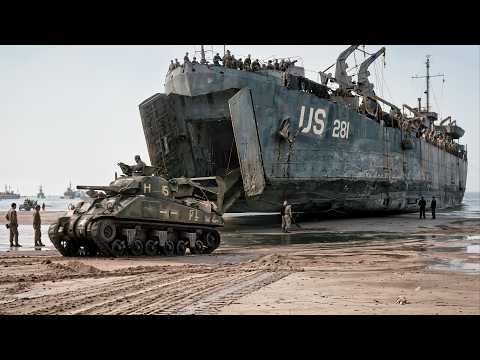
Out of enemy firing range, the LSTs waited to move in until the beaches were cleared. The arrival of motorized equipment marked the end of the first phase of the landing. “The LCIs, their first loads of men now on the beaches, go out to the transports to ferry more troops inshore.” Still waiting beyond gun range, the LSTs unloaded supplies on smaller LCTs. Heavier equipment was transferred to giant rhino ferries, flat-bottomed barges that would land it ashore.
And reinforcements arrived—thousands of men. “Defeated and disarmed, the first German soldiers captured in France wait until someone has time to evacuate them.” Out in the channel, the rescue boats of the Coast Guard were looking for survivors and aiding damaged vessels. The hospital ships were waiting for the wounded. Another Coast Guard-manned LCI, badly crippled, could not reach the shore, and its wounded were removed.
The beach was firmly in Allied hands now, and the vast extent of the operation was visible. Silent evidence of the fierce battle was apparent everywhere. “But in a few days, many of the damaged ships will be afloat again.” More and more troops moved inland to push the enemy back, and the LSTs landed their cargoes on the beach. Barges built especially for the Normandy operations were left on the shore to be unloaded.
During the daytime, there were only Allied planes in the air. But at night, German bombers harassed the beachhead and dropped mines offshore. “Out of sunken blockships, artificial harbors have been built.” Until a port was won from the enemy, these had to handle all Allied shipping. Bad weather came after the fighting on the beaches was over. The heavy storm left a trail of damaged ships. Once again, the landing barges moved out into the channel—this time, loaded with German prisoners.
In England, prisoners boarded a Coast Guard transport. Ships that had carried thousands of American soldiers overseas now returned westward with a different cargo—men who were beaten and captured in Normandy. “Of course, the one place that intrigued me was my first trip to London and the House of Parliament and Big Ben.” The photographer’s voice softened as he recalled those days, the pictures now more than a quarter of a century old. “The thing that amused and entertained our boys who were stationed all over England was Westminster Abbey.”
But the war was far from over. As the Allies pushed deeper into France, the photographer continued to document the journey—through the liberation of Paris, the Battle of the Bulge, and finally into Germany itself. “We had a tremendous reception all the way across France, but when we got to Germany, the reception was not there.” The homes in the German area had white flags in front of them as an indication of surrender. Children on their way to school held their ears because the guns were firing not far away.
The photographer’s journey would take him to the Siegfried Line, to Aachen under fire, and eventually to Berlin, where he witnessed the tremendous damage from the bombings. “Wars don’t seem to prove very much except to destroy property and kill people.” And yet, the pictures have lasted. They are beginning to fade, but the memories—and the lessons—remain.
As the film reel comes to an end, the photographer’s voice trails off, leaving us with a final thought: “The atomic bomb is here to stay. The question is, are we?” The screen fades to black, but the story is far from over. The images captured on that 16mm film would go on to become some of the few color pictures of the invasion, a testament to the courage and sacrifice of those who were there. And as we look back, we are reminded that the real D-Day was not just a battle—it was a human story, told through the lens of a camera.
The reel ended, but the room stayed silent. In the dim lecture hall, no one moved for a long moment—the kind of silence that follows a thunderclap, when the air itself seems to hold its breath. Then, slowly, chairs scraped against the floor, and the audience rose, murmuring in low voices, as if afraid to break the spell the old photographer had cast.
He stood near the projector, a small, stooped figure with a notebook tucked under one arm, accepting handshakes and quiet thanks. “Thank you, sir,” a young man said, gripping his hand. “I never knew my grandfather’s war looked like that.” The photographer nodded, but his eyes were somewhere else—fixed on the fading images still flickering on the screen behind him, ghostly and pale.
Later, in the corridor outside, a woman approached him. She held a program from the event, folded and creased, and her voice trembled. “You mentioned a man named Bill Stringer,” she said. “The one who was killed trying to get into Paris. He was my uncle. We never knew what happened to him—only that he didn’t come home.”
The photographer looked at her for a long moment, then reached into his bag and pulled out a small, worn envelope. “I have something for you,” he said quietly. “I kept it all these years, not knowing who to give it to.” Inside was a single black-and-white print, creased and faded: a group of correspondents laughing at Mont Saint-Michel, arms slung around each other’s shoulders, Bill Stringer in the center with a grin that seemed to defy the war itself.
The woman pressed the photograph to her chest and wept without shame. The photographer waited, his own eyes glistening. “He was brave,” he said at last. “They all were. And now you know.”
Outside, the evening had turned cold. The photographer walked slowly to his car, the weight of the evening settling on his shoulders. He thought of the faces he had captured—the young soldier imitating a Notre Dame football player, the men bathing in a Brittany lake, the children holding their ears against the guns. Some had lived. Many had not. “The pictures have lasted,” he had told the audience. “They’re beginning to fade, I’m afraid.”
But it wasn’t the film he was thinking of now. It was the memory of that June morning, standing on the deck of LCI Number Five, the horizon filled with ships, the sky bruised with smoke. He had been young then, with steady hands and a camera that felt like a weapon. He had believed, as they all had, that if they could just show the world what war truly looked like, no one would ever let it happen again.
He started the engine and drove home through the dark streets, the projector reel resting on the passenger seat beside him. Somewhere in the back of his mind, a voice from the past echoed—Lieutenant Patton, briefing the crew, telling them they would sail that afternoon. “And they let out a cheer,” he remembered, “because this is the job they were waiting for. They wanted to get it done and go home.”
Most of them had gone home. But not all. And the ones who hadn’t—they lived on in the frames of a 16mm film, frozen in time, waiting for someone to press play and remember.
The photographer pulled into his driveway and sat for a moment, the engine ticking as it cooled. The reel on the seat beside him caught the moonlight, and he thought of the woman in the corridor, her hands trembling around that creased photograph. “He was brave,” he had told her. “They all were.” But the words felt small against the weight of what he had seen.
Inside, he set the reel on his desk and poured a glass of water. The house was quiet, the way it always was after these talks—too quiet, as if the ghosts had followed him home. He opened the notebook under his arm and turned to a page he had written decades ago, the ink fading now: “June 6. Went ashore at Utah. Pete and Wes beside me. The water was deeper than we thought. Men drowned before they ever reached the sand.”
He closed the notebook and looked out the window. Somewhere beyond the dark trees, the world was still turning—still building rockets, still teaching children to hold their ears against the guns. “The atomic bomb is here to stay,” he had said. “The question is, are we?”
He picked up the reel and held it to the light, the film inside wound tight like a secret. One day, he knew, these frames would outlive him. And when they did, someone would press play and see what he had seen—the courage, the chaos, the terrible beauty of men who walked slowly and cautiously toward the unknown.
He set the reel down and switched off the lamp. The dark was kind, the way it always was at the end of a long day. “The pictures have lasted,” he whispered to the empty room. “But will they be enough?”
What do you think—will the images of war ever truly teach us, or will we always need someone to remind us of what they mean?
Report this article
Select a reason for reporting:






