James Rivera had handled thousands of historical photographs in his five years as a curator at the National Museum of African American History and Culture. Daguerreotypes of freedmen, portraits of activists, snapshots of everyday life—each image carried its own weight. But on a humid September morning in 2024, a box from a Richmond estate sale made him stop cold.
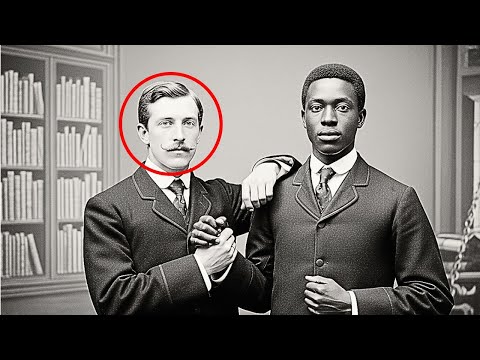
Inside, wrapped in tissue paper, was a studio portrait from 1889. Two young men stood side by side in identical dark suits, one white, one black, hands clasped in a gesture of brotherhood. For Virginia, 24 years after the Civil War, such an image was extraordinary. James leaned closer. Something was wrong.
The white man’s hand on his companion’s shoulder wasn’t resting—it was gripping tightly, knuckles pale. The black man’s smile didn’t reach his eyes, and his free hand was clenched into a fist. In the background, barely visible, hung a chain.
James turned the photograph over. Faded brown ink read: “Thomas and Marcus. Last photograph before the departure. May God forgive us for what we have done. September 14th, 1889.”
Forgive us. Not what we will do—what we have done. James’s pulse quickened. He photographed the image from every angle, then opened his laptop. He needed to find out who Thomas and Marcus were, and what dark secret was hidden beneath their posed friendship.
The next day, he met Dr. Patricia Okoye at the Library of Virginia. They pulled property records, court files, labor contracts. Within an hour, Patricia found the Whitmore family plantation, Oakwood—1,200 acres, 43 enslaved people in 1860. The 1870 census listed a Marcus Freeman, age 16, laborer, still at Oakwood.
James found Marcus’s labor contracts, year after year, each binding him to William Whitmore for minimal wages, debts for food and housing that never shrank. “This is peonage,” Patricia said quietly. “Legal slavery under a different name.”
Then a civil case from September 1889: William Whitmore versus his son Thomas, a property dispute over “human chattel unlawfully retained.” Thomas had accused his father of illegal peonage and filed evidence. Four days later, the photograph was taken.
Thomas died on October 2nd, 1889—“accidental shooting” while cleaning a rifle. The sheriff called it a hunting accident before any investigation. The family physician signed off. No newspaper mentioned the lawsuit.
James and Patricia exchanged a look. Thomas had been murdered. And Marcus Freeman had vanished.
Three days later, a call from Dr. Raymond Cole at the Freedmen’s Bureau project changed everything. “I found him. In 1891, a Marcus Freeman joined the First Baptist Church of Philadelphia—carpenter, originally from Virginia.”
Marcus had escaped. He had built a life, married, started a business. And in 1902, he had testified before Congress about the peonage system at Oakwood—and about the friend who paid the ultimate price for his freedom.
James read the 15-page testimony, hands shaking. Marcus described how Thomas had discovered his father’s crimes, copied the ledgers, filed the counterclaim. How on the night of October 2nd, Thomas whispered, “Run, Marcus. Papers, desk. Run.” How Marcus fled north with the legal documents that proved his freedom—documents Thomas had obtained the very day he died.
But the story wasn’t over. Marcus’s granddaughter, Dorothy Hayes, had kept his papers for decades. They had ended up in an estate sale, then on James’s desk. Now James needed to find those boxes—and the truth they still held.
Jennifer Park’s office sat in a renovated Victorian building on Franklin Street, not far from where Anderson & Sons Photography had once operated on Broad. She led James to a storage room where five cardboard boxes waited on a folding table, each labeled in marker with Dorothy Hayes’s name.
“These are the personal papers,” she said. “Family letters, business records, legal documents. They seemed too private to donate, but we haven’t located any living relatives.”
James pulled on archival gloves and opened the first box. Bundles of letters tied with faded ribbon. He untied one and began to read—Marcus Freeman’s clear, educated hand, evidence of the literacy Elizabeth Whitmore had secretly taught him as a child.
A letter to his son Thomas, dated 1929: “You bear the name of the bravest man I ever knew. He was my brother in all but blood, and he gave his life so that I could be free. The truth must not die with me.”
James photographed each page, then moved to the third box. Inside, wrapped in oilcloth, lay documents from 1889. His hands trembled as he unfolded the first.
A court order dated October 2nd, 1889—the day Thomas died. Signed by Judge Robert Chambers of the Richmond Circuit Court, it ordered Marcus Freeman’s immediate release from all labor contracts with William Whitmore, declared those contracts fraudulent, and awarded him $500 in back wages.
The second document was Thomas’s affidavit, his handwriting confident and precise, detailing the copied ledgers, the unpaid wages, the testimony of other trapped workers. It ended with words that brought tears to James’s eyes:
“I submit this evidence not as a son betraying his father, but as a citizen upholding the law, and as a friend honoring the humanity of Marcus Freeman. If there is shame in this testimony, it belongs to those who maintain such systems, not to those who expose them.”
The third item was a second print of the photograph, with a note in Thomas’s hand: “To Marcus—this photograph was taken so that no one can deny our friendship or question my sincerity. If something happens to me, use this evidence to prove the truth. Your friend always, Thomas Whitmore.”
James sat back, overwhelmed. Thomas had prepared for his own death. He had given Marcus not just freedom, but the means to prove what had really happened.
The fifth box held Marcus’s leather diary, kept from 1890 to 1900. The first entry, January 15th, 1890: “I am free. Thomas died to make it so, and I will not waste the gift he gave me.”
Scattered through the years were entries about Thomas—birthdays remembered, the anniversary of the photograph, the day Marcus taught his own son to read. “I tell him about the man whose name he carries, and why courage matters more than comfort.”
James spent two days documenting everything. With Jennifer Park’s permission, he arranged for the documents to be preserved and donated to the museum. But he had one more task: to find the living descendants.
Patricia traced the line. Marcus’s son Thomas had a grandson, Marcus Freeman II, who became a civil rights lawyer in the 1960s. His daughter, Dr. Alicia Freeman, a retired professor of African American history, lived in Oakland.
James called her, heart pounding. There was a long pause on the line. Then, her voice thick with emotion: “Thomas Whitmore. My grandfather told me stories about him when I was a child. He said Thomas Whitmore was the reason our family was free. But we never had proof—just stories.”
“I have the proof,” James said.
Alicia Freeman arrived at the museum three days later, and James met her in the conservation lab with Patricia at his side. She was a tall woman in her seventies, silver hair pulled back, and she moved through the documents with the discipline of a scholar and the hunger of a granddaughter. When she reached the photograph, she stopped breathing for a moment.
“We always knew Marcus Freeman was brave,” she said, tracing the glass above her great-great-grandfather’s face. “We knew he escaped and built something. But I never understood what it cost. Thomas was just a name in stories—almost a myth. This makes him real.”
She turned to the letter Thomas had written on the back of the second print. She read it twice, then pressed her palm flat against the table as if steadying herself.
“They loved each other,” she said. “Not romantically—as brothers. The system tried to make them enslaver and enslaved, and they refused the roles. That refusal is the whole story.”
James asked the question he had been holding since Richmond. “Would your family be comfortable with an exhibition?”
Alicia laughed, wiping her eyes. “Comfortable? It would be an honor. People need to understand that slavery didn’t end in 1865—it changed clothes. And they need to know about white people like Thomas Whitmore, who risked everything, not just their reputations.”
But James wasn’t finished. He still wanted to find Thomas’s descendants—to learn whether they had grown up believing the sanitized version of William Whitmore, the respected planter who mourned his only son.
Patricia traced William’s line through a second marriage. A daughter, grandchildren, and finally a great-great-grandson named Robert Whitmore, a retired attorney in Alexandria. James called him cautiously, unsure what a man might feel upon learning his ancestor was a murderer.
Robert agreed to meet. He sat in the museum’s conference room while James laid out the affidavit, the court order, the newspaper clipping of the “accidental shooting.” For a long time, Robert said nothing.
“My family always said Thomas died in a hunting accident,” he finally said. “We were told his death devastated my great-great-grandfather. There were hints of a conflict, but nothing specific.” He looked up. “How do I feel? Ashamed that William Whitmore was my ancestor. Proud that Thomas Whitmore was.”
He paused, then continued. “My family benefited from wealth built on enslaved labor and illegal peonage. That’s a hard truth, but pretending it didn’t happen would be worse. I’d like to be part of telling this story—if you’ll let me.”
James felt the last piece settle into place. The exhibition would have both families in it—not as accusers and accused, but as witnesses to the same truth.
Over the following months, they built it together. They titled it The Photograph That Testified: A Story of Friendship, Courage, and the Fight Against Peonage. The centerpiece was the image itself, lit so every detail showed—the too-tight grip, the clenched fist, the chain half-hidden in the painted library.
Beside it hung Thomas’s note: “We stand as equals here, as we should stand under the law.”
One gallery section explained peonage—the fraudulent contracts, the manufactured debts, the sheriffs who returned runaways in chains. Another followed Marcus north to Philadelphia, his carpentry shop, his congressional testimony. A video played on a loop: Alicia Freeman and Robert Whitmore, each telling the story from their side of the bloodline.
“Facing difficult family history isn’t easy,” Robert said in his recording. “But we can’t change what our ancestors did. We can only choose how we remember them—and how we act now.”
On opening day, James stood near the gallery entrance and watched the crowd. A young Black woman wept in front of Marcus’s diary. An elderly white man lingered beside Robert, who was volunteering as a docent, and murmured something about his own Virginia grandfather. Parents knelt to explain peonage to their children.
Alicia came to stand beside James. “He kept those papers for over forty years,” she said quietly. “He wanted people to know. And now, a hundred and thirty-five years later, they’re finally listening.”
James nodded, but his attention had drifted to a figure at the far end of the gallery—a man in his thirties, standing very still before the photograph, a leather satchel hanging from his shoulder. He hadn’t moved in ten minutes. When he finally turned, James saw that his eyes were red, and that he was holding a small, worn envelope, the kind that might have been sealed decades ago.
The man caught James’s gaze and walked toward him with the deliberate steps of someone carrying something heavy.
“Mr. Rivera?” he said. “My name is Daniel Hayes. Dorothy Hayes was my great-aunt. I think I have something that belongs with this exhibition.”
He held out the envelope. On the front, in faded brown ink, was a single line of handwriting James recognized instantly from the photograph’s reverse.
For Marcus, if I do not return. T.W.
The seal was still unbroken.
James’s breath caught. “Have you opened it?” he asked. Daniel shook his head. “It was with Aunt Dorothy’s things. The will said to give it to a museum if any of us ever found it.”
They opened it together in the conservation lab, under Patricia’s watch. Inside was a single sheet in Thomas’s hand, dated September 30th, 1889—two days before he died.
“Marcus—if you read this, I am gone. My father knows what I have done. The papers are filed. You are free. Live, marry, build. Name a son for me if you can. Do not mourn too long. Your friend, Thomas.”
Alicia read it aloud, her voice breaking on the last line. Robert Whitmore bowed his head. Daniel stood between them, the envelope still in his hands.
James looked at the photograph on the wall—two young men, forever twenty-three, hands gripping, eyes afraid, refusing to let go. The chain behind them had never been the whole story. The letter was.
What would you have done, in Thomas Whitmore’s place—or in Marcus Freeman’s?
Report this article
Select a reason for reporting:






