In the summer of 1942, the same American fighter was living two completely different lives. Over Burma and China, the shark-mouthed P-40s flown by American volunteers were credited with destroying nearly 300 Japanese aircraft. Over the Libyan desert, a 22-year-old German pilot claimed 17 Allied planes in a single day—many of them P-40s. Same factory in Buffalo, same Allison engine family, same basic airframe. In one sky, the plane looked like a predator. In another, it looked like prey. And the reason, it turned out, had almost nothing to do with anything the engineers in Buffalo had drawn.
Put yourself in that factory for a moment. You’re a Curtiss-Wright engineer, and reports are coming in from two wars at once. From Asia come headlines about the Flying Tigers, a handful of American mercenaries tearing through the Japanese Air Force in your airplane. From North Africa come reports of British and South African squadrons losing pilots week after week to Messerschmitts that seem to appear from nowhere and vanish just as fast. No memo survives in which a Curtiss engineer wrote, “We cannot explain this.” But look at the problem the way they had to see it. If the plane was bad, why was it winning in China? If the plane was good, why were the desert squadrons bleeding? And if you had to fix it, what exactly would you change?
Before we can answer that, there’s something strange you should know. Both sets of numbers I just mentioned—the 300 and the 17—are more fragile than they look. We’ll come back to that, because when the numbers shrink, the real answer becomes clearer.
And there’s another detail to keep in mind. The famous shark mouth painted on the Flying Tigers’ noses—the image that defines the P-40 in popular memory—didn’t start in China. It started in the desert, on the losing side of this story.
To understand how one plane could live two lives, we have to go back to the moment of its birth and to one decision that seemed logical at the time. In the late 1930s, Curtiss had a fighter called the P-36 Hawk. It was an acceptable plane with a big radial engine in the nose, and the Army Air Corps had bought it. But by 1938, that acceptable fighter was already falling behind. Europe was building sleek fighters with long, pointed noses and liquid-cooled inline engines, and the Air Corps wanted something faster, and fast, and cheap.
The man who answered the call was Curtiss’s chief engineer, Donovan Berlin. His idea wasn’t a work of art designed from scratch. It was more practical and, in a way, more clever. Take the P-36 airframe the factory already knew how to build, and bolt on a new liquid-cooled engine, the Allison V-1710. Change the nose, keep most of the rest. In October 1938, that hybrid flew as the XP-40. After some work on the cooling system and drag reduction, it became fast. And because so much of it was already familiar to the factory, it could be built in large numbers almost immediately. In 1939, that mattered more than anything else. The Army ordered it in quantity and the Buffalo plant began tooling up for production.
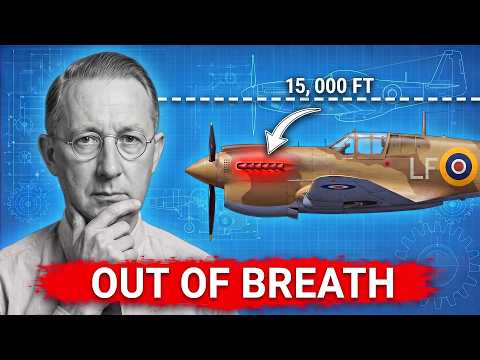
But there was a hidden decision inside the engine that would shape the entire war story. At high altitude, the air gets thin and a piston engine begins to suffocate. To counter that, engines use a supercharger—a compressor that stuffs more air into the cylinders. The Allison in the P-40 had a simple, single-stage supercharger. At low and medium altitudes, it was fine. But at around 15,000 feet, the engine began to gasp. Climb higher, and power faded and the plane got sluggish exactly when a fighter pilot needed power most.
Why not use something better? The Army had experimented with turbochargers—compressors driven by exhaust gases that kept engine power much higher at altitude. But turbochargers were complex, bulky, and rare, so the Army reserved them for bombers and the twin-engine P-38. The P-40 got the simple version. It was a reasonable choice for a cheap, quick-to-build fighter. It was also a choice that permanently defined the altitude band where this plane would be effective. So remember this, because the whole story depends on it. The P-40 was a low-to-medium altitude fighter. Down there, it was heavy, rugged, well-built, fast in a dive, and quick to maneuver at speed. Up high, it was in trouble.
Now, a plane doesn’t fight alone. It needs someone who understands its strengths completely, and the man who did was a former Army officer—stubborn, hard of hearing, and more or less pushed out of the Air Corps. His name was Claire Chennault.
In the early 1930s, the U.S. Army was in love with bombers. The fashionable idea was that big, fast bombers would always get through, and fighters had become irrelevant. Chennault, an instructor at the Air Tactics School, argued the opposite, loudly and repeatedly. He wrote about defensive pursuit, about fighters working in pairs, about team attacks, and above all, about relying on early warning to be in the right place at the right altitude before the enemy arrived. He lost that argument. Hearing problems and clashes with bomber generals ended his career, and in 1937 he retired as a captain.
Then he did something unusual. He went to China to advise Chiang Kai-shek’s air force just as the war with Japan exploded into full-scale invasion. Over the next four years, he watched the Japanese Air Force closely. He studied their planes, their formations, their habits, and how Chinese pilots died fighting them. This is the experience that would matter later. By 1941, Chennault probably knew more about how Japanese fighters behaved in combat than anyone else in the American orbit. What he didn’t have was an air force.
That changed through a deal that seems odd today. In 1941, the United States was not at war with Japan, but Washington quietly allowed a private company to recruit American military pilots to resign, travel to Asia as civilians, and fly for China. They would be paid about $600 a month—far more than their service pay—plus a bounty widely said to be $500 for every Japanese plane destroyed. That bounty would matter when we get to the numbers.
The planes came from a British order. One hundred Curtiss Tomahawks—the export version of the early P-40—were diverted to China. These were not first-rate aircraft. The group arrived short of spare parts, short of proper radios, with gunsights they had to improvise. Some pilots had never flown a fighter. Others had never flown anything that powerful. This was the American Volunteer Group. Later, the press called them the Flying Tigers.
So here’s the question. A brand-new unit of mercenaries with a fighter that choked above 15,000 feet was about to face an air force that had been fighting in China for years. How the hell were they supposed to win?
Chennault’s answer started with the enemy. The fighters the volunteers would mostly face belonged to the Japanese Army. The older Nakajima Ki-27 with fixed landing gear, and the newer Ki-43 Hayabusa. These were beautiful planes built on a completely different philosophy from the P-40. Japanese Army pilots valued one thing above almost all else: maneuverability. In a tight, slow turning fight, these fighters could out-turn almost anything the Americans had.
But that agility came from somewhere. It came from weight they weren’t carrying. Early Ki-43s had no armor behind the pilot. Their fuel tanks were not self-sealing, meaning a bullet that punctured a tank wasn’t plugged by swelling rubber. That left a leak and often started a fire. And they carried only two machine guns.
Now look at the P-40 next to it. Heavier, yes, and far less agile in slow turns, but it had armor, protected fuel tanks, and six machine guns in the Tomahawk model. One fighter had shed weight to excel at maneuver. The other had carried weight so its pilot could survive hits.
So Chennault turned that comparison into a rulebook. Never get into a turning fight with a Japanese fighter. Never. If you try to out-turn him, he will win. Instead, start above him, dive, fire a burst, and keep going. Use the speed you gained to climb away, return to altitude, and dive again. In the dive, the heavy P-40 accelerated powerfully, and the light Japanese fighters couldn’t keep up. Often a single good burst on an unarmored plane with unprotected tanks was enough.
This is the part that’s easy to miss—the hidden half of the full answer. “Start above him” sounds simple, but the P-40 climbed slowly, and remember, it got sluggish at high altitude. So how do you guarantee you’re above the enemy when the fight starts?
Chennault had built that answer years before the volunteers arrived. Across southern China, a network of observers with telephones and radios watched the sky. When Japanese planes passed over them, reports raced ahead to the airfields. That gave P-40 pilots something precious: time. Time to take off, time to climb, time to wait in the sun when the enemy arrived. The warning net gave the P-40 the altitude its engine couldn’t provide. Hold onto that idea, because we’re going to tear it away in a few minutes.
On December 20, 1941, less than two weeks after Pearl Harbor, the volunteers fought their first real battle. Ten Japanese bombers headed for Kunming. The warning net reported them. The P-40s took position, and the Americans claimed most of the formation. Japanese records indicate fewer bombers went down than was announced, but the raiders didn’t return to Kunming for a long time, and that mattered more than the exact count.
A few days later came a bigger test at Rangoon, Burma. On December 23 and again on Christmas Day, large Japanese formations of bombers and fighters hit the city. Defending it were one squadron of the AVG and a handful of RAF Brewster Buffalos. The Americans lost pilots and planes and the fights were savage, but they used dive-and-zoom tactics, refused to mix it up, and mauled the attackers. Over the following weeks, the volunteers kept fighting over Burma while the Allied front collapsed around them.
Then the newspapers took over. In early 1942, full of defeats at Pearl Harbor, the Philippines, and Singapore, the Flying Tigers were the only story Americans were winning. And the stories kept repeating the same thing: “They’re shooting down Zeros.” Here the popular version of this story begins to distort.
The Mitsubishi A6M Zero was the Japanese fighter Americans had heard about. It was the Pearl Harbor plane that terrified Allied pilots across the Pacific. So when papers reported the Flying Tigers beating Zeros, it sounded like proof the P-40 could defeat Japan’s best. It’s easy to see why people believed it. The Zero and the Ki-43 were both light, nimble fighters with radial engines and retractable landing gear. In a fast, confusing fight at distance, they looked very similar. Allied pilots everywhere called almost any Japanese fighter a Zero.
But the Zero belonged to the Japanese Navy. The units the Flying Tigers mostly fought over Burma and China belonged to the Japanese Army and flew Ki-27s and Ki-43s. The Zeros in many of those reports were Army fighters, later codenamed Oscar and Nate. This doesn’t make the achievement fake. The Ki-43 was a lethal dogfighter in skilled hands, but it changes what the story proves.
The P-40 wasn’t winning because it was a better plane than the world’s best fighter. It was winning because the volunteers were fighting a specific kind of enemy—light, fragile, built for maneuver—using a tactic designed to exploit exactly that, from a position the warning net provided. The P-40’s weight, armor, and dive speed were precisely the right tools for that problem, which raises the obvious question. What happens when you take the same tool and point it at a completely different problem?
Six thousand miles to the west, the British had been fighting in North Africa since 1940. In 1941, they began using Tomahawks there too, and later Kittyhawks, an updated P-40 with a modified nose and more guns. In April 1941, the Germans sent a fighter unit to Libya to support Rommel—Jagdgeschwader 27, flying Messerschmitt Bf 109s.
On paper, this fight should have been more even than it turned out. The early 109 E wasn’t vastly superior to the Tomahawk. But by late 1941, the Germans began introducing the Bf 109 F, and that changed things. The F was slimmer, sleeker, and climbed far faster than the P-40. Its engine had a supercharger that adjusted automatically as the plane climbed, keeping power at higher altitudes. So now reverse everything we just learned in China.
Against the Japanese, the P-40 was the heavier, faster-diving machine attacking a lighter enemy from above. Against the 109 F, the P-40 was the worse-climbing plane that lost performance first. The Germans controlled the high altitude almost automatically. But comparing planes is still only half the answer. The other half was the mission the British gave the P-40.
In the desert, RAF fighters were tied to the army on the ground. They escorted bombers at medium and low altitudes. They attacked trucks, tanks, and supply convoys. They flew where the ground battle was, at the altitude that battle demanded. This was useful work and it mattered, but it kept the P-40s low, slow, and predictable. German pilots in JG 27 often did something different. Most of the time they flew what they called “free hunt,” roaming high above the battle in widely spaced pairs looking for targets with no obligation to protect anyone. And there was no Chennault-style warning net to give the P-40s time to climb above them. The Germans chose when the fight started, and they started it from above.
So what did a desert P-40 squadron do when Messerschmitts appeared overhead? Often the answer was the defensive circle, the Lufbery, where each plane follows the one ahead so any German attacking one P-40 finds another P-40 behind him. It’s a reasonable defensive trick against an enemy who wants to get into a close fight. But against an enemy who doesn’t, it’s a trap.
Imagine the scene. A circle of P-40s turns slowly at low altitude. A pair of 109s comes down fast from above, picks one plane, fires, and keeps going, zooming back up before the circle can react. Then they do it again. Doesn’t that sound familiar? It’s Chennault’s tactic. It’s exactly what the Flying Tigers did to the Japanese. In the desert, the P-40 was on the receiving end of its own playbook.
And in that position, the strengths that won in China mattered little. The P-40’s dive speed doesn’t help when you’re already low. Its armor helps you survive one pass, but the attacker will come again. Its turning ability is a fine escape tool, but only if you see the attacker coming. No German pilot used that advantage more ruthlessly than Hans-Joachim Marseille.
He’d been a discipline problem in Europe, a show-off who kept getting into trouble. In Africa, he became something else entirely. He developed an attack style that broke the usual rules, diving into those defensive circles and firing in very short bursts from sharp angles, using very little ammunition per hit. On September 1, 1942, he claimed 17 Allied planes in a single day, many of them P-40s. Eight of those claims came in roughly 10 minutes. And now, here’s the first crack in the numbers.
When historians compared Marseille’s claims that day with Allied loss records, the numbers didn’t match precisely. Allied losses that can be matched to his engagements appear to be fewer than 17, and researchers still argue over the exact figure. What isn’t in dispute is that he was extremely dangerous, and P-40 squadrons paid heavily. Marseille didn’t survive that month. On September 30, 1942, the engine of his new Bf 109G failed and the cockpit filled with smoke. He rolled the plane to bail out, struck the tail, and his parachute never opened. He was 22 years old.
So far the answer seems clear. The P-40 was good against the Japanese and bad against the Germans. But that’s too simple, and there’s one man who proves otherwise. Clive Caldwell was an Australian who flew Tomahawks and Kittyhawks in the desert. He was credited with about 20 victories over Germans and Italians there, in the same plane against the same enemy. He practiced gunnery obsessively, including firing at his own plane’s shadow on the desert sand to learn deflection shooting. In his hands, the P-40 was no easy prey.
That tells you something important. The airframe could win in the desert. It just needed things the desert usually didn’t provide. Altitude, surprise, and a pilot who could make one pass count. So what was Curtiss in Buffalo doing about all this? Here you can almost see the engineers reading the reports. Because whether or not anyone wrote the word “confused,” Curtiss addressed the right problem. They chased altitude.
The most direct fix was changing the engine. The British Rolls-Royce Merlin, built under license in America by Packard, had a two-speed supercharger that kept power much higher up. Curtiss put it in the P-40F. It was a real improvement above 15,000 feet, but Merlins were in demand for other planes, so supply was always thin. Curtiss also attacked the weight problem directly. Later in the war, the P-40N stripped weight wherever possible. Some early N models even gave up two of their six guns to save weight. And a heavily redesigned prototype, the XP-40Q, with a sleeker nose and a better engine, pushed performance much closer to the best fighters of the day.
Every fix helped. But none of them fully worked. The basic design was a 1938 airframe that had begun life as a modified P-36. You could add power, cut weight, and reshape the nose, but you were always improving yesterday’s plane while other companies were building tomorrow’s. By the time the XP-40Q flew, the Army had better options and no reason to re-tool factories for a new P-40.
And here’s the irony. The thing that made the P-40 hard to develop was the same thing that made it valuable in the first place. The P-40 was easy to manufacture. That was the heart of Berlin’s idea in 1938. A known airframe, known tooling, and a factory that already understood it. In 1939 and 1940, when America and its allies desperately needed fighters, Curtiss could deliver them in numbers while more advanced designs were still on the drawing board. Production kept climbing in Buffalo. P-40s went to American squadrons, to Britain, Australia, the Soviet Union, and China. By the time production finally ended in late 1944, Curtiss had built 13,738 of them.
Think about what that number means. For much of 1941 and 1942, before Mustangs, Thunderbolts, and Hellcats existed in quantity, the P-40 was simply the fighter America had. It wasn’t the best fighter in the world, but it was the fighter available in numbers when the war arrived. And that kept Curtiss-Wright among the country’s biggest defense contractors.
But there’s a detail buried in 1940 that would come back to haunt Curtiss. That year, the British were trying to buy every fighter they could get. They approached North American Aviation, a California company building trainers, and asked it to build P-40s under license. North American’s president, James “Dutch” Kindelberger, refused. Or, to be more precise, he said he could design a better fighter himself, and quickly. He even bought Curtiss’s wind tunnel data on its fighter work to help speed things up. The British agreed. The plane North American built was the P-51 Mustang.
It was so successful that the demand for the P-40 helped trigger the order that replaced it. Keep that in mind. We’ll come back to it at the end. Meanwhile, in the desert, the story still needed proof. If the theory was right—that the P-40 lost because of altitude and tactics, not because it was a bad plane—then giving P-40s the right conditions in the desert should change the result. That’s exactly what happened on April 18, 1943.
By then, the war in North Africa was nearly over. The Germans were trapped in Tunisia, moving troops and supplies from Sicily in big, slow Junkers Ju 52 transports that crawled just above the sea. Groups of American P-40s, including the 57th Fighter Group, launched to hunt them, with Spitfires flying above to provide cover. Look at that formation. The P-40s were low, at their comfortable altitude. Above them, Spitfires guarded against the Messerschmitts that made desert flying so deadly. Below them was exactly the kind of target a heavy, well-armed fighter could tear apart: slow, unarmed transports.
They found a huge formation of Ju 52s over the Gulf of Tunis. The P-40s dove in. What followed became known as the Palm Sunday Massacre. American claims exceeded 70 planes shot down. German records suggest the number was closer to twenty-four transports destroyed, with many more damaged. Still, it was one of the worst days for German air transport in the war. Same plane, same desert theater, completely different result. Give the P-40 a protected sky above and an enemy below, and it behaved exactly as it had in China.
Now let’s return to those opening numbers, because I promised they’d shrink. The Flying Tigers were officially credited with destroying about 296 Japanese aircraft between December 1941 and July 1942. Remember the bounty? Every confirmed claim was worth money. That doesn’t mean anyone was lying. In air combat, many pilots who fire on the same plane see it go down and each claims it. And often a burning, smoking plane isn’t fully destroyed. Historian Daniel Ford later compared AVG claims with Japanese records and arrived at a much lower figure for planes destroyed in air combat—about 115. That sounds like a debunking, but here’s the strange part.
Even with that lower number, the exchange ratio is still lopsided. The AVG lost only about twelve P-40s in air combat. More pilots died in accidents, to ground fire, and during Japanese raids on their airfields. Even after correction, the pattern holds. The same thing happens in the desert. German claims, including Marseille’s, were inflated as claims were from all sides. Even with corrected numbers, the Messerschmitts usually won fighter-versus-fighter because they started from above.
So the corrected numbers don’t erase the contrast. They sharpen it. What’s left is the real answer to the headline. The side that controlled altitude and early warning won the engagements in both theaters, regardless of which plane was better on paper. But even that isn’t the whole picture, and it wouldn’t be fair to stop there. Because this is the heart of the desert loss.
The P-40 lost many fighter duels to the Bf 109, but the Allied air forces in North Africa won the air campaign. By the time of El Alamein in late 1942, the Desert Air Force had more planes, more fuel, and more supplies, and kept bombing Rommel’s army from the air. JG 27 had a few dozen fighters and a handful of brilliant pilots. The Allies had squadron after squadron of P-40s that kept attacking trucks, tanks, and airfields, even while Messerschmitts shot some of them down. The Germans won many individual fights. But they couldn’t stop the bombs from falling. And as the battle went on, experienced German pilots died one by one—Marseille among them—and weren’t easy to replace. The Allies had a steady flow of new pilots and new planes rolling off production lines that the Germans couldn’t match.
And in China, the reverse correction applies. The Flying Tigers’ success depended on Chennault’s warning net, on the specific type of Japanese fighters they faced, and on Chennault’s years of study. When the AVG was folded into the U.S. Army in July 1942, the plane didn’t change, but the war around it did. The Japanese adapted, and later in the war they introduced better planes and tactics. P-40s kept fighting in China, but the lopsided numbers of the early days didn’t continue the same way.
So the P-40 wasn’t a hero in China and a failure in the desert. It was the same tool in two different systems. In one system, everything around it—the warning net, the tactics, and the enemy’s design philosophy—served its strengths. In the other, everything around it—the escort mission, the low altitude, and the enemy’s climb rate and engine—exploited its weaknesses.
And what happened to the people who made that tool? Donovan Berlin, the engineer who turned the P-36 into the P-40, left Curtiss in late 1942. The plane he created was being built by the thousands and fighting on every front, but Curtiss’s attempts to produce a real replacement kept stumbling. He moved to General Motors, where he worked on another fighter project, the P-75. That plane didn’t enter service either.
As for Curtiss-Wright itself, it met a stranger fate. During the war, it was one of America’s largest manufacturers, building P-40s, Helldiver bombers, C-46 transports, engines, and propellers. But the war ended, orders collapsed, and the jet age began. Curtiss tried to enter jets with a huge night fighter called the XF-87 Blackhawk. In 1948, it lost the competition to Northrop’s F-89. That same year, Curtiss-Wright sold its aircraft division—and the buyer was North American Aviation. The company that in 1940 refused to build P-40s under license and built the Mustang instead ended up swallowing what was left of the aircraft division of the company that created the P-40. Curtiss-Wright survived as a maker of components and spare parts, but it never built another fighter.
So let’s go back to where we started. Remember the shark mouth? The image that every film and model kit ties to the Flying Tigers and their victories in China? It started with No. 112 Squadron of the RAF in the desert, on Tomahawks flying in a theater where the P-40 suffered most. British pilots were said to have copied the design from German Bf 110s they’d seen. Then a photo of 112 Squadron’s painted Tomahawks appeared in an illustrated magazine in India. The volunteers in Asia saw that photo and painted the same teeth on their noses. Accounts differ on the exact magazine, but the direction the idea traveled is not in dispute. The symbol of victory in China came from the desert.
And maybe that’s the truest answer to the question in the title. Curtiss’s engineers had no way to explain the difference from inside the factory, because the difference was never inside the plane. The shark mouth was the same on both sides of the world. So were the airframe, the engine, the armor, and the guns. What changed was who started the fight from higher up, who knew the enemy was coming, what kind of enemy it was, and what mission the plane was given.
In China, the P-40 was the heavier plane diving out of the sun onto a fragile enemy who wanted to turn. In the desert, the lighter target was heading down while a faster-climbing enemy dove on it from the sun. The same machine, the same Buffalo, on the opposite end of the same tactic.
So here’s the question for you: if you were the engineer in Buffalo reading both sets of reports, would you have kept improving the P-40—or would you have bet everything on building its replacement? Let us know in the comments.
Report this article
Select a reason for reporting:






