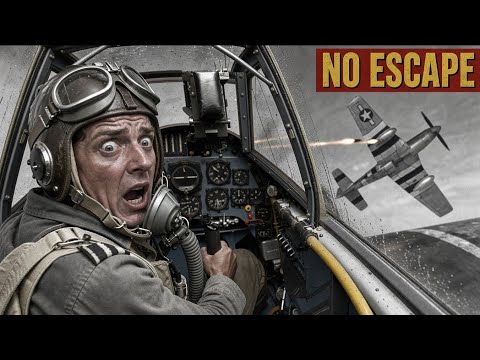
January 11, 1944. The sky over Ochersleben, Germany, was a trap waiting to spring. Thirty German fighters circled like wolves, ready to tear into the unprotected American bomber formation. They had done it a hundred times before—wait for the escort to turn back, then strike. But this time, a single P-51 Mustang dove out of the clouds, guns blazing, and refused to leave. For the next thirty minutes, one pilot would take on an entire squadron—and change the course of the air war.
The Germans called it the ‘big week’ of their defense. For two years, they had mastered the art of waiting. Watch the escorts, don’t engage them. Wait. The Americans came by day, hundreds of bombers at a time, but their fighters could only go so far. Somewhere past the Dutch border, over the flatlands west of the Rhine, every American escort’s fuel ran out, and they had to turn back. German observers knew that point almost exactly. Their pilots knew it too. So they waited, sometimes circling in plain sight of the bomber crews, waiting for the moment the little silver shapes turned west. Then the sky was theirs.
On January 11, 1944, they waited for that moment as they always did. The escorts turned back as usual, and the German fighters launched their attack. Then a different shape dropped out of the clouds above them. Slimmer than a Thunderbolt, faster than anything they expected to meet this deep inside Germany. It didn’t turn back. It didn’t run out of fuel. And the German pilots were about to discover that every trick they had used to shake an American fighter no longer worked.
This is the story of the day that rule stopped working. The day the German Air Force learned there was no longer a line in the sky to hide behind. And it’s the story of one American pilot, born in China, who found himself completely alone over a German industrial town, surrounded by more than 30 enemy fighters, and a bomber formation that had no one else to protect it. What he did over the next half hour would earn him the Medal of Honor. And what his plane represented would help decide the air war over Europe.
But to understand why that morning mattered, you first have to see the war from the German side. Because in the fall of 1943, the German side was winning. By then, the defense of the Reich had become a machine. Radar stations along the Dutch and German coasts picked up American bombers while they were still forming over England. In underground bunkers, planners tracked each formation across huge glowing maps. Controllers vectored fighter groups into position by radio, arranging them in the air where the bombers had to pass. Single-engine Messerschmitt 109s and Focke-Wulf 190s dove in head-on, targeting cockpits. Behind them came the heavy fighters, twin-engine Messerschmitt 110s, which the Germans called Zerstörer—Destroyers. Many carried rocket tubes under their wings and fired them at bomber formations from outside the range of American guns, breaking up the formations so the single-seat fighters could finish off the damaged planes.
None of it worked as long as American fighters were present. But everything worked once they left. On October 14, 1943, the Eighth Air Force sent B-17s to the ball-bearing factories at Schweinfurt. The Thunderbolts that accompanied them turned back near the German border, exactly as the Germans expected. What followed lasted for hours. Sixty Flying Fortresses were shot down. By nightfall, nearly 600 Americans were killed, captured, or missing. Many of the bombers that limped back would never fly again. The crews called it ‘Black Thursday.’ After that, the American daylight bombing campaign against the heart of Germany stopped. For weeks, the Eighth Air Force didn’t dare go deep again.
To the Germans, Schweinfurt looked like proof that the Americans had arrived believing the bomber could punch its own way through. The B-17 bristled with heavy machine guns, and dozens of them flew in tight combat boxes to form a wall of interlocking fire. American doctrine said that wall would be enough. The British had tried daylight bombing early in the war, taken heavy losses, and retreated to the cover of night. They warned their allies. But the Americans pressed on anyway.
Now the math was impossible to ignore. A bomber crew had to complete 25 missions to go home. If the Eighth Air Force lost 5% of its planes each time, most crews wouldn’t finish their tour. Over Schweinfurt, the loss rate was many times that. The young men at bases in England could do the math as easily as anyone in headquarters. The answer was clear, and for two years no one could deliver it. The bombers needed fighters that could go the whole distance—to the target, over it, and back again.
The P-47 Thunderbolt was tough and sturdy, but it guzzled fuel. The P-38 Lightning had longer range, but not enough were available in England, and its engines struggled in the bitter cold at high altitude. Neither could escort bombers over central Germany. The Luftwaffe commanders understood this perfectly. They didn’t need to win the air war. They only needed to make daylight bombing so expensive that the Americans couldn’t sustain it.
Then, in the first week of 1944, American leadership changed. Ira Eaker, who had built the Eighth Air Force around the idea of the self-defending bomber, was sent to the Mediterranean. His replacement was Jimmy Doolittle, the man who had led the raid on Tokyo two years earlier, a former air racer with a doctorate in aeronautics from MIT. Doolittle had no loyalty to theories that were getting his aircrews killed. He cared only about what worked. And he had just been handed something new.
There was only one group of them in England. Technically, it didn’t belong to his air force. And for most of its short life, almost no one had wanted it. The Mustang began as a British request and an American gamble. In the spring of 1940, with France collapsing and Britain preparing for invasion, a British purchasing commission crossed the Atlantic looking for fighters. The commission went to North American Aviation in Inglewood, California, and asked the company to build a design for another company, the Curtiss P-40, under license. North American’s president, James Kindelberger, known to everyone as ‘Dutch,’ objected. He insisted his engineers would design a completely new fighter, a better one, and they would do it fast. They did it with astonishing speed. The first airframe rolled out in just over 100 days.
It featured a new type of wing designed to keep air flowing smoothly over more of its surface and reduce drag. The radiator was placed in a scoop under the fuselage, arranged so that hot air rushing out the back gave the plane a small forward push. It was sleek, light, and carried an unusual amount of fuel for its size. The British called it the Mustang. And for two years, it was a thoroughbred with the wrong heart. Its American Allison engine performed brilliantly near the ground, but lost power at high altitude—exactly where the air war over Europe was fought. The Royal Air Force used early Mustangs for low-level reconnaissance. The U.S. Army bought some as dive bombers. No one thought it was the answer to anything.
Then in the spring of 1942, a Rolls-Royce test pilot named Ronald Harker flew one. He landed convinced that everything about the plane was right except the part that pushed it. ‘Put a Merlin in it,’ he urged. ‘The two-stage supercharged Merlin from the Spitfire, designed to work in thin air at high altitude.’ The result was practically a new airplane. With the Merlin, the Mustang flew higher and faster while keeping its enormous range. In Detroit, Packard was already building Merlin engines under license. By the summer of 1943, P-51Bs were rolling out of the factory in California. Finally, here was the fighter that could fly from England to the heart of Germany, fight there, and come home. The plane no one wanted had become the plane everyone needed.
The first American group to take it into combat over Europe was the 354th Fighter Group. They arrived in England in November 1943 and were soon settled at Boxted in Essex. The men called themselves the ‘Pioneer Mustang Group,’ and they earned the name by learning to fly a brand-new airplane in the worst weather England had seen in years and discovering its flaws the hard way. There was something odd about them, too. The 354th didn’t belong to the Eighth Air Force, the heavy bomber command that desperately needed long-range escorts. It belonged to the Ninth, a tactical air force being assembled to support the coming invasion of France. Theoretically, the most valuable fighters in England were assigned to attack trains and support infantry. In practice, the Eighth Air Force borrowed them.
So in January 1944, a few dozen Mustangs from a borrowed group were the only fighters in England that could escort bombers all the way. One of the group’s squadrons, the 356th, was led by a 30-year-old major named James Howard. He was tall, quiet, older than most of the men he commanded, and one of only two men in the group who had seen aerial combat before. Born in 1913 in Canton, southern China, where his father, an American eye surgeon, taught at a college, the family lived in China through the years when the old empire fell and warlords fought over what was left. When James was twelve, bandits kidnapped his father in Manchuria and held him for weeks before releasing him. The boy who waited all that time to learn whether his father was alive did not grow up with many illusions.
The family moved to St. Louis when he was fourteen. He enrolled at Pomona College in California, planning to follow his father into medicine, until a Navy recruiter convinced him to fly instead. Within a few years, he was flying fighters off the carrier Enterprise. In 1941, he resigned his commission to join a secret volunteer air force being recruited to fight for China against Japan—the American Volunteer Group, the ‘Flying Tigers.’ Flying P-40s over Burma and China, he was credited with downing six Japanese planes, and was shot down once by ground fire and survived capture. When the group was disbanded in the summer of 1942, he returned home with dengue fever, hard combat experience against overwhelming odds, and a phrase from the country of his birth. He had it painted on his Mustang: ‘Ding Hao.’ In the slang of the time, it meant something like ‘Number One,’ the best there is.
At four in the morning on Tuesday, January 11, 1944, lights came on in the huts scattered across eastern England. At bomber bases, crews ate breakfast in the dark and filed into briefing rooms. When the covers came off the wall maps, the route stretched deeper into Germany than most of them had ever gone. The targets were aircraft factories. Oschersleben, where the Ago works built Focke-Wulf 190s. Halberstadt, where Junkers built bomber wings. The factories around Braunschweig linked to Messerschmitt 110s. The planners’ logic was stark and simple. The German fighters built in those cities were killing American bombers. So the bombers had to go to those cities.
At Boxted, the Mustang pilots had their own briefing. Their job was to meet the bombers deep inside Germany, near the targets, just as the Thunderbolts were running low on fuel. The 354th could put about 50 Mustangs into the air. That was the entire long-range escort for the deepest raid of that winter. The group commander, Kenneth Martin, and Howard alternated leading the group in the air. That day, it was Howard’s turn.
Then the heavy bombers began to take off. 663 planes, B-17 Flying Fortresses and B-24 Liberators, climbed out of the English fog in slow circles and formed up over the North Sea. There were more than 6,000 young men in the air that morning. Each one had a hometown, a bed made before dawn, and a story of how he got there. Almost none of those stories were ever written down. The men who survived mostly kept silent. The ones who didn’t never got the chance.
This is the part of the war I always come back to. Every raid, every camp, every crossing carried thousands of stories like it. And most of them unfolded where there were no cameras pointing. I’ve told 11 of them here on this channel from beginning to end. I’ve taken those videos down myself, so you can’t watch them anywhere now. They survive only in an audio collection called ‘Behind the Wire,’ nearly 6 hours of narration with a companion booklet, available in the description.
Over the Dutch coast, the sky ahead of the bombers was already closing in. The forecast had promised good weather over Germany. It didn’t happen. Clouds piled up in layers around the formations, and back in England, the airfields were starting to fog in, raising the nightmare of hundreds of bombers returning in the afternoon to runways no one could see. At headquarters, the decision was made to recall. The order went out by radio. Two of the three bomber divisions turned back. The third, the 1st Bomb Division with B-17s heading for Oschersleben and Halberstadt, was already deep inside Germany. At its head flew Brigadier General Robert Travis. The targets were close. Behind him, the formation stretched for miles of sky, and any group turn would scatter it at the moment German fighters arrived. Travis held his course.
The consequences were immediate. The 1st Division would reach the target without the rest of the force the mission had been planned around. And the German controllers, who had been tracking three bomber streams, could now vector almost all their strength against just one. They did. Fighter units launched from airfields across northern Germany and Holland. Single-engine 109s and 190s. Zerstörer groups with rocket tubes slung under their wings. Even night-fighter crews were pressed into daylight service to guard the approaches to Berlin. Many of these men had been doing this for years. They climbed, formed up, and executed exactly what their system had taught them. They waited for the escort to leave. And right on schedule, the Thunderbolts reached the limit of their range and turned west.
From inside German cockpits, it looked like any other day. Bomber groups ahead, glittering and unprotected. Zerstörer crews taking position to line up for their rocket runs from outside the range of American gunners. Single-seat fighters wheeling wide to attack from the front. Inside those bombers, men fought in conditions hard to imagine. At that altitude, the air outside was cold enough to freeze exposed skin to metal in seconds. Gunners stood at waist windows in electrically heated suits, breathing through rubber oxygen masks that froze as they fought. When German fighters attacked head-on, the closing speed was so fast that a gunner might get one or two seconds of firing before the attacking plane flashed past.
They had all watched the Thunderbolts leave. They knew what usually came next. Then the clouds above them tore open, and the Mustangs came through.
There’s a detail here worth pausing on. From a distance, a Mustang didn’t look especially strange to a German pilot. Its outline resembled a Messerschmitt 109 so closely that American bomber gunners mistakenly fired on P-51s, which is why Mustangs of that period carried broad white identification stripes. A German pilot, expecting Thunderbolts, might glimpse slim, single-engine fighters above him and not immediately realize what he was seeing. By the time he did, they were already on him.
The fight spread across dozens of miles of sky, and one German pilot after another began to learn what this plane could do. Against a Thunderbolt, a struggling German pilot could often outclimb his attacker. Against a Lightning, he could turn and dive away. These were the survival methods that had saved men for two years, passed down from veterans to new arrivals. Now a German pilot came out of his dive to find the Mustang still behind him. He climbed, and it climbed with him. He turned hard, and it stayed glued to him. And on top of all that, there was one thing no maneuver could fix. This fighter was not going to run out of fuel and go home. It could stay as long as the fight lasted.
For the crews of the twin-engine Zerstörers, the situation was worse. The Messerschmitt 110 was deadly against bombers left alone. Heavy, loaded with rockets, and slow to maneuver, it was nearly helpless against a single-engine fighter that came looking for it. The man in the rear seat, facing backward behind a single gun, was the first to see the Mustang coming and the last who could do anything about it.
James Howard led the 354th into that fight. As the Germans closed on the bombers, his squadrons broke away to chase them, and Howard himself went after one of the 110s. He fired, and it went down. Then he pulled up, looked around, and found no one. It happens constantly in air combat, and it’s terrifying every time. A few seconds of violent maneuvering, and the wingmen who were beside you are gone, scattered into their own fights miles in every direction. Howard climbed back up to the bomber stream. He was completely alone.
The B-17s around and below him belonged to the 401st Bomb Group, and they were in serious trouble. More than 30 German fighters were closing on the formation. There was not another American fighter in sight. This is the moment the story turns. The rational thing to do, which no one would have blamed him for, was to regroup. Call on the radio, find his squadrons, and come back with help. One fighter against 30 isn’t a fight. It’s just arithmetic. Howard dove straight at them.
Most of what happened next came from the men who watched it. Bomber crews pressed their faces to the windows and glass of the turrets. They saw a single Mustang dive on a German fighter lining up on the formation, fire, and pull away. Then climb, and do it again. For nearly half an hour, that was the pattern. Climb, pick out a fighter approaching the bombers, dive, fire, pull away, climb again. Some of the Germans he hit went down, others limped away. Many simply abandoned their attacks because the Mustang was boring in on them and they didn’t want to find out what would happen next.
Then his guns began to fail. The P-51B carried four heavy machine guns set at an angle inside its thin wings to fit them. During violent maneuvering, the ammunition belts could twist and jam. One gun went silent, then another, then a third. Before the fight was over, he had nothing left to shoot with. He kept making his passes anyway. Think about it from the other side. You’re lining up your guns on a B-17. Suddenly a Mustang comes diving at you from above. You have no way of knowing its guns are empty. All you know is what two years of combat have taught you. A fighter diving on you from above and behind is how pilots die. So you break away, and the bomber you were about to kill keeps flying.
The German pilots in that sky couldn’t shake him and didn’t dare ignore him. For 30 minutes, one plane kept breaking up their attack on that formation. The bomber crews didn’t know who he was. They couldn’t talk to him on the radio. All they could see was that he didn’t leave. The commander of the 401st, Colonel Harold Bowman, later said it looked like one American taking on the entire German Air Force.
The formation reached Oschersleben. Bomb bay doors opened over the factory that built many of the fighters attacking them, and bombs fell through the winter haze. Then the B-17s turned for England, and the Germans followed, and Howard stayed with them until his fuel gauge left him no choice. Then he turned west alone over Germany with empty guns, in the only type of American fighter that could make that trip home. It was a long way across Germany, across Holland, and across the gray expanse of the North Sea, on an engine that had to keep running the whole way because there was no one left in the sky to call for help.
He landed at Boxted that evening. When ground crew examined the Mustang for damage, they found a single bullet hole. In his post-mission report, Howard said very little. He had lost his group. He had found bombers under attack. He had gone after the fighters. He thought he might have hit a few. Mostly, he wanted to know if the bombers had made it home safely.
At the bomber bases, intelligence officers were hearing a very different account. Crew after crew described the same thing. One P-51 appeared out of nowhere and drove the German fighters away from them for half an hour. Bowman wanted to know who was flying it. The question traveled from base to base until it reached Boxted and came back with the pilot’s name. After that, things moved quickly. On January 19, the New York Times identified Howard as the lone American fighter pilot who had taken on some 30 German planes. Newspapers across the country began calling him ‘a one-man air force.’ An officer on a B-17 who flew two full tours later said it was the best piece of combat flying he saw in all his time over Germany. Howard was uncomfortable with the attention and gave reporters as little as he could. The official record eventually credited him with destroying several German fighters that day and probably damaging or destroying more. The gunners who watched the fight believed the real number was higher. Howard never seemed much interested in arguing about it.
But January 11 was not the overwhelming victory people like to imagine. 60 American heavy bombers did not return to their bases. About 600 men, the same grim number as Black Thursday. What changed was what the Germans saw. Over Schweinfurt, the Luftwaffe had fought on its own terms. Over Oschersleben, American fighters were waiting for it deep inside Germany, at the moment it believed it would be alone with the bombers. The German pilots who came back that night brought disturbing news. The Americans now had a fighter that didn’t turn back. Jimmy Doolittle understood what that meant better than anyone.
Soon after taking command, he walked into the office of his fighter commander, Major General William Kepner, and noticed a sign on the wall. It read: ‘The first duty of the fighters is to bring back the bombers safely.’ Doolittle ordered it taken down. The new sign said their first duty was to destroy the German fighters. It might sound simple. But it changed everything. American fighters were no longer tied to the bombers. They could fly ahead, hit German formations as they assembled, chase them to the ground, and eventually strafe their airfields. Many bomber crews were uneasy at first—a fighter hunting miles away is harder to trust than one flying beside your wing. But the logic was cold and correct. The Luftwaffe had to come up to defend the factories. And every time it came up, it lost pilots it couldn’t replace.
More Mustang groups arrived through the winter and spring. In late February 1944, during what became known as ‘Big Week,’ the Americans threw everything they had at the German aircraft industry. The Luftwaffe came up to fight. In March, American fighters appeared over Berlin. Hermann Göring is said to have told his interrogators after the war that when he saw Mustangs over his capital, he knew the war was lost. The numbers behind it were catastrophic. Adolf Galland, who led the German fighter force, later wrote that his day fighters lost more than a thousand pilots in the first four months of 1944, including many of his most experienced commanders. The factories, dispersed into forests and tunnels, kept producing airframes. The pilots were another matter. A factory could replace a fighter in days. Nothing could replace a man with three years of combat experience. The replacements arrived with a fraction of the training their American opponents had, and many of them didn’t last long.
That was what it meant to run out of places to hide. By the spring of 1944, there was no safe altitude, no safe distance, and no safe airfield. The escorts no longer turned back at the border. Sometimes they followed German pilots home and caught them on approach, wheels down, with nowhere else to go. The rule that had kept a generation of German pilots alive—watch the escort and wait—had become a trap. There was nothing left to wait for.
Kenneth Martin saw little of that. A month after Oschersleben, he collided with a twin-engine German fighter, survived, and was captured. Howard took over the 354th in his place and kept flying combat until the spring, adding to his score before eventually returning home. That June, the War Department made his Medal of Honor official. He would be the only American fighter pilot in the European Theater to receive it. And the paperwork behind it tells you something. Howard’s own account was a few terse lines. What drove the award was what other men had seen from their turrets and windows. That’s how so much of this war was recorded. Not in the words of the man who did it, but in the forms filled out by strangers, combat reports, and witness statements. And for each of the 60 crews that didn’t come back that day, there is a missing aircrew report followed by a telegram telling the family only that their son was missing. Most of those papers still exist. Many families never saw them.
Somewhere in those files are men whose grandchildren are watching this now. If one of them is your relative and all you have is a name, a photo in uniform, and a box of belongings no one explained, you can still trace him. I wrote a guide for that purpose called ‘Find Your Grandfather’s War’ on how to reconstruct an American soldier’s record from those few pieces. The link is below this video.
James Howard’s own record was never in doubt. He stayed in the Air Force Reserve after the war and reached the rank of brigadier general. He went into business, served as an airport manager, and in 1991 published a memoir called ‘Roar of the Tiger.’ He died in Bay Pines, Florida, in March 1995 at the age of 81 and was buried at Arlington National Cemetery.
For the bomber men, January 11 was another terrible day in a terrible winter. For the German fighter men, it was something different. It was the first time the sky over their own country had broken its promises. For two years, they had known exactly where the Americans would stop. After that morning, the Americans had no stop. The air war went on for another 16 months. German pilots kept taking off, climbing to meet the bombers, and fighting with a courage their cause never deserved. But more of them were about to discover the same truth the men over Oschersleben found that month. They looked up expecting to be alone with the bombers, only to find an American fighter that had gone the whole distance and wouldn’t leave.
The story began over an industrial town no one had heard of, with about 50 Mustangs and a quiet man from Canton making another pass with empty guns because the bombers below him had no one else.
Howard’s story became legend, but the men who flew with him knew the truth: he wasn’t trying to be a hero. He was trying to buy time. Every pass he made, every German pilot who broke off, gave the bombers a few more seconds to reach the target. And in that brutal arithmetic, seconds were lives.
The Luftwaffe never recovered. By the time the war ended, the skies over Germany belonged to the Mustangs. But the cost was staggering—60 bombers lost that day, 600 men gone. The victory was real, but it was paid for in blood.
James Howard rarely spoke of that morning. When asked, he simply said he did what any pilot would have done. But the men in those B-17s knew better. They saw a lone Mustang dive into a swarm of enemies and refuse to leave.
What would you have done, alone in the sky with empty guns and thirty enemies? Tell us in the comments below.
Report this article
Select a reason for reporting:






