June 2016, Al Tanf Garrison, Southeast Syria. A dusty triangle of desert where the borders of Syria, Iraq, and Jordan meet. A BBC camera lens catches something it was never meant to see. Twelve men in beige chemmers, sunglasses, beards down to their chests, heavy machine guns mounted on tubular steel frames, anti-tank missiles in the back—and underneath all that equipment, the unmistakable silhouette of a Toyota Land Cruiser pickup truck.
For decades, the Special Air Service had gone to war in Land Rovers—Pink Panthers in Oman, stripped-down Defender 110s in Iraq. The Land Rover wasn’t just a vehicle; it was part of the regiment’s identity. And by 2016, the SAS had quietly walked away from it. They were fighting the Islamic State in the same Toyota that the Islamic State was driving, the same Toyota that aid workers drove, the same Toyota that Syrian civilians drove. And they had done it on purpose.
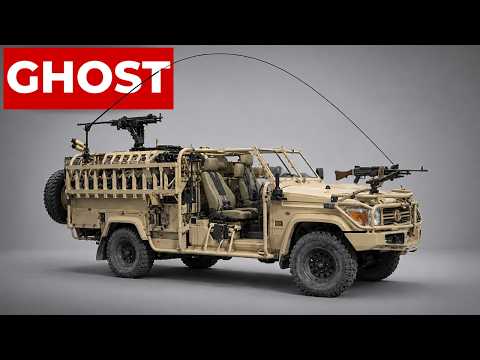
This is the story of how British engineers took the most ordinary truck in the Middle East, bolted a steel skeleton onto its back, and handed the Special Air Service a weapon that ISIS could not see coming until it was already inside their compound.
To understand why the regiment abandoned the Land Rover, you have to understand what the war in Syria actually looked like. By 2014, the Islamic State controlled territory the size of Britain. They moved in convoys of white Toyota Hilux pickups, often brand new, often still wearing dealer plates. According to ABC News reporting from October 2015, Toyota sold 18,000 Hiluxes and Land Cruisers in Iraq in 2013 alone, up from 6,000 just two years earlier. Iraqi Ambassador Lukman Faily told ABC News that ISIS had acquired hundreds of brand new Toyotas, and nobody could fully explain how. Mark Wallace, chief executive of the Counter Extremism Project and a former United States Ambassador to the UN, put it plainly. He told ABC News that the Toyota Land Cruiser and Hilux had effectively become almost part of the ISIS brand.
So, picture the problem facing British special forces planners. You need to insert a four-man patrol deep into contested territory. You need them to move through villages where every third vehicle is a Toyota. You need them to look like nothing in particular. And you arrive in a Supercat Jackal, a 6.5-ton open-topped British military vehicle that looks like nothing else on Earth.
The Land Rover wasn’t the answer, either. The classic SAS Land Rover, the Pink Panther of Oman fame, and its desert patrol vehicle successor, was retired from regiment service after the Al-Qaim raid on March 17, 2003. The Supercat HMT 400 took over the heavy patrol role. But the HMT 400 has the same visibility problem as the Jackal. It is unmistakably Western military hardware. In a theater where being recognized as Western military was the single fastest way to compromise an operation, the regiment needed something else. They needed a vehicle that disappeared.
The answer was already in production, and it had been built not in Britain, but in Jordan. In 2003, Jankel Armoring Limited of Weybridge, Surrey, signed a joint venture with the King Abdullah II Design and Development Bureau in Amman. The new company was called Jordan Light Vehicle Manufacturing. Their first product entered production in June 2005. The Jordanians called it Al Thalab, the Arabic word for the fox.
The concept was straightforward to the point of being radical. Take a Toyota Land Cruiser 79 Series cab chassis pickup, the workhorse diesel utility truck sold across Africa and the Middle East, strip the cargo bed, bolt on a tubular steel space frame designed to flex with the chassis over broken ground, add two weapon stations—one swing arm mount at the commander’s position for a general purpose machine gun, one geared traversing ring at the rear for a .50 caliber heavy machine gun, a Mark 19 grenade launcher, or a 40 mm automatic grenade launcher—add two antenna mounts, add power take-offs for radios, add a roll cage, add optional stretcher fittings for casualty evacuation, leave everything else alone. The engine in the operational specification is the Toyota 4.5 L 1VD-FTV V8 turbo diesel. 151 kW of power at 3,400 revolutions per minute, 430 Nm of torque from 1,200 revolutions, five-speed manual gearbox, part-time four-wheel drive with a low-range transfer case, solid front and rear axles, coil springs at the front, leaf springs at the rear, a 130 L factory fuel tank, crew of four with space for two stretcher cases.
Now, before we get into how the regiment actually used this thing in Syria, if you’ve made it this far into the deep dive, hit subscribe. It costs nothing, and it tells the algorithm that detailed British military engineering content has an audience. Now, back to Al-Tanf.
The specifications that matter for a special forces patrol vehicle are not horsepower and top speed—they are range, payload, and the boring stuff. Reliability, parts availability, whether you can fix it in the desert with a spanner. Jankel’s published figures put the unrefueled range of the Al-Thalab long-range patrol vehicle between 1,200 and 1,500 km, depending on configuration and load. Payload sits at around 1,550 kg in the baseline build. The vehicle is rated to operate between -15°C and +55°C. It is fully air transportable in a Hercules C-130 or an A400M, and it fits inside a Chinook helicopter with the roll bars folded and the weapons removed. It is designed for self-sustained 10-day patrols.
These numbers matter, but they are not why the regiment chose this vehicle. The regiment chose it because of what the platform underneath is. The Toyota Land Cruiser 79 series is the most boring truck in the world. It uses a body-on-frame chassis, solid axles front and rear, a diesel engine with mechanical fuel injection in most international markets, no common rail electronics, no drive-by-wire, no computer that needs a dealer laptop to diagnose. A broken half shaft can be replaced in a workshop in Erbil. A failed alternator can be sourced in Amman. A radiator can be welded by a mechanic in Hassaka who’s been welding the same radiators for 30 years. In 2016, the official Toyota dealership network in the Middle East was selling more 79 series cab chassis trucks per year than the British Army had ever bought Land Rovers. Spare parts were everywhere and critically, every spare part for the truck underneath looked like a spare part for a civilian truck. You could resupply your patrol vehicle without anyone ever knowing it was a patrol vehicle.
This is the part the headlines miss. The Al-Thalab is not a Toyota with guns bolted on. It is a Toyota that has been engineered by a British defense contractor to remain mechanically identical to every other Toyota in the region. The Jankel space frame attaches at the chassis interface points. The original Toyota suspension is retained. The original Toyota cooling system is retained. The original Toyota fuel system is retained. From 30 meters away, you cannot tell it apart from the white Land Cruiser that just drove a UN water engineer to a refugee camp. That is the weapon. The truck is the weapon.
On August 8th, 2016, BBC Middle East correspondent Quentin Somerville published the photographs that everyone in Whitehall had spent two years pretending did not exist. The pictures had been taken in June. They showed British soldiers in tactical kit standing alongside their Al-Thalabs at the New Syrian Army base at Al Tanf, following an ISIS attack on the base. In his audio report, Somerville described them as a small but lethal force of 12 men who had come laden with weaponry to fight their way out of any trouble.
The BBC report noted the vehicles were carrying an arsenal of equipment including sniper rifles, heavy machine guns, and anti-tank missiles. The Guardian’s Ewen MacAskill, writing the same day, cited an independent source confirming the men were UK special forces. The Ministry of Defense, as is standard practice for any question about United Kingdom special forces, declined to comment.
Parliament had authorized British airstrikes inside Syria on December 2nd, 2015. Parliament had not authorized British ground troops. The regiment was inside Syria anyway. They were operating under separate authorities that the Ministry of Defense never explains on the floor of the House of Commons.
What we know from documented sources is this. United Kingdom special forces rotated through Al Tanf to train Syrian opposition fighters—first the New Syrian Army, later the Revolutionary Commando Army, and after October 2022, the Syrian Free Army. They worked alongside American special operators, including Delta Force operators from 1st Special Forces Operational Detachment-Delta. They conducted what defense analysts assessed to have been a mix of training, liaison, intelligence work, and direct action. The specifics are classified, and unless a primary source confirms them, they remain classified.
What we also know is that the Americans were watching the British Toyota approach with quiet professional jealousy. On March 7th, 2018, defense reporter Joseph Trevithick published a piece in The War Zone revealing that United States Special Operations Command had issued a formal requirement for a vehicle whose body panels could be reconfigured to mimic a Toyota Hilux, a Ford Ranger, or a Toyota Land Cruiser 200. The SOCOM specification stated that the result had to be essentially indistinguishable from its commercial counterparts to observers standing approximately 330 feet away while it was traveling at a nominal speed of 35 miles per hour.
A United States Air Force Journal piece published in 2023 quoted the complaint that had echoed through the ranks for years. The piece was titled “Toyotas and Terrorists.” The line that mattered was a single question. Why are ISIS’s trucks better than ours? The British answer had been in production since 2005.
The Al-Thalab also exposed something uncomfortable about the alternatives. The American Ground Mobility Vehicle 1.1, built by General Dynamics on a Flyer 72 chassis under a $562.2 million contract awarded on August 22nd, 2013, is a bespoke special operations platform. Crew capacity of nine, payload of around 2,585 kg, range of about 640 km. It is an excellent vehicle. It does not look like a Hilux. The Australian Special Operations Vehicle Surveillance Reconnaissance, the Nary, ordered in August 2008 at a cost of 80 million Australian dollars for 31 vehicles, is a Supercat HMT Extenda variant. It does not look like a Hilux, either. The British, by going through Jankel and Jordan Light Vehicle Manufacturing, bought something the Americans were still writing requirements documents about in 2018.
The price of that capability, however, was paid in full on March 29th, 2018. That day, in Manbij, northern Syria, an explosion killed Sergeant Matt Tonroe of the 3rd Battalion, the Parachute Regiment, attached to United Kingdom Special Forces. He was 33. He died alongside American Master Sergeant Jonathan J. Dunbar of Delta Force.
The Pentagon and the Combined Joint Task Force initially attributed the deaths to an ISIS-emplaced improvised explosive device. In July 2019, the Ministry of Defense issued a revised statement. Forces News carried the verbatim text on July 28th, 2019. Sergeant Matt Tonroe died from blast injuries caused by an explosion during a military operation. It was initially believed that Sergeant Tonroe was killed by enemy action. However, subsequent investigation concluded that Sergeant Tonroe was killed by the accidental detonation of explosives carried by coalition forces.
The defense secretary at the time, Gavin Williamson, told Sky News on March 30th, 2018 that Sergeant Tonroe fought to protect British values, British freedoms, and to keep us back at home safe. The regiment lost a man. The Ministry of Defense eventually told the truth about why. That is the cost of the work that was being done out of vehicles that looked to the casual observer at the next checkpoint like another aid worker’s pickup.
Jankel announced on July 10th, 2023 that more than 500 Fox family vehicles had been delivered globally. The official operator list published in the same Weybridge press release names 15 nations. The United Kingdom is one of them. The United States is another. So are France, Belgium, New Zealand, Romania, Italy, Spain, Oman, Jordan, Brunei, Indonesia, Mauritania, Botswana, and South Korea. France’s special forces variant, the VPS 2, was unveiled at Eurosatory in 2018 and is built on the same Toyota 79 series chassis. Belgium’s order of 108 Fox rapid reaction vehicles, placed in January 2016, switched to the Toyota Hilux chassis. The vehicle the British originally co-designed for the Jordanian army in 2005 is now the quiet standard for European special operations.
Look at what the Land Rover Pink Panther represented in 1968. A vehicle painted to disappear into the Omani desert. A vehicle designed to extend the operational reach of small patrols into hostile territory. A vehicle whose entire purpose was to let 12 men do the work of 1,200 by being where the enemy did not expect them.
The Al-Thalab is the same idea 50 years later, applied to a different desert and a different enemy. The paint scheme is no longer pink. The vehicle is no longer British-built end to end. The engine is no longer a Rover straight-six. But the principle is unchanged. Get the small patrol into the place the enemy is not watching. Give them the firepower to fight their way out if they are seen—and above all, do not look like what you are.
The British regiment did not abandon the Land Rover because the Land Rover was bad. They abandoned the Land Rover, the Supercat, and the Jackal for the Syria role because the war had changed, and the rules of being seen had changed with it. The enemy drove Toyotas. The civilians drove Toyotas. The aid workers drove Toyotas. And so, in the end, did the regiment.
A British defense company. A Jordanian factory. A Japanese chassis. A weapon system that lets 12 men disappear into a country of 40 million. That is what the BBC’s photographer captured at Al Tanf in June 2016. Not a Toyota with guns on it. A piece of British engineering doctrine 80 years old, hiding in plain sight. The Fox was always the point.
But here is the question that keeps defense planners awake at night. When the next war arrives, and the enemy switches to a different truck, will the British still be driving the Fox—or will they be three years behind, writing requirements documents while someone else’s convoy rolls past the checkpoint? What do you think—does camouflage-by-ordinariness still work in an age of drones and thermal optics, or is the Fox’s greatest trick about to be exposed? Let us know in the comments below.
Report this article
Select a reason for reporting:






