Elvis Presley was on top of the world in 1973. His comeback special had reignited his career, and Aloha from Hawaii had just been beamed live to millions across the globe. He was the biggest star American entertainment had ever produced, with a catalog of hits that included Heartbreak Hotel, Hound Dog, and Jailhouse Rock—songs that had been generating royalties for him since 1956 and showed no sign of slowing down.
Then, in March of that year, Elvis and his manager, Colonel Tom Parker, walked into RCA and offered to hand over every future artist royalty on everything Elvis had ever recorded—permanently—in exchange for one lump payment. RCA agreed and paid $5.4 million. Parker took half. After taxes and his divorce settlement, Elvis kept only a fraction. From that day forward, he never earned another cent in artist royalties on those recordings, and neither did his daughter, his father, or his estate after he died in 1977.
Elvis was 38 years old, still selling out arenas, still under contract, and in no immediate danger of running out of work. Yet he signed away the most valuable back catalog in American popular music because he wanted cash in hand that year. His estate later sued Parker for fraud and mismanagement, and the matter was settled in 1983—long after the catalog was gone for good.
What stands out is that nobody involved was in any trouble. Elvis had a record company that would have restructured almost anything rather than lose him. He traded a permanent income stream for one payment because that was what his manager put in front of him.
Mario Lanza was another star who let pride cost him everything. In the early 1950s, he was one of MGM’s most bankable names, a genuine operatic tenor who had crossed over into movie stardom with The Great Caruso. The studio cast him in The Student Prince and he pre-recorded the entire score beautifully. But when director Curtis Bernhardt asked him to tone down the emotion in one song, Lanza refused. “He told Bernhardt that he was there to direct the acting and that the singing was Lanza’s own department,” then walked off the set and announced he would not return as long as Bernhardt was attached.
MGM canceled the production and sued him for more than $5 million. The suit was settled in May 1953 on painful terms: Lanza gave the studio permission to use every one of his pre-recorded vocals, and MGM dropped its damages claim. The film was finally made in 1954 with Edmund Purdom mouthing the words while Lanza’s voice came out of the speakers. Audiences heard Mario Lanza and watched somebody else get the credit and the career boost.
Lanza lost his MGM contract, went nearly two years without a picture, and never again had a studio building major productions around him. He moved to Italy in 1957 and died there in 1959 at the age of 38. And the argument that started all of it had been about how much feeling to put into one song.
The settlement handed MGM everything it actually wanted because the studio needed the voice far more than it needed Lanza on camera. By refusing to show up, he made it cheap and easy for them to take one and leave the other out of the picture entirely.
When Sanford and Son premiered on NBC in 1972, it became one of the biggest shows on American television almost overnight. Redd Foxx, who had spent decades grinding out work on the nightclub circuit, was finally a national star in his fifties. He also spent the next five years fighting the people who signed his checks.
In January 1974, Tandem Productions sued him for $10 million after he simply failed to turn up for the taping of a new season—a holdout over money and over a dressing room he wanted to have a window in. That dispute got patched up, but the pattern did not change. In 1977, Foxx walked away from the show entirely, six seasons in and still enormously popular, to take an ABC variety hour called Simply Redd Foxx.
NBC responded by canceling Sanford and Son, which meant he had personally ended the most successful thing he would ever be part of. The variety hour lasted a few months. He tried again with a revival called Sanford in 1980 and with The Redd Foxx Show in 1986, which ABC pulled after twelve episodes.
The money went out faster than it ever came in. He reportedly earned $4 million in a single year at his peak and had almost nothing to show for it. By 1983, he was filing for bankruptcy, listing $881,000 owed to creditors and more than $1.6 million owed to the IRS, the state of California, and Los Angeles County.
On November 28, 1989, federal agents arrived at his Las Vegas home and seized it along with seven vehicles, roughly $12,000 in cash, and a dozen guns over liens totaling $755,000 for the years 1983 through 1986. With penalties and interest, the bill had climbed close to a million, and agents reportedly left him his bed. He was still working to pay it down when he died in October 1991, owing more than $3.6 million in taxes. Eddie Murphy paid for his funeral.
He had been a working comedian for more than thirty years before television found him, which is what makes it so hard to explain. A man who came up that way knew exactly how rare a hit show was, and he walked out on one anyway.
Dennis Hopper had a different problem: he was handed freedom most directors never get and used it to make something almost nobody could sit through. Easy Rider cost around $400,000 in 1969 and brought in tens of millions, convincing the studios they had no idea what young audiences wanted. Universal set up a program to finance five young filmmakers with almost no interference, and Hopper got $1 million and complete final cut.
He took all of it to Peru and spent much of 1970 shooting a picture then titled The Last Movie, inviting a crowd of actor and musician friends down to be in it and improvising so far past the screenplay that the writer, Stewart Stern, later said the script had not so much been taken away from him as quietly put aside.
Hopper missed his delivery date at the end of 1970. He took the footage home to Taos and cut a conventional, followable version of the film. And then, after spending time around the director Alejandro Jodorowsky, he threw that version out and rebuilt the whole thing into something deliberately fractured and out of order, finishing in the spring of 1971.
The last movie won the Critics’ Prize at the Venice Film Festival that year, which he took as proof he had been right. Then it opened in New York, ran for four weeks, and collapsed, and Universal effectively buried it.
The consequences lasted the rest of the decade. Hopper did not direct another film until Out of the Blue in 1980—a gap of nine years—and he barely appeared in an American picture until Francis Ford Coppola cast him in Apocalypse Now in 1979. He had been handed the exact freedom that every filmmaker of his generation was begging for, with a studio willing to pay for it. And he used it to make something almost nobody could sit through. The studios drew the obvious conclusion about handing that freedom to anybody else.
The detail people keep coming back to is that he had already cut a version that worked—a conventional edit that was finished and sitting there—and he threw it away on purpose after deciding it was too ordinary.
Rod Serling created The Twilight Zone and served as its on-camera host, the man in the narrow suit whose voice and cadence became one of the most recognizable things on American television. He wrote well over ninety of the scripts himself and held an ownership interest in the show through his own production company. When the series ended in 1964, CBS came to him with a straightforward pitch: the show had consistently run over budget, and they were never going to recover what they had put into it. He might as well take a payment now and let them buy out his stake.
Serling had spent years fighting network executives and sponsors over censorship. He was perfectly capable of holding a line when he believed in something, but he was also exhausted after five seasons of writing at a pace almost nobody in television has matched before or since. He took the deal and sold his rights back to CBS.
What followed is one of the most valuable syndication runs in the history of the medium. The Twilight Zone has been in continuous rerun rotation for sixty years, generating hundreds of millions of dollars, and CBS recovered its costs many times over. Serling’s brother, Robert, later recalled that Serling’s wife, Carol, put the family’s loss at somewhere around $4 million, and his daughter, Anne, has said plainly that selling the show may have been the worst mistake her father ever made.
He did not even get to enjoy the reruns because he hated what syndication did to the episodes, with scenes cut out of finished stories to make room for more commercial breaks. So he spent the last decade of his life watching his best work get chopped up on television while somebody else collected the money for it. He died in 1975 at the age of 50, still writing, still taking assignments, still narrating commercials to keep the income coming in.
He had spent five years proving he understood television better than almost anyone alive. And then he let the network across the table tell him what his own show was going to be worth.
Dorothy Dandridge became the first black woman ever nominated for the Academy Award for Best Actress for Carmen Jones in 1955. For a few years afterward, she was one of the highest-paid black performers in the country, headlining at the Waldorf in New York and at clubs across Europe and Latin America between pictures. She was also, by every account of the people around her, almost entirely disengaged from her own finances.
She turned the money over to advisers and business managers and did not independently check what was being done with it year after year through the period when she was earning the most she would ever earn. She was eventually told that the people handling her accounts had taken roughly $150,000 from her and that she owed about $139,000 in back taxes that nobody had been setting aside.
On top of that, she put a large portion of what remained into an oil venture she had been assured could not possibly fail—wells that produced almost nothing and returned almost nothing. Her 1959 marriage to the nightclub owner Jack Denison made it worse rather than better because his business ventures drew on her money and her name. When the marriage ended in 1962, the financial damage stayed behind.
She filed for bankruptcy in 1963. She lost her home in the Hollywood Hills, sold off furniture and jewelry, and moved into a small apartment on Fountain Avenue. Taking nightclub bookings she did not want to pay down judgments from lawsuits. She was 42 years old when she died in 1965, less than a decade after an Oscar nomination that should have made her financially untouchable.
The part that stayed with the people who knew her was how little of it came from anything she did on a stage or in front of a camera. She simply never once asked to see the books. She had every reason to know she would not get a second run at that level of earning because she had spent years being told there were almost no leading parts written for a black actress in American film, no matter how good her reviews were. And she handed the money she did have over to people she never once checked on.
Marlon Brando was the most admired screen actor in America by 1960, a man whose work in A Streetcar Named Desire and On the Waterfront had changed how a generation approached acting. MGM hired him for a remake of Mutiny on the Bounty, budgeted at around $10 million—an enormous number for one picture. Brando did not have script approval written into his contract. He took it anyway by refusing to perform.
The director, Lewis Milestone, said afterward that if Brando did not like something, he would simply stand in front of the camera and not act, leaving the production to either rewrite the scene his way or shoot nothing at all. The budget climbed to nearly $20 million. The film took in roughly $13.7 million in the United States against a break-even point closer to $30 million, helping produce a studio-wide loss of $17 million for MGM that year.
Then came the second decision. The Saturday Evening Post ran a piece pinning the disaster on him. Rather than let it go, he sued the magazine for $5 million and talked the president of MGM into publicly supporting the suit—putting the studio’s own name behind a loud argument about how difficult its own star had been. That endorsement was used against the MGM president when he was pushed out shortly after the film opened in November 1962.
The lawsuit did nothing for him, and the most gifted actor of his generation spent the rest of the sixties as a man studios would not risk their money on. Ten full years passed before a director had to fight Paramount to get him cast in The Godfather, and the industry finally remembered what he could do. He had walked into Tahiti with the leverage to get nearly anything he wanted, and he spent all of it rewriting scenes that nobody had asked him to rewrite.
Before Elvis arrived, Eddie Fisher was the biggest recording star in the United States—a young man with thirty-five songs in the Top 40 and his own NBC television program, Coke Time with Eddie Fisher, which ran from 1953 to 1957 and put him in American living rooms twice a week. By his own reckoning, laid out years later in his autobiography, he earned and spent something on the order of $20 million across his career.
He gambled heavily for years and wrote afterward that he had told himself it was harmless recreation, estimating that over one stretch alone he dropped somewhere around half a million dollars. He was also, by his own account, careless about nearly every piece of paperwork he signed, taking on ventures he did not understand and never keeping anybody independent between himself and the people managing his affairs.
It caught up with him in 1970 when he filed for bankruptcy in San Juan, Puerto Rico, listing $916,300 in debts against $40,000 in assets. He was 42 years old, still perfectly capable of filling a room, and he spent the following decades working because he had to rather than because he wanted to.
When the book came out in 1999, reviewers kept remarking on how much remorse there was in it over the money—described with the specificity of a man who had gone back through all of it afterward and counted. He died in 2010 at the age of 82, having been at various points in his life one of the best-paid performers in the country and legally insolvent, without ever really changing how he handled either situation.
Ernie Kovacs invented a large share of what television comedy would become, working out visual gags and camera tricks on low-budget local programs in Philadelphia before moving to national shows through the 1950s. He was also convinced that the American tax system was deeply unfair, and he responded by simply declining to pay most of what he owed—without ever taking it to court or putting a lawyer on it to fight the assessment properly.
He put money into shell corporations with deliberately silly names. In 1961, on the same day he was hit with a $75,000 lien for back taxes, he bought the California Racquet Club, apparently on the theory that it would function as a write-off. The government eventually started garnishing as much as 90% of everything he earned, which meant that a man capable of some of the most original work on television was reduced to taking game show appearances and film parts he had no interest in purely to service a debt that kept growing anyway.
When he was killed in a car crash early in 1962, he owed several hundred thousand dollars and there was no plan and no reserve behind him. His widow, Edie Adams, turned down a benefit special that their friends in the industry had organized on her behalf, telling them that she could take care of her own children. Then she went out and took every commercial and nightclub booking she could get, most famously the long-running cigar campaigns, and she paid the entire thing off herself over years. She also absorbed a bill from ABC of around $150,000 for budget overruns on his programs.
Every dollar of it came out of her career instead of his. The money had been there the whole time because he worked constantly and was paid well for it. What stood between his family and a comfortable estate was a decision he made on principle and then never revisited as the interest kept compounding.
Robert Reed spent five seasons as Mike Brady on The Brady Bunch between 1969 and 1974, playing one of the most recognizable television fathers in American history on a show that has essentially never been off the air since. He also spent those five seasons at war with the people making it. Reed had trained as a serious dramatic actor, had studied in London, and had come off a long run on The Defenders. He took the position almost from the start that the material he was handed on a family sitcom was beneath the profession.
Rather than take that up quietly with his agent, he wrote memos—long ones, constantly—to the producers and to the show’s creator, Sherwood Schwartz, taking scripts apart line by line to explain what was implausible in them and why the whole enterprise embarrassed him. It went on like that for years.
The breaking point arrived with the last episode filmed in 1974: a story in which the oldest Brady son’s hair turns bright orange overnight from a bottle of cheap hair tonic. Reed found it so ridiculous that he refused outright to appear in it. He put his reasons in writing again, complaining about the slapstick and noting that the boy’s hair changed color, in his own words, in a twinkling of a writer’s eye.
Schwartz did not argue with him. He simply rewrote the episode to take the father out of it completely, told Reed’s agent that Reed did not need to report for work, and made clear that he would not be paid for the episode and would not receive residuals on it either—which, on a series that has run continuously in syndication for more than fifty years, turned out to be a genuinely expensive thing to give away over a plot about hair tonic.
Reed then turned up on the set anyway to keep complaining, standing off camera on an episode he was not in, which changed nothing. Schwartz said afterward that Reed was the only real problem he ever had on that production, that he should never have been cast in the first place, and that if the series had been renewed, the part would have gone to somebody else. What seems never to have occurred to Reed is that the show was going to be his legacy, no matter how he felt about the writing. He worked steadily for another fifteen years and earned Emmy nominations for serious dramatic work in Rich Man, Poor Man and Roots. And he is still, to almost everyone who has ever seen him, Mike Brady—which is precisely the outcome he spent five years writing memos to prevent.
The Three Stooges made 190 short films for Columbia Pictures between 1934 and 1957, the longest run of its kind in the business. Moe Howard was the one who handled the team’s business affairs. The arrangement Columbia had them on was a one-year contract with an option, which meant the studio could decide every twelve months whether to keep them, and the studio head, Harry Cohn, ran the same routine on them every single year. He waited until the last possible moment to pick up the option and told them the market for comedy shorts was dying out and they should be grateful there was any work at all. They believed him every year for twenty-three years.
In all that time, the team never once asked for a raise and never once received one. Moe wrote in his own autobiography that he only learned afterward how popular they had actually been and how much Columbia had been making from them the whole time.
On December 20, 1957, the shorts unit was shut down and the Stooges were finished, and nobody thought it necessary to tell them directly. Moe came back to the lot afterward to say goodbye to people he had worked beside for more than two decades and was turned away at the gate because he no longer held a current studio pass.
Then came the part that must have been genuinely difficult to watch. In September 1958, Columbia’s television division packaged 78 of the shorts for syndication, and within a year, all 190 were running constantly on stations across the country. A whole new generation found them. The merchandise went everywhere. The Stooges became more famous in the early 1960s than they had ever been in theaters. They received nothing from any of it because they had no residual rights and had never asked for a piece of the films themselves.
Moe had signed the same option year after year without ever calling Cohn’s bluff. The one question that would have changed everything for three families never got asked out loud. Their shorts played in front of features in thousands of theaters every week for more than two decades, and a single afternoon spent asking a booking agent how often those films were actually running would have told them everything Cohn was working so hard to keep from them.
Orson Welles made Citizen Kane at RKO in 1941 at twenty-five years old under a contract so generous that the industry took it as an insult. The single most important clause in it gave him final cut, meaning nobody could alter his film without his say. For his second picture, The Magnificent Ambersons, he sat down with RKO and renegotiated. In that renegotiation, he gave the final cut clause away.
Then, with Ambersons shot but the edit still unfinished, he accepted a government request to go to Brazil in early 1942 and begin shooting a documentary called It’s All True as part of the wartime Good Neighbor program, leaving the cutting room behind on what he believed was an understanding that he could finish the edit from Rio. The understanding did not survive contact with the studio.
A preview screening in Pomona on March 17, 1942, went badly with the audience. The editor, Robert Wise, trimmed several minutes, and a second preview went no better. Because Welles had signed away the only protection that mattered, RKO then cut more than forty additional minutes out of the picture, shot a new and cheerier ending in late April and early May that ran directly against everything the film had been building toward, and destroyed the negatives of the removed footage to clear space in the vault. Bernard Herrmann had his name taken off the credits when more than half his score disappeared.
The film lost $620,000. Welles came back to find himself locked out of his own offices on the lot, the Brazilian footage abandoned and unfinished, and his reputation inside the industry rewritten from boy genius to expensive problem. He was 26 when he made that trade, and he spent the following four decades scraping together money for his own projects and taking acting jobs and voice work and commercials to pay for them, never again handed a studio’s resources with anything close to that kind of freedom.
He had been handed the only contract in Hollywood that could have protected him from exactly what happened to Ambersons. He negotiated it away himself, and then he got on a plane and left the film sitting in a cutting room belonging to a studio that no longer needed his permission for anything.
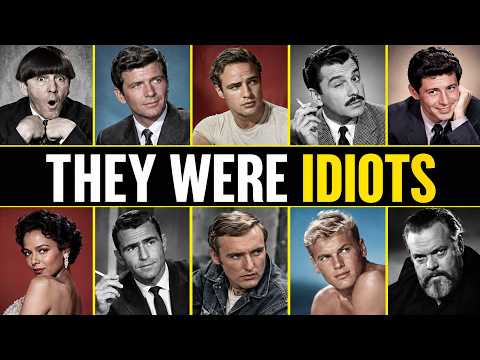
Looking back across all twelve, the pattern is almost identical: a moment of pride, exhaustion, or trust placed in the wrong person, and a lifetime of royalties handed to somebody else. None of them were in trouble when they signed. Every one of them had leverage they never used. So which of these twelve decisions do you think was the most avoidable—and who would you add to the list? Let us know in the comments below.
Report this article
Select a reason for reporting:






