The photograph had lain forgotten in the archives of the Boston Historical Society for decades. Dated June 15, 1910, it showed the wealthy Matthews family posed stiffly in the drawing room of their Victorian home. Richard Matthews, a successful textile merchant, stood beside his wife Elizabeth, while their three children sat neatly in front of them. The family’s wealth was evident in their elegant clothes and the ornate furnishings surrounding them—a Persian rug, mahogany furniture, and gilded oil paintings reflecting their social standing among Boston’s elite.
In 2023, historian Dr. Eleanor Wells discovered the image while cataloging materials for an exhibition on Boston’s industrial families. With a PhD in American social history, Dr. Wells was known for uncovering neglected stories within traditional historical records. At first glance, the Matthews family portrait seemed like a typical formal portrait of the era—stiff poses, serious expressions, and precise composition reflecting early 20th-century American photography traditions.
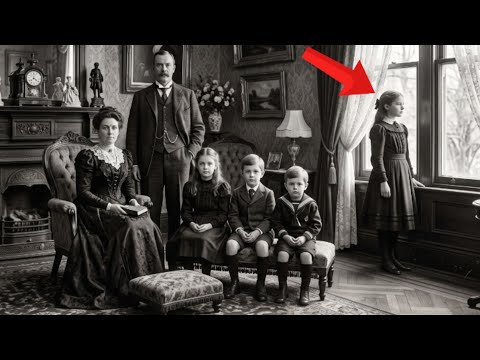
However, when Dr. Wells examined the photograph under proper archival lighting and magnification, something unexpected caught her trained eye. By the window in the background stood another child, partially visible, perhaps eight or nine years old, staring directly at the camera. The image was slightly blurry, but his presence was unmistakable, watching the family scene with an inexplicable, ambiguous expression.
The child’s clothing was simpler than the luxurious attire of the Matthews children, and his position apart from the family group suggested a deliberate choice by the photographer. Dr. Wells noted in her research journal that according to all Matthews family records, there were only three children in the household at that time. The identity of this fourth child was completely undocumented in any of the family trees or social records she had examined so far.
Initial examination by conservation experts confirmed the photograph was an original from 1910, unaltered and untouched. The mysterious figure by the window was present when the picture was taken, raising questions about a potentially undocumented member of the Matthews household. A hidden history waiting to be revealed.
Dr. Wells began her investigation by examining official Boston records from the early 20th century. The city’s meticulous documents provided a framework for understanding the Matthews family’s public identity. The 1910 census listed only five individuals in the Matthews household: Richard, 42; Elizabeth, 38; and their three children—William, 15; Margaret, 12; and James, 8. No fourth child was officially documented as residing at the family’s Commonwealth Avenue address.
Birth records in the Massachusetts State Archives confirmed that Elizabeth Matthews had given birth to only these three children, with medical records noting complications after James’s birth that prevented further pregnancies. Parish records from the family’s Episcopal church similarly showed that only three Matthews children were baptized, confirmed, or attended Sunday school during that period.
Dr. Wells expanded her search to include city directories, school enrollment records, and neighborhood maps from 1908 to 1912. Her findings revealed that the Matthews family employed two live-in servants—an Irish cook and a Swedish housekeeper—and occasionally hosted relatives for extended visits, but none matched the age of the child in the window. The documentary evidence presented a clear contradiction to what was plainly visible in the photograph.
“Either this child was deliberately erased from official records, or he had another connection to the household that didn’t warrant documentation in traditional historical sources,” Dr. Wells explained to colleagues at the Boston Historical Society.
A promising thread emerged from Elizabeth Matthews’s personal correspondence, preserved within the family papers. In a letter dated March 1910, Elizabeth mentioned that the special arrangements for “C” had been finalized, though no further explanation was provided in that particular document. The letter “C” appeared several more times in Elizabeth’s appointment books from the same period, often linked to meetings with her charitable organization.
The child’s deliberately marginal position in the photograph suggested an ambiguous status within the household—present but not part of the family. This visual positioning mirrored the documentary positioning: present in the physical space but absent from the official record. For Dr. Wells, such a contradiction was the beginning of a historical mystery requiring deeper investigation.
The photograph was sent to Dr. Thomas Anderson, a specialist in early photographic techniques at the Smithsonian Institution. With 30 years of experience analyzing historical images, Dr. Anderson approached the Matthews photograph with scientific rigor, using traditional examination methods and advanced digital enhancement techniques.
After a week of meticulous analysis, Dr. Anderson confirmed that the figure was not a photographic flaw or optical illusion. The child was physically present when the photograph was taken, standing about six feet behind the family group near a prominent window in what appeared to be the family’s drawing room. Digital enhancement revealed additional details previously unclear. The child had dark hair and wore simple clothing—neither the luxurious attire of the Matthews children nor the typical uniform of household staff. The clothes were of acceptable quality but noticeably less formal than the family’s garments in the photograph. His posture indicated he was placed there deliberately, not captured accidentally while passing by.
“Notice how the child looks directly at the camera,” Dr. Anderson noted in his detailed report. “This indicates awareness of the ongoing photography, given the long exposure times of cameras in 1910, which typically required several seconds of complete stillness.” This was a deliberate inclusion by the photographer and likely by the family as well.
Further analysis of the room’s shadows and lighting patterns confirmed the photograph’s authenticity. The shadow cast by the child matched correctly with the natural light source from the window, and the child’s reflection could be faintly seen in a decorative mirror on the opposite wall, eliminating the possibility of darkroom manipulation or later addition to the negative.
Most importantly, Dr. Anderson discovered a small detail on the windowsill beside the child—a handwritten note or card, too small to read even with magnification, but deliberately placed in the scene. This type of personal artifact suggested that the child’s presence had meaning beyond mere coincidence.
“This photograph tells a carefully designed story,” Dr. Anderson concluded. The child’s presence was intentional, but his separation from the family group was equally deliberate. In the visual language of early 20th-century photography, this spatial arrangement conveyed significant social information about relationships and status that would have been immediately clear to contemporary viewers.
Dr. Wells’s investigation took an unexpected turn when she discovered that Richard Matthews had been the subject of several newspaper articles in 1909. As a prominent businessman in Boston’s textile industry, his activities occasionally warranted mention in city newspapers, particularly the Boston Globe and the more labor-oriented Boston Daily Standard.
In the Boston Globe archives, she found coverage of a textile workers’ strike at one of Matthews’s factories in November 1908. The articles presented Matthews as a complex figure—described by business associates as progressive-minded, and by labor organizers as less harsh than most, though hardly a friend to the working man. Several articles mentioned Matthews’s reputation as a progressive employer who implemented safety improvements after a tragic accident at his factory in October 1908.
The accident, described in detail in an October 15 article, occurred when a spinning machine malfunctioned, killing three workers and injuring several others. Among the dead was a woman named Mary O’Malley, identified as a widow with one child—a daughter, eight years old. The article noted the shock felt by Boston’s Irish immigrant community in the South End, where many of Matthews’s workers lived.
A follow-up article dated November 3, 1908, reported that Matthews had made arrangements for ongoing care for the affected families beyond standard compensation, though specific details were not reported. This unusual action had apparently helped mitigate tensions that could have led to more sustained labor unrest.
Dr. Wells also found a social column from April 1910 that briefly mentioned Elizabeth Matthews’s involvement with the “Children’s Aid Society,” a charity that placed orphans with families or in appropriate institutions. The column noted that her personal commitment to the cause had intensified over the previous year, becoming a leading voice in the organization’s efforts to improve conditions for the city’s underprivileged children.
“The timeline aligns perfectly,” Dr. Wells wrote in her research notebook. The factory accident occurred in October 1908. Elizabeth’s charitable work intensified throughout 1909. The mysterious “C” appeared in correspondence by March 1910, and the photograph with the unknown child was taken in June 1910.
The breakthrough came from an unexpected source: the family’s account books, meticulously kept by Elizabeth Matthews and preserved within the family papers at the Historical Society. From 1900 to 1915, Elizabeth recorded every family expense in remarkable detail, from major purchases to daily expenditures.
Beginning in November 1909, a new recurring entry appeared in the household accounts: a monthly allowance for “C” of $18. This continued regularly through 1912, with occasional additional expenses for “C’s” clothing and medical needs. In February 1910, a significant one-time expense was recorded: room arrangements for “C,” $42—suggesting the preparation of living quarters within the house.
This was a substantial sum, as economic historian Dr. Rachel Harris explained. Eighteen dollars a month in 1910 was equivalent to roughly $500 today—enough to cover a child’s basic necessities, but noticeably less than what was typically spent on a family member of their social standing. The Matthews family spent far more on suits and necessities for their biological children, according to these same records.
Additional entries revealed that in September 1910, funds were allocated for “C’s” school supplies and reading books, indicating the child was receiving an education. By 1912, entries had evolved to include books for “C” and occasionally private lessons for “C.” An April 1912 entry noted fees for “C’s” examinations, suggesting formal educational assessment.
Most revealing was a December 1910 entry: “Christmas gift for Catherine, doll, $3.50.” This was the first time a full name appeared in connection with the mysterious “C.” Later holiday entries included gifts for Catherine alongside those purchased for the Matthews children, though the amounts spent remained clearly different, reflecting a hierarchical relationship.
These account books told Dr. Wells that the Matthews family had been financially supporting this girl named Catherine over multiple years. “The expenditures suggest care that went beyond mere charity,” Dr. Wells concluded. Yet the separate accounts and different scale of funding indicated the child maintained a distinct status from the Matthews children. She occupied an unusual middle ground—neither servant nor family member in the traditional sense.
Dr. Wells’s research into Elizabeth Matthews’s personal correspondence revealed crucial insights into the family’s relationship with Catherine. In letters to her sister in New York, Elizabeth began mentioning Catherine occasionally in late 1909, gradually painting a picture of the child’s position within the household.
A letter dated December 18, 1909, was particularly revealing. “Catherine has begun to settle in. She rarely speaks, but watches everything with those serious eyes of hers. Richard believes maintaining distance is wise given the circumstances, but I find myself drawn to the child. The circumstances of her coming to us still weigh on my conscience, though I know we did the right thing by her. The alternative was simply not morally acceptable.”
In a February 1910 letter, Elizabeth wrote: “I have arranged a small room for Catherine adjacent to the servants’ quarters, though better furnished.” Richard had questioned the necessity of such arrangements, but she reminded him of his promise after the accident. He had finally agreed, though insisting they maintain proper boundaries. “The child needs stability after such tragedy, and I intend to provide it within the constraints of our position.”
By April 1910, Elizabeth’s letters showed an evolution in the family dynamic. The children reacted differently to Catherine’s presence. William remained distant and reserved. Margaret showed unexpected kindness in teaching her sewing, and young James seemed to have found a quiet companion for his reading. “We maintain propriety in public, of course, but within our home, some natural affection has developed despite Richard’s concerns about excessive attachment.”
The most significant letter, dated July 1912, revealed a turning point. Richard had finally relented after seeing Catherine’s exceptional performance in her examinations. “She will join Margaret at the Academy this autumn. It is not an adoption—Richard is firm on that point—but it is a step toward giving her the opportunities her mother would have wanted for her. The debt we owe cannot truly be repaid, but perhaps this education may begin to balance the scales. I only wish I could acknowledge her more openly without risking Richard’s position or the family’s standing.”
These private writings confirmed that Catherine had been brought into the Matthews household after her mother’s death in the factory accident, as a private act of compensation far from public view.
To understand Catherine’s full story, Dr. Wells examined the Matthews Textile Company’s records, recently donated to the Boston Museum of Industrial History. Employment files, accident reports, and internal correspondence from 1900 to 1920 offered an unprecedented view of business practices of the era.
Catherine’s mother, Mary O’Malley, appeared in the employment records as a spinner hired in 1905. An Irish immigrant widow who had lost her husband to pneumonia in 1903, she worked at the factory for three years before the tragic accident. Her personnel file noted her as a reliable, precise, and skilled employee with no disciplinary records.
The accident report, dated October 14, 1908, described in precise detail a machinery failure that claimed the lives of three workers, including Mary O’Malley. The subsequent investigation revealed that safety mechanisms had been repeatedly reported as faulty, but repairs were postponed to avoid production stoppages—a common and controversial practice in industrial operations of the time.
Internal correspondence between Richard Matthews and his factory manager revealed the company’s response. “The O’Malley child requires immediate attention. No relatives capable of claiming her in Boston, and her nearest family in Ireland is unreachable. The orphanage seems the likely destination, though Mrs. Matthews has expressed reservations given the circumstances of the mother’s death.”
A later memo from Matthews, dated October 30, 1908, directed: “Mrs. Matthews suggests a temporary arrangement in our home pending more suitable permanent arrangements. Proceed with discretion. The matter must remain private to avoid setting a precedent with other affected families.”
The most revealing document was a private note from the factory manager to Matthews six months after the accident. “Rumors among the workers about your household’s care for the O’Malley girl are generating considerable comment. Though your charity is commendable, it might be wise to consider how this appears to those who lost family members without receiving the same attention.” Union representatives had made informal inquiries about preferential treatment for victims’ families. Matthews’s handwritten reply in the margin read: “The arrangement continues as specified. Mrs. Matthews insists we will handle any complications, Doctor.”
Dr. Wells’s inquiry extended to the archives of several Boston educational institutions. Initially, she found no record of Catherine O’Malley in public school records for 1909–1911, suggesting she likely received private instruction during her early years with the Matthews family—a common practice for children in transitional social positions. Records indicated that Elizabeth Matthews had arranged for the niece of her housekeeper, a trained instructor, to provide Catherine’s early education.
By 1912, Catherine’s enrollment at the Academy was confirmed. The registration listed her as “Catherine O’Malley, ward of Richard Matthews,” a designation that carefully avoided claiming her as a daughter while granting her access to the institution’s prestigious education.
Dr. Wells published her findings in the Boston Historical Society’s quarterly journal under the title “The Girl by the Window: A Forgotten Act of Conscience.” The article traced Catherine’s life through subsequent records—her graduation from the Academy in 1916, her enrollment at a teacher’s college, and eventually her marriage in 1924 to a young lawyer. She lived until 1978, never publicly discussing her unusual childhood.
The photograph, now displayed in the exhibition with Dr. Wells’s research, no longer shows a mysterious, forgotten child. It shows Catherine O’Malley—a girl whose life was quietly reshaped by a tragedy, a debt of conscience, and a family’s imperfect attempt at justice.
What would you have done in Elizabeth Matthews’s place—openly acknowledge Catherine at the cost of scandal, or shelter her in silence as the family chose? Share your thoughts below.
Report this article
Select a reason for reporting:






