Imagine a film so powerful that it grips you for 96 minutes with nothing but twelve men in a sweltering room, arguing about a murder case. No car chases, no explosions, no exotic locations—just raw, unrelenting human conflict. That’s 12 Angry Men, a movie that studio executives once dismissed as “too boring” to make. Yet it became one of the most celebrated films in history. How did a project that almost never saw the light of day turn into a masterpiece that still resonates today? The answers are stranger and more fascinating than you might think.
But before we dive into the weird and wonderful details, let’s set the scene. It’s 1957. The film industry is churning out colorful musicals and epic westerns. A black-and-white chamber piece about a jury deliberation seems like box office poison. Yet, against all odds, 12 Angry Men was born from a real-life jury duty experience, shot in just 21 days on a shoestring budget, and almost forgotten after its initial release. Its journey from flop to classic is a testament to the power of storytelling—and a treasure trove of bizarre behind-the-scenes stories.
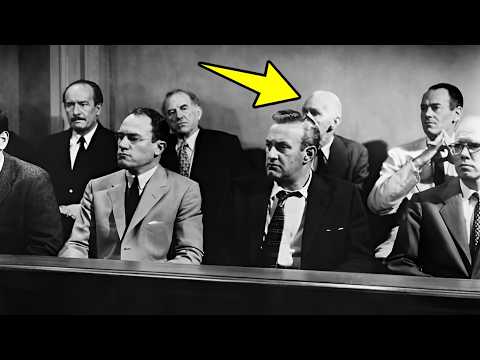
Take Henry Fonda, for instance. He was a Hollywood legend, but he produced only one film in his entire career: this one. Fonda believed in the script so much that he put his own money on the line, even though he hated the endless meetings and budgeting. “I swore I’d never produce again,” he later admitted. Yet without his gamble, the film might have remained a forgotten TV drama. Then there’s the shooting schedule: 21 days of intense rehearsals and filming that left actors literally collapsing from the heat. Lee J. Cobb, who played the explosive Juror 3, reportedly fainted on set—but he got up and kept going. That’s dedication.
And the camera work? Director Sidney Lumet, in his feature debut, used a sneaky trick: as the arguments heat up, the camera slowly moves lower and tighter, making the room feel like a pressure cooker. You don’t notice it consciously, but your body does. “I wanted the audience to feel trapped,” Lumet said. The result is a claustrophobic intensity that action films can only dream of.
But perhaps the weirdest fact of all is the film’s initial reception. Audiences in 1957 shrugged it off. It made barely a million dollars—pocket change compared to the era’s blockbusters. Critics praised it, but the public didn’t care. It wasn’t until television reruns and international remakes that 12 Angry Men found its audience. Today, it’s studied in film schools and quoted by directors. “Sometimes the crowd misses greatness the first time around,” as the saying goes.
So, what other secrets lie hidden in this legendary film? From the deliberate ambiguity of the accused boy’s ethnicity to the fact that the jurors have no names until the final moments, every detail is intentional. And wait until you hear about the sweat—literally. The crew sprayed actors with water to simulate perspiration, and the set was so hot that some actors nearly passed out. It’s a film that pushed its cast to the limit, all for the sake of authenticity.
As we delve deeper, you’ll discover how a real-life jury duty experience inspired Reginald Rose’s script, why the film was remade in at least seven countries, and how a single room became the most powerful character in the movie. Stay tuned—because the story of 12 Angry Men is just as gripping behind the scenes as it is on screen.
And that’s before we get to the most quietly radical choice of all: the jurors have no names. For nearly the entire film, they’re identified only by number—Juror 3, Juror 8, Juror 10. It’s a deliberate stripping away of identity, status, and backstory, because in a jury room none of that is supposed to matter. Twelve strangers, equal under the law, deciding a life-or-death case.
It’s only in the final moments, after the verdict, that two jurors casually exchange names. It’s almost jarring—like suddenly remembering these people are real individuals after all. That tiny touch drives home the idea that justice shouldn’t be about who you are, but about fairness. It’s a blink-and-you’ll-miss-it detail that makes the film stick in your mind.
Then there’s the sweat. You can practically feel the heat radiating off the screen, and that wasn’t acting. The set was deliberately overlit with heavy studio lamps, turning the jury room into an actual sauna. The crew cranked up the temperature, and stagehands spritzed the actors with water bottles between takes to keep the illusion of dripping perspiration alive.
Some actors got so hot they began fainting during long takes. When you see Juror 7 wiping his brow in frustration, or Juror 3 pounding the table with sweat running down his face, that’s not performance—it’s survival. The sweat became its own character, a reminder that justice doesn’t happen in pristine courtrooms but in messy, uncomfortable human spaces.
But the most surprising origin story belongs to the script itself. Reginald Rose didn’t dream it up in a writer’s room—he lived it. In 1954, Rose was called for jury duty on a manslaughter case. Inside that cramped room, he experienced the heated arguments, clashing personalities, and moral weight of deciding another person’s fate. The intensity stuck with him.
Rose went home and turned that experience into a one-hour television play. It was such a hit that it laid the foundation for the feature film three years later. He admitted that while he fictionalized much of it, the raw emotions were very real—the jury room felt like a battlefield where logic and prejudice collided head-on. Without that stint on jury duty, one of the greatest scripts in American cinema might never have existed.
And here’s a strange twist of history: 12 Angry Men was Sidney Lumet’s feature debut. He was just 33, a rising talent from television and theater, suddenly handed the reins of a movie that could sink his career before it started. His secret weapon was his theater background—he staged the film almost like a play, demanding weeks of rehearsal before the cameras rolled.
Every pause, every stare, every shift in body language was worked out in advance. By the time filming began, the actors moved like a well-oiled machine. Lumet went on to direct classics like Dog Day Afternoon and Network, but 12 Angry Men remains the film that announced his arrival—a debut that still outshines many directors’ entire careers.
Yet for all its brilliance, the film barely made a ripple when it first hit theaters. It covered its costs but wasn’t pulling in the numbers studios bragged about. Audiences in the late 1950s wanted colorful musicals and gritty westerns, not a black-and-white chamber piece about jurors arguing in a hot room. Critics respected it; the general public shrugged.
Then television changed everything. When the small screen became a household staple in America, 12 Angry Men found a second life. Its intimate setting and dialogue-heavy script translated perfectly to the living room. Reruns, school screenings, and late-night broadcasts introduced the film to millions who had never set foot in a theater in 1957.
What’s remarkable is how the film’s reputation grew organically. No marketing campaign, no studio push—just word of mouth and the quiet persistence of teachers, critics, and film societies. A movie that underperformed at the box office became one of the most beloved and studied films in cinema history. Sometimes the crowd misses greatness the first time around, but history eventually catches up.
And that global reach didn’t stop at American borders. The film has been remade in at least seven countries, each version putting its own cultural spin on the story while keeping the core intact: twelve people wrestling with justice inside a room. Germany did it in 1963. Norway, India, Japan, Russia, France, and even China followed.
One of the most celebrated foreign versions is the Hindi film Ek Ruka Hua Faisla from 1986, widely regarded as a masterpiece of Indian cinema. Russian director Nikita Mikhalkov remade it in 2007, adding unique cultural commentary while still paying homage to the original. The central theme—prejudice, justice, doubt—translates perfectly across borders. It doesn’t matter if the accused is American, Indian, Russian, or French. The debate over fairness and truth hits home everywhere.
But there’s a quieter, more disturbing detail hiding in the original film. The accused teenager is never given a clear background. There are hints he might be Puerto Rican, but it’s never confirmed. Why leave that detail vague? Because it forces the audience to focus on the jurors’ prejudices rather than the boy’s identity.
You’re watching twelve men project their biases onto someone they don’t really know—and that makes the story sting even harder. By leaving the boy’s ethnicity open, every generation of viewers brings its own social tensions into the story. In the 1950s, audiences may have thought about Puerto Rican immigrants. Later adaptations shifted focus depending on local context—racism, class bias, nationalism.
It’s a brilliant trick. By not telling you exactly who the boy is, the story becomes about everyone. He could represent any marginalized group, any community judged unfairly. That’s why the debates in the jury room still feel relevant decades later. Prejudice evolves, but the danger of judging people by assumptions remains the same.
And then there’s the editing—shockingly sparse by modern standards. At the start of the film, shots run long, sometimes holding on a single actor for minutes. It creates a sense of realism, as though you’re sitting in that jury room with no escape. But as the arguments intensify, the cuts become faster and more frequent, mirroring the rising tension.
Lumet basically weaponized editing to manipulate the audience’s emotions. There are very few cuts in the first half of the movie, which was considered unusual for the time. Most directors would have cut frequently to keep things interesting. But Lumet trusted the material and his actors. He let the camera linger, forcing you to stew in the discomfort. That slow build is part of what makes the film so suspenseful.
And here’s the thing about that famous single room: it was never just a set. It was a pressure cooker designed to break men down. The walls seemed to close in, the ceiling seemed to lower, and the heat became a physical presence. By the end, you’re not watching a movie—you’re surviving an ordeal. That’s why audiences still lean forward in their seats sixty years later, sweating right alongside the jurors.
It’s a strange irony that a film so obsessed with doubt became one of the few certainties in cinema history. 12 Angry Men didn’t just survive its rocky start—it rewrote the rules of what a movie could be. No spectacle, no stars flexing their egos, just twelve men and a single room that somehow contained the entire human condition.
And the weirdest part? The film’s influence keeps mutating. Directors cite it as a masterclass in tension. Law schools screen it to teach reasonable doubt. Even modern courtroom dramas borrow its DNA, whether they know it or not. A movie that executives thought would put audiences to sleep became the blueprint for gripping storytelling.
So the next time you’re stuck in a hot, cramped room with people who won’t listen to reason, remember: you’re not just uncomfortable. You’re living inside the greatest movie ever made about discomfort. And that’s a strange kind of legacy.
Which bizarre fact about 12 Angry Men shocked you the most—the fainting actors, the 21-day shoot, or the fact that it was almost never made? Drop your thoughts below, and let’s argue about it like twelve sweaty jurors with everything on the line.
Report this article
Select a reason for reporting:






