March 18th, 1944. A radio intercept station outside Calais, France. Hauptmann Klaus Weber of the German Funkabwehr leaned closer to his headset as another burst of Morse code crackled through the static. Three dots, a dash, two more dots. The pattern was familiar, unmistakably even. He’d been tracking this particular operator for six weeks now. American First Army Group, FUSAG, General George Patton’s command.
Weber scribbled notes in his logbook, cross-referencing the transmission against his growing file of intercepted American radio traffic. The signals intelligence suggested massive troop concentrations across southeastern England. Tank divisions, artillery regiments, entire corps preparing for the inevitable invasion across the Strait of Dover. The pattern was clear. The Allies would strike at Pas-de-Calais, the shortest route to Germany’s industrial heartland.
But something nagged at Weber’s trained ear. Something he couldn’t quite articulate. The American operator sending this traffic had a distinctive fist, the unique rhythm and timing that made every Morse code operator as identifiable as a fingerprint. Weber had logged this particular fist for weeks, yet lately there were variations, tiny inconsistencies in the spacing between characters, slight differences in the length of dashes. Either the operator was getting sloppy or Weber was tracking multiple operators using the same call sign.
He dismissed the thought. Standard procedure dictated one operator per call sign. The variations were probably just fatigue or atmospheric interference. The intelligence was solid. The pattern unmistakable. FUSAG was preparing to invade at Calais, and every transmission confirmed it.
What Weber didn’t know, what German intelligence wouldn’t discover until long after the war had ended, was that the man behind that Morse key wasn’t with FUSAG at all. He was part of a deception so audacious that it would keep 15 German divisions frozen in place while the real invasion landed 200 miles away. One radio operator’s stupid improvisation was about to change the course of history.
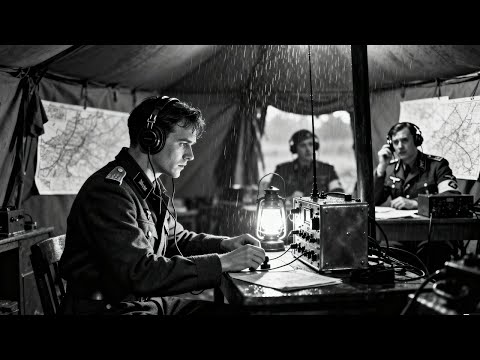
By March 1944, the Allied invasion of Europe was inevitable. The question wasn’t if, but when and where. German commanders knew the blow was coming. They’d fortified 2,400 miles of coastline from Norway to Spain, but resources were finite. Field Marshal Erwin Rommel couldn’t defend everywhere with equal strength. He needed to know where the Allies would strike.
That made signals intelligence Germany’s most valuable weapon. The Funkabwehr, Germany’s radio monitoring service, operated over 80 listening stations across occupied Europe. Trained operators sat at their positions around the clock, headphones pressed to their ears, transcribing every Allied transmission they could intercept. They couldn’t break the encryption, but they didn’t need to. The metadata told them everything. Call signs identified units. Transmission volumes indicated activity levels. Radio direction finding pinpointed locations.
By tracking which units were transmitting from which locations, German intelligence could build a remarkably accurate picture of Allied order of battle. This wasn’t guesswork. This was science, refined over four years of war into a precise analytical tool. The technique hinged on a curious quirk of human nature. Every Morse code operator developed a unique fist, the personal rhythm and timing with which he sent signals. Some operators naturally sent slightly longer dashes. Others placed fractional pauses between letter groups. These variations were unconscious, as distinctive as a signature, and German intercept operators learned to recognize individual American and British radio operators by their fists alone.
The intelligence picture that emerged by early 1944 was alarming. German listening posts tracked massive radio activity concentrated in southeastern England, directly across from Pas-de-Calais. The transmission patterns indicated the First United States Army Group, FUSAG, under command of General George S. Patton. Intercepts suggested the formation included the Third Army, the First Canadian Army, and multiple armored divisions. Radio direction finding fixed their positions near Dover and Folkestone.
The numbers backed up the analysis. German intelligence estimated FUSAG’s strength at 150,000 troops. Aerial reconnaissance reported tank parks, ammunition depots, and fuel storage facilities clustered around southeastern English ports. The logic was inescapable. The Allies would cross the Strait of Dover, the shortest route to France, striking at Pas-de-Calais, where their air cover would be strongest and their supply lines shortest.
Rommel responded by concentrating the 15th Army, 15 full divisions, along the Pas-de-Calais coast. These were Germany’s best troops, equipped with the newest Tiger tanks, positioned behind the strongest fortifications of the Atlantic Wall. If the Allies came across the Dover Strait, they’d meet a reception that would make Dieppe look like a training exercise.
What made the German confidence particularly unshakeable was the source reliability. This wasn’t just radio intercepts. Double agents confirmed the intelligence. Aerial photography supported it. The pattern was consistent across every intelligence source. FUSAG was real. Patton was preparing to lead the invasion. The strike would come at Calais.
The Funkabwehr operators were so confident in their analysis that they’d begun logging individual American radio operators by fist signature. Hauptmann Weber maintained detailed files on 12 FUSAG operators, tracking their transmission patterns, noting their habits and idiosyncrasies. He knew when they came on shift. He recognized their rhythm variations. He even noted when one operator appeared to have a cold based on slight delays in his sending rhythm.
Intelligence officers in Berlin studied these reports and concluded the Allied deception, if any existed, must be elsewhere. No force this size could maintain radio discipline this perfect unless it was real. Every transmission reinforced the pattern. Every intercept confirmed the assessment. FUSAG was preparing to cross the Strait of Dover, and German intelligence had tracked their every move.
They were tracking ghosts, but ghosts that spoke with remarkably convincing voices tapped out on Morse keys by operators who discovered something the German Funkabwehr’s sophisticated analysis had never anticipated. Sometimes the simplest deceptions worked precisely because they seemed too stupid to be intentional.
German signals intelligence prided itself on precision. The Funkabwehr wasn’t staffed by amateurs. These were trained specialists who’d spent years perfecting their craft. They’d tracked Soviet formations across the Eastern Front. They’d identified British bomber groups before they’d reached German airspace. They understood radio deception because they practiced it themselves. That understanding made them confident they couldn’t be fooled.
Radio deception required perfect operator discipline. It required maintaining consistent fists across multiple operators impersonating the same unit. It required transmitting precisely calculated volumes of traffic, not too much to be suspicious, not too little to be invisible. Most critically, it required maintaining the deception for weeks or months without a single operator making a mistake that would expose the fraud.
The Germans knew this because they’d tried it themselves. Wehrmacht deception operations consistently failed because maintaining operational security across dozens of radio operators was impossible. Someone always made a mistake. A fist changed. A call sign was used incorrectly. The pattern broke down, and Allied signals intelligence noticed immediately.
So when German intelligence analyzed the FUSAG transmissions and found minor inconsistencies, they didn’t trigger alarms. They expected minor variations. Real military operations were messy. Real radio nets had operator substitutions, equipment malfunctions, atmospheric interference. The slight variations in the FUSAG traffic patterns actually made them more credible, not less.
Hauptmann Weber noted the inconsistencies in his logs, but his analysis never questioned the fundamental assessment. Operator 4A shows minor timing variations, possibly fatigue or equipment degradation. Pattern consistent with standard rotation protocol. Confirms continuing FUSAG preparation activity.
What the Funkabwehr analysts couldn’t conceive was that the Americans would intentionally introduce errors into their deception traffic. German doctrine taught that deception required perfection. Small mistakes revealed fraud. Therefore, if traffic contains small mistakes, but maintained overall pattern consistency, it must be genuine.
Meanwhile, across the channel, Allied intelligence was reaching a disturbing conclusion. Operation Fortitude, the plan to deceive Germany about the invasion location, was faltering. The phantom FUSAG had been created using inflatable tanks, wooden artillery, and dummy landing craft. Reconnaissance planes would photograph them. Double agents would report on them. But maintaining radio silence from a supposedly massive military formation would be suspicious. So, Allied signals intelligence created phony radio networks. Operators would impersonate units that didn’t exist, generating traffic that suggested normal military activity.
But there was a problem. Impersonating another operator’s fist was nearly impossible. Each man’s sending rhythm was as unique as his fingerprint. German intercept operators would notice if one operator suddenly replaced another without explanation. The solution required either finding operators who could perfectly mimic each other’s fists, which was impossible, or finding a way to make operator substitution seem natural. Neither option looked feasible.
Allied deception planners were preparing to accept that FUSAG’s radio traffic would have to be limited, reducing its credibility. Then a radio operator named Technical Sergeant Jack Dramis had what his commanding officer called the stupidest idea I’ve heard all week. It was so simple, so obviously wrong by every doctrine, that it just might work. But only if the Germans believed what they expected to believe.
Dramis proposed the unthinkable: deliberately rotate operators through call signs, introduce fatigue, simulate equipment failures — make the deception messy enough to look real. Lieutenant James Fox carried the idea to Major Ralph Ingersoll, who saw it instantly. “It’s brilliant because it’s backward. We’re not trying to fool them into thinking FUSAG is perfect. We’re trying to fool them into thinking FUSAG is real.”
Within a week, the 3103rd Signal Service Company rewrote its entire protocol. Operators created backstories for their phantom personas. Operator 4A sent with a rushed, youthful fist; Operator 2C with veteran precision. When 4A supposedly went on leave, 7B substituted with a noticeably different rhythm. Every inconsistency was planned.
On March 15th, the new deception went live. Hauptmann Weber logged the rotations without alarm. “FUSAG units showing normal personnel rotation patterns. Fist characteristics consistent with replacement protocol.” The operator changes confirmed the army existed. Real units rotated men. The Germans knew this. They expected it.
For eight months, Dramis and his team maintained the illusion. Weber built psychological profiles of twelve FUSAG operators — men who never existed, whose quirks were inventions of twenty American radio operators. On June 6th, when the real invasion struck Normandy, the FUSAG net kept transmitting. For six weeks, fifteen German divisions waited at Pas-de-Calais for Patton’s phantom army.
After the war, captured Funkabwehr files revealed the truth. Weber’s meticulous logs described Operator 4A as a rushed young graduate and 2C as a disciplined veteran. Both were Jack Dramis — one sending fast because he was late for lunch, the other careful because he was following a script. “We never suspected the Americans would deliberately make their deception less perfect,” a German counterintelligence officer admitted. “That’s exactly what made it perfect.”
Dramis received no medals. The Ghost Army stayed classified until 1996. He returned to Detroit, worked as an electrical engineer, and rarely spoke of the war. When finally interviewed in 1998, he shrugged. “I just thought about how real radio operators actually work. They get tired. They make mistakes. I figured if we acted human, we’d look more real than if we tried to be perfect.”
The lesson outlived him. Post-war intelligence schools taught that effective deception must embrace controlled imperfection. Wars are won by generals and tanks, but also by sergeants who notice what everyone else overlooks. The Germans believed Dramis’s ghosts because they looked exactly like what reality should look like.
So here’s the question for you: in an age of algorithms and artificial intelligence that hunt for patterns, is the most convincing lie still the one that looks perfectly, deliberately human — and what does that say about how easily we mistake imperfection for truth?
Report this article
Select a reason for reporting:






