In the deadly skies over Europe, one fighter plane stood out as the ultimate weapon that turned the tide of World War II. The P-51 Mustang was not just an aircraft; it was a game-changer that gave Allied bombers the protection they desperately needed and shattered the German Luftwaffe’s dominance. As pilots who flew it would tell you, the Mustang was the best fighter of the war, a machine that combined speed, range, and firepower in a way no other plane could match.
But this legendary fighter almost never existed. Its journey from a rejected design to the undisputed champion of the skies is a story of innovation, desperation, and the relentless pursuit of victory.
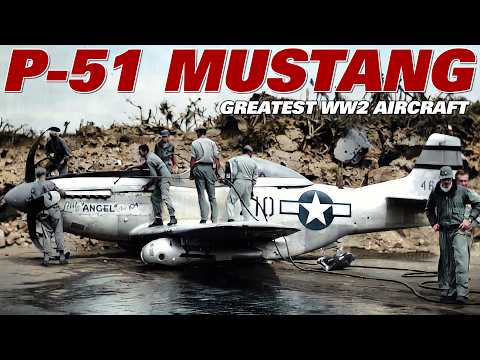
In the summer of 1940, Britain stood alone against Nazi Germany. The Royal Air Force was locked in a desperate struggle with the Luftwaffe, and the situation was critical. British fighters like the Spitfire and Hurricane were valiant, but they couldn’t be produced fast enough to counter the threat of invasion. Desperate for solutions, Britain turned to America for help.
North American Aviation had a design for a new high-performance fighter on the drawing board. In just 117 days, they produced a prototype that was sleek, fast, and had double the range of the Spitfire. But at high altitudes, its Allison engine lost power, making it unsuitable for aerial combat. The RAF ordered 620 of these new planes, naming them Mustangs. They were excellent for ground attack, but not for the high-altitude dogfights that would decide the war.
Everything changed on December 7, 1941, when Japan attacked Pearl Harbor. The United States entered the war, and the priority became defeating Hitler in Europe. Thousands of American troops, including young, confident pilots, poured into Britain. These men were eager to prove themselves in combat, but they faced a formidable enemy: the battle-hardened pilots of the Luftwaffe.
The Americans had a powerful new fighter, the P-47 Thunderbolt. It was a massive machine, heavily armed and rugged, but it had a major flaw: its range was limited. It could only escort bombers part of the way to targets in Germany. When the Thunderbolts had to turn back, the bombers were left vulnerable to German fighters, resulting in devastating losses. The need for a long-range escort fighter became painfully clear.
Meanwhile, the Mustang was sitting on the sidelines, underappreciated. It had the range and speed, but its engine was its Achilles’ heel. Then, in 1942, a team of engineers from Rolls-Royce had a radical idea: replace the Allison engine with the Merlin, the same engine that powered the Spitfire. The result was a revelation. The Merlin gave the Mustang incredible performance at high altitudes, and it did so efficiently. The RAF and the US Army Air Forces were impressed, and large orders were placed. The American-made Packard Merlin became the standard engine for all future Mustangs.
The final piece of the puzzle fell into place in May 1944 with the introduction of the P-51D. It featured a bubble canopy for unparalleled visibility and a redesigned fuselage. The Mustang had become the ultimate fighter. It was fast, agile, and deadly. Pilots fell in love with it. “It was a pilot’s airplane,” one ace recalled. “You became part of the plane.”
Armed with six .50-caliber machine guns and capable of carrying external fuel tanks, the Mustang could escort bombers all the way to Berlin and back. It was the game-changer the Allies had been waiting for. With the Mustang leading the way, the Allies gained air superiority, and the tide of war turned.
But the fight was far from over. The Luftwaffe was still a dangerous foe, and the young American pilots would face their baptism by fire. Many would not return.
For the young pilots arriving in England, the first mission was a brutal awakening. “I was scared to death,” one recalled. “Anyone who says they weren’t is a liar.” The nerves, the vibration of the engine, the sheer altitude—it all took a toll. Some returned to base and vomited on the tarmac, convinced they didn’t have what it took.
But then came a quiet moment of grace. A crew chief climbed onto the wing, looked at the shaken pilot, and said three words that changed everything: “I’ve seen worse.” It was a small kindness, but it was enough. The pilot never threw up again. He knew he could do it.
That bond between pilot and ground crew was sacred. The crew chief owned the plane on the ground, tending to it like a daughter. “When you climb in and they strap you down, it’s no longer his plane,” a pilot explained. “It’s mine.” They named their Mustangs after wives and sweethearts, painting the names on the noses. One pilot, inspired by the song from Disney’s Dumbo, called his plane “Baby Mine.”
Day after day, massive formations of bombers and fighters thundered into the German sky. The pilots lived a strange, fractured life—quiet English countryside one moment, the full horror of modern air war the next. Like Roman gladiators, they might celebrate a victory one day and mourn a lost friend the next.
In the cockpit, there was only the pilot—navigator, gunner, and commander all in one. At 25,000 feet, the temperature was fifty below zero outside, and the thin aluminum skin of the Mustang did little to keep out the cold. Numbed by the chill, blinded by the sun, and deafened by the roar of the Merlin, the senses dulled. Boredom was as much an enemy as the Luftwaffe.
Then, without warning, the radio would crackle with a sharp warning. German fighters were diving on the bomber stream below. The drop tanks were jettisoned, and the Mustangs plunged into the fight. “We were always attacking, no matter how many of them there were,” a pilot said.
Hitting a moving target at 400 miles per hour required instinct, not calculation. “It’s like throwing a football,” one ace explained. “You just had to lead it and guess.” A tenth of a second meant sixty feet—there was no time to think, only to act. The best tactic was to sneak up behind an enemy from below, unseen. In half the kills, the victim never knew what hit him.
But the hunters could become the hunted in an instant. One pilot, flying with his wingman Bert, heard the younger man’s frantic shouts over the radio. “109! Let’s get out of here!” He told Bert not to panic—then realized the sounds he heard weren’t his engine backfiring, but 20mm cannon shells exploding around his cockpit.
He slammed the stick left and kicked the rudder, diving for the clouds. In the chaos of a dogfight, the odds leveled out. It became a blur of chance encounters and narrow escapes. One wrong move, one moment of hesitation, meant almost certain death.
He watched an enemy pilot try to pull up at the last second, but the parachute didn’t open fully. The German hit the ground. “It was a hard moment,” he admitted. “Then you realize those people are just like me. He was a fighter pilot, and so was I.” All of it happened in seconds—seconds that felt like an eternity.
And over Berlin, there was nothing the Mustang pilots could do but watch. The capital was ringed by hundreds of anti-aircraft guns, and the bombers had no choice but to fly straight into the exploding flak. “We don’t mess with that,” a fighter pilot said. “But what they were doing was far more dangerous than what we were doing.”
Once the bombers cleared enemy airspace, the Mustangs were unleashed. Any remaining ammunition was spent on targets of opportunity—Luftwaffe airfields, road convoys, supply trains. “Anything that moved, we shot it up,” one pilot recalled with a grin. It was exhilarating, a chance to vent the tension of the long escort mission.
But ground strafing was a deadly business. For every enemy plane the Mustangs destroyed in the air, five were lost to ground fire. The pilots had to fly low, skimming the treetops, and the German flak gunners were waiting. Tracers streaked up like glowing golf balls, and the cockpit filled with the smell of cordite and fear.
One pilot remembered a childhood visit to the dentist’s chair. “I thought, it won’t hurt for long,” he said. That was the mantra every time he dove into a hornet’s nest of anti-aircraft fire. It won’t hurt for long.
As the bombs rained down on German industrial cities, the heart of the Nazi war machine was torn apart. But the destruction weighed on the men who delivered it. “Sometimes we dropped through cloud cover and hit the city instead of the military target,” a pilot admitted. “I’d rather imagine my bombs might kill someone I’d rather not kill.”
By late in the war, the once-dominant Luftwaffe was scraping the bottom of the barrel. Fuel, spare parts, and trained pilots were all running out. “They were sending up kids with hardly any training,” a Mustang pilot said. “It was like shooting fish in a barrel. And if he’s the enemy, I don’t mind shooting fish in a barrel.”
The numbers were staggering. On January 14, 1945, Mustangs claimed 161 kills in a single series of sweeps. On April 16, over 700 German aircraft were destroyed, most of them on the ground. More than 80 planes were wiped out in one raid on a single airfield. Hitler’s mighty air force, once the terror of Europe, was finished.
“I didn’t hate the Germans,” one pilot reflected. “I hated the son of a bitch. That solved a lot of my problems.” It was a cold, simple logic that kept men sane in an insane war.
With the Allies now masters of the sky, German ground forces were at their mercy. Without fighter cover, they were pounded relentlessly as Allied armies advanced toward the heart of Germany. Hermann Göring, head of the Luftwaffe, knew exactly what the Mustang had done to him. When he saw the fighters over Berlin, he told his captors, “I knew the jig was up.”
When the war in Europe ended in May 1945, the Mustang was still flying, now in the Pacific. But its days of glory as the long-range escort were ending. “It was a hell of an airplane,” one veteran said softly. “It was unique. In one day, I mean, it was the best to me. You never forget it.”
He paused, then added, “I have to tell you this—I think it’s the only thing I did in my life that did anything for humanity. And so you never forget it.”
Even now, decades later, the missions come back in dreams. “I dream about the missions,” another pilot confessed. “I dream about what I could have done, what I should have done, where I made mistakes, where I could have improved myself. I still dream about it all the time.”
In those days, there was a powerful sense that they were fighting to save democracy. “Without a doubt, we were all committed to winning, to sacrificing our lives if necessary,” he said. “There was no question about it. People didn’t back down, even though they were outnumbered fifteen to one.”
And if you don’t believe in something, you don’t do it. “People ask me, didn’t you hate it?” one ace laughed. “And I say, are you kidding? I was twenty years old and they gave me this big, beautiful airplane. I had the time of my life.”
The Mustang’s legacy was sealed not just by its victories, but by the men who flew it. They were ordinary young men thrust into extraordinary circumstances, and they rose to the occasion. They fought for freedom, for each other, and for the chance to fly the finest fighter of the war.
After the war, many of these pilots returned home, built families, and lived quiet lives. But the skies never left them. “I still look up whenever I hear a plane,” one veteran admitted. The Mustang had become a part of them, a chapter of their youth that defined the rest of their lives.
Today, the P-51 Mustang remains a symbol of American ingenuity and courage. It was more than a machine; it was a beacon of hope in a dark time. And for those who flew it, it was the adventure of a lifetime.
So, what does the Mustang mean to you? Share your thoughts in the comments below.
Report this article
Select a reason for reporting:






