There is a painting that hangs in the dim corridors of the British Library. It shows a man seated on a Western-style sofa, draped in white muslin, his eyes carrying a weight no crown could ever relieve. Beside him sits his queen, and between them a young daughter whose name history never bothered to record.
The man is Wajid Ali Shah, the 11th and last king of Awadh—one of the wealthiest kingdoms the Indian subcontinent had ever produced. By the time that portrait was taken, everything he had known—his throne, his city, his music, his magnificent court—had been ripped from his hands by a corporation masquerading as a government.
But this story is not really about him. Not entirely.
While the fall of Wajid Ali Shah has been told and retold, dramatized in Satyajit Ray’s films and mourned in Urdu poetry for generations, there is a chapter almost nobody talks about. What happened after? What happened to his children—the dozens of princes and princesses born of a king with over 300 wives? What happened when the pensions dried up, when the palaces crumbled, when the family name went from commanding armies to being synonymous with poverty, poison, and madness?
This is a story of what empire does to the people it leaves behind. And it begins not in some distant century, but in a moment you can almost reach out and touch.
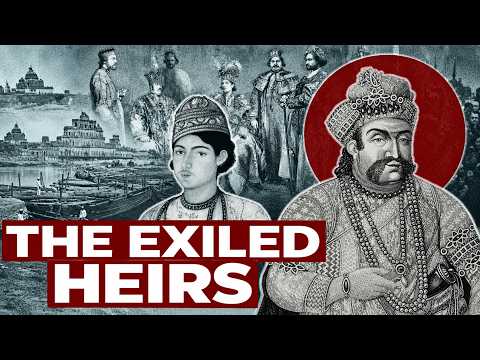
Let me take you back to 1822, to a city that smelled of rosewater and gunpowder in equal measure: Lucknow. Wajid Ali Shah was born on the 30th of July into a dynasty that traced its bloodline to the Nishapuri rulers of Persia. The Nawabs of Awadh had carved out their own kingdom from the dying corpse of the Mughal Empire, and by the time young Wajid drew his first breath in the gilded chambers of Lucknow, Awadh had become one of the most culturally refined kingdoms in the Eastern world.
The architecture was breathtaking. The cuisine was legendary. The music, the poetry, the dance—all of it hummed through the streets like a living, breathing organism.
But there was a rot beneath the surface, and that rot had a very specific name: the British East India Company.
Long before Wajid Ali Shah ever sat on the throne, the Company had been systematically hollowing out Awadh from the inside. Through a series of treaties and so-called alliances, beginning with a subsidiary alliance in 1801, the Nawabs had been forced to disband their military, pay for the upkeep of British troops stationed on their own soil, and obey the instructions of a British resident—essentially a colonial overseer sitting in their court.
The Nawabs became kings in name only, plaster statues in their own palaces, presenting a gorgeously rich exterior but almost hollow within, as one historian put it.
By the time Wajid Ali Shah ascended the throne on the 13th of February, 1847, at just 25 years old, the fate of Awadh had already been sealed. The Company wanted the kingdom. It was fertile, it was rich, and the vast majority of sepoys in the Company’s own army came from Awadh’s villages. The only question was the pretext.
And here is where the tragedy truly begins to take shape.
Because Wajid Ali Shah was not, as British propaganda later insisted, a debauched fool incapable of governance. He was a man of extraordinary artistic genius. He elevated Kathak dance to new heights, composed ghazals still sung today, wrote plays, invented new ragas, and patronized an entire ecosystem of artists, musicians, and poets. His court at Lucknow was a living museum of Hindustani culture.
He even invested 18 lakhs and 30,000 rupees in government notes as a financial provision for his wives and female relations—suggesting a man who did think about administration when the British would later claim otherwise.
But none of that mattered to Lord Dalhousie, the Governor-General of India, who had made a career out of swallowing kingdoms whole. Dalhousie had already annexed Jhansi and Satara using the infamous doctrine of lapse. But with Awadh, he did not even bother with legal pretense.
On the 7th of February, 1856—just two days before the ninth anniversary of the king’s coronation—Colonel James Outram, the British resident, presented Wajid Ali Shah with two documents. The first was a letter from Dalhousie declaring that the British government could no longer support the Awadh regime. The second was a treaty demanding that the Nawab sign away his kingdom forever.
Wajid Ali Shah refused to sign.
He believed, perhaps naively, that the British sense of justice would prevail. He decided to travel to Calcutta and from there to London, where he would appeal directly to Queen Victoria. He genuinely believed that if the queen could hear his case, the annexation would be reversed.
On the 13th of March 1856, the king boarded a steamer named the General MacLeod. When the citizens of Lucknow learned that their beloved Nawab was leaving, the city erupted in grief. Contemporary accounts describe thousands of mourners lining the streets, weeping openly. Many followed him all the way to Kanpur, singing songs of lament.
One Urdu text from the period, the Asrari Wajidi, captured the scene with devastating precision: “The condition of this town was such that on the departure of the king, the life became extinct and the body of the town was left soulless.”
He arrived at Matiabruz, a nondescript neighborhood on the southern fringes of Calcutta, on the 13th of May 1856, with a vast entourage of musicians, attendants, court members, and four of his wives. But he did not bring all of his family—and it is in this separation, this fracturing of a dynasty across geography and circumstance, that the fates of his children were sealed in wildly different and often horrifying directions.
To understand what happened to Wajid Ali Shah’s children, you first have to grasp the scale of the family we are talking about. This was a man with over 300 wives, both permanent and temporary, and approximately 48 children by the time he was deposed. His family tree was not a tree at all—it was a labyrinth tangled by multiple intermarriages, competing claims, and the deliberate confusion that comes when a dynasty is scattered by force.
When Wajid Ali Shah left for Calcutta, he took some of his family with him, but crucially, he left behind one wife and one son who would go on to shape the course of Indian history in ways that would terrify the British and haunt the Awadh royal line for generations.
That wife was Begum Hazrat Mahal, and that son was Birjis Qadr.
Begum Hazrat Mahal’s story is one of the most extraordinary in the history of colonial resistance, and it is impossible to tell the story of Wajid Ali Shah’s children without telling hers first—because she is the reason one branch of this family became legends, while the others became ghosts.
Her real name was Muhammadi Khanum. She was born around 1820 in Faizabad, the old capital of Awadh, and her origins were as far from royalty as you could possibly imagine. She was sold by her own parents and became a tawaif, a professional courtesan and dancer. She entered the royal household as a khawasin, a lady’s maid, and during one of her dance performances, she caught the attention of the king, who gave her the title Mahak Pari—Fairy of Fragrance.
She was taken into the royal harem, and in August of 1845, she gave birth to a son, Birjis Qadr. The birth elevated her to the rank of a full wife, and she was styled Hazrat Mahal.
But here is the thing: at some unknown point before the exile, Wajid Ali Shah actually divorced her in order to stay within the Islamic limit of four wives. So when the king left for Calcutta, Hazrat Mahal was no longer technically his wife. She was left behind in Lucknow with her young son—and the king, perhaps deliberately, perhaps carelessly, moved on without her.
It was the worst mistake the British ever allowed to happen.
Because when the Indian Rebellion of 1857 erupted across northern India the following year, it was Begum Hazrat Mahal who picked up the fallen standard of Awadh and turned it into a weapon.
The rebellion had its immediate trigger in the infamous greased cartridges controversy, but in Awadh, the real fuel was the annexation itself. The sepoys were furious. The feudal landlords, the taluqdars, were furious. The common people of Lucknow who had wept when their king departed were furious. And Hazrat Mahal channeled all of that fury into organized resistance.
In May of 1857, as British authority collapsed across the region, Hazrat Mahal seized control of Lucknow. On the 5th of July, she formally declared her 12-year-old son, Birjis Qadr, the new Nawab of Awadh, with herself serving as regent.
It was an extraordinary act. A woman who had been born into poverty, sold as a child, elevated through the harem, and then discarded by the very king she had served, was now running a government, commanding armies, and directing a war against the most powerful empire on Earth.
And she was effective. Under her leadership, the rebels won a decisive victory at the Battle of Chinhat, forcing the British to retreat into the residency at Lucknow, where they endured a siege that lasted 87 days. Hazrat Mahal organized an army of women and appointed a commander named Uda Devi, a legendary sharpshooter, to lead them. She coordinated with other rebel leaders, managed the administration of the state, and refused every single offer of surrender or amnesty that the British threw at her.
Meanwhile, back in Calcutta, the British were keeping a very nervous eye on Wajid Ali Shah himself. During the uprising, they detained the deposed king at Fort William, fearing that his mere presence might inspire the rebel sepoys gathering strength across Bengal. The king, who had always been more artist than warrior, sat in British custody while his estranged wife and young son fought a war in his name hundreds of miles away.
But the tide eventually turned. The British poured reinforcements into Awadh, and by early 1858, Lucknow was recaptured. Hazrat Mahal and young Birjis Qadr were forced to flee, first through the countryside, then northward toward the Nepalese border, pursued by British columns the entire way. They narrowly escaped capture multiple times, largely because of rear-guard actions fought by loyalist commanders who sacrificed themselves to buy the Begum and her son time.
Eventually, they crossed into Nepal, where the Prime Minister, Jung Bahadur Rana, granted them sanctuary. But the price was steep. Hazrat Mahal had to surrender much of the valuable jewelry and heirlooms she had carried out of Lucknow. Ironically, this was the same Nepalese Prime Minister who had sent troops to help the British crush the rebellion in Awadh in the first place.
And it was in Nepal that the first great tragedy of Wajid Ali Shah’s children unfolded.
Because for the next two decades, Hazrat Mahal and Birjis Qadr lived in exile in Kathmandu, cut off from the world they had known. The conditions of their sanctuary were strict. Nepalese authorities warned them not to communicate with rebel leaders and Indians. They were watched, monitored, and essentially imprisoned in a country that was not their own.
When Queen Victoria issued her famous proclamation of 1858 offering amnesty to the rebels, Hazrat Mahal was the only major leader of the rebellion who formally and publicly rejected it. She issued a counter-proclamation mocking the British claim to religious tolerance and pointing out their destruction of Hindu and Muslim temples to build roads. She wrote, with acid precision, about the hypocrisy of a government that promised freedom of worship while forcing its subjects to eat pigs, drink wine, and bite greased cartridges. It remains one of the most extraordinary documents of anti-colonial resistance in Indian history.
But exile ground her down. Hazrat Mahal lived in Kathmandu in increasingly diminished circumstances, growing old in a country that was not hers, separated from the kingdom she had fought to save, and from the husband who had left her behind. She died on the 7th of April, 1879, roughly 59 years of age. She was buried in the grounds of Kathmandu’s Jama Masjid in a grave so nondescript that it was very nearly lost to history entirely.
And her son, Prince Birjis Qadr—the boy who had been crowned Nawab of Awadh at the age of 12 and had spent his entire adolescence and young manhood in Nepalese exile—now found himself truly alone.
For 34 years, Birjis Qadr lived in Kathmandu. He became a poet, organizing mushairas and composing ghazals in beautiful calligraphy. He married Mehtab Ara Begum, a granddaughter of Bahadur Shah Zafar, and together they had five children.
In 1887, his father died, and on Queen Victoria’s Golden Jubilee, the British pardoned Birjis Qadr. He returned to Calcutta around 1892, settling in Matiabruz, the same neighborhood where his father had spent his final years.
But he was not returning to a warm welcome. In August 1893, less than a year after his return, Birjis Qadr, his wife, and his son Khurshid Qadr were poisoned at a family dinner. The standard historical reconstruction points to relatives threatened by his claims on his father’s pensions and inheritance.
Birjis Qadr died on the 14th of August, 1893, at the age of 47. His son reportedly died as well. Only his pregnant wife and one daughter who had been too ill to attend survived.
Mehtab Ara went into hiding, raising her remaining children in secrecy, terrified that the relatives who had killed her husband would come for them next.
Today, the descendants of Wajid Ali Shah live quiet lives across India. Manzilat Fatima, the great-great-granddaughter of both Wajid Ali Shah and Begum Hazrat Mahal, runs a catering service in Kolkata called Nawabi Kababi, specializing in Galouti Kebabs, Biryani, and Haleem—the last culinary traditions of a vanished kingdom served from a kitchen in Kolkata.
Shahanshah Mirza, a descendant through another line, serves as a quiet custodian of a legacy most of the world has forgotten. He has spoken about how the family’s dastarkhwan, the traditional cloth spread on the floor for meals, has been replaced by a dining table.
It sounds like a small thing. But when your entire identity is built around a culture that expressed itself through food, music, and ceremony, the loss of even a dastarkhwan is a kind of death.
And then there is the haunting story of Malcha Mahal. In the 1970s, a woman calling herself Begum Wilayat Mahal claimed to be the granddaughter of Wajid Ali Shah. She and her two children took up residence in a 14th-century ruin in Delhi without electricity or running water. Wilayat Mahal died by suicide in 1993. Her son, Prince Cyrus, was found dead in 2017, having refused hospitalization for dengue fever.
Whether or not the Malcha Mahal family were truly descendants remains unresolved. But even if Wilayat Mahal was performing a fiction, the story she was performing—of a royal family reduced to living in ruins, clinging to a name the world no longer recognized—that story was heartbreakingly real.
Because it was already happening to the actual descendants.
Wajid Ali Shah’s thumri, Babuls Mora Naihar Chhuto Jai—a song about a bride leaving her father’s home, composed as a metaphor for his own forced departure from Lucknow—is still performed by classical musicians across India. His contributions to Kathak dance are foundational. The cuisine of Lucknow, which he patronized and refined, is now recognized as one of the great culinary traditions of the world.
He was not a great king in the political sense. He could not save his kingdom. But he was something that Lord Dalhousie and Colonel Outram and the entire machinery of the East India Company could never be. He was a creator. And creation, it turns out, outlasts conquest every single time.
The East India Company was dissolved. The British Empire collapsed. The officials who signed the orders annexing Awadh are remembered, if at all, as footnotes in history textbooks. But Wajid Ali Shah’s music is still being played. His dances are still being performed. His food is still being served by his own descendants from a kitchen in Kolkata.
His children, though, paid the price for his creativity and his failure in equal measure. They were scattered across continents, poisoned at family dinners, exiled to nameless graves in Kathmandu, reduced to living in medieval ruins without electricity, forced to work as teachers and caterers and government clerks.
That is the true cost of empire—not just the kingdoms it steals, but the generations it breaks. Long after the last British flag was hauled down from Indian soil, the children of the last king of Awadh were still paying the bill.
And in Kolkata today, in the quiet bylanes where the great-great-grandchildren of a dynasty live their ordinary lives, the tombs of Matiabruz still stand. The gold-colored tomb of Wajid Ali Shah rests behind an iron grill in the Shahi Imambara he built in 1864. On the walls around it, plaques trace the family tree, and newspaper clippings tell the story of the torturous infighting that tore the royal lineage apart.
The fish—the ancient insignia of Awadh, symbolizing freedom and the life-giving properties of water—is still engraved on either side of the arched entrance.
Freedom. That is what the fish symbolized. And the man who carried that symbol was never free again after the 7th of February, 1856. And neither, truly, were any of his children.
What do you think—does a legacy of art and culture truly outlast the empires that try to erase it, or is that just a comforting story we tell ourselves to make the loss bearable?
Report this article
Select a reason for reporting:






