They found 150 German soldiers killed, the wounded had been thrown out of hospital windows from several meters high, beaten and mutilated. Others had water poured on them and were left abandoned in the cold to die of hypothermia. These words belong to an officer of the Wehrmacht who discovered the remains of the Theodosia Massacre, which occurred between December 29, 1941, and January 1, 1942. Communist troops showed no mercy to all the Germans they found in that region of Crimea, but they were particularly cruel to those in the hospital recovering from injuries.
None of this is unusual. War turns men into monsters and unleashes their darkest passions—hatred, resentment, the desire for revenge, and the urge to kill become evident when a soldier is in an extreme situation. Today, we will tell you everything about the worst massacres committed by the armies of the United States and the Soviet Union.
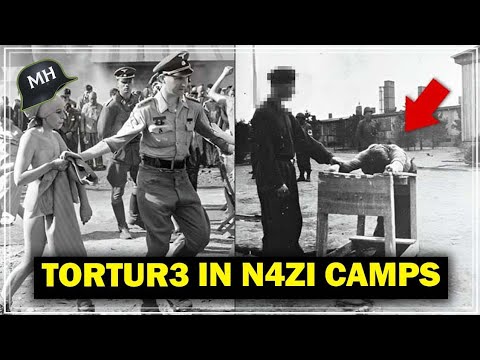
Some of the most terrible war crimes of the US Army were committed during the campaign in Sicily in mid-1943. Through this operation, the Allies aimed to open a new front in southern Europe and from there put pressure on Hitler’s troops. The Allies advanced through Sicily with little resistance. On July 10, 1943, the Americans arrived in the small town of Canicatti, where they were welcomed with open arms by the locals. The ordinary people were exhausted from constant combat, which had turned the town into ruins. The artillery fire in the preceding days had destroyed many houses and public buildings. One of the many shells had shattered the wall of a soap factory—a product that was highly valuable in times of scarcity. During the American occupation, about 40 villagers took the opportunity to go to the establishment with buckets and fill them with liquid soap.
When the commanding officer, Lieutenant Colonel George H. McCaffrey, heard about this, he went to the factory to disperse the crowd. When the Sicilians ignored his orders and continued looting the building, the American lost his patience. He ordered his men to shoot the people, but the troops, aware that this amounted to killing defenseless civilians, refused to do so. It was then that McCaffrey, feeling that his authority was in danger, decided to take action on his own. He drew his .45 caliber Colt revolver, aimed at the crowd, and pulled the trigger again and again. His soldiers watched in horror as people fell one after another and chaos took over the scene. The lieutenant colonel reloaded his weapon twice, so he fired 18 shots in total. In total, there were eight confirmed deaths during the Canicatti Massacre, including a 12-year-old child who died from a gunshot wound to the stomach. However, it is believed that there may have been more victims. The slaughter was covered up by the US Army, and it was not known until 1998 when the son of one of the witnesses revealed the events. There were no consequences for McCaffrey, who not only was not punished but was also awarded government positions.
The war crimes of the US Army in Italy did not end there. More massacres occurred in the following days. Many American soldiers were convinced that their orders were to kill all Italians they encountered. This was because, while traveling to Sicily by boat, they heard a furious speech by General George S. Patton over the loudspeakers, which said: “During the battle, you might see enemies shooting at you, but then when they’re surrounded and try to surrender—oh no, those bastards must die. You have to kill them, stab them in the rib or liver. We learn the reputation of being killers, and when rumors spread that we are beasts, no one will want to face us.” The consequences of these words would be devastating.
On July 14, 1943, a battle was fought near the Sicilian village of Biscari, resulting in a victory for the US troops, who captured 48 enemies. No one suspected that Sergeant Horace West, who was in charge of the prisoners, had his own plans. The officer led the victims to an olive grove in the rear. Later, West would say the following: “There was something boiling inside me. I just wanted to kill and destroy, to see the enemies bleed to death.” Upon reaching their destination, he forced the Italians to line up while his comrades watched in astonishment. The sergeant took a submachine gun and aimed it at the prisoners, signaling to the other Americans to turn away if they didn’t want to see blood. West then opened fire on the defenseless men, delighted with the spectacle of blood unfolding before his eyes. The corpses lay on the ground, and a few were still agonizing amid cries of pain. The sergeant approached the dying, put a pistol to their hearts, and finished them off one by one.
When news of the Biscari Massacre reached Patton, West was tried by a military tribunal. He was sentenced to life in prison, but later President Dwight Eisenhower pardoned him, and he served until the end of the war. He died in 1974 without having paid for his crime.
Despite the heinous nature of these crimes, none of the countries involved in the war were without blame. In the case of the Soviet Union, the Red Army was responsible for spreading terror wherever it went, leaving behind a trail of death and destruction. When the Russians initiated the 1944 counter-offensive and marched against Germany, one of the first towns to fall was the village of Nemmersdorf in East Prussia. When they arrived in the village on October 21 of that year, they found dozens of defenseless inhabitants taking refuge in an improvised bunker. These people were of German descent, making them ideal targets for the Soviets to unleash their fury. The commanding officer ordered them to leave the bunker and come outside. What followed was an unprecedented slaughter carried out with rifle butts and shovel blows. Those who did not die immediately were shot, and the women were raped. The massacre left a pile of corpses that was discovered days later by the Wehrmacht when they regained control of the village.
Let’s hear the testimony of a German soldier who had the misfortune of witnessing the scene: “At a farm, we found women crucified against a cart. Near a tavern, we saw two other women impaled against the doors of a barn with their arms outstretched like Christ. Inside the houses, there were a total of 72 dead girls, including a child. We also saw babies with crushed heads.” The Nemmersdorf Massacre was used by Joseph Goebbels to demonstrate the cruelty of the Soviets. In the short term, this policy proved effective, as it led to an increase in volunteers for the militias.
Something similar happened in January 1945 when the Red Army, still in East Prussia, captured the village of Metgethen after a 4-day battle. Once again, communist troops showed no mercy to the local population. Women were subjected to all kinds of humiliations and were then executed. Men and children were shot mercilessly, and many were sent to a tennis court. Later, the facility was destroyed with explosives so that those locked inside died engulfed in flames. Eventually, the Soviets had to leave the village, which was reclaimed by the Wehrmacht. Now we will hear the testimony of Captain Hermann Sommer, who reported on the massacre: “I made my own observations on February 27, 1945, when I arrived in Metgethen on official business. I found the bodies of 12 women and six children, all of them naked and piled up. Most of the infants had their skulls crushed by heavy objects, and their small bodies bore bayonet wounds. The women were between 40 and 60 years old and had been stabbed to death. All of them had black and blue marks from the beatings they received.”
Like so many other massacres, the one in Metgethen did not receive much attention. The killers were not punished for their crimes, and the event went unnoticed amid the hardships of war. As we can see, the war accustomed people to an unprecedented level of savagery and cruelty. Although many of these tragedies went unpunished, researchers and historians are currently working to document them as thoroughly as possible. This way, victims can have a place in collective memory, and their suffering will not be forgotten.
But documenting them is not the same as confronting them. For decades, these files sat in sealed archives—Canicatti buried until a witness’s son spoke in 1998, Biscari reduced to a footnote in Patton’s otherwise celebrated career. History tends to polish its heroes and bury its monsters, especially when the monsters wore the right uniform.
What remains, then, is a question each generation must answer for itself. The Theodosia hospital, the olive grove outside Biscari, the bunker at Nemmersdorf, the tennis court in Metgethen—these are not relics of a distant age. They are warnings. When men are told that the enemy is less than human, some of them will believe it, and a few will act on it. The uniforms change. The slogans change. The graves do not.
Researchers continue to comb through the archives, giving names back to the nameless and testimony back to the silenced. That work matters, because a crime that is remembered cannot be quietly pardoned into legend. The victims of these massacres never received justice. They received something slower and colder: the truth, finally written down.
And perhaps that is all history can offer—not vengeance, not closure, but a record that refuses to look away. The rest is up to those who read it.
So here is the question we leave with you: if the men who committed these atrocities were never punished—some even rewarded—what does that say about how we choose to remember our wars, and who gets to be called a hero?
Report this article
Select a reason for reporting:






