May 1945. The Third Reich was collapsing, and hundreds of thousands of German soldiers surrendered. Among them was Hans Verer, a 24-year-old tank officer who looked 40, his uniform hanging loose on a starved frame. He had not seen his family in three years. He expected torture, execution—everything Nazi propaganda had promised. What he found instead would shatter everything he believed.
As the British truck carried him through the green English countryside, Verer stared through gaps in the canvas. Fat cows grazed in fields. Children played in intact streets. Women hung laundry on clotheslines. This was not the defeated, starving Britain propaganda had described. His mind struggled to make sense of it.
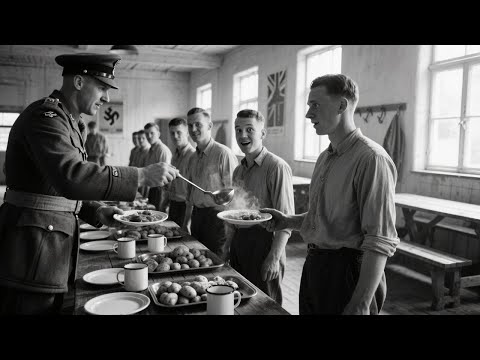
At Camp 174 near Sheffield, a British sergeant walked down the line. “Supper is at 6:00. The line forms at the mess hall. Do not push. There is enough for everyone.” Verer’s hands began to shake. He had prepared himself to die. He had not prepared himself for this.
At exactly 6:00, the mess hall doors swung open. Verer stepped through and froze. Five serving stations stretched along the wall, steam rising from huge metal pots. The smell hit him like a physical force—real meat, potatoes, gravy. His knees went weak.
He shuffled forward, counting the chunks on his plate: three pieces of beef, four carrots, potatoes. Eight ounces of mashed potatoes with melting butter. Two thick slices of white bread. Margarine. Strawberry jam. A mug of hot tea with two lumps of real sugar.
A British officer stood nearby. “Take as much as you want. There is plenty more in the kitchen. If you are still hungry after you finish, you can come back for seconds.”
Take as much as you want. The words made no sense. In the Wehrmacht, stealing a single potato could get you court-martialed. Food was measured, rationed to the gram. And now this British officer was saying food was not precious—that there was an endless supply.
Verer sat down, hands trembling so badly he almost dropped his plate. Around him, other prisoners stared at their food, afraid it would disappear if they touched it. One man ate too fast and vomited. Verer expected punishment. Instead, two British guards brought a bucket, a mop, and a cup of water. No anger. No cruelty. They just cleaned up and walked away.
Verer took a small bite of stew. The taste exploded—salt, fat, real beef. He chewed slowly, swallowed. His stomach did not reject it. With each bite, something broke inside his chest.
The days that followed brought more impossible discoveries. Breakfast at 7:00—porridge with milk and sugar, bread with butter, real coffee. Lunch at noon. Dinner at 6:00. Every single day. 3,500 calories per day—more than triple what German civilians were eating.
Once a week, the Red Cross delivered parcels: chocolate, fifty cigarettes, real soap, razor blades. The camp had a medical building with forty beds, real doctors, penicillin. Verer had suffered from an infected tooth for eight months. In the British camp, he mentioned it to a guard. Two hours later, a dentist fixed it in twenty minutes. He almost cried from relief.
Prisoners who volunteered for farmwork got paid—three shillings per day. Actual British money. Verer signed up immediately. The idea of being paid to work felt like a dream.
Every new discovery made the confusion worse. Britain had been bombed for years. German U-boats had sunk thousands of supply ships. Britain should be starving. But here was abundance. Here was organization. Here was a system that worked.
Verer began to feel something he had not felt in years. It was not gratitude exactly. It was deeper and more disturbing. It was doubt. Doubt about everything he had been told. Doubt about Germany’s strength. Doubt about who the real barbarians were.
The breaking point came on Christmas Day 1945. Verer had been in Camp 174 for seven months. The war was over, but most prisoners were still waiting to go home. Two weeks before Christmas, the camp commander announced a special holiday meal. Verer expected maybe an extra slice of bread. He did not expect what actually happened.
On Christmas morning, prisoners were told they did not have to work. The mess hall was decorated with paper chains made in the craft workshop—colored paper, glue, scissors given to enemy prisoners like children in school. In the Wehrmacht, there had been no paper to spare. Everything went to the war effort.
At noon, the doors opened. Verer smelled roasting meat—not the usual beef stew, something richer. The serving tables were covered with white cloths. British guards stood along the walls, smiling, some wearing paper hats.
The first server placed a thick slice of roasted turkey on his plate. Eight ounces of white meat with crispy brown skin. Verer stared at it. He had not eaten turkey since before the war, at a family dinner when his father was still alive.
Then came roasted potatoes, golden and crispy. Brussels sprouts cooked with butter. A spoonful of dark red cranberry sauce. A thick slice of Christmas pudding soaked in brandy with sweet butter sauce on top.
At the end of the line, each prisoner received a small bag. Inside were chocolates, three oranges, and two bottles of British beer—real beer with actual alcohol.
Verer carried his tray to a table and set everything down carefully. He picked up an orange and held it in his palm. It was heavy and cold, the skin bright orange, almost glowing. He had not seen fresh citrus in four years. This single orange was worth more than a week of German ration.
A British chaplain walked to the front of the hall—an older man with white hair and a kind face. He spoke in German, which surprised everyone. His accent was not perfect, but it was clear enough.
He invited everyone to bow their heads. Some prisoners did, some did not. Verer bowed his head because he did not know what else to do. The chaplain prayed simply and shortly. He thanked God for the end of the war. He asked for peace. He asked for healing for all the nations that had suffered.
Then he said something that made Verer’s throat tighten. “You are far from home and far from your families, but you are not forgotten. You are men, not animals. You deserve dignity and kindness. That is what we believe. That is what our faith teaches us. So today, we share this meal with you as brothers in Christ.”
The chaplain stepped back. Someone started singing. It was Stille Nacht—Silent Night, the old German Christmas carol. One voice became ten, then fifty, then hundreds. Eight hundred German prisoners sang together in a British camp while guards stood quietly and listened.
Verer opened his mouth, but no sound came out. His eyes burned. Tears ran down his face, and he could not stop them. Around him, grown men were crying openly. The Luftwaffe pilot who had vomited on the first day sat across from Verer with tears streaming into his beard.
The pilot whispered, “My God, they are Christians. Real Christians. And we…” He could not finish the sentence. Verer understood perfectly.
Nazi propaganda had called the British subhuman, weak, decadent, controlled by Jews, destined to lose because they were morally inferior to the master race. But here was the truth, served on a clean plate with turkey and cranberry sauce. The British had been bombed for years. Blockaded by U-boats. They had sent hundreds of thousands of men to die on battlefields. And still they had enough food to give enemy prisoners a Christmas feast. Still they had enough humanity to treat those prisoners with basic decency.
Verer picked up his fork and took a bite of turkey. It was tender, juicy, perfect. He ate slowly, tasting every bite. He ate the potatoes. He ate the Brussels sprouts even though he had never liked them. He ate the Christmas pudding and felt the brandy burn slightly on his tongue.
He peeled one of the oranges, and the smell of citrus filled his nose—sharp and sweet and almost overwhelming. He split it into sections and ate them one by one. Each bite tasted like a memory of childhood, of Christmas mornings before the war, of a world that had been destroyed.
After the meal, Verer sat at the table for a long time. Other prisoners talked quietly or sang more carols. Some drank their beer and laughed—actual laughter, for the first time in months.
Verer pulled out the small notebook the guards allowed him to keep. He had been writing in it since August—little notes about daily life, about his thoughts, about the things he saw. Now he wrote something different.
“I have fought for six years believing we brought civilization to the world. Today I ate better than my mother has eaten since 1942. The guards do not beat us. The food is real. The Red Cross parcels are not propaganda—I opened one myself. I have eaten it. If Britain—bombed and blockaded and fighting for survival—can feed us like this, what does that mean? What have we done? What was it all for?”
The words looked small and weak on the page. But they represented something enormous breaking inside him. Every piece of Nazi ideology he had believed was cracking apart. The lies were not complicated. They were simple and obvious. You did not need a university education to understand. You just needed a plate of turkey and the absence of cruelty.
Over the following weeks, Verer noticed changes in himself and in other prisoners. Men started asking for English lessons. The British brought in teachers, and soon there was a waiting list. Prisoners wanted to learn the language of their captors. They wanted to read English newspapers. The British allowed this too—uncensored newspapers arrived every day.
At first, many prisoners refused to believe the photographs from Bergen-Belsen and Auschwitz. They said it was propaganda, that the British had faked the pictures. But the evidence kept coming—more photos, more testimonies, more documents. And the British did not force anyone to believe. They just left the newspapers on tables in the common room and let the prisoners read them or not, as they chose.
Verer read everything. He studied the photographs of piled corpses and skeletal survivors. He read the testimonies of camp guards who described the gas chambers and the crematoriums. He felt sick. He felt angry. He felt ashamed. Not because he had been in a concentration camp or personally committed atrocities—he had been a tank officer on the Eastern Front. But he had been part of the system. He had worn the uniform. He had believed the lies. He had fought for this.
He volunteered for farmwork again—not for the money, but because he needed to be outside, needed to be useful, needed to do something normal. He worked alongside British farmers who had lost sons and brothers in the war. These men should have hated him. Instead, they treated him with basic decency. They showed him how to operate the machinery. They corrected his English when he made mistakes.
One farmer’s wife packed extra sandwiches in Verer’s lunchbox—thick slices of bread with cheese and pickle. One afternoon, Verer gathered the courage to ask her why. Why did she give him extra food? Why was she kind to him? Her husband had died at Dunkirk. She had every reason to hate Germans.
The woman looked at him with tired eyes and said simply, “You’re a long way from home, love. Everyone deserves a bit of kindness.”
That sentence broke something in Verer that the Christmas feast had only cracked. He went back to the barracks that night and cried into his pillow like a child. Not because he was sad, though he was. Not because he was ashamed, though he was that too. He cried because he finally understood what civilization actually meant.
It was not about tanks or technology or military power. It was about this. A farmer’s wife packing extra sandwiches for an enemy soldier. A chaplain saying, “You deserve dignity.” A buffet line with the words, “Take as much as you want.” That was civilization, and Germany had abandoned it completely.
January 1948. The transport train pulled into Hamburg’s ruined station. Verer stepped onto a platform of shattered glass and soot, birds flying through the empty steel roof. He had gained forty pounds in captivity. His face had color. He carried a wool blanket, a bar of soap, and a letter of reference from an English farmer.
He found his mother in a basement shelter—fifty-two years old, looking seventy, weighing almost nothing. She stared at him without recognition until he said “Mama, it’s me. Hans.” Her legs gave out. He caught her before she fell.
She touched the soap and wept. She read the English letter she could not understand, turning it over in her hands. “The British did this? They gave you these things?” He told her about the turkey, the oranges, the dentist. She shook her head, unable to believe.
Verer never spoke of glory again. He kept the letter and his camp diary in a box for forty-four years. At his funeral in 1989, his daughter read the Christmas entry aloud—the words about dignity, about what civilization truly meant.
Treating enemies with humanity is not weakness. It is the ultimate victory.
What would you have believed, standing in that mess hall line with an empty stomach and a lifetime of lies behind you?
Report this article
Select a reason for reporting:






