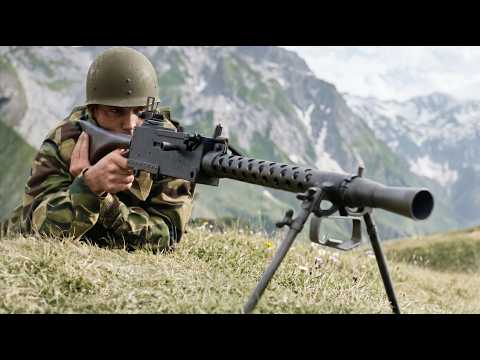
He stumbled through the French field, the weight biting into his shoulder with every step. Thirty-two and a half pounds of stamped steel and machine gun—a brick that never let him forget it. The men beside him carried rifles. He carried a curse. He hated the gun. He hated the committee that built it. Then the tree line erupted.
German riflemen poured out, spreading wide, moving fast. He dropped into the mud, kicked open the bipod, and dragged a belt of .30-06 into the feed tray. He pressed the trigger—and the hated brick roared to life. For the next several minutes, it did what no rifle in his squad could do. It did not stop.
This is the story of the M1919A6—the worst gun the US Army ever asked a man to carry, and the one he was most grateful for when the fighting started. But to understand why, we have to go back to a problem the American rifle squad couldn’t solve on its own.
By 1944, the squad was built around the M1 Garand, a semi-automatic rifle that gave every man fast, accurate fire. For sustained automatic fire, they had exactly one weapon: the Browning Automatic Rifle, the BAR. Rugged, beloved—and limited in a way that got men killed. It fed from a 20-round magazine. Twenty rounds, then a pause to reload. Its barrel was fixed, so it couldn’t be swapped when it overheated.
American doctrine treated the machine gun as a helper to rifle fire. The Germans did the opposite. Their squad was built around its belt-fed machine gun, the MG 34 and later the MG 42. The rifleman existed to carry ammunition, protect it, and move it. A full German squad hauled close to 1,800 rounds for that single weapon.
And that weapon was a nightmare. The MG 42 fired between 1,100 and 1,350 rounds a minute. The ear couldn’t separate the individual shots. To the men on the receiving end, it sounded like tearing cloth, like a saw biting wood. The Germans called it the Knochensäge, the bone saw. American GIs called it Hitler’s buzzsaw.
It frightened American troops so badly that the War Department made a training film just to calm them down. Film Bulletin Number 181 promised the men that the German gun was good, but theirs was better. That its bark was worse than its bite. Think about that: the army was making movies to talk its own soldiers out of being terrified.
What the American squad needed was its own belt-fed gun. Something one man could grab, run forward, and drop into a new position. The army already owned a belt-fed Browning—the M1919A4. But it weighed a ton and took a crew to run it. It rode on a heavy tripod, and it took time to set up. Too slow to keep pace with infantry pushing forward.
So in 1943, two groups inside the army went to war with each other over how to fix it. The Ordnance Department wanted to build a true general-purpose machine gun from scratch—light, belt-fed, with a fast barrel change. The right answer, and the slow one. The Infantry Board didn’t have time for the right answer. Men were dying now. So they insisted on a shortcut: take the proven A4 and bolt parts onto it.
Give it a bipod like the BAR. Give it a lighter barrel you could change from the front. Give it a stamped metal shoulder stock and a carry handle like the British Bren. The Infantry Board won. On April 10th, 1943, the modified gun was classified substitute standard as the M1919A6. It would carry a grudging second-class status for its entire service life.
Here’s the part nobody planning it seemed to notice: the gun built to be light was not light. The finished A6 weighed 32 pounds and 8 ounces. The BAR it was meant to supplement weighed about 20 pounds. So the new light machine gun came in roughly 12 pounds heavier than the automatic weapon already in the squad. It was even about a pound heavier than the bare A4 receiver it was based on.
The former Ordnance officer Conrad Schreyer put the irony plainly: “The A6 weighed 32 and 1/2 pounds, which made it 12 and 1/2 pounds lighter than the A4 mounted on its tripod.” Read that the other way around. The only way this gun counted as light was to measure it against a gun bolted to a heavy tripod and run by a crew.
The historian Bruce Canfield called the result an unhappy compromise and revived the old joke that fit it perfectly: the A6 was like a camel—a horse designed by a committee. Saginaw Steering Gear, a division of General Motors, would build 43,479 of them. A small mountain of a gun nobody had really wanted.
And then the men in the field picked it up, and the same gun that ruined a march turned into the most valuable thing on the line.
Here is the brutal arithmetic. The BAR gunner fired 20 rounds and reloaded. The A6 gunner fed a woven belt of 250 rounds and fired in long bursts at 400 to 550 rounds per minute. He didn’t stop to change magazines. He kept feeding until the belt ran out or the barrel begged for mercy. One man, lying behind one gun, could put out the fire of most of a squad.
The place that proved it was Mortain. In early August 1944, Hitler ordered a massive armored counterattack in Normandy—Operation Lüttich. Elements of four Panzer divisions, including the 2nd SS Panzer Das Reich and the 1st SS Panzer Leibstandarte, drove west to cut the American breakout in half. Standing in their path was the 30th Infantry Division, Old Hickory.
At the crossroads village of Saint-Barthélemy, roughly 700 men of Lieutenant Colonel Robert Franklin’s 1st Battalion, 117th Infantry, plus about 200 men of the 823rd Tank Destroyer Battalion, met the Panzers head-on with rifles, machine guns, bazookas, and a handful of anti-tank guns. They were outnumbered and outgunned, and they made the Germans pay for every yard.
A few miles away, the 2nd Battalion, 120th Infantry, was cut off and surrounded on a piece of high ground called Hill 314. They held it for five days. By the time relief broke through on August 12th, 227 men of that battalion had been killed, wounded, or captured. Around 300 walked off the hill.
Now, an honest note, because this channel doesn’t pretend. The records from Mortain, like almost every record of the war, simply say “machine guns.” The A6 and the A4 looked nearly identical in the mud, and units carried them side by side. No surviving report singles out one A6 gunner by name on that hill, but this is exactly the fight the A6 was born for: infantry in fixed positions breaking massed assaults with sustained belt-fed fire.
When German infantry came across open ground toward Old Hickory’s line, it was belt-fed .30-caliber Brownings—guns of this type—that met them. Not 20 rounds in a pause, but a continuous wall of fire that didn’t let up while a man could still feed it.
That is the horror the title promises. Not gore, something colder. The knowledge that a single American kid from a farm in Ohio, lying behind one ugly, hated gun, could break the spine of a charging platoon before it ever reached him.
If you’d rather know the real story than the polished one, subscribe. This channel covers the weapons and the men who carried them every week without the myths.
While the gun was earning its keep on the line, it was also quietly failing at the job it had been invented to do. Start with the obvious: the weight. 32 and 1/2 pounds of sharp edges and hard angles. Men hated carrying it so much that just as they had with the BAR, many gunners tore the bipod and the extra hardware off to shave a few pounds. The improvements were the first things thrown away.
Then the barrel. The whole selling point was that you could change it from the front without stripping the gun. True, and still slow. A German MG 42 crew could swap a glowing barrel in seconds. The A6 gunner fumbled a hot, awkward swap that took far longer, and he needed a glove or an asbestos mitt to do it without cooking his hand.
And here’s the detail almost everyone misses. The A6 fired from a closed bolt with a lighter barrel than the A4. Lighter barrel, less metal to soak up heat—which means the gun built for sustained fire actually overheated faster than the heavier gun it replaced. The longer you leaned on it, the harder it fought you. Rounds could cook off in a chamber too hot to hold them. So the endless stream of fire was never quite endless. It was belts and heat and a gunner racing his own barrel.
The Infantry Board that forced the gun into existence eventually admitted it in its own paperwork. The A6 was satisfactory as an intermediate type, it said, but not a satisfactory light machine gun for infantry use. Ordnance felt it had been saddled with a weapon it never wanted. The gun fell between two stools: too heavy to be a real light machine gun and less stable than a tripod gun.
The historian Dolf Goldsmith summed up the mood of the men stuck with it. Through the spring and summer of 1944 he wrote, “The infantry was less than happy with the A6, but there was simply nothing else available that could have been used instead. That is the whole gun in one sentence. Nobody loved it. Everybody used it. Because the alternative was nothing.”
And it wasn’t only the hedgerows of France. The same gun with all the same flaws was hauled up some of the worst ground in the Pacific. On Okinawa in the spring of 1945, the 77th Infantry Division fought through a maze of ridges and caves around the Maeda Escarpment. Brutal close fighting against a dug-in Japanese defense that had to be burned and blasted out of the rock one position at a time.
On May 14th, 1945, a soldier of the 77th named Private First Class Ralph Colberg was photographed there with his A6. We don’t have a long combat account from him. We have his name, his unit, his gun, and the date—and that’s worth being honest about. He is a face for the thousands of men who carried this thing. Not a Hollywood quote.
But the gun’s value on Okinawa was real and simple. When Japanese troops counterattacked, often at night, often in numbers, a belt-fed Browning that one man could carry forward and drop into a shell hole was exactly what stopped them. Heavier than a man wanted on the climb. Precisely what he prayed for when the screaming started in the dark.
So if the A6 was such a compromise, why does it matter at all? Because it was the army learning a lesson the hard way—in public, under fire. The Germans had solved this problem before the war even started: one belt-fed gun, light enough for a man to carry, with a barrel he could change in seconds, serving as both the squad’s automatic weapon and its machine gun—the general-purpose machine gun. The A6 was America groping toward that same idea and not quite reaching it.
The Ordnance Department had been right all along. After the war, American designers stopped bolting parts onto an old gun and finally built the thing from the ground up. They borrowed the feed system from the MG 42—the gun that had terrified a generation of GIs—and married it to other proven mechanisms. The result was adopted on January 30th, 1957, as the M60.
The M60 weighed about 23 pounds, nearly 10 pounds lighter than the A6. It was belt-fed, it had a genuine quick-change barrel, and it was built to replace both the BAR and the entire M1919 family in one weapon. The exact dual role the A6 had reached for and missed.
The A6 soldiered on anyway. It fought through Korea, where belt-fed fire against massed assault was worth its weight in gold. It carried on into the early years of Vietnam in the hands of South Vietnamese troops. A placeholder that refused to retire until the real answer finally arrived.
Go back to that American infantryman in the French field. The one cursing every pound of the brick on his shoulder. He was right. It was too heavy. It was awkward, badly balanced, and it overheated when he needed it most. Every complaint he had was true.
And none of it mattered the moment a German platoon stepped out of the tree line. Because while he held that trigger down, while the belt fed and the barrel screamed, the men spread out in front of him could not advance, could not stand, and in many cases did not survive.
That was the bargain the M1919A6 offered the men who carried it. Hate me on the march. Curse my weight, curse my edges, curse the committee that built me. Just don’t ask what your squad does without me when they come.
So what do you think—was the A6 a failure, or a flawed savior? Sound off in the comments below.
Report this article
Select a reason for reporting:






