The morning of October 14, 1944, dawned crisp and clear over the Swabian countryside. In the small village of Herrlingen, Field Marshal Erwin Rommel, the legendary Desert Fox, was enjoying a rare moment of peace. His beloved wife, Lucie, was nearby, and his only son, Manfred, had been granted leave to visit. They walked together in the garden, the war feeling distant for just a few precious hours. Rommel, still recovering from injuries sustained in a strafing attack in Normandy, wore his favorite Afrika Korps leather jacket. He spoke to Manfred about the future, about a possible posting to the Eastern Front. Neither of them knew that this would be their final conversation.
Just before noon, a dark green car with Berlin plates pulled up to the gate. Two generals stepped out: Wilhelm Burgdorf and Ernst Maisel. They had come from Hitler’s headquarters with a chilling ultimatum. Rommel’s heart must have sunk as he saw them, but he maintained his composure. He invited them inside, and they politely asked to speak with him alone. Manfred and Captain Hermann Aldinger, Rommel’s loyal aide, left the room. The generals wasted no time. They presented Rommel with a damning accusation: high treason for his alleged involvement in the July 20th plot to assassinate Hitler.
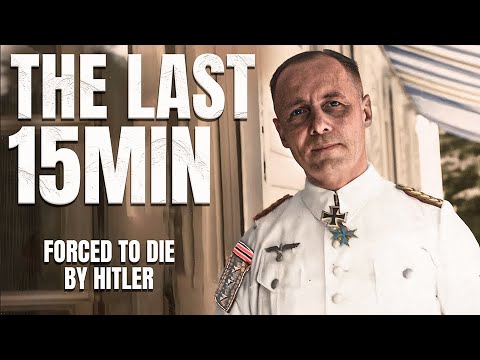
Burgdorf laid out the Führer’s offer: a choice between the People’s Court and certain execution, or a quiet suicide with a promise of a state funeral and protection for his family. “The head of state allows you to choose,” Burgdorf said, his voice cold and official. Rommel, a man of honor and duty, understood immediately. There was no real choice. To defend himself would mean dragging his family through the mud of a show trial, and likely their destruction as well. He had to die.
He climbed the stairs to his wife’s room. Lucie later recalled the moment he entered, his face pale but resolute. “I’ve come to say goodbye,” he said softly. “In 15 minutes, I will be dead.” Lucie’s world shattered. She begged him to defend himself, to fight, but Rommel knew it was futile. “It’s useless. I wouldn’t make it to Berlin. They would kill me on the way.” Just then, he noticed Manfred listening at the door. He called his son in and explained the situation with a heavy heart. Manfred, only 15, was thrust into a nightmare. He asked if they could resist, but Rommel shook his head. “It’s better for only one to die than for all of us to end up involved in a useless shootout.”
Rommel asked Manfred to fetch Aldinger. The captain, who had been with Rommel through thick and thin, was horrified when he learned the truth. He urged Rommel to escape, to fight, but Rommel refused. “All the streets are blocked by SS men. Cars and the Gestapo are everywhere,” he explained. “I have to think about Manfred and my wife. If I choose the first option, they will not suffer any harm, and they will still receive a pension.” Aldinger was devastated but knew his commander was right. There was no way out.
Rommel changed into his uniform, picked up his field marshal’s baton, and walked out of the house for the last time. Burgdorf and Maisel stood by the car, their faces unreadable. They raised their arms in salute. “Field Marshal,” they greeted him. Rommel returned the salute, then turned to his son. He shook Manfred’s hand firmly, a silent goodbye that spoke volumes. He climbed into the back seat of the car. The driver closed the door, and the car pulled away, disappearing around a bend. Manfred and Aldinger stood watching, their hearts heavy with dread.
The car stopped 500 meters away, in a clearing near a small forest. Burgdorf ordered the driver and Maisel to get out and wait. They walked away, leaving Rommel alone with the two generals. Ten minutes later, they returned. The driver later recalled seeing Rommel slumped in the back seat, his face contorted, the smell of bitter almonds in the air. “He was clearly dying,” the driver said. “There was still potassium cyanide in his mouth.” Rommel was dead, not from a hemorrhage as the official report would later claim, but from poison forced upon him by his own Führer.
Back at the house, the phone rang. Aldinger answered. The voice on the other end delivered the news: Field Marshal Rommel had died of a hemorrhage. Aldinger slowly climbed the stairs to Lucie’s room. There was no need to speak. She knew. The Desert Fox was gone, but the legend was just beginning.
Within minutes, the phone rang again. This time it was Burgdorf, his voice clipped and businesslike. “The field marshal has suffered a hemorrhage,” he announced. “The Führer has ordered a state funeral. He will be buried in Herrlingen.” Aldinger listened in silence, then slowly replaced the receiver. He turned to Manfred, who stood frozen in the hallway, his young face a mask of shock and disbelief.
That same afternoon, the house was filled with the sound of official condolences and the cold efficiency of the SS, who had surrounded the property and now oversaw every detail. Lucie remained in her room, her grief a private, consuming storm. Manfred was left to wander the corridors, a boy thrust into a world of whispers and lies. He remembered his father’s last words to him: “If you utter a single word about what happened here, they will not feel bound by the agreement.” The weight of that promise settled on his shoulders like a leaden cloak.
Word spread quickly. The official cause of death was announced as a cerebral hemorrhage, a result of the injuries Rommel had sustained in Normandy. Hitler himself sent a telegram: “Accept my sincere sorrow for the sensitive loss that the death of your dear husband represents for you. The name of Marshal Rommel will forever be associated with the heroic campaigns of North Africa.” Propaganda Minister Joseph Goebbels followed with his own message of condolence, and Reichsmarschall Hermann Göring wrote of being “deeply moved to learn that your husband, Marshal Rommel, died as a hero as a result of his wounds.” The words rang hollow to those who knew the truth.
Preparations for the funeral began immediately. The Nazis, ever the masters of spectacle, intended to turn Rommel’s death into a grand propaganda event, a celebration of a loyal soldier’s sacrifice. A state funeral with the highest military honors was scheduled for October 18th. The guest list included some of the most powerful men in the Third Reich. Field Marshal Gerd von Rundstedt, the aged commander who had once led the Western Front, was chosen to deliver the eulogy. He was told the same lie: Rommel had died of a heart attack, brought on by his wounds.
On the morning of the funeral, the small village of Herrlingen was transformed. SS officers in their black uniforms lined the streets. The roads were closed to all but the funeral procession. A cold autumn drizzle fell, as if the heavens themselves were weeping. The Rommel family home was filled with flowers sent by the highest offices of the Reich, their sweet scent clashing with the bitter atmosphere of deceit.
Lucie Rommel, dressed in black, moved through the day like a ghost. Her face was pale and drawn, her eyes red-rimmed. She accepted the condolences of generals and party officials with a quiet dignity that belied the fury and despair within her. Manfred stood by her side, his own grief a silent, smoldering fire. He watched the men who had ordered his father’s death now gather to praise him, their faces solemn, their words empty.
The coffin, draped in the swastika flag, was carried on a gun carriage through the village. The streets were lined with soldiers and civilians, their faces a mixture of genuine sorrow and calculated reverence. The procession made its way to the Herrlingen cemetery, where a freshly dug grave awaited. The sound of marching boots and the muffled beat of drums echoed through the damp air.
At the graveside, von Rundstedt stepped forward. His voice, old and weary, carried across the silent crowd. “A great soldier has left us,” he began. “His heart belonged to the Führer and to the Fatherland.” The words were a bitter irony, a final insult to the man who had been forced to die for a cause he no longer believed in. Manfred clenched his fists, his nails digging into his palms. He wanted to scream, to shout the truth, but he remembered his father’s plea. He remained silent.
The ceremony concluded with the firing of a volley and the lowering of the coffin into the earth. As the first clods of dirt fell onto the wooden lid, Lucie Rommel turned away. She had said her final goodbye to the man she loved, but the world would never know the truth of his death. The legend of the Desert Fox, however, was already taking root, destined to grow beyond the lies and the propaganda, a testament to a man whose military genius and personal integrity would outshine the darkness of the regime he served.
In the weeks that followed, Manfred returned to his studies, his youth stolen by a secret too heavy to bear. He kept his promise, but the silence carved deep lines into his soul. Lucie withdrew to her home, accepting the pension and the condolences while knowing every word was a lie. The family survived, but they did so as ghosts in their own lives.
Captain Aldinger was haunted by that day for the rest of his years. He had saluted his commander one last time, held the door, and then listened for a phone call that would confirm the unthinkable. “I put on his coat for the last time,” he would later say, his voice breaking. “And I watched him walk into the forest and never come back.” He never spoke publicly of the truth until the war was long over.
The legend, however, refused to die. British soldiers who had fought him in the desert still spoke of him with grudging respect. “To do a Rommel” became their phrase for a task executed with cunning and flawless improvisation. His enemies honored him more honestly than his own Führer ever had.
Lucie passed away in 1971 and was laid to rest beside her husband in the Herrlingen cemetery. Manfred lived to see his father’s name cleared in the eyes of history, becoming mayor of Stuttgart. The truth of October 14, 1944, eventually emerged, but the myth of the Desert Fox had already outgrown it.
Erwin Rommel served three German governments, never joined the Nazi Party, and died at fifty-two for a crime he did not commit. The question history still asks is simple: was he a hero, a victim, or a man who chose silence to save the people he loved?
What do you think — did Rommel make the right choice that day, or should he have fought back? Share your thoughts in the comments.
Report this article
Select a reason for reporting:






