The camera shook, but it kept rolling. On the morning of June 6, 1944, Sergeant Richard Taylor of the US Signal Corps crouched low on the eastern end of Omaha Beach, his arm bleeding from a fresh wound. Around him, American soldiers scrambled for their lives—some dove behind shingle, others sprinted across open sand as machine gun fire tore through the air. Then, in a heartbeat, two men fell, cut down in the frame. Taylor kept filming. That shaky, raw footage would become the only motion picture captured during the first assault waves on Omaha Beach—a fleeting, unfiltered glimpse into the chaos of D-Day’s deadliest sector.
But the film raises haunting questions. Where exactly was Taylor standing? What was happening around him in those desperate seconds? And how did the men in that footage—the soldiers of Company L, 16th Infantry Regiment—manage to fight their way off a beach that was designed to be a killing ground? The answers lie buried in aerial photographs, German defense maps, and the testimony of survivors. This is the story of Fox Green, the forgotten sector where the first wave landed—and where courage was measured in inches of sand.
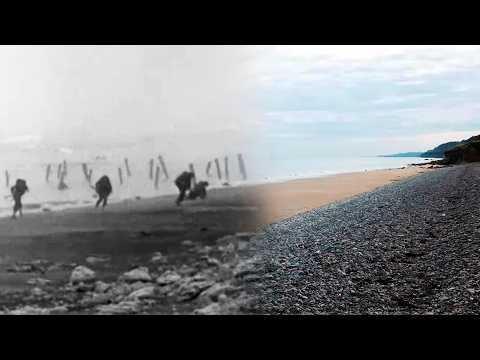
The odds were stacked against them from the start. Omaha Beach was a natural fortress, its 50- to 100-foot bluffs bookended by sheer cliffs, offering German defenders a perfect vantage point. Along the four-mile stretch, they had built a network of interlocking strongpoints—Widerstandsneste, or resistance nests—each armed with machine guns, mortars, and anti-tank guns. Nine of the fifteen nests on Omaha clustered around the four main draws, the valleys that offered the only viable exits from the beach. But our focus is on a lesser-known spot: Exit F1, a narrow fisherman’s path leading to the hamlet of Cabourg. Above it sat WN60, a crescent-shaped fortress of trenches and concrete, manned by forty men of Grenadier Regiment 726. Two Belgian 75mm field guns, two mortar tobruks, and a tank turret made it a lethal obstacle. The terrain itself—three- to four-meter rock cliffs—funneled any attacker into a narrow killing zone. No one was supposed to assault here. But war rarely follows the plan.
“No plan survives first contact with the enemy.” That maxim would be proven with brutal clarity on Fox Green. The Americans had divided Omaha into sectors, with the Big Red One—the 1st Infantry Division—tasked with the eastern half. Leading the assault was Company L, 3rd Battalion, 16th Infantry. Among them: Captain John Armellino, a 23-year-old veteran of North Africa and Sicily; and Lieutenant Jimmy Monteith, a Virginian known for his calm under fire. Their objective was WN61, a strongpoint guarding the eastern half of the Colleville draw, but a series of mishaps would send them into the jaws of WN60 instead. As the naval bombardment roared overhead, most of its fury missed the dug-in Germans. Smoke obscured the coastline, and the landing craft drifted off course. By the time Company L touched down at 7:00 a.m., thirty minutes late, they were scattered and disoriented.
Lieutenant Klenk’s boat hit the sand 700 yards east of its intended target—right under the guns of WN60. Artillery fire ripped into the craft, killing nineteen men before they could even disembark. The other boats fared little better. Private John Sweeney remembered the moment he was hit: “All of a sudden, I got hit by machine gun fire from the left front. I was turned completely around. The bazooka I was carrying was full of holes and the life belt I was wearing was taken right off me.” Those who survived the run-in found themselves wading through waist-deep water, then trudging across 200 yards of open sand with no cover, as machine guns from WN60 and WN61 crisscrossed the beach. Some reached the base of the cliffs, huddling in the shadow of the bluffs, pinned down and taking casualties.
By 7:30 a.m., the situation was desperate. The tide was rising, threatening to drown the wounded and swallow the beach. New waves of troops were landing into the same maelstrom, and command and control had broken down. Captain Armellino, realizing that staying put meant death, dashed across open ground to establish contact with two Sherman tanks that had made it ashore. He was hit by a mortar fragment, severely wounded. Command fell to Lieutenant Cutler, with Monteith and Klenk at his side. They knew there was only one hope: the F1 draw, a narrow break in the cliffs just 100 yards from WN60’s guns. It was a suicidal prospect, but it was the only way off the beach.
Monteith volunteered to race back to the tanks, hammering on the turret of the lead Sherman until he got the crew’s attention. He pointed out the targets in WN60, then sprinted back to join his men. “Follow me!” he shouted, and the survivors of Company L began to climb. The advance was slow, agonizing—a yard-by-yard crawl under constant fire, using the terrain for cover. The tanks provided crucial support, knocking out the 75mm guns in their dugouts. But the Germans above were not giving up. A patrol led by PFC Joseph Liebowitz found itself in a grenade duel with the defenders; Lieutenant Klenk ordered bayonets fixed and the trench cleared. Fifteen Germans surrendered. Elsewhere, 17-year-old Private Joe Artensio silenced a machine gun with a well-placed grenade at point-blank range. The fight was a series of desperate, individual skirmishes—not a clean battle, but a bloody, confusing struggle for every inch of ground.
As the morning wore on, the Americans finally reached the summit. WN60 was not captured in a single dramatic charge, but through a grinding, exhausting advance that outflanked the position. By late morning, the men of the 16th Infantry had passed beyond the strongpoint, pushing toward Cabourg and Le Grand Hamel. But the cost was high. German counterattacks came swiftly, determined to drive them back into the sea. And in the thick of that fight, Jimmy Monteith was everywhere, rallying his men, crossing open ground under fire to strengthen their defenses. He was killed when the enemy surrounded his unit. His Medal of Honor citation would later say: “His courage, gallantry, and intrepid leadership is worthy of emulation.” Today, he lies buried in the Normandy American Cemetery, a stone’s throw from WN60, overlooking the beach where he made his stand.
Sergeant Taylor’s film remains a testament to that day—shaky, raw, and utterly human. It shows not the sweeping victory of legend, but the chaotic, terrifying reality of young men fighting to survive. And it leaves us with a question: what happened next? How did the survivors of Fox Green hold their ground against the inevitable counterattacks? That is a story for another time.
The hours that followed the capture of WN60 were a blur of exhaustion and defiance. The men of Company L, joined by stragglers from other units, dug in along the crest of the bluffs and waited for the inevitable German response. They did not wait long. Around midday, the first counterattack came—a probing thrust by infantry supported by mortar fire, testing the American line. It was beaten back, but the fighting was savage and close-quarters, grenades and rifle fire echoing across the broken ground.
Monteith, now the senior officer on the crest, moved constantly along the line. “He was everywhere at once,” one survivor recalled. “You’d see him sprinting across open ground, dropping into a foxhole, pointing out targets, then moving again before the Germans could zero in on him.” His calm under fire was contagious. Men who had been paralyzed by fear on the beach found themselves standing up, firing, holding their ground. The position was not yet secure—it was barely a foothold—but it was theirs.
The German counterattacks intensified as the afternoon wore on. A second, more determined assault struck the western flank, threatening to roll up the American line. Monteith organized a hasty defense, shifting men and machine guns to meet the threat. “Hold here,” he told them. “We don’t give up this ground.” The fighting was brutal, often hand-to-hand, but the line held. By late afternoon, the Germans had pulled back, their counterattacks spent.
But the cost had been staggering. The men on the crest were running low on ammunition, and the wounded were everywhere. Medics worked frantically, often under fire, dragging casualties into whatever cover they could find. Sergeant Taylor, his arm still bandaged, continued to document the scene—though his camera now captured not the chaos of the landing, but the grim aftermath: exhausted soldiers huddled in foxholes, medics tending to the wounded, the dead laid out in rows.
As evening approached, the situation on Fox Green began to stabilize. More troops and supplies were coming ashore, and the beach, though still under intermittent fire, was no longer a killing zone. The survivors of Company L, reduced to a fraction of their original strength, held their position. They had done what had seemed impossible: they had fought their way off Omaha Beach.
But the battle was not over. Inland, the Americans were pushing toward Colleville-sur-Mer and beyond, and the Germans were preparing a final, desperate effort to throw them back. For the men on the bluffs above Fox Green, there would be no rest. The longest day was not yet done.
As dusk settled over the bluffs, the survivors of Company L scraped deeper into the Norman soil. They had no illusions about what morning would bring. German artillery continued to fall in sporadic, murderous bursts, and the men who had climbed the F1 draw now found themselves defending the same ground they had bled for.
“We didn’t talk much,” one veteran later recalled. “We just looked at each other and nodded. We knew what we’d done. We knew what it cost.” By nightfall, fewer than half of the original assault sections remained fit for duty. The beach below was a graveyard of wrecked landing craft and silent bodies, lit only by the glow of fires and the distant flash of naval guns.
Sergeant Taylor’s camera had long since run out of film. What he captured that day—the falling men, the scrambling survivors, the sheer terror of the first waves—would become the defining visual record of Omaha Beach. But the men who lived it carried something the camera could never show: the weight of having stared into the abyss and refused to blink.
By midnight, the first reinforcements began to arrive, moving cautiously through the darkness toward the front lines. The men of Fox Green passed them without ceremony—a nod, a hand on a shoulder, a whispered warning about the machine gun nest still holding out to the east. Then they slumped into their foxholes and slept the sleep of the utterly spent.
Jimmy Monteith would not see the dawn. Neither would the hundreds of others whose names never made the citations. But the ground they took—that narrow, blood-soaked strip of bluff above a fisherman’s path—remained in Allied hands. And from that foothold, the liberation of Europe would begin.
Today, the cliffs above Fox Green are quiet. The guns are silent, the trenches softened by decades of grass and wildflowers. But if you stand there at low tide and look down at the sand, you can still trace the line of the F1 draw. You can still imagine the men who climbed it, under fire, with nothing but courage and each other.
What would you have done, on that morning, with the sea at your back and the enemy above?
Report this article
Select a reason for reporting:






