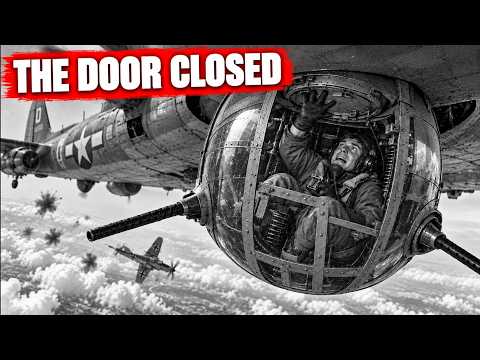
At 25,000 feet over occupied Europe, the temperature outside the Flying Fortress could plummet to 40 below zero. Suspended beneath the belly of the bomber, inside a 44-inch sphere of aluminum and plexiglass, a young man lay on his back, knees drawn to his chest, heavy machine guns resting on either side of his head. The ground was five miles below his boots. His parachute was not with him. There was no room for it. It waited above in the fuselage, near a small circular door that only opened when his guns pointed straight down at the earth.
On January 3, 1943, over the French port of Saint-Nazaire, a 23-year-old sergeant from New Jersey climbed out of that ball, reached for his chute, and found it shredded to pieces. Four months later, returning from the same target, another ball turret gunner on his first mission felt the power die in his turret. Above the door over his head, his bomber was on fire. One of these men would fall four miles with nothing on his back. The other would turn and walk straight into the flames. Both began that morning the same way: folded inside a machine that allowed a man to exit only through one door, in one position.
The engineers thought in pounds of drag. The gunners thought in inches. When American designers looked at the heavy bombers taking shape on the eve of World War II, they saw a weakness any fighter pilot would exploit in minutes. The bomber was well protected from the sides and above, but below, in the shadow of its belly, was a wide blind spot in the sky. A fighter that dove under the formation and climbed into that blind spot could fire almost without reply. Someone had to guard the belly.
The problem was that anything hung under the plane fought the wind. Drag ate speed. It ate fuel. It ate range. Every extra inch beneath the fuselage meant a bomber that flew a little slower, burned a little more, and reached a little less deeply into enemy territory. So when Sperry Gyroscope built the turret that would hang beneath the B-17 Flying Fortress, they built it small. The ball turret was a sphere of aluminum and plexiglass about 44 inches in diameter. Inside that space, designers placed two .50-caliber Browning machine guns, their ammunition boxes, a computing gunsight, the electric and hydraulic motors that drove the ball, the controls, and one human being.
It was a clever machine. It could rotate in a full circle and tilt from the horizon to straight down at the ground. It moved fast. It hit hard, and it gave the Fortress eyes and teeth in the one direction it lacked them. What the blueprint did not show was the man. And because the ball was so small, the ball chose the man.
The Army tested pilots for coordination, judgment, and nerve. No one tested ball turret gunners that way. There was no special examination for courage or reflexes. The real question was simpler and far more brutal: Can you fit inside it? Could you fold your knees to your chest, stay that way for hours, and still operate two heavy machine guns with your hands and feet? In most crews, the job went to the shortest, lightest gunner. Old hands would tell you there was a maximum height of about 5 feet 4 inches. Plenty of men who flew the ball were taller. They adapted, but they paid for every extra inch in aching knees, necks, and spines. The ball did not care about rank. It did not care about age, education, or bravery. It cared only about the length of your legs.
In the winter of 1942, one of the young men who adapted to it was a sergeant named Alan Magee. Born on January 13, 1919, in Plainfield, New Jersey, he was not a big man, and nothing about him suggested his name would one day appear in the history books. He was 22 when the Japanese struck Pearl Harbor, and like millions of young Americans that winter, he went looking for a way into the fight. The Army Air Forces trained him as an aerial gunner. Then someone looked at his build and assigned him the one job bigger men could not do.
By the end of 1942, Magee was in England with the 303rd Bomb Group. The men of that group called themselves the Hell’s Angels. They flew from a field called Molesworth in the flat, wet farmland of Huntingdonshire, where fog crept from the fields and the mud never dried. Magee belonged to the 360th Bomb Squadron. He was young, he was far from New Jersey, and he spent his working days hanging upside down beneath an airplane while men he had never met tried to kill him.
Far from Magee in age and temperament, there was another man the ball would choose. Maynard Harrison Smith was born in 1911 in Caro, Michigan. By the time America entered the war, he was over thirty, older than many of the officers who would give him orders, and he carried a reputation that preceded him wherever he went. He did not take to authority easily. He had run afoul of the law back home and, by his own account, was offered the choice many young men of that era heard from a judge: prison or the Army.
On August 31, 1942, at the age of thirty-one, Maynard Smith enlisted in the Army Air Forces. He passed through gunnery school. He was small and wiry, even lighter than Magee. In March 1943, he sailed to England and joined the 423rd Bomb Squadron of the 306th Bomb Group, stationed at Thurleigh in Bedfordshire. The men there gave him a nickname borrowed from a Sunday comic strip about mountain folk. They called him Snuffy.
Snuffy Smith was not an easy man to love. Men who remembered him described him as cocky and abrasive, quick to argue and slow to take orders. Bomber crews that trained and flew together for months became closer to families, and families are careful about who they let into their lives. A crew trusted a man with their lives every day. Few of them wanted to trust their lives to Snuffy Smith. He waited as a reserve gunner while other men went out on missions without him. But every Flying Fortress needed a ball turret gunner, and the man who climbed into the ball did not need to be liked. He only needed to fit.
So when his turn finally came, the oldest man in the crew, the one nobody had wanted, was given the smallest space on the plane.
To understand what these two men were climbing into, you have to understand what the Eighth Air Force was in that long first winter. The Americans came to England believing in daylight precision bombing. The British had tried daylight bombing of Germany early in the war and been torn apart, so the RAF had gone to the cover of night. The Americans believed their Flying Fortresses could do what the British bombers could not. Flying in tight formations, wingtip to wingtip, and bristling with heavy machine guns, the formation would defend itself. It had to. In that first winter, there were no American fighters with the range to escort the bombers deep into Europe. Once the escort turned back, the bombers were on their own.
Many of the first targets lay on the coast of France, and none was more important or more hated than the bases of the German U-boat fleet. The U-boats were sinking Allied ships in the Atlantic at a terrifying rate and returning to massive concrete shelters in ports like Lorient, Brest, and Saint-Nazaire. The roofs of those pens were reinforced concrete several feet thick. Around them, the Germans had packed anti-aircraft guns in maximum density, and German fighter squadrons waited at airfields along the coast. American crews had a nickname for Saint-Nazaire that said everything about it. They called it Flak City.
A mission day began in darkness. A sergeant walked through the cold huts with a flashlight, waking the men. There was breakfast for those whose stomachs could take it, then the briefing room, where a curtain covered a map at the front. When the curtain was pulled back, a string showed the route of the flight, and from the length of that string, everyone knew how hard the day would be and how many of them might not live to see its end. Then came the trucks, the hardstands, the bombers looming in the dark, and the ground crews finishing their checks.
For every other man on the plane, boarding meant walking to his station. For the ball turret gunner, it did not. The ball turret on a Flying Fortress could not be retracted into the plane. The Consolidated Liberator had a ball turret that retracted into the fuselage, but the Fortress did not. Its turret hung permanently beneath the belly, just aft of the radio room, with just enough clearance for normal takeoff and landing. If a tire blew or the landing gear collapsed, the turret was the first thing to hit the runway.
So the rule was simple. On takeoff, the turret was locked with its guns in a horizontal position, pointing backward toward the tail, and the gunner did not ride in it. He sat on the floor of the fuselage with the other men, in the waist or the radio room, feeling the four engines run up to full power and the plane shudder on the runway. It was a strange way to go to war. The cockpit smelled of gasoline, hot oil, cold metal, and leather flight jackets. The noise was so loud that men shouted into each other’s ears and still caught only half the words. Through the small windows, the gray English countryside tilted and slid out of sight. Somewhere below the floor he sat on, the empty ball hung in the wind, waiting for him.
The gunner felt its presence without seeing it. For the first hour of every mission, he was just a passenger, sitting on bare aluminum with his knees up, the position he would hold for the rest of the day. In theory, a gunner could climb into the ball from the outside while the bomber stood in its hardstand. But he would then be trapped down there for the entire takeoff, lying on his back with concrete accelerating beneath him a few inches away. Almost no one chose that.
There was another thing about the ball, and every man who flew it knew it by heart. There was no room in that sphere for a parachute pack. The ball turret gunner wore his harness, the straps fixed around his legs and chest, with two empty metal snaps in front where the chest pack would clip on. The parachute itself stayed above inside the fuselage, near the turret, stored where he could reach it once he was out. To get out of the ball, its guns had to be pointed straight down. To reach his parachute, he had to be out of the ball. Everything depended on the order of those events.
On January 3, 1943, Alan Magee sat on the floor of a Flying Fortress as it climbed from Molesworth into the winter sky. The bomber’s name was painted on its nose in bright letters, borrowed from a breakfast cereal advertisement back home: Snap, Crackle, Pop. It was his seventh mission. The target was Flak City.
The formation gathered over England, dozens of bombers circling and taking their places, squadron after squadron, group after group, until the sky was full of contrails. Then it turned south and west toward the sea. The moment to enter the ball came once the bomber was well airborne, usually over the water, before reaching the coast of occupied France. Magee unbuckled himself from the floor and moved to the turret. Entering it was a ritual, and every step of it mattered.
First, the ball had to be rotated until its guns pointed straight down at the sea. Only in that position did the small circular door at the back of the ball line up with the inside of the fuselage. Magee lifted the door open. Beneath it was the interior of the ball, and beneath that, through the plexiglass, was open air and the gray glitter of the ocean thousands of feet below. He lowered himself inside, feet first. He placed his shoes in the heel rests on either side of the round window at the front of the ball. He strapped the safety belt around his body. He pulled the door shut behind him and locked it. Then he powered up and swung the guns toward the horizon. As the ball turned, he turned with it. By the time the guns were level, he was lying on his back, knees up, shoes in front of his face, and the ground was behind the glass between his feet. He was no longer inside the plane. He was hanging beneath it.
Now he had to connect himself to the machine. Once the door was closed, the ball turret gunner was tied to the flying fortress by a bundle of hoses and cables. There was an oxygen hose for his mask. There was a plug for the intercom in his helmet, so he could hear the crew and they could hear him. There was a plug for the electrically heated suit he wore under his flight gear. There was a small light. Every one of those lines ran through the base of the turret into the fuselage above. Without oxygen, he would pass out within minutes at that altitude, quietly, without even knowing what was happening. Without the heated suit, the cold would seep into his hands and feet and begin to damage them. If one of the lines came loose, he had to find the fault by touch, wearing thick gloves, in a space that barely allowed him to bend his elbows.
The cold was a living thing at that altitude. Outside the plexiglass, the air temperature could drop to 40 below zero. That is the one temperature where Fahrenheit and Celsius meet, and both mean the same thing. Bare skin that touched exposed metal could freeze to it. A man who took off his glove to fix a jammed gun might lose the use of his fingers. His breath condensed inside his oxygen mask and froze into tiny grains of ice that he had to crush out of the rubber to keep the mask working. Around him, the turret offered some protection, but not much. There was an armor plate built into the ball, about half an inch thick, but it covered only part of him. The rest of what stood between Alan Magee and the German guns was aluminum and plexiglass.
And he was alone. He could hear the crew over the intercom, the pilot’s voice, the navigator calling out positions, the other gunners reporting, but he could not see any of them. For hours at a time, those voices in his headset were the only proof that there was still a bomber flying above him. Every few minutes, someone on the crew would call the stations to check on each other. Pilot to tail. Pilot to waist. Pilot to ball turret. Ball turret here. Roger. It was a habit born of hard experience. A man starved of oxygen does not cry out for help. He simply stops answering.
To fight, Magee needed every part of his body. Above the gunsight, two short handles jutted toward him. By moving them, he worked the valves and switches that drove the turret in a circle and tilted it up and down. The trigger button was on those handles under his thumbs. It took both hands. His left foot rested on a pedal that set the range in the gunsight, and he used it constantly as a fighter closed in. His right foot was on a switch that keyed his microphone. So if a ball turret gunner wanted to warn the crew of a fighter coming from below, he had to press with his right foot to talk while his left foot set the distance to the target and his hands tracked and fired. Every limb had a job. None could be spared to wipe frost from his sight, scratch his nose, or reach for anything he had dropped. It was more like playing a church organ than firing a rifle. And he had to do it lying on his back with his knees folded to his chest.
The sight in front of his face was a Sperry K-4, a computing gunsight that hung from the top of the turret. Before combat, the gunner set it to match the size of the fighters he expected to meet. When he looked into its small glass reflector, he saw lines of light projected over the scene through the window at his feet. As a fighter closed in, he pressed with his left foot to move those lines until they filled the space between the fighter’s wings. When the wings fit, the range was right. At the same time, the sight sensed the speed of the turret’s rotation and calculated how far ahead of the target the bullets had to fly. It was a remarkable piece of engineering. A Navy gunnery manual for the same family of Sperry sights noted that they continued to work even when the gunner, spinning beneath his plane, lost all sense of which way he was facing. That happened more often than anyone liked to admit.
As the ball turret turned, the horizon moved across the glass. The sea and the land slid beneath his shoes. The bomber he was defending disappeared entirely above his head. The sight always knew where the fight was. But most of the time, the man working it did not.
Then there was the ammunition. Each gun fed from its own magazine, a few hundred rounds per gun, the exact number varying by model and period. The .50-caliber Browning fired between 750 and 850 rounds per minute. If he held both triggers down, he could empty his ammunition in less than a minute. On a mission that might last eight hours or more, that was all the ammunition he had, with no practical way to reload in the middle of a fight. So ball gunners were trained to fire in short bursts, and only when the enemy fighter was inside true range. The brass casings fell through a chute and out of the plane, scattering in the sky below the formation. A panicked man who fired at everything that moved might find his guns empty at the moment the real attack came.
Even his window could betray him. The gunner could not fight what he could not see through the circular pane between his feet, and the Flying Fortress had several ways of blocking that view. Engines threw oil, and a leaking engine could smear the glass until the world below was just a brown blur. At high altitude, moisture could freeze inside the panels. Worst of all was the relief tube. Crews urinated into a tube that emptied beneath the fuselage, and the slipstream could blow what came out straight back onto the ball turret. One gunner, in a memoir of his missions written years later, complained that his plexiglass was sometimes coated with frozen urine. Crews learned to warn the ball gunner before using it, so he could rotate his turret out of the way.
And through all of it, there was the waiting. Long stretches of the mission passed with nothing to shoot at. The ball turret gunner lay folded inside his sphere, scanning the empty sky below, turning slowly left and right, watching the sea crawl by. The engines roared above him without pause, a deep note he felt in his teeth and ribs. His knees ached. His neck stiffened against the back of the ball. His heated suit warmed parts of his body and left others numb. He could not stand. He could not stretch. He could not even roll over. He could only watch and listen to the voices in his headset and wait for the moment when the sky below him suddenly filled with enemies.
Men who served in the ball turret later said the waiting was a special kind of punishment. A man alone in a glass bubble had plenty of time to think about how he would get out of it. Those were the working conditions on a quiet day.
January 3, 1943, over Saint-Nazaire, was not a quiet day.
The bombers reached the French coast in tight formation, and the sky ahead began to change. Small black puffs appeared, one then several, then dozens, blooming silently and hanging in the air. From inside the ball, flak looked almost harmless. Then the bursts came close enough for Magee to hear them over the engines, a hard thump like a giant door slamming, and feel the bomber shudder. Steel fragments tore through the air in every direction. A piece no bigger than a fingernail, moving fast enough, could punch through aluminum and human flesh.
German fighters were up too. On the run in, a Focke-Wulf peeled from the sun and dove beneath the formation. Magee saw it first, the only man who could. He pressed his right foot to key the mic, his left foot set the range, and his hands tracked the fighter through the K-4 sight. The wings filled the lines. He fired a short burst. The fighter broke away smoking.
Then the bomb bay opened, and the Fortress steadied on its run. For those long minutes the pilots could not turn to dodge the flak. The whole formation had to hold its course while the guns below adjusted their range. Then the burst came, and the plane was hit.
Accounts differ on the exact order of what happened next, and whether flak or fighters delivered the fatal blow. But they agree on what matters. The flak damaged Magee’s turret. Magee himself was wounded. The ball, his little shell of metal and glass, was no longer a place he could fight from or survive in. He had to get out.
To get out, the guns had to point straight down. Only then would the door line up with the fuselage above. Magee rotated the turret, unlatched the door, and pulled himself out of the ball onto the floor of the bomber. He was hurt. He had lost the oxygen line to his turret, and the plane around him was shaking apart.
He reached for his parachute. He found it, but it was useless. Shrapnel had torn the pack open. The silk inside was shredded and spilled. Everything that had punched through the bomber and into him had also found the one thing that was supposed to save him if everything else failed. There was no time to find another. There was no time to think at all.
Another shell struck the bomber. A piece of the right wing tore away. The Fortress spun, flipped, and fell. Inside a spinning bomber, the world becomes a weapon. The force pins a man to the floor or the wall or the ceiling, and he cannot even lift his arms. Loose equipment flies through the air. Ammunition belts writhe like snakes. Men trying to reach the doors cannot crawl a single yard. In those seconds, with oxygen gone at nearly four miles up, Alan Magee lost consciousness.
What happened in the moments after that, no one can say for certain. Some accounts say the bomber exploded. Others say the spinning plane broke apart or threw him clear. What is known is that Alan Magee left the Flying Fortress, and that when he left it, he had nothing on his back.
He was falling. From about 20,000 feet, the distance to the ground is nearly four miles. A human body falling through the air does not keep accelerating forever. It reaches a point where the push of the wind equals the pull of the earth, and after that it falls at a steady speed of about 120 miles per hour. At that speed, a fall of four miles takes roughly two minutes. Two minutes of wind and cold and nothing.
Some versions of the story say Magee woke briefly during the fall and prayed. Some say he remembered nothing at all. Whatever he knew or did not know in those last seconds, the city of Saint-Nazaire was rising beneath him, with its docks and streets and rooftops, its concrete U-boat pens, and the railroad tracks running to the port. At the heart of those tracks stood the city’s train station, with its glass roof. Alan Magee went through it.
He crashed through the glass roof of the Saint-Nazaire train station and landed inside the building. The glass broke around him and above him. Something in that impossible sequence, the angle of the roof, the shattering of the panes one after another, and the way the structure collapsed beneath him, slowed him enough. When the German soldiers reached him, they found an American airman lying in the wreckage of the station, torn by glass and shrapnel, his bones broken, his right arm nearly severed. He was alive.
High above, the rest of the formation flew on toward home. In the bombers that returned to England that evening, men reported the Fortresses they had seen go down and the parachutes they had counted and the ones they had not seen. No one watching from the formation imagined that one of the men who had fallen without a chute was still breathing on the floor of a train station in Saint-Nazaire.
Four months passed. The war went on. The bombers kept returning to the French coast because the U-boats were still there. On May 1, 1943, Sergeant Maynard Smith flew his first combat mission. It had taken a long time for Snuffy Smith to get a seat on a bomber. Now that he had one, he was in the ball turret. The target that day was Saint-Nazaire again.
Smith went through the same ritual Magee had. Takeoff from Thurleigh sitting on the floor of the fuselage, the climb over England, the guns rotated down, the small door lifted, the feet placed in the rests, the safety belt, and then the door pulled shut and locked over his head. Oxygen, intercom, heated suit. The gun swung toward the horizon and the world turned over until he lay on his back staring at the sea between his feet.
For a man on his first mission, everything was new and nothing was explained twice. Every sound might be an enemy fighter. Every shudder might be flak. He was thirty-one years old, a man with a record and a temper, folded inside a metal ball beneath strangers who did not much like him, and about to find out what he was made of.
Below him, the coast of France appeared gray and green through the haze. He was about to learn what the older men knew: that the bombers had been coming to this same port for months, and that the Germans knew they were coming. Every crew that went to Saint-Nazaire came back with stories to tell. The black bursts crawling across the sky toward you, the fighters coming out of the sun, and the empty bunks in the barracks the next morning.
Now Snuffy Smith would see it for himself from the one seat on the plane that let a man see everything below him and almost nothing above.
The bombing run went the way such runs went. The flak opened up, the bombs fell, and the formation turned for home. Then something went wrong with the navigation. On the way back, the formation drifted off its planned course. Thinking they were nearing England, the bombers began to let down and found themselves over the Brittany coast near the heavily fortified port of Brest. The German guns there had been waiting all day.
Flak came up thick and accurate, and German fighters dove in to finish what the guns had started. Smith’s Fortress was hit badly. Fuel tanks were punctured. The intercom was destroyed, which meant the crew could no longer talk to each other. And the electrical controls of the ball turret failed.
For a ball turret gunner, that was the nightmare. Everything in the turret ran on electrical power from the plane. The door to the fuselage opened only when the guns pointed straight down. Put those two facts together, and you have the fear every ball turret gunner carried into every mission. If the power failed with the guns in any other position, the door faced open sky or a solid ring of metal.
There was an emergency hand crank. Another man in the fuselage could fit it and turn the turret by hand until the door lined up, but that depended on a comrade being alive, conscious, close enough to reach it, and thinking of the ball gunner instead of himself.
Smith got out. He managed to open the hatch and pull himself out of the crippled turret into the fuselage of his bomber. What he found there was fire.
Ahead of him, the radio room was burning. Behind him, toward the tail, more fire was spreading. The plane’s oxygen system had been ruptured, and the leaking oxygen fed the flames, making them burn hotter and faster than anything a man would ever see on the ground. Inside the radio compartment, ammunition began to explode from the heat, and fragments flew across the compartment. The fire burned so hot that the radio equipment itself began to melt.
Three of the crew had already left. With the bomber burning around them and no way to talk to the pilots, they had jumped. They went out over the sea and were never seen again.
Smith was now the only man left alive in the rear of a burning plane, still far from England, with German fighters still coming. He could have jumped too. Below him was the cold Atlantic off the Brittany coast, and bailing out was a choice men made in that situation every day. No one would have called it cowardice.
But Snuffy Smith did not jump. He grabbed a fire extinguisher and went at the flames in the radio room.
He threw burning debris and glowing ammunition out of the wide openings in the fuselage. When the German fighters came back, he left the fire and went to the waist guns and fired back at them. Then he returned to the flames. He found the tail gunner wounded and bleeding. Smith dragged him to safety, gave him first aid, and laid him where the bleeding would slow. Then he went back to the fire again.
He went back and forth, from the fire to the guns, to the wounded man, and back to the fire. When the extinguishers were empty, he kept fighting the flames anyway. He wrapped himself in protective gear and smothered the remaining fires with his hands and body.
Up front, the pilots had no idea what was happening behind them. They had no intercom. They only knew the plane was still flying, so they kept flying it. The Fortress held together, mile after mile over the water. When the coast of England finally appeared, the pilots landed the flying fortress at the first airfield they could reach. It touched down, rolled, and broke in half.
Sergeant Maynard Smith, the oldest man nobody had wanted, walked out of the wreckage alive.
Two men, two missions, the same French port, four months apart. One fell out of the sky without a parachute. The other refused to use his. And for both of them, what happened afterward was nothing like what they had expected.
Alan Magee woke to find himself a prisoner. The men who carried him out of the Saint-Nazaire train station wore German uniforms. The Americans had come that morning to bomb their port. By every rule of war, Magee was an enemy, and in the eyes of many on the ground that day, he was one of the men who had brought death to their city. Yet the Germans did not leave him to die.
His injuries were appalling. He had been hit by shrapnel again and again. Most accounts count 28 separate wounds. His bones were broken. His face was damaged. His right arm was nearly severed from his body. Any one of those injuries, left alone in a cold station in January, would have been enough to kill him. He was taken for medical care, and a German military surgeon began working on him. War accounts often mention what that doctor did. He did not simply amputate the ruined arm, which would have been the easiest and fastest way to deal with a prisoner of war. He saved it. Somewhere in Saint-Nazaire, a German doctor devoted his skill and his time to stitching and rebuilding the arm of an American airman who had come there to drop bombs.
The news Magee would later learn about his crew was much harder than his own injuries. The Snap, Crackle, Pop went down in the woods near Saint-Nazaire. Of the ten men who had taken off aboard her that morning, seven were killed. Only three survived to become prisoners. One of them, the navigator Glen Harrington, lost a leg. Magee had survived what could not be believed. Most of the men he had flown with did not live to see what was ordinary. The Snap, Crackle, Pop was only one of the bombers that did not return home that day. On January 3, 1943, by one count, about 75 American airmen were killed in the raid on Saint-Nazaire.
For the rest of the war, Alan Magee was a prisoner. He spent the long months behind barbed wire, recovering slowly, as all prisoners of war spent their days. Cold, hungry, bored, and never certain what tomorrow would bring. The war that had almost killed him in two minutes now passed slowly, one grim day after another. He learned to use the arm the German surgeon had saved. He learned to live with the scars and with the faces of the men who had not fallen with him. On clear days, he could hear the drone of bombers passing high overhead. The same sound he had once lived inside, now coming from a sky he could only look at. Somewhere up there, other young men were folded up, lying on their backs with their knees at their chests, watching the ground between their shoes. He knew exactly what they were feeling.
He was liberated in May 1945, when the war in Europe ended. He returned home to the United States to live an ordinary life, which was exactly the kind of life he had been fighting for. Then he did something that tells you a great deal about the man. After falling nearly four miles from an airplane, Alan Magee learned to fly.
Snuffy Smith’s war took a different turn. What he did over the Channel on May 1 spread quickly through the Eighth Air Force. The pilots who brought that broken Fortress home had not seen most of what happened. They had no intercom. But the wounded tail gunner had seen it, and the wreckage of the bomber told its own story. The burned radio room, the melted equipment, the charred metal, and the holes through which burning debris had been thrown into the sky. A man on his first mission, in a crippled turret, while the crew around him jumped, chose to stay and fight the fire.
Maynard Smith was awarded the Medal of Honor, the highest award for valor the United States can give. He was the first enlisted airman in the Army Air Forces to receive it. In July 1943, the Secretary of War himself, Henry Stimson, came to England to present the medal. And here the story of Snuffy Smith turns one last time into something only reality would dare to write. According to one famous account, in the same week the Secretary of War arrived to hang the nation’s highest award around his neck, Sergeant Maynard Smith was on kitchen duty. He had been put there as punishment for breaking the rules. The man who had walked through fire was scrubbing pots.
He was pulled out of the kitchen, cleaned up, and put in front of the cameras. The photographs show a small, serious man standing perfectly straight while the most powerful man in the American war effort pinned the medal to his chest. It did not change him. He remained the difficult, stubborn man he had always been. He flew only a few more missions before being pulled from combat flying, and his life after the war was not easy. He died in 1984. Snuffy Smith was never the hero anyone would have chosen. He was simply the man who was there when the door of his turret opened onto a burning plane, and he walked toward the fire instead of away from it.
There is another danger of the ball turret that every story about it eventually reaches, and that danger, more than any other, has been distorted by memory and imagination. At the end of a mission, a damaged bomber sometimes could not lower its landing gear. A Flying Fortress could survive a belly landing without wheels well enough, but not with the ball turret hanging beneath it. The turret and the heavy mount that carried it were fixed to the fuselage. If the bomber landed on its belly with the turret in place, the fuselage was likely to break at exactly that point. So crews were trained to jettison the turret before a belly landing. There was no quick-release lever. The turret was removed the hard way, by unscrewing its bolts with tools while the bomber circled the field. It was slow, cold, miserable work done by exhausted men in a hurry, and when it was done, the turret fell whole into the English countryside.
From that danger came one of the most vivid and haunting images of the air war. A ball turret gunner trapped inside his broken turret as the landing gear fails, watching the runway rush toward his face. Americans of a certain generation remember it from the screen. In 1985, an episode of Steven Spielberg’s television series Amazing Stories, titled “The Mission,” told exactly that story. Could it happen? Certainly, a damaged turret could trap a man inside, and some gunners may have died that way, but the documented cases are far fewer than the stories suggest. The most famous versions of the story come from fictional works written after the war. The truth was less dramatic and in some ways more demanding. Most of the time, the crew got the gunner out and then took the turret apart with wrenches and hammers so the rest of them could live.
There is also a poem. In 1945, an American poet named Randall Jarrell, who spent the war training pilots rather than fighting, published five short lines titled “The Death of the Ball Turret Gunner.” It is one of the most famous poems of the war. It ends with a line that has stayed in readers’ minds for eighty years. “When I died they washed me out of the turret with a hose.” It is a horrifying and beautiful line. It is also the image many people carry of the ball turret gunner, a boy curled like a fetus in a metal womb, waiting to die.
But the real men who manned the ball were not merely victims. They were workers. They did hard labor in an impossible space, and most of them did it again and again.
Decades after the war, the people of Saint-Nazaire did something remarkable. The city that American bombers had struck many times chose to remember the Americans who died in its sky. They honored Alan Magee and the crew of the Snap, Crackle, Pop with a memorial. The man who had once crashed through the roof of their train station came back, not as an enemy, but as a guest.
Alan Magee died on December 20, 2003. He was 84 years old. He had lived 60 years longer than he was ever expected to, thanks to a pane of glass, a German surgeon, and luck so strange that no novelist would have dared to invent it.
Most ball turret gunners never fell four miles. Most never received a medal. Their names are not in the history books, and no poem was written about any of them. They woke in the dark, cold huts of the English countryside. They ate what breakfast they could. They went to the end of the runway sitting on the floor of the fuselage. Somewhere over the water, they pointed the guns straight down, lifted the small circular door, and lowered themselves into the ball. They closed the door behind them, swung the guns toward the horizon, and lay on their backs for hours with two machine guns and a gunsight while the whole world hung beneath their feet. Then, when it was over, they pointed the guns down again and climbed out. And the next morning, if their names were on the list, they did it again.
The ball was a clever machine. Sperry built it small to reduce drag, and it worked. But engineering was not the whole story. What made the ball turret fight was a man small enough to fit inside it, and willing, one more time, to fold himself in half and close the door.
Which of these two men would you have been — the one who fell without a parachute, or the one who walked into the fire?
Report this article
Select a reason for reporting:






