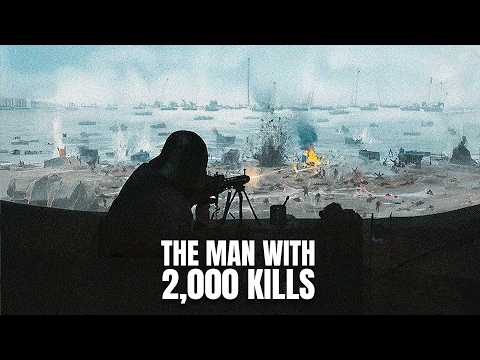
Dawn on June 6, 1944, broke over the English Channel with a deceptive calm. The largest armada ever assembled churned toward the coast of Normandy, carrying thousands of young men who believed the bombing runs had already shattered the German defenses. They were wrong. And waiting for them, hidden in a concrete bunker atop the cliffs, was a 20-year-old German machine gunner named Heinrich Severloh.
His weapon: an MG42, capable of firing 1,200 rounds per minute. His position: Widerstandsnest 62, a fortress overlooking a stretch of beach the Allies had code-named Easy Red. What happened in the next few hours would earn him a nickname he never wanted—“The Beast of Omaha.”
Severloh was not a fanatic. He was a farm boy from northern Germany, conscripted into the Wehrmacht and sent to France after a bout of frostbite on the Eastern Front. He spoke little French, learned a few words from his commanding officer, Lieutenant Bernhard Frerking, and spent his off-hours helping local villagers. But on this morning, all that mattered was survival.
“It was them or me,” he later recalled. “I thought I was going to shoot for my own life.”
At 6:30 a.m., the first landing craft lowered their ramps. American soldiers of the 1st Infantry Division waded into the surf, weighed down by 60-pound packs, rifles held high. Severloh waited, as ordered, until they were knee-deep in the water—too deep to run, too shallow to hide.
Then he pulled the trigger.
The MG42 roared, a sound like tearing canvas. Bullets tore through the water, kicking up geysers of spray. Men fell before they could take a single step. Those who survived the first burst dove behind beach obstacles, only to be cut down as they tried to advance. The rising tide pushed the wounded and the dead against the steel hedgehogs, and the water turned red.
Severloh fired burst after burst, pausing only to change barrels or switch to his Mauser rifle when the machine gun overheated. He estimated he fired 12,000 rounds from the MG42 and another 400 from his rifle. “I nearly emptied an entire infantry landing craft,” he said. “The sea was red around it, and I could hear an American officer screaming hysterically into a loudspeaker.”
By noon, the beach was littered with bodies. Severloh had become the single most lethal defender on Omaha Beach, his field of fire covering the eastern end of Easy Red. But the Americans kept coming. Wave after wave, each one met with the same relentless fusillade. The tide rose, shrinking the beach and pushing more men into his sights.
Then, around 3 p.m., a grenade exploded near his position, wounding him in the face. Lieutenant Frerking ordered a retreat. “He called me by my first name,” Severloh remembered. “That’s when I knew it was over.”
He fled through the communication trench, carrying his hot machine gun, his heart pounding. Behind him, WN62 fell silent. The Americans had taken the beach. But the cost—and the man who inflicted it—would haunt both sides for decades.
Severloh was captured days later, still wounded, and shipped across the Atlantic to a prisoner-of-war camp in the United States. For nearly two years he worked the fields of America, harvesting crops by day and lying awake at night, the sound of the MG42 echoing in his memory. He spoke little English and understood even less, which was perhaps a mercy—until the day a comrade translated an article from an old magazine describing the carnage on Easy Red.
The words hit him like a physical blow. “The men assigned to unload weapons couldn’t get through the blood-soaked mud,” the article read. “They kept slipping.” Severloh sat in silence, the weight of a thousand invisible deaths pressing down on his chest.
He was released in April 1947, his father having petitioned for his return to help on the family farm. But the farm could not shelter him from what he had done. The first thing he did upon returning to Germany was to find the mother and widow of Lieutenant Frerking, the officer who had called him by his first name in those final moments. Together they located Bernhard’s grave in a military cemetery a few kilometers from Omaha.
In 1949, he married Lisa, a girl he had loved before the war. She became the only person with whom he could speak of the horrors he had witnessed—and inflicted. “For a long time, she was the only one who knew the real me,” he said. “The man who could not stop seeing the bodies in the surf.”
Decades passed. Severloh made pilgrimages to Normandy, walking the same sand where he had once poured fire into the ranks of young Americans. He met veterans from both sides—men who had shot at him, men who had watched their friends die at his hands. In 1984, he received a call from France Gluckl, a former gunner from the 726th Regiment, who organized a reunion of the defenders of WN60 through WN63. It was there that Severloh learned details he had never known—the Sherman tanks that had been destroyed below his position, the exact timing of the waves, the names of the men who had fallen.
One encounter proved especially profound. Severloh tracked down David Silva, an American soldier he had shot three times on Easy Red after reading about him in Cornelius Ryan’s The Longest Day. Silva had survived, become a priest, and moved to Ohio. Their first letters were returned, but Severloh persisted, and eventually the two men met. “He forgave me,” Severloh said, his voice breaking. “I did not deserve it, but he forgave me.”
In 2000, after fifty-five years of silence, Severloh published his memoirs. He had never intended to write a book, but the trauma demanded release. “I did not write it to glorify what I did,” he insisted. “I wrote it so that people would understand what war does to the soul of a man.”
Journalists came, then filmmakers, then historians. Some sensationalized his story, calling him the Beast of Omaha, a title he despised. During a 1984 interview with ABC, a reporter pressed him on the number of men he had killed. When he refused to answer, the interviewer suggested a thousand. “To end the interview, I agreed,” Severloh admitted. “I even hinted it could be twice that. It relieved my burden, but it also made me famous for the wrong reasons.”
In 2003, he returned to Normandy one last time to film a documentary. Standing on the beach below WN62, he was asked to walk toward another man. As they approached, Severloh realized it was David Silva—the man he had shot nearly sixty years earlier. They embraced, and the cameras kept rolling.
The two men stood in the sand, the years collapsing between them. Silva, frail but steady, grasped Severloh’s hand. “You were doing your job,” he said quietly. “I was doing mine.” Severloh could only nod, tears cutting lines through the dust on his face. The cameras captured it all, but for once, the old soldier did not care who saw.
After the filming, they walked together to the American cemetery overlooking the beach. Rows of white crosses stretched to the horizon. Severloh stopped at the edge of the grass, unwilling to step further. “I have no right to be here,” he murmured. Silva took his arm. “You have every right,” he replied. “You are why some of these men are remembered.”
It was their last trip to Normandy. Both men knew it. They said goodbye at the airport, two old soldiers bound by a single morning of violence that had shaped the rest of their lives. Silva died a few years later, and Severloh mourned him as a brother.
Back in Germany, Severloh retreated to his farm, but the past would not stay buried. Letters arrived from historians, journalists, and curious strangers. Some praised him; others condemned him. He answered every one, patiently explaining that he was neither hero nor monster—just a soldier who had been ordered to hold a position and had done so with terrible efficiency.
His memoir, WN62: A German Soldier’s Memories of the Invasion, became a quiet success. It was not a bestseller, but it found its way into the hands of veterans and their families. Severloh received letters from American widows, sons, and grandchildren. Some wrote to forgive him. Others wrote to ask why. He never had a satisfying answer.
“I cannot give them back their fathers,” he told an interviewer in 2004. “I can only tell them the truth. And the truth is that war makes murderers of us all.”
In his final years, Severloh’s health declined. He suffered from heart problems and the lingering effects of his war wound. But his mind remained sharp, and he continued to speak out against war whenever asked. He warned young Germans against nationalism, against the seductive pull of uniforms and flags. “I wore the uniform,” he said. “I know how easy it is to forget your humanity.”
He died on January 14, 2006, at the age of 82. His wife Lisa was at his side. In accordance with his wishes, there was no military funeral, no honor guard. He was buried quietly in a village cemetery, far from the cliffs of Normandy.
But his story did not end with his death. The bunker at WN62 still stands, its concrete walls pockmarked by bullets and shrapnel. Tourists visit it every summer, standing where Severloh once stood, looking down at the peaceful beach below. Some leave flowers. Others leave stones. A few leave notes, scrawled in German, English, and French.
“I came here to hate you,” one note read. “I left understanding.”
That understanding is the quiet legacy of a man who spent half his life running from a single morning. Severloh never asked to be forgiven, and he never forgave himself. “I wanted to disappear into the fields,” he once said, “but the fields kept reminding me of the sea.”
Today, the concrete remains of WN62 crumble slowly into the grass, and the tide still rolls in over Easy Red, washing the sand clean each night. Historians debate the numbers, but the sea keeps no records. Only the silence remains—and the letters, and the stones, and the question that every visitor must carry home.
If a man spends fifty-five years confessing what he did on one June morning, does the telling become its own kind of penance—or just another way of never escaping?
Report this article
Select a reason for reporting:






