The American fighter was crawling back across the English Channel, and by every rule of aerial combat, it should have already been at the bottom of the sea. A cannon shell had jammed the canopy shut, trapping the pilot inside. Hydraulic fluid blinded him. And a German Focke-Wulf 190 was parked on his tail, pumping rounds into his aircraft with methodical precision.
Then, the impossible happened. The German pulled alongside, dipped his wings in a chilling salute, and turned for home. The American limped back to base and began counting the holes in his Thunderbolt. He stopped at 200.
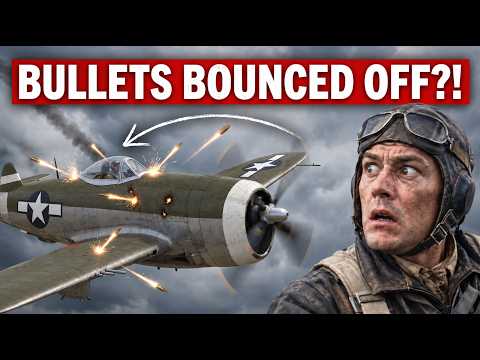
That was the first thing the P-47 did that sounded fake. The other eight are stranger still, and they all began with a train ride and a company on the brink of collapse.
In the late 1930s, a small outfit called Seversky Aircraft was bleeding money. Its founder, Alexander de Seversky, was a one-legged Russian naval aviator and a brilliant salesman, but a lousy businessman. By April 1939, the company had lost $550,000. The board threw him out. The company got a new name—Republic Aviation—but kept its chief engineer, Alexander Kartveli, a Georgian immigrant who had learned one crucial lesson: to breathe at high altitude, an engine needed a turbocharger.
In November 1939, the Army asked Kartveli for a lightweight interceptor called the XP-47. It was small, fast, and modestly armed—exactly what everyone expected a fighter to be. Then war reports from Europe changed everything.
Pilots needed armor behind their seats. They needed self-sealing fuel tanks. They needed enough firepower to shred an enemy in a two-second burst. Kartveli and the Army looked at the tiny XP-47 and agreed it would lose. So the Army wrote a new wish list, and it was enormous: 400 mph at 25,000 feet, six or eight .50-caliber guns, pilot armor, self-sealing tanks, and at least 315 gallons of fuel.
Every item added weight—the very thing fighter designers spent their careers trying to eliminate. A heavy fighter climbed slowly and turned wide. In 1940, building one seemed like building a slow target.
Kartveli didn’t try to cram it all into his little plane. He threw the design out entirely.
In June 1940, he traveled to Wright Field, Ohio, where the new requirements took shape. On the train back to New York, according to a colleague, Kartveli sketched the new fighter on the back of an envelope. He was worried about wing loading—how much weight each square foot of wing would carry. He estimated 12,000 pounds in combat and drew a semi-elliptical wing of 300 square feet. That was exactly the wing the Thunderbolt would end up with.
A fighter drawn on a train by a man who had just been told his first design wasn’t good enough.
The Army ordered a prototype in September 1940. Designated XP-47B, it shared almost nothing with the lightweight XP-47 except the name. Most designers started with the airframe and looked for an engine. Kartveli started with the engine: the Pratt & Whitney R-2800 Double Wasp, eighteen cylinders, roughly 2,000 horsepower—a staggering figure for a single-engine fighter.
But power alone wasn’t enough. At 30,000 feet, the engine would choke. Remember the turbocharger? Kartveli put it in the rear fuselage, behind the pilot. That meant routing air from the nose through ducts to the supercharger, then back to the engine, while exhaust gases spun the turbine. The inside of the fuselage became a plumbing system.
Once you build a fighter around ducts, everything else changes. The ducts made the fuselage deep. The deep fuselage meant the wings sat high. The huge engine demanded a massive propeller—12 feet, 2 inches in diameter—to turn all that power into thrust. A prop that big on a high wing required very long landing gear to keep the blade tips off the runway. But long gear needs space in the wing to fold into—the same space Kartveli needed for eight machine guns and their ammunition.
So the Thunderbolt’s landing gear grew longer as it extended. The legs were telescopic, stretching nine inches when lowered and shrinking when retracted, fitting into the wing and leaving room for the guns. The plane literally stretched its legs before landing.
Add it all up—engine, supercharger, ducts, armor, self-sealing tanks, eight .50-caliber guns—and the XP-47B weighed 12,086 pounds when loaded. That’s the fourth thing: a brand-new fighter that weighed roughly twice as much as its rivals. It was the largest single-engine fighter ever built.
On May 6, 1941, just eight months after the Army ordered it, test pilot Lowery Brabham flew the prototype from Republic Field in Farmingdale to nearby Mitchel Field. There was smoke in the cockpit during that flight, but he stuck with it. When he landed, he said, “I think we’ve got the grand prize.”
The name “Thunderbolt” is credited to Republic’s sales manager, Hart Miller. But the test pilot’s enthusiasm didn’t answer the real question: a 12,000-pound fighter might fly beautifully in a straight line, but what happens when it faces a much lighter German fighter that can turn circles around it?
The answer turned out to be: don’t turn—dive. And when you dive, the Thunderbolt’s story gets truly strange.
On November 13, 1942, two young Army lieutenants, Harold Comstock and Roger Dyer, took new P-47Cs up from the Republic factory area. Their mission was dull—testing a new type of radio antenna. They climbed to roughly 35,000 feet and then pushed into a steep dive.
Then something terrifying happened. Comstock felt a shudder, and the controls went dead. He pulled back on the stick, and the plane didn’t answer. It kept diving. Dyer tried the same thing and hit the same wall. They finally regained control in thicker air and landed safely.
Kartveli himself questioned Comstock about what he’d experienced. What happened next is the fifth thing, and it’s the most fake of all because it actually was.
On December 1, Republic issued a press release. The newspapers picked it up and ran with it. The Associated Press reported that the two lieutenants had dived their Thunderbolts at 725 miles per hour—faster than the speed of sound at high altitude.
Chuck Yeager wouldn’t officially break the sound barrier until 1947 in a rocket plane built for the job. And here was a production fighter that appeared to have already done it.
You can understand why people believed it. The Thunderbolt was heavy, and heavy things fall fast. The pilots had genuinely lost control in a way they’d never trained for. Something strange had happened up there.
But it certainly wasn’t supersonic flight. The P-47 wasn’t built for it, and airspeed readings in a steep high-altitude dive were unreliable. The Army acknowledged the number but never confirmed the plane had gone supersonic. According to accounts of the incident, General Hap Arnold made it clear there would be no further discussion of that dive.
So what did they actually find? As an aircraft approaches the speed of sound, shock waves form on the wings and tail, and the controls can lock up or even reverse. It was called compressibility, and the Thunderbolt was one of the first fighters heavy and fast enough in a dive to push American pilots to its edge. Later P-47 models got dive flaps to recover trim after a dive.
The legend says the Thunderbolt beat the sound barrier. The truth is that it was among the first aircraft to show Americans where that barrier was.
Remember the name Roger Dyer. He’ll come back.
By late 1942, the first Thunderbolts reached England, and the pilots greeted them with mixed feelings. Some had been flying Spitfires. The Thunderbolt felt like a truck by comparison, and it had a real weakness that would follow it through the rest of the war in Europe: range. Its huge engine drank fuel, and the bombers it was supposed to escort were flying deeper and deeper into Germany.
The first Thunderbolt combat missions over Europe began in April 1943. Pilots quickly discovered that no German fighter could match a P-47 in a dive. A German pilot could escape a Thunderbolt by turning, not by diving. The weight that made it sluggish in a turn made it a hammer falling from above. So smart Thunderbolt pilots stayed high, picked their moment, dove at enormous speed, fired, and used that speed to climb back up.
Which brings us back to June 26, 1943.
That evening, 48 P-47Cs of the 56th Fighter Group lifted off from Manston on the English coast to escort B-17s returning from a raid near Paris. One of the pilots was a young lieutenant from Lawton, Oklahoma, named Robert S. Johnson. He was flying near the rear of the formation when sixteen Focke-Wulf 190s attacked.
Johnson’s fighter took cannon fire. Fluid sprayed through the cockpit. The canopy jammed. Alone, wounded, and unable to bail out, he turned for England. Then, according to Johnson, a single FW 190 found him. The German pilot examined the Thunderbolt, settled behind it, and opened fire.
Johnson hunched behind the armor plate. Remember that armor? It was on the Army’s 1940 wish list. In that moment, it was the only thing between Johnson and the bullets. The German attacked again and again. The Thunderbolt kept flying. Finally, out of ammunition, the German pilot pulled alongside, dipped his wings in salute, and turned back toward France.
Johnson made it to Manston. He climbed out and tried to count the bullet holes, but gave up after passing 200 without walking around the plane.
Now, let’s be honest. Most of what happened in that cockpit rests on Johnson’s own account, written after the war. The German pilot is often identified as Egon Mayer, one of the Luftwaffe’s leading aces on the Western Front. It’s a reasonable identification, but it was never proven beyond doubt. What is certain is that Johnson came home in a fighter that, by any normal standard, should have been at the bottom of the English Channel.
And what about Roger Dyer, the other pilot tied to that 725-mph headline? He was killed in action on that same day, June 26, 1943. Same day, two very different endings.
Johnson kept flying. He would later score 27 victories and become the first American fighter pilot in Europe to surpass Eddie Rickenbacker’s World War I record of 26. He said afterward that the Thunderbolt’s tough structure saved a lot of lives. He knew that firsthand.
So why did it survive? Part of the answer was weight. All that structure and armor was something Kartveli accepted on purpose. The other part was the engine—the sixth thing that sounds fake. The Thunderbolt’s R-2800 was air-cooled. Its finned cylinders were cooled directly by the wind. The Spitfire and Mustang used liquid-cooled engines with radiators and cooling lines running through the airframe. One bullet through a cooling line could drain the system, and within minutes the engine would overheat and quit. The Thunderbolt had nothing to drain.
So P-47 pilots described the same thing again and again. They’d come back with the engine running rough and coughing, land, and discover that one cylinder—sometimes two—had been shot completely away. Eighteen cylinders minus one still gets you home. That’s not one lucky story. It’s a pattern repeated in pilot accounts from Europe to the Pacific. The plane did its job. The pilots trusted it.
Now a problem appeared that had nothing to do with aerodynamics: could anyone build enough of them? Republic was the company that nearly went bankrupt in 1939. Thunderbolt orders were so huge that Republic had to quadruple the size of its Farmingdale plant and build three new runways. Even that wasn’t enough. In November 1942, the Army authorized a second factory far from Long Island, in Evansville, Indiana. Curtiss-Wright built some too. A company that had been losing money a few years earlier became one of the most important fighter producers in the country.
Meanwhile, Kartveli’s team kept pushing the same idea—more engine, more power—which brings us to the seventh thing. On August 4, 1944, a lightened experimental version called the XP-47J, with a more powerful R-2800, a tight-fitting cowling, and a cooling fan, hit 504 mph in level flight. That made it, by most accounts, the first propeller-driven fighter to exceed 500 mph in level flight. Not in a dive this time—in flat-out speed. The fat, heavy, ugly airplane was the one that got there first. The J model never entered production because Republic was moving on to more advanced designs, but the family everyone called too heavy produced the fastest propeller fighter of its time.
Back in England, the 56th Fighter Group was proving the Thunderbolt’s worth in a different way. Its commander, Colonel Hubert Zemke, developed tactics built around exactly what the plane did well: altitude, speed, diving attacks, and staying together. The group became known as “Zemke’s Wolfpack.”
And here’s the eighth thing. Ask most people which American fighter dominated the skies over Europe, and they’ll say P-51 Mustang. But the top-scoring American aces in the European Theater flew the Thunderbolt. Robert Johnson, the man nobody could shoot down, with 27 victories, and Francis Gabreski, son of Polish immigrants from Oil City, Pennsylvania, with 28.
The 56th finished the war with 665 and a half aerial victories—about 100 more than any other fighter group in the Eighth Air Force—and 39 aces. But Gabreski’s story has an ending that shows where the Thunderbolt’s path was heading. By July 1944, Gabreski had flown 193 combat missions. He was the leading American pilot in Europe. He was waiting for transport back to the States, and on July 20 he decided to fly one last mission. He wasn’t chasing German fighters. He was strafing an airfield near Bassumheim, Germany, flying very low. So low that his propeller tips struck the ground. The Thunderbolt began shaking violently. He crash-landed, tried to escape, and was captured. The best American pilot in Europe spent the rest of the war in Stalag Luft I until April 1945.
Why was the best pilot in Europe flying a few feet off the ground in the first place? Because the war had changed around the Thunderbolt. That range problem never went away. When longer-legged P-51 Mustangs arrived in numbers, they could escort bombers all the way to Berlin. Escort missions increasingly went to them. So the Thunderbolt got a new job, at low altitude. Trains, trucks, bridges, airfields, tanks—fighter-bomber missions.
And look what happened. Every decision Kartveli made for high-altitude combat in 1940 paid off in a completely different way. Eight guns designed to shred fighters could shred locomotives and trucks. The heavy structure could carry bombs and rockets. And an engine that kept running with cylinders shot away was exactly what you needed when every German soldier with a rifle or a flak gun was shooting at you from a few hundred feet.
Don’t make it sound simple. Take the Ninth Air Force’s 362nd Fighter Group. It was credited with destroying more than 5,000 trucks, 350 tanks, and 600 locomotives. And over 15 months of combat, more than 70 of its pilots were killed. In June 1944 alone, the group lost 30 Thunderbolts. Other units started calling it “the 362nd Suicide Group.” That’s what survivability really meant. It didn’t mean you couldn’t be hurt. It meant you might come home when no other plane could.
Thunderbolt units racked up staggering numbers across Europe—thousands of locomotives, tens of thousands of rail cars and trucks. Treat those numbers as wartime claims. Pilots flying at 300 mph through smoke and flak can’t always tell what’s destroyed and what’s damaged, and even published records don’t agree with each other. What you can say with certainty is that the Thunderbolt became, in the Smithsonian’s words, perhaps the best ground-attack aircraft the United States used.
So we can finally put the numbers on the table, because they mean something now. The company that nearly went bankrupt in 1939 and its partners produced 15,683 Thunderbolts. More than 9,000 at Farmingdale, more than 6,000 at Evansville, a few hundred at Curtiss. That’s the largest production run of any American fighter ever. Near the end of the war, more than 40% of Army Air Forces fighter groups overseas were flying them. The plane’s famous toughness shows up in the records too. The Air Force Museum estimates the Thunderbolt’s combat loss rate at less than seven-tenths of one percent. Over more than a million combat hours. A remarkably low figure for a plane that spent so much of the war flying at treetop height.
And now, the honest correction. The Thunderbolt didn’t do it alone. By 1944, the Allies were producing planes and pilots faster than Germany could replace either, and the Luftwaffe was losing experienced pilots faster than it could train new ones, with fuel shortages cutting training time. A tough plane matters more when its pilots are well trained, well supplied, and outnumber the enemy. In the end, all three were true. Yet the plane still took losses. More than 5,000 Thunderbolts were lost in operations, including more than 1,700 lost outside combat to accidents, crashes, and bad weather. The Jug made a pilot’s return home more likely. It didn’t make anyone completely safe.
But there’s another piece of this story most people have never heard—the ninth thing. In 1942, after German U-boats sank Mexican ships, Mexico declared war on the Axis. In 1944, Mexico formed a fighter squadron to fight overseas alongside the Americans. 36 pilots and a few hundred ground crew. It was called Escuadrón 201, the Aztec Eagles. And the plane they trained on and took to war was the Republic P-47D Thunderbolt. American pilots called it “the Jug.” The Mexican pilots called it “El Jarro.”
In 1945, they went to Luzon in the Philippines, attached to the U.S. 58th Fighter Group, with green, white, and red stripes on their cowlings. They provided close air support for American and Filipino troops and flew long-range strikes against Japanese targets as far away as Taiwan—missions that could take about seven hours, possible only in a fighter designed to carry enormous amounts of fuel. That 315-gallon item on the Army’s 1940 wish list was still paying off on the other side of the planet. The squadron flew about 800 combat sorties, logged nearly 2,000 combat hours, and lost seven pilots. To this day, Squadron 201 remains the only military unit in Mexican history to fight outside Mexico’s borders. A country’s entire combat history written in Thunderbolts.
Mexico wasn’t alone. Brazil sent its own fighter group to Italy, also flying P-47s, attacking bridges, railways, and supply lines in the final campaign there. Before they left, the Brazilian pilots trained in New York at Suffolk County Army Airfield on Long Island, not far from where the Thunderbolts were built. Today, that airfield bears a name you already know. It’s called Francis S. Gabreski Air National Guard Base.
So what happened to the people and the company that made all this? In 1948, the Thunderbolt was redesignated the F-47, and it stayed with the Air National Guard into the mid-1950s—the last radial-engine fighter the Air Force flew. Republic moved on to jets with the F-84 Thunderjet, and Kartveli kept designing for years. Gabreski came home from the POW camp and went right back to fighters, scoring six and a half more victories in jets over Korea.
But Republic never became a giant. In 1965, Fairchild quietly bought its stock and took control, and Republic became a division inside someone else’s company. The founder’s name had faded in 1939. Now the second name would fade too. According to one company history, Republic’s archives were destroyed in 1987. Much of the paper trail behind this story simply vanished.
Yet the idea didn’t die. In 1972, the Fairchild Republic team flew another airplane. It was designed to fly low over the battlefield, carry a huge gun, absorb damage that would down other planes, and bring its pilot home. Deliberately heavy. Deliberately ugly. The pilots gave it a friendly, slightly insulting nickname, just like “the Jug.” The Air Force called it the plane that started it all: the A-10 Thunderbolt II.
Now go back to the beginning. June 26, 1943. A German pilot, maybe one of the Luftwaffe’s best, pulls alongside an American fighter he’s been shooting at for minutes. He sees the holes. He sees the jammed canopy. He sees a plane that, by everything he knows about fighters, should have come apart by now. Then he leaves.
It wasn’t a miracle. What that German pilot was looking at was a decision made three years earlier on a train by an immigrant engineer whose first fighter had just been judged not good enough. The armor that stopped his bullets was on the 1940 wish list. The engine that kept running had no cooling lines to cut. The weight that made the Thunderbolt seem slow and heavy was the whole point of its design. Everyone in 1940 knew a fighter should be light. Kartveli built one that wasn’t. And that’s why all nine of these things sound like fiction—they only make sense once you accept the one truth nobody wanted to believe about the Thunderbolt. Its size was never a flaw. It was the design.
So here’s my question for you: if you were that German pilot, would you have saluted—or pulled the trigger?
Report this article
Select a reason for reporting:






